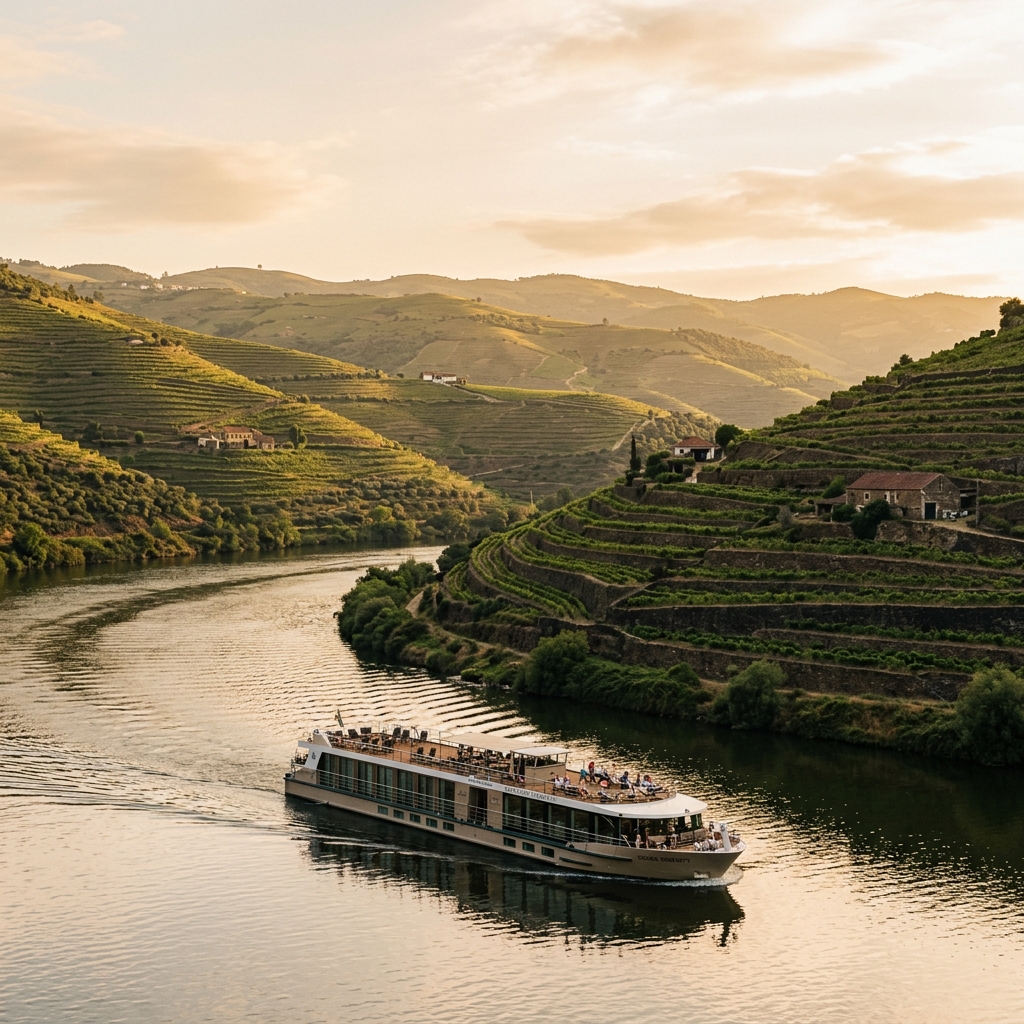
The Douro Valley is one of the oldest wine regions in the world, a UNESCO World Heritage Site of terraced vineyards that climb sheer hillsides above a river that cuts through northeastern Portugal. Traveling it by boat is one of the most quietly spectacular ways to move through Europe. The river does the work. You watch the terraces rise and fall, the schist villages catch the afternoon light, and the quintas (wine estates) appear at the bends in the river as though they have always been there.
TL;DR: A Douro Valley river cruise runs 7–8 days round-trip between Porto and the Spanish border (or 3–4 days one-way), with prices ranging from roughly €800 per person on CroisiEurope to €9,000+ on Scenic. The harvest season (September–October) is the best time to go and sells out 9–12 months in advance. Fly into Porto (OPO) or take the Alfa Pendular train from Lisbon in about 3 hours.
The Douro Valley: Why Go by River
The valley is too long and too narrow for conventional tourism. The road that runs alongside it is beautiful but winding, and the villages that appear on the opposite bank from a boat are inaccessible by car without long detours. The river, by contrast, connects everything, the quintas have their own docks, the villages their own landing steps. A river cruise is not just a pleasant way to travel the Douro; it is in many respects the only way to see it properly.
The field is the reason to come. The Douro has been farmed for wine since the Romans, and the terracing, schist retaining walls built by hand over centuries to hold a thin layer of soil on near-vertical slopes, represents one of the great agricultural achievements of European history. According to UNESCO, the Alto Douro Wine Region has been continuously cultivated for some 2,000 years (UNESCO World Heritage Centre, 2001). From a boat deck at golden hour, with the terraces turning amber and the first lights appearing in a village above, it is genuinely difficult to believe that a place this beautiful exists.
Citation capsule: The Alto Douro Wine Region was inscribed on the UNESCO World Heritage List in 2001 as a “living cultural field” that has been continuously cultivated for approximately 2,000 years. It is recognized as an outstanding example of traditional European viticulture and land use. (UNESCO World Heritage Centre, 2001)
The Routes
Porto to Barca d’Alva (Full Valley)
The full Douro cruise runs approximately 210 kilometers from Porto to Barca d’Alva, near the Spanish border, passing through five locks (at Crestuma, Carrapatelo, Régua, Valeira, and Pocinho). The Carrapatelo lock, one of the highest in Europe at 35 meters, is a spectacle in itself. Round-trip cruises take 7 to 8 days; one-way cruises take 3 to 4 days and are increasingly popular combined with a return by coach or rail.
Porto to Régua (Short Cruise)
A shorter option for travelers with less time: Porto to Peso da Régua is the most intensively farmed section of the valley and covers the majority of the famous wine-producing quintas. This 3–4 day round-trip option is offered by most operators and captures the essential Douro experience without requiring a full week.
Day Trips from Porto
Several operators run day trips from Porto into the valley, typically 8–10 hours, by boat one way and coach returning, stopping at a quinta for a wine tasting and lunch. These are a genuine introduction to the valley for travelers spending only a few days in Porto.
What to Expect Onboard
Douro river ships are smaller than ocean cruise ships, typically 80 to 120 passengers, built low to pass under the valley’s bridges. This scale makes them feel less like a resort and more like a house party on the river. The crew knows your name by day two. Meals are taken together. The deck is always accessible.
Ship Design
Most Douro cruise ships have two or three passenger decks, a sun deck, a dining room, a bar, and a small lounge. Cabins range from entry-level interior staterooms to larger river-view suites with floor-to-ceiling windows or private balconies on newer vessels. The difference in experience between an interior cabin and a river-view stateroom is significant, if budget allows, upgrade.
Meals
Food on Douro cruises is typically Portuguese or broadly Mediterranean, with regional dishes appearing when the ship is in the valley: bacalhau (salt cod), caldo verde (potato and kale soup), grilled sardines, roasted meats. Most cruises include all meals and at least some wine. Quality varies by operator, premium lines invest noticeably more in both ingredients and kitchen staff than budget operators.
Excursions
Standard excursions include wine tastings at quintas (typically 2–3 during a full valley cruise), walking tours of valley towns (Régua, Pinhão, Lamego), a visit to the Douro Museum in Régua, and in some itineraries a day trip to Salamanca. Most cruises include a handful of excursions in the base price; others charge separately.
The Wine: What You’ll Drink
The Douro produces two things that have made it famous: Port wine (a fortified wine historically shipped to Porto for aging in the caves of Vila Nova de Gaia) and increasingly celebrated unfortified table wines sold under the Douro DOC designation.
At the quintas on shore excursions, you will typically taste both, a dry white Douro to start, a red Douro with lunch, and a tawny or LBV Port as a dessert wine. Well-regarded quintas geared to receiving cruise guests include Quinta do Crasto, Quinta do Vallado, Quinta da Pacheca, and Quinta de la Rosa.
On board, wine service varies by operator. Some lines include wine with meals; others charge extra. On a dedicated wine cruise, several operators run these with an on-board sommelier or winemaker, the tastings are more structured and educational.
: On a mid-October sailing we’ve found that quinta visits during harvest offer something no standard wine tour replicates: the chance to watch the fruit come in from the terraces and, on some estates, to tread grapes in the traditional lagares. The atmosphere is genuinely celebratory.
When to Go
Spring (April–May): The valley is green from winter rains, wildflowers on the terraces, moderate temperatures. Good light for photography. Slightly lower prices than summer.
Summer (June–August): Hot, often very hot, with temperatures reaching 38–40°C in the upper Douro. The deck is an asset; the shade is essential. Peak season prices and the most competition for cabins.
Harvest (September–October): The Douro harvest (vindima) is the most celebrated time to visit. The terraces are in full color, the quintas are busy with pickers, and the atmosphere is extraordinary. This is the best season and it sells out earliest, book 9–12 months in advance.
Winter (November–March): Many operators suspend cruises in winter when water levels can make the locks unreliable. The valley is quiet and beautiful but access is limited.
How Much Does a Douro River Cruise Cost?
Prices vary dramatically by operator, cabin type, and season. As a general rule, you get what you pay for: a budget line and a luxury line are sailing the same river, but the gap in ship quality, food, and excursion depth is real. The table below shows approximate per-person prices for a 7-night full-valley cruise in a twin cabin, based on published 2025–2026 rates. All figures are rough guides, early-booking discounts, solo supplements, and inclusions change the all-in cost significantly.
| Operator | Duration | Per Person (twin cabin) | Typically Includes |
|---|---|---|---|
| CroisiEurope | 7 nights | €800–€1,400 | Meals, some excursions |
| Riviera Travel | 7–8 nights | £1,200–£2,000 | Meals, guided excursions, some flights |
| Titan Travel | 7–8 nights | £1,300–£2,000 | Meals, excursions, often with flights |
| Viking River Cruises | 8 nights | €2,000–€4,000 | Meals, excursions, port charges |
| AmaWaterways | 7 nights | €3,000–€6,000 | Meals, excursions, port charges, bikes |
| Scenic | 8 nights | €5,000–€9,000 | All-inclusive (drinks, gratuities, excursions) |
A few things to watch when comparing prices. First, check what’s included, CroisiEurope’s headline rate looks low until you add excursion costs. Second, cabin category matters enormously: a river-view or French balcony cabin on Viking or AmaWaterways typically adds €300–€600 over the base interior rate and is worth every euro. Third, solo travelers almost always face a single supplement.
: The price gap between CroisiEurope and Viking is around €1,200 per person, but Viking’s itinerary includes more structured excursions and a notably higher food budget per passenger. For wine-focused travelers who plan to pay for additional quinta visits anyway, Viking’s all-in value is often closer than the headline numbers suggest.
Citation capsule: Douro river cruise prices for a 7–8 night full-valley itinerary range from approximately €800 per person (CroisiEurope, twin cabin, 2025–2026 schedules) to over €9,000 per person (Scenic, all-inclusive). The spread reflects genuine differences in ship age, cabin size, food quality, and excursion depth rather than simply brand premium.
What to Pack for a Douro Cruise
Packing for a river cruise is simpler than most travelers expect. The ships are compact, storage space is real but not unlimited, and the itinerary is relaxed enough that you don’t need separate wardrobes for different occasions.
Bring These
Sun protection is non-negotiable. The sun deck on a Douro ship is exposed, and the valley’s position in northeastern Portugal means full sun from mid-morning through late afternoon. High-SPF sunscreen, a wide-brimmed hat, and UV-protective sunglasses are essential from April onward. In July and August, a light long-sleeved shirt for midday deck time is genuinely useful.
Layers for evenings on the water. The Douro evenings can be surprisingly cool, especially in spring and autumn. A light fleece or packable down jacket for post-dinner deck time is the single most common thing passengers wish they’d brought.
Comfortable walking shoes with grip. Shore excursions involve cobblestones, the narrow lanes of Pinhão, the steep streets of Lamego, the uneven paths between quinta vines. Trainers work fine. Flip-flops do not.
EU power adapter (Type F, two-pin). Portugal uses the standard European plug. Most ships have a limited number of adapter loans at reception, but bring your own.
A small daypack. For excursions: water bottle, camera, sunscreen, jacket. Ships usually provide a tote bag, but a pack with shoulder straps is more practical on hillside quinta walks.
Leave These at Home
Formal wear. Douro cruises are smart casual even on the most premium lines. A collared shirt or a simple dress is entirely sufficient for dinner, no jacket required, no ties expected. You’ll spot the occasional blazer on Viking sailings, but it’s the exception.
Excessive luggage. Cabin storage, even on newer ships, is designed for compact packers. A medium-sized checked bag plus a carry-on is the practical limit for a 7-night cruise.
: We’ve found that the travelers who pack the lightest are invariably the most comfortable, not because the ships lack storage, but because the excursions are on foot, often in heat, and carrying a large bag on a cobblestone hill in Régua in August is nobody’s idea of slow travel.
Getting to Porto: Flights and Trains
Porto Francisco Sá Carneiro Airport (IATA: OPO) is the gateway for most Douro cruise passengers. It handles a substantial volume of European traffic and is well-served from major hubs.
Flying into Porto (OPO)
Direct flights to Porto operate from London (Heathrow and Gatwick on BA and TAP, Stansted and Luton on Ryanair and easyJet), Amsterdam, Paris, Frankfurt, Madrid, and Lisbon. TAP Air Portugal, Ryanair, easyJet, and Vueling are the main carriers. From North America, TAP operates nonstop service from Boston and Newark to Lisbon, with onward connections to Porto; flight time from the US East Coast to Lisbon is approximately 6.5–7 hours. Porto’s airport sits about 11 kilometers north of the city center; the Metro’s Violet Line (Line E) connects it to central Porto in around 30 minutes for €2.
Train from Lisbon
Travelers combining Porto with Lisbon, a natural extension of a Portugal trip, have an excellent rail option. Comboios de Portugal (CP) operates Alfa Pendular high-speed tilting trains between Lisbon Santa Apolónia and Porto Campanhã roughly every 90 minutes throughout the day. The journey takes approximately 2 hours 45 minutes to 3 hours, and tickets cost €25–€35 in second class when booked in advance through cp.pt. The service is reliable, comfortable, and considerably less stressful than driving the A1.
: Most cruise operators arrange a transfer from Porto airport to the ship’s startation point. If yours doesn’t, the Metro to the city center followed by a taxi or Uber to the dock (typically at the Alfândega cruise terminal or at Cais de Gaia in Vila Nova de Gaia) is straightforward and costs well under €20 total.
How to Book
Operators
The main cruise lines operating on the Douro:
- Viking River Cruises: The market leader globally, with several Douro itineraries. Well-organized, reliable, good food, strong excursion program. Mid-to-premium pricing.
- AmaWaterways: Premium positioning, newer ships, wine-focused itineraries with expert guides. Higher price point but strong reputation.
- Scenic: Ultra-luxury positioning, all-inclusive pricing (including excursions, premium drinks, and gratuities). Among the newest and most design-forward vessels on the river.
- CroisiEurope: The French budget operator with the most affordable Douro cruises. Ships are older, service is less polished, but the route and fields are identical. A good option for price-conscious travelers.
- Riviera Travel and Titan Travel: UK-focused operators at mid-range prices, often packaging flights with the cruise.
What to Compare When Booking
- What’s included: Meals, wine, excursions, gratuities, and flights all vary. Calculate the all-in cost, not the headline price.
- Ship age: Newer ships have larger cabins, better deck space, and more contemporary design. Check the ship’s build year.
- Cabin category: River-view cabins are worth the premium. A French balcony (floor-to-ceiling sliding doors that open inward) is a good compromise between balcony experience and cabin size.
- Itinerary direction: Porto to Barca d’Alva (eastward) means the most dramatic lock ascent; the reverse means arriving into Porto at the end, which many travelers prefer.
Combining with Porto
A Douro cruise pairs naturally with 2–3 days in Porto at the beginning or end. Porto is a dense, hilly, UNESCO-listed city of azulejo tiles, port wine caves, and extraordinary food. The Mercado do Bolhão for produce and cheese, a francesinha (Porto’s extraordinary beer-and-meat sandwich) for lunch, a port wine cave tasting in Vila Nova de Gaia in the afternoon. Porto rewards slow exploration as much as the valley does.
Porto’s historic center (Ribeira) was inscribed on the UNESCO World Heritage List in 1996 (UNESCO World Heritage Centre, 1996), making a Porto extension a double UNESCO trip alongside the Douro Valley itself, a fact worth mentioning to anyone who needs convincing.
FAQ
How long is a typical Douro Valley river cruise?
The full Porto to Barca d’Alva route takes 7–8 days round-trip. A one-way cruise takes 3–4 days. Shorter Porto to Régua itineraries are available for travelers with less time, typically running 3–4 days round-trip and covering the most intensively farmed wine country.
What is the best time of year for a Douro river cruise?
The harvest season (September to mid-October) is the most atmospheric time to visit, the quintas are active, the terraces are turning gold, and the valley is at its most visually dramatic. Spring (April to May) is the second-best option with lower prices and pleasant temperatures. (UNESCO World Heritage Centre, 2001)
Are Douro river cruises worth the cost?
For travelers interested in wine, landscape photography, slow travel, or simply a deeply restorative week on the water, yes. The Douro is not an adrenaline destination, it is a place to sit on a deck, watch a field unfold, drink excellent wine, and eat well. For the right traveler, that is precisely the point.
How does a Douro cruise compare to Rhine or Danube?
The Douro is smaller, quieter, and less infrastructure-heavy. Ships carry 80–120 passengers versus 150–200 on the larger rivers. The fields are more dramatic and less populated. It appeals to travelers who want immersion in a single region rather than a multi-country highlights reel.
Can I book a Douro cruise as a solo traveler?
Yes, though most operators charge a single supplement (typically 50–100% of the cabin rate) to occupy a double cabin alone. A few operators offer solo cabins or guaranteed share programs. Ask specifically about solo supplement policies when comparing operators.
Do I need travel insurance for a Douro river cruise?
Yes, and standard travel insurance is not enough. You need a policy that includes trip cancellation (cruise deposits are typically non-refundable within 90 days of departure), medical coverage abroad, and crucially medical evacuation cover. The Douro Valley is rural; the nearest major hospital to the upper valley is in Porto or Salamanca. A policy with at least €500,000 in medical evacuation cover is the sensible minimum. Check that your policy covers river cruises specifically, some adventure travel exclusions can apply.
What languages are spoken on Douro cruises?
English is the working language on virtually all international lines, Viking, AmaWaterways, Scenic, Riviera Travel, and Titan all operate in English. CroisiEurope is the main exception: as a French operator, its Douro sailings are conducted primarily in French, with English often available but as a secondary language. If you’re a non-French speaker considering CroisiEurope for the price advantage, check the specific sailing’s language designation before booking. Shore excursion guides throughout the valley speak English as standard.
James Morrow has traveled the Douro Valley by boat, rail, and on foot. He writes about slow travel and train journeys for Art of the Travel.