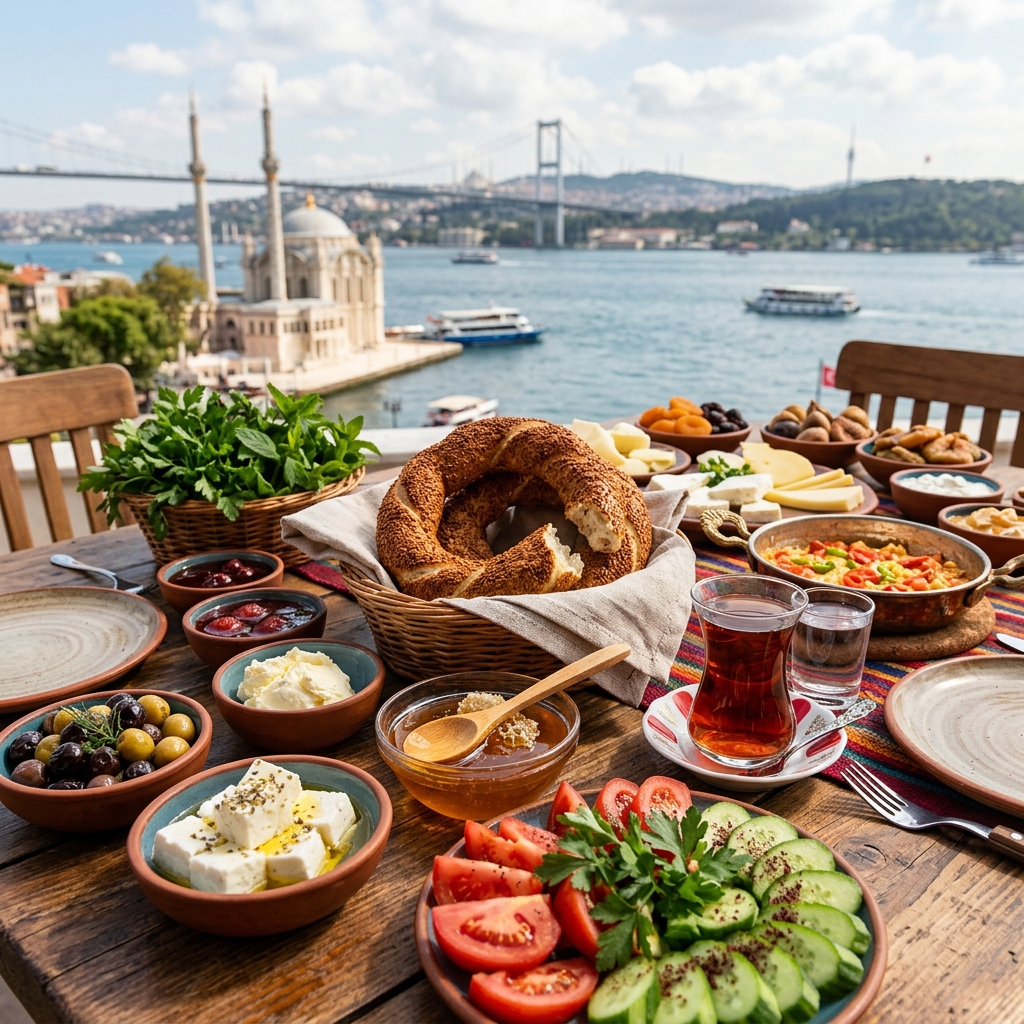
Istanbul is a city of 15 million people built at the intersection of two continents, two seas, and six centuries of imperial kitchen tradition. It has the Spice Bazaar and the Grand Bazaar, fishing boats on the Bosphorus, and a street food culture so deeply embedded that eating while walking is practically a civic virtue. For a food traveler, it is one of the most rewarding cities on earth.
TL;DR: Start at the Galata Bridge for balık ekmek (grilled fish sandwich), cross to Kadıköy on the Asian side for the best market eating, have a full Turkish breakfast (kahvaltı) at a proper lokanta, buy Turkish delight from Hafız Mustafa rather than the tourist shops, and end at a meyhane in Beyoğlu with raki and cold mezes. That is two days, well spent.
Why Istanbul Is One of the World’s Great Food Cities
The Ottoman Empire at its height governed the eastern Mediterranean, the Middle East, and North Africa from Istanbul for six centuries. The palace kitchens of Topkapı employed hundreds of cooks and codified a cuisine that absorbed Persian spicing, Arab grilling traditions, Anatolian grain culture, Greek seafood cookery, and Balkan dairy fermentation into something entirely its own.
The result is a food culture of extraordinary depth, one that exists not in restaurants as a performance but in the daily life of the city. The simit seller at the tram stop at 7 a.m. The lokanta with its trays of slow-cooked dishes ready by noon. The meyhane table that fills up at 10 p.m. and empties at 2 a.m. Food in Istanbul is not a tourist amenity. It is the rhythm of the city.
The Essential Foods: What to Eat
Simit
The bread of Istanbul, a ring of dough coated in grape molasses and sesame seeds, baked until the exterior is almost caramelized. Sold from carts and bakeries throughout the city from early morning for a few lira. The best simits come from cart vendors whose trays are visibly turning over fast. Eat one warm with a glass of çay (black tea) and white cheese: this is breakfast for most of Istanbul.
Balık Ekmek
Grilled mackerel in a half loaf of white bread, with onion and parsley, eaten standing at the waterside. The boats moored at the Eminönü end of the Galata Bridge are the canonical place, vendors grill the fish on board and hand it across the railing. This is a mandatory Istanbul experience and it costs almost nothing.
Börek
Thin pastry (yufka) layered with white cheese, spinach, or minced meat and baked until flaky. The su böreği (water börek) at Karaköy Güllüoğlu, one of the city’s great börek bakeries, open from early morning, comes out of the oven in continuous trays. Arrive before 9 a.m. for the best selection.
Döner
Not the rotating spit you see in European kebab shops, that is a derivative, often a diminished one. The real döner is lamb (and sometimes beef) layered and slow-cooked, carved to order, and served in bread or on a plate with yoghurt and tomato sauce. A proper döner place will have a queue at lunch and run out of meat by mid-afternoon.
Midye Dolma
Mussels stuffed with spiced rice, served cold from a tray at street carts throughout the city. The vendor opens them one at a time, squeezes lemon on each, and passes them over. You pay for however many you eat. Found near the ferries at Eminönü, on street corners in Kadıköy, outside meyhanes in Beyoğlu.
Künefe
A dessert of shredded wheat packed with stretchy white cheese, soaked in syrup, and baked until golden. Served immediately, hot, from a small copper pan, with a dusting of ground pistachio. Best in the meyhane neighbourhoods of Beyoğlu after dinner. A meal that ends with künefe ends correctly.
The Neighbourhoods: Where to Go
Karaköy
Karaköy sits at the northern end of the Galata Bridge, where the old city connects to the newer European side. A working port district that has gentrified without losing its texture, fishing supply shops next to excellent cafes, the ferry terminal for the Asian side a short walk away.
Karaköy Güllüoğlu is the city’s most famous börek bakery. The su böreği (white cheese and parsley) and the kol böreği (rolled pastry with spinach or meat) come out continuously from early morning. Join the queue; it moves fast.
For breakfast, the cafes around the port serve the full kahvaltı spread, multiple cheeses, olives, eggs, honey, kaymak (clotted cream), and unlimited çay, at tables facing the water. This is among the best ways to start a day in any city.
Kadıköy
Kadıköy is what Istanbullus mean when they say the “real” Istanbul. A mixed neighbourhood of students, professionals, and old families on the Asian side of the Bosphorus, reached by a 20-minute ferry from Eminönü or Karaköy. Take the ferry. The crossing, with the city skyline receding behind you, is worth the journey in itself.
The market streets around Kadıköy Pazarı are the best place in the city for fresh produce, spices, pickles, and street food. Walk slowly. Eat whatever has the longest local queue. Çiya Sofrası, a legendary lokanta on Güneşlibahçe Sokak, serves dishes from across Anatolia that appear nowhere else in Istanbul: sour tamarind stews, lamb with quince, regional breads from provinces most tourists have never heard of.
Beyoğlu and İstiklal Caddesi
İstiklal Caddesi is Istanbul’s main pedestrian street, a kilometer of international chains, bookshops, music venues, and side streets that contain some of the city’s best meyhanes. The Asmalımescit neighbourhood, a few blocks off İstiklal toward the Bosphorus, is the heart of Istanbul’s late-night eating culture.
Meyhane (see below) is the dominant dining format here. Arrive no earlier than 9 p.m. and be prepared to stay.
Sultanahmet: Eating Well in Tourist Territory
The area around Hagia Sophia and the Blue Mosque is tourist Istanbul. The restaurants immediately adjacent to the monuments charge two to three times the local rate. Walk two streets away and the city reasserts itself.
Tarihi Sultanahmet Köftecisi on Divan Yolu has been serving the same dish, köfte (grilled minced lamb meatballs), white beans in tomato sauce, bread, since 1920. Do not order anything else. There is nothing else. This is the point.
The Turkish Breakfast
The Turkish breakfast (kahvaltı) is not a meal. It is a philosophy of hospitality expressed in small plates. A proper spread covers a table with: olives, several types of white cheese (beyaz peynir, kaşar, lor), tomatoes, cucumbers, fried or poached eggs, honey, kaymak, strawberry and rose jam, simit, fresh bread, and an unlimited supply of çay in small tulip-shaped glasses. It takes at minimum 90 minutes to eat properly.
The difference between a hotel buffet breakfast and a proper kahvaltı is the difference between a photocopy and the original. The cheeses matter. The bread matters. The quality of the honey and kaymak matters. The best breakfast neighbourhoods are Karaköy, Ortaköy (further up the Bosphorus, next to the suspension bridge), and Kadıköy on the Asian side.
The Meyhane: Dinner on Istanbul Time
The meyhane (tavern) is the center of Istanbul’s nighttime food culture. It is not a restaurant in the European sense, it is closer to a Greek taverna, a place where you arrive late (9 p.m. at the earliest; midnight is normal), sit at shared tables, order cold mezes to start, drink raki (anise spirit mixed with water and ice, which turns milky white), and stay until 2 a.m.
The ritual is specific. Cold mezes first: white cheese, marinated vegetables, hummus, tarama, stuffed grape leaves. Then hot mezes: fried calamari, liver with red onion and sumac, börek. Then fish, if the evening warrants it. Raki is drunk slowly through all of this, sipped, never shots. The total bill per person, with drinks, runs 600–1,200 lira.
The best meyhane streets are in Beyoğlu, the side streets off İstiklal, particularly Asmalımescit, and in Kumkapı, the old Byzantine harbour district where meyhane restaurants spill into the street.
The Grand Bazaar and Spice Market
The Mısır Çarşısı (Egyptian Bazaar, also called the Spice Bazaar) near Eminönü is the better food destination of the two major covered markets. It has been selling spices, dried fruits, nuts, cheese, and lokum (Turkish delight) since the 17th century. The stalls at the entrance are tourist-oriented, walk to the back and into the surrounding streets for the vendors who supply restaurant kitchens and local households.
For Turkish delight: buy from Hafız Mustafa (multiple locations including İstiklal Caddesi) or Ali Muhiddin Hacı Bekir (operating since 1777, with a shop near Eminönü). The rose and mastic flavours are the standard. A 250g box is worth carrying home.
Food Tours Worth Taking
For a first visit of two or three days, a guided food tour genuinely earns its cost. The best operators take small groups through neighbourhoods a first-time visitor would not find independently and explain the cultural context behind what they are eating.
Culinary Backstreets Istanbul runs half-day neighbourhood walks (approximately €85–100) through Kadıköy or Karaköy with groups of six to eight. They also run a longer all-day tour covering both sides of the Bosphorus.
Istanbul on Food offers neighbourhood walks focused on Beyoğlu and Galata at similar price points, with strong historical grounding.
If you have a week in the city, you probably do not need a guide. The neighbourhoods are navigable, menus often have photos, and locals are hospitable to curious eaters. A food tour is most valuable as an orientation for a short visit.
Practical Notes
Timing: Lokantas serve lunch from noon to 2 p.m. and are often closed for dinner or serving a reduced menu. Meyhanes and restaurants open for dinner from 7 p.m. but do not fill up until 9 or 10 p.m. Street food runs essentially all hours.
Cost: Istanbul remains excellent value by European standards. A full kahvaltı costs roughly €5–7. A döner wrap is €3–4. A meyhane dinner with drinks is €20–40 per person. Carry some cash in lira, card acceptance is inconsistent at street level.
Getting around: The ferry network is the most pleasant way to cross the Bosphorus. The Marmaray metro line runs through a tunnel under the strait and connects the European and Asian sides in minutes. Both are cheap and scenic in different ways.
FAQ
What is the best neighbourhood for food in Istanbul?
Kadıköy on the Asian side is the local favourite, a lively market neighbourhood with excellent street food and none of the tourist mark-up of Sultanahmet. For a single afternoon, take the 20-minute ferry from Eminönü, walk the market streets, eat midye dolma from a cart, and return at sunset with the city skyline behind you.
What should I eat for a first meal in Istanbul?
Walk to the Galata Bridge, buy a balık ekmek (grilled mackerel sandwich) from one of the boats moored at Eminönü, and eat it standing at the waterside railing. It costs almost nothing, it is genuinely delicious, and it establishes immediately that this is a city that takes street food seriously.
Is Istanbul food expensive?
Istanbul is very good value by European standards. A full Turkish breakfast at a proper lokanta costs around €5–7. A döner wrap or balık ekmek from a street vendor is €3–4. A sit-down meyhane dinner with mezes, raki, and grilled fish runs €20–40 per person. The exchange rate has been volatile, carrying local currency is advisable for street purchases.
Where should I buy Turkish delight?
Buy from Hafız Mustafa or Ali Muhiddin Hacı Bekir, not from the tourist-facing shops near the Spice Bazaar entrance. The quality difference is significant. The rose and mastic flavours are the most traditional.
Are Istanbul food tours worth it?
For a visit of two to three days, a guided food tour from an operator like Culinary Backstreets or Istanbul on Food is genuinely worthwhile. You will eat things you would not have found independently and understand the context of what you are eating. For a longer visit, the neighbourhoods are navigable on your own.