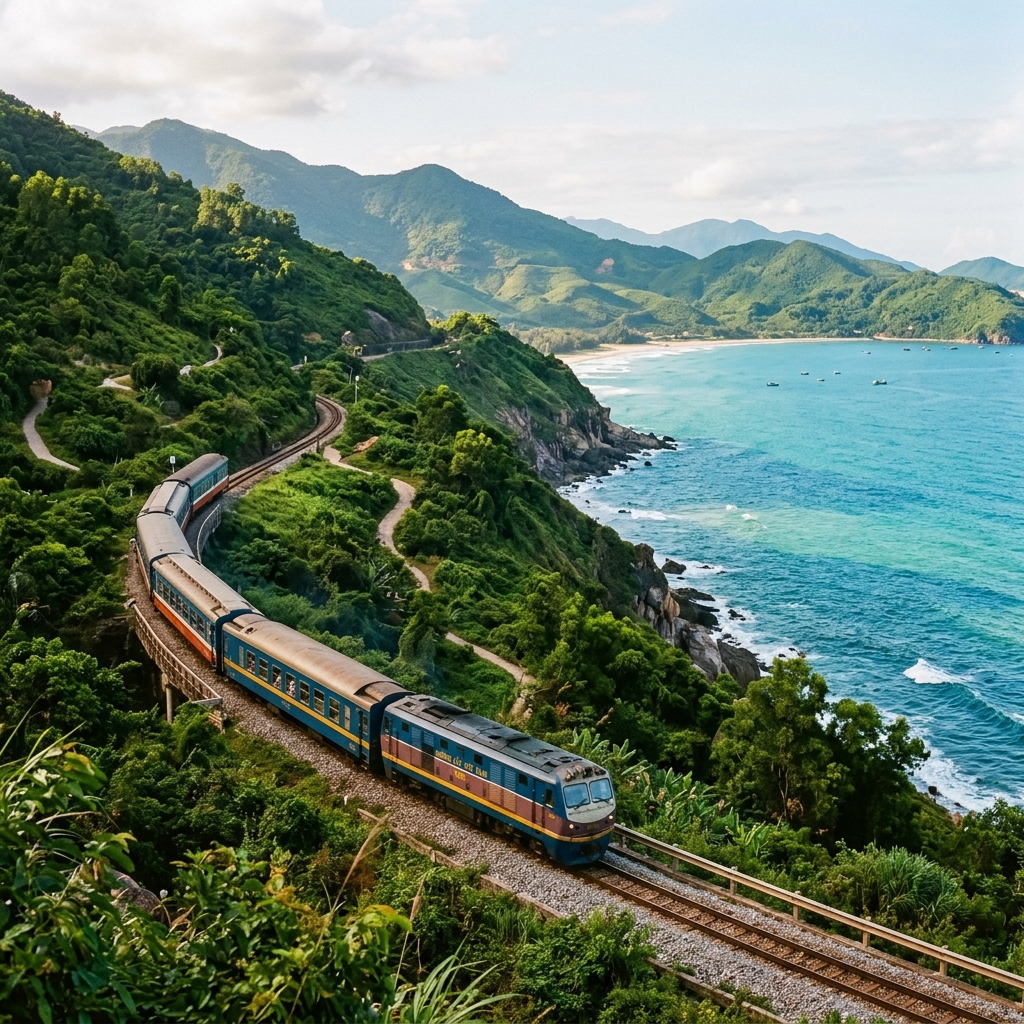
Vietnam is 1,726 kilometres from end to end and shaped like a stretched S, narrow in the middle, broad at both tips. For most of that length, the Reunification Express runs alongside it: a single-track railway that stitches together the country’s history as much as its geography.
The line was built under French colonial administration starting in 1899, destroyed repeatedly during thirty years of war, and reassembled by 1976, the year after reunification, as both a practical transport link and a symbol. The name is deliberate. The train connects Hanoi (the north, the wartime capital) to Ho Chi Minh City (the south, still called Saigon by most people who live there). Riding it is not just a way to travel between cities. It is a way to read the country.
The Route and What It Means
The full journey from Hanoi to Ho Chi Minh City covers 1,726km in 30–35 hours. Every serious guide to Vietnam train travel will tell you the same thing: do not do it all at once.
This is good advice. The route passes through some of the most beautiful and historically significant fields in Southeast Asia, the rice paddy flats of the Red River Delta, the limestone karst of Ninh Binh, the imperial city of Hue, the clifftop drama of the Hai Van Pass, the resort coast around Da Nang. Riding it in a single 33-hour push means sleeping through most of it. Breaking it into sections means experiencing Vietnam as a series of genuinely different places.
The ideal itinerary: Hanoi (3–4 days), Ninh Binh (2 days by day trip or overnight), Hue (2–3 days), Da Nang then on to Hoi An, Hoi An (7–14 days for slow travelers), then overnight train to Ho Chi Minh City (3–4 days).
Understanding the Classes
Vietnam Railways runs four classes, and the difference in experience between them is significant.
Hard Seat (Ghế Cứng)
Wooden or basic padded bench seats in open carriages. Fine for journeys under 2 hours. Not recommended for overnight travel.
Soft Seat (Ghế Mềm)
Padded reclining seats, air-conditioned on better trains. Perfectly adequate for day journeys up to 5–6 hours. This is what you want for the Hue–Da Nang leg.
Hard Sleeper (Giường Nằm Cứng)
Six-berth open compartments with thin mattresses, fan-cooled on older trains. Prices are low, around $15–25 for most overnight legs. Acceptable for budget travelers; not luxurious.
Soft Sleeper (Giường Nằm Mềm)
Four-berth air-conditioned compartments with proper mattresses, curtains, and a closing door. This is the right choice for overnight journeys. Prices start at around $30 for shorter legs and $40–55 for longer routes like Da Nang to Ho Chi Minh City. Book these.
The SE1 and SE2 are the fastest and most comfortable express trains on the full Hanoi–HCMC route. For individual legs, the SE3/SE4 and SE7/SE8 are also reliable and slightly cheaper.
The Best Sections
Hanoi to Ninh Binh: 2 Hours, $3
Ninh Binh is sometimes called “Ha Long Bay on land”, limestone karst towers rising from flat water, but here the water is flooded rice paddies rather than sea, and the caves are inland. The effect is quieter, stranger, and more intimate than Ha Long.
The train from Hanoi takes about 2 hours and costs around 60,000–80,000 VND ($3) in soft seat. Multiple daily departures from Hanoi’s Ga Ha Noi station.
At Ninh Binh, the main attractions are Trang An (a UNESCO-listed wetland karst complex where you row between limestone cliffs in a small boat), Tam Coc (similar, more touristic), and Bich Dong Pagoda built into a cave. Ninh Binh rewards an overnight stay rather than a rushed day trip, the field at dawn and dusk, when the mist sits over the paddies, is the version worth seeing.
Hue: The Imperial City
Hue was Vietnam’s imperial capital under the Nguyen dynasty (1802–1945) and suffered some of the heaviest fighting of the American War during the 1968 Tet Offensive. The Citadel, a walled imperial complex modeled on Beijing’s Forbidden City, was reduced to rubble in the battle and has been slowly restored ever since. The incompleteness is part of what makes it haunting.
Beyond the Citadel: the Thien Mu Pagoda (above the Perfume River), the imperial tombs scattered in the hills south of the city, and Hue’s distinctive food culture, bun bo Hue (spicy lemongrass beef noodle soup, nothing like pho), com hen (tiny clams over cold rice with fifteen garnishes), banh khoai (crispy stuffed crepe). Eat at small family restaurants on Bach Dang street along the river.
Hue to Da Nang: The Hai Van Pass
Distance: 105km. Journey time: 2.5 hours. Price: around 120,000–160,000 VND ($5–7) in soft seat.
This 2.5-hour section contains the most spectacular 30 minutes of rail travel in Southeast Asia. The Hai Van Pass (literally “Ocean Cloud Pass”) divides Vietnam’s central coast, geographically, climatically, and historically. The train climbs from sea level to the pass at around 500m elevation along a series of curves cut into the cliffside. Below, the South China Sea. Above, jungle and cloud. The track is single-lane, the curves tight, and the vistas continuous for about 30 minutes before the descent to Da Nang Bay.
Sit on the sea side: left side of the carriage traveling south (Hue to Da Nang), right side traveling north (Da Nang to Hue). This matters.
Hoi An: Where You Stay for Two Weeks
Hoi An has no railway station. The nearest station is Da Nang, 30km to the north. From Da Nang station, take a Grab taxi (30–40 minutes, around 120,000–160,000 VND) to Hoi An.
This is a minor logistics note. What it does not change is the fact that Hoi An is one of the best slow travel bases in Southeast Asia.
The old town is a UNESCO-listed trading port preserved from the 15th–19th centuries, narrow lantern-lit streets, yellow-walled merchant houses, Chinese assembly halls, Japanese-influenced covered bridge. The surrounding countryside is rice paddies and river delta, best explored by bicycle.
The slow travel case for Hoi An:
- Cooking classes: Hoi An has some of the best cooking class infrastructure in Asia. Morning market tours followed by half-day lessons in making white rose dumplings, cao lau noodles, and banh mi run $20–35 and are worth doing twice.
- Tailors: Hoi An has over 400 tailoring shops. A well-fitted linen shirt or pair of trousers takes 24–48 hours and costs $15–40.
- Cycling: The countryside surrounding the old town is flat, uncrowded, and beautiful. Renting a bicycle ($2/day) and cycling through paddy field paths and fishing villages is one of those simple pleasures that accumulates over weeks.
- Food: Cao lau (thick wheat noodles with pork and greens) and banh mi (the Banh Mi Phuong version, frequently described as the world’s best) are enough reason to stay.
Daily budget in Hoi An: $20–30 for accommodation in a mid-range guesthouse, food, bicycle rental, and one or two activities. One of the most pleasant places in Asia to spend money slowly.
Da Nang to Ho Chi Minh City: The Overnight South
Distance: 935km. Journey time: 15–17 hours. Price: $40–55 for soft sleeper.
This is the longest single leg most travelers on the Reunification Express take. The SE1 departs Da Nang in the early afternoon and arrives in Ho Chi Minh City the following morning. The train passes through Quy Nhon (a largely undiscovered beach city), Nha Trang (the resort coast), and Phan Thiet before the flat approach to HCMC.
Book a soft sleeper. Dinner in the dining car (simple Vietnamese dishes, 80,000–120,000 VND) is part of the experience.
How to Book Tickets
Vietnam Railways (dsvn.vn)
The official site sells tickets at face value. The interface has improved, but international card acceptance can be unreliable. Worth trying; use an aggregator as backup.
Baolau and 12go.asia
Both accept international cards reliably and show real-time availability. The booking fee (around $1–3 per ticket) is worth the convenience. Baolau in particular has an excellent interface for comparing train options and classes on each route.
Booking advice: For overnight soft sleepers during peak periods (July–August, Vietnamese Tet holiday in late January/early February), book 2–3 weeks ahead. For shoulder season, a week in advance is usually sufficient. The Hue–Da Nang daytime leg rarely sells out and can be booked at the station.
Slow Travel Budget: Vietnam by Train
Hanoi: $25–35/day. A decent guesthouse in the Old Quarter costs $20–30; pho bo from a street vendor is $2; a sit-down restaurant dinner with beer is $8–12.
Hue: $20–30/day. Slightly cheaper than Hanoi, excellent food scene, manageable on foot and bicycle.
Hoi An: $20–30/day. Slightly more touristy pricing in the old town itself; one street over, prices drop. The best value in Hoi An is its cooking classes, which cost money but are worth every dong.
Ho Chi Minh City: $25–35/day. The city has an excellent food scene (Ben Thanh market area, District 3 local restaurants) and a livelier nightlife than anywhere else in Vietnam. Worth 3–4 days at the end of the trip.
The full Vietnam train journey, Hanoi to HCMC in soft sleeper, with two overnight trains and two daytime legs, costs roughly $80–120 in total tickets. For 1,726km of one of Asia’s most spectacular rail routes, this is one of the great travel bargains.
Practical Notes
Carry snacks and water: A bag of provisions from a convenience store before boarding makes a long journey significantly more comfortable. Vendors walk the train selling drinks and snacks, but the selection is limited.
Upper vs. lower berths: The lower berth in a six-berth compartment offers more sitting space during the day but receives more foot traffic. The middle berth offers more privacy. Most experienced train travelers prefer the middle berth.
Sea-side seating on the Hai Van Pass: Left side traveling south (Da Nang to Hue direction), right side traveling north.
Safety: Vietnamese trains are safe. Solo travelers, including solo women, regularly report positive experiences on overnight trains. Keep valuables secure in your berth.
Station locations: Hanoi station and Saigon station are both close to city center neighborhoods and walkable to accommodation in the Old Quarter and District 1 respectively.
The Reunification Express is not fast and is not luxury. It is one of Asia’s great railway journeys, through a country that rewards slow observation. The rice paddies of Ninh Binh at dawn, the walled old city of Hue, the Hai Van Pass at 500m above the sea, none of these can be seen from a plane. The train exists specifically to show them to you, and it does so at exactly the right speed.
For more slow travel in Southeast Asia, see Southeast Asia on a budget and our guide to what slow travel actually means.