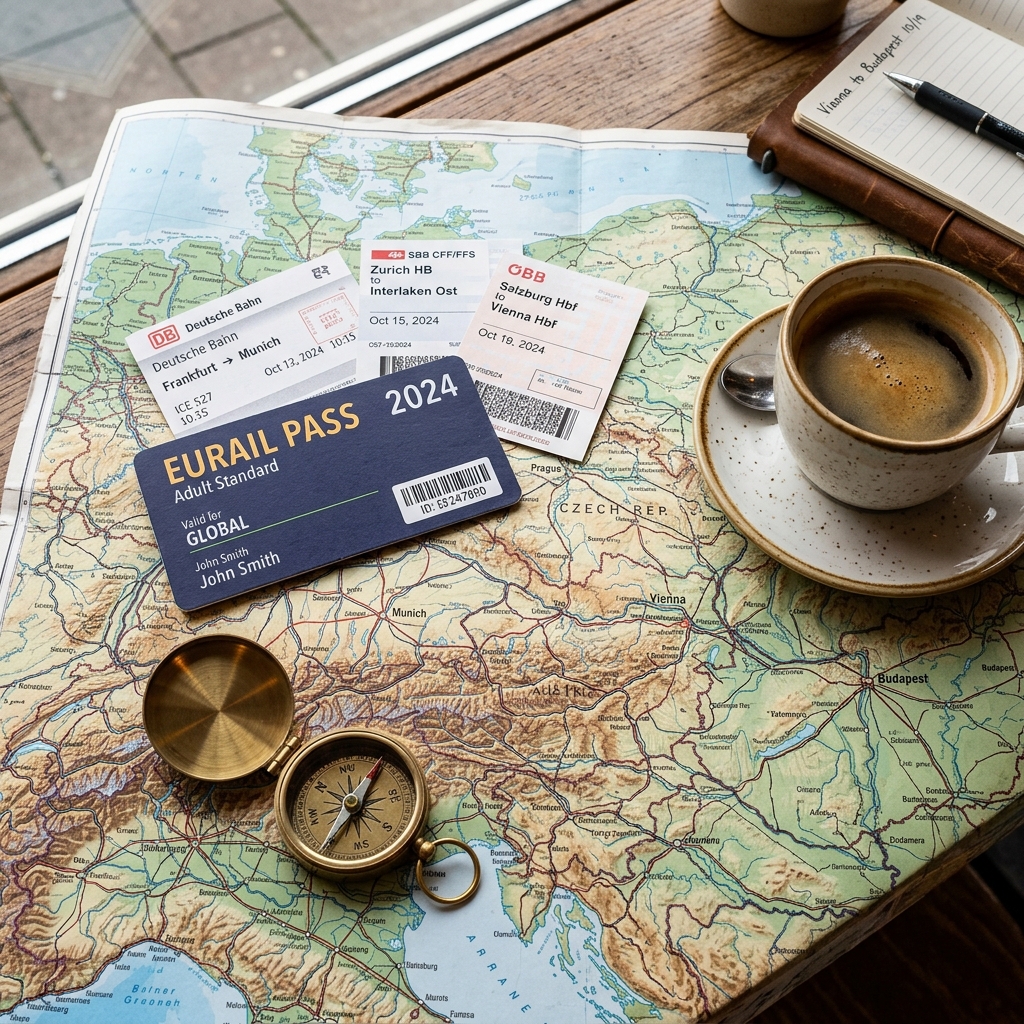
A rail pass is a product catalog, not a verdict. This desk lists what you can buy — Global versus One Country, flex versus continuous — then sends the yes/no maths to the worth-it page.
More than 1.237 million Eurail and Interrail passes were sold in 2023, an all-time record, up 25% on the prior year (Matador Network, 2023). Volume is not proof the catalog default is the right SKU. The useful question on this page is which pass type matches the trip; whether that pass beats tickets for these dates lives on Is a Eurail pass worth it?. Residency — who must buy Interrail instead — is Interrail vs Eurail. How to check out the tickets if you skip the pass is How to Book European Train Tickets. Medical cover for the same trip is Travel Insurance for Europe. Timing the inbound flight is Flight Booking Strategies for Slow and Overland Travel. Planning the first rail trip: Europe by train. Live hubs: the journal and tools. This desk does not sell passes; see how we make money.
Desk note: this desk does not run a private catalog lab and did not buy every Global and One Country SKU as a field test. Pass prices and reservation fees below are research ranges from published Eurail, Interrail, RailPass, and Seat61 pages — not a live quote. Confirm current prices before you buy.
TL;DR: Eurail is for non-Europeans; Interrail is for European residents — same network, different eligibility. A 7-day Global flex pass sits in a research range around €185–$231 (adult, 2nd class). Add a research range of €5–€35 per high-speed reservation. The pass beats walk-up tickets on flexible, multi-country trips of 5+ trains. Skip the pass for fixed itineraries booked 6+ weeks ahead (Seat61, 2026). Skip Global continuous if you have rest days. Skip Italy One Country when Trenitalia and Italo advance fares are already cheap.
Before you buy — the checklist the catalog page skips
Work this list before you open Eurail.com or Interrail.eu. The SKU is not the trip cost.
- Name the product you are eligible for. Residents of Europe for six months buy Interrail. Everyone else buys Eurail. Do not shop the brand — see Interrail vs Eurail.
- Count long-distance boardings, not countries. One flex day per calendar day you take a long train. Most two-to-three week trips need 5–8 days, not a continuous month.
- Look up reservation fees on the high-speed legs. Frecciarossa, TGV, AVE, Eurostar. A 7-day pass used on seven flagship trains can add a research illustration of €70–€245 in fees.
- Name the exclusions. Italo is out. Domestic UK trains are BritRail, not this pass. Glacier Express and Bernina need supplements. City metro is not covered.
- Decide skip versus buy. Skip Global continuous if you will sit still for rest days. Skip a One Country Italy pass when dates are locked and you can book Trenitalia or Italo weeks ahead. Skip the Global Pass entirely for 1–2 countries with 3–4 trains booked ahead — buy tickets on the booking guide.
What Is the Difference Between Eurail and Interrail?
Eurail and Interrail are the same pass with one difference: where you live. European residents (anyone who has lived in Europe for at least six consecutive months) buy Interrail. Everyone else, Americans, Australians, Canadians, Japanese travelers, buys Eurail. Both are issued by Eurail Group, a joint venture of 33 national railway operators (Eurail Group, 2024). Both cover identical trains in identical countries at essentially the same prices.
The persistent myth that Eurail is the “international” version or covers more countries is simply wrong. It traces back to the 1970s and 1980s, when Eurail was marketed heavily in North America while Interrail was pitched as a budget product for European students. The two products have converged entirely. The branding just hasn’t caught up with reality.
Who qualifies for which pass?
Interrail is open to residents of all 27 EU states, plus the UK, Norway, Iceland, Switzerland, Turkey, Serbia, North Macedonia, and Bosnia-Herzegovina. Residency is what matters, not citizenship. A French passport holder living in New York buys Eurail. A Brazilian expat who has lived in Berlin for a year qualifies for Interrail (Interrail.eu, 2026).
Eurail covers everyone outside that list. There’s no residency threshold to clear, no documentation to submit, and no application process. You buy it online, download the Rail Planner app, and activate your pass when you’re ready to travel.
One practical note on the UK: Post-Brexit, UK residents still qualify for Interrail. However, the pass does not cover domestic UK trains, only the Eurostar departing from London St Pancras. For unlimited UK rail travel, you’d need a separate BritRail Pass (BritRail, 2026).
Eurail vs Interrail full comparison
Citation Capsule: Eurail and Interrail are both issued by Eurail Group, a joint venture of 33 European railway operators. Together they sold 1.237 million passes in 2023, a 25% year-on-year increase and an all-time record. The products cover identical networks; the only difference is that European residents (6+ months of residency) buy Interrail while all other travelers buy Eurail (Matador Network, 2023; Eurail Group, 2024).
When Does a Rail Pass Save Money, and When Does It Not?
The pass saves money in three specific situations: you’re traveling flexibly without fixed dates; you’re crossing three or more countries; or you’re making five or more long-distance train journeys in a single month. In all three cases, the pass’s fixed upfront cost averages out to a per-journey rate that beats walk-up point-to-point fares. Walk-up fares on European high-speed trains can run three to five times the advance price (Seat61.com, 2026).
Point-to-point tickets win when you’re booking at least six weeks ahead with fixed dates, staying in one or two countries, or traveling primarily through Italy. The Italian network, operated by Trenitalia and Italo, has aggressive advance pricing that routinely undercuts the One Country Pass cost by a wide margin. This is the most common scenario where a pass holder ends up paying more than a traveler who simply bought tickets.
The pass wins when:
- Your itinerary is flexible and you’re booking trains close to departure
- You’re crossing three or more country borders
- You’re making five or more train journeys within a one-month window
- Your route passes heavily through Germany, Austria, Switzerland, or Scandinavia, regions with low or zero reservation requirements
- You’re under 28 (youth pricing shifts the break-even significantly)
Point-to-point tickets win when:
- You have fixed dates and can book 6–12 weeks in advance
- You’re visiting one or two countries only
- Your trip is focused on Italy, Trenitalia and Italo advance fares are excellent
- You’re making only three or four long-distance journeys total
- Your route is dominated by short hops where budget airlines compete aggressively on price
The Italy scenario deserves emphasis. A Rome–Florence–Venice circuit booked eight weeks ahead on Italo (Italy’s private high-speed operator) sits in a research range around €65–€80 total in second class. A Eurail Italy One Country Pass for three travel days sits around €157, and you would still pay €13 per Frecciarossa reservation on top, since Italo does not accept passes at all. Skip Italy One Country on this shape of trip. The pass does not just fail to save money. It costs more than twice as much.
booking Italian trains affordably
Worked example: Paris to Rome in 21 days across seven countries
Here’s a real itinerary comparison: Paris → Amsterdam → Berlin → Prague → Vienna → Venice → Rome over three weeks, using seven train journeys.
[CHART: Comparison table, pass vs point-to-point on Paris-Amsterdam-Berlin-Prague-Vienna-Venice-Rome itinerary, source: Rail Europe / Seat61.com 2026]
The numbers tell a clear story. On walk-up fares, the pass wins decisively, you’d spend €404–€622 on tickets versus €275 all-in for the pass plus reservations. But book that same itinerary six to ten weeks ahead, and point-to-point advance fares come in at €174–€320. The pass stops being the cheaper option the moment you commit to fixed dates and book ahead.
The conclusion for this specific itinerary: if you’re flexible, buy the pass. If you’ve already planned your dates and can book now, buy the individual tickets.
Citation Capsule: On a seven-leg itinerary from Paris to Rome via Amsterdam, Berlin, Prague, Vienna, and Venice, walk-up point-to-point fares total approximately €400–€620. A Eurail 7-day Global flex pass costs €212 plus around €63 in mandatory reservation fees, a total of roughly €275. The pass saves up to €350 on flexible bookings but costs more than advance tickets booked 6–10 weeks ahead (Rail Europe, Seat61.com, Eurail.com, 2026).
What Types of Rail Passes Are Available?
Both Eurail and Interrail offer the same structural options: a Global Pass covering all 33 countries, One Country passes for focused trips, and regional options for specific border crossings. Prices for 2026 range from around €163 / $178 for a 4-day flex pass to €555 / $606 for three continuous months of travel (RailPass.com, 2026). All figures below are adult second class.
[IMAGE: Screenshot of Eurail Rail Planner app showing pass activation screen and travel day selection, search terms: Eurail Rail Planner app mobile pass]
The Global Pass: all 33 countries
The Global Pass is the flagship product. It covers every participating country in the network, approximately 250,000 km of European railway (Eurail.com, 2026), and comes in two formats.
Flex passes give you a set number of travel days to use within a fixed window (one or two months). You choose when to activate each day. This is almost always the better choice. A continuous pass burns travel days on slow days, rest days, and city stays. A 10-day flex pass used across two months gives you far more flexibility than a 15-day continuous pass at a similar price.
Continuous passes run from a fixed start date for 15 days, 22 days, one month, two months, or three months without interruption. These suit travelers moving every day. Skip Global continuous if you have rest days, city stays, or any calendar day without a long train — you are paying for days you will not use. For most trips under three weeks, the flex pass delivers better value.
One Country passes: good for Germany, not for Italy
One Country passes cover a single nation and cost significantly less than the Global Pass. A Germany pass (3 days of travel) costs around €150 for adults. A Swiss pass starts at around €195. These work well when your entire trip is within one country and you’re traveling spontaneously.
The notable exception, again, is Italy. Trenitalia’s advance pricing is competitive enough that the Italy One Country Pass rarely makes financial sense unless you’re booking last-minute. Spain’s One Country Pass is a stronger option, Renfe’s advance pricing isn’t as aggressive, and the AVE high-speed network is excellent.
Age tiers that matter
Youth (under 28): saves 20–25% off the adult price. This is the tier that changes the entire break-even calculation. At youth pricing, the pass becomes attractive for shorter itineraries where adult pricing wouldn’t make sense.
Senior (60+): saves approximately 10%. A useful discount, though not as significant as youth pricing.
Children under 12: travel free with an adult passholder. A practical benefit for family travel that point-to-point tickets don’t replicate without buying separate children’s tickets.
The Reservation Trap: Why Your Pass Isn’t Enough to Board
This is the section most rail pass buyers don’t read carefully enough. The pass covers your base fare on nearly every train in the network. On most regional and intercity trains, that’s all you need, scan your app, board, and travel. But on Europe’s high-speed trains, you also need a separate seat reservation. These aren’t included in the pass, they cost real money, and they must be booked in addition to your pass (Seat61.com, 2026).
Reservation fees for passholders in 2026:
- ICE (Germany, high-speed): €5.50 per journey
- RailJet (Austria / Czech Republic): €3 per journey
- Frecciarossa / Frecciargento (Italy, high-speed): €13 per journey
- TGV (France, domestic and international): €10–€20 per journey
- AVE (Spain, high-speed): €10–€30 per journey
- Thalys / Eurostar (Paris–Amsterdam, Paris–Brussels): €22 per journey
- Eurostar (London–Paris, London–Brussels, London–Amsterdam): €35 per journey
Regional and intercity trains across most of Europe, the slower but still comfortable services connecting smaller cities, require no reservation at all. You board freely, scan your pass, and sit anywhere not marked reserved. Build your itinerary around these trains and reservation fees largely disappear.
The Eurostar fee is the biggest shock. At €35 per direction, a London–Paris return absorbs €70 in reservation costs before you’ve boarded a single other train. A cheap advance-purchase Eurostar economy ticket can cost €39 each way when booked 60 days ahead. The passholder reservation alone nearly matches that. For London–Paris travel specifically, an advance point-to-point Eurostar ticket will almost always be the smarter purchase.
How to book pass reservations
Reservations are made through the Eurail Rail Planner app or directly via the Eurail website. For most trains, you can book up to 90 days ahead, and on popular summer routes (especially TGV and Eurostar), booking early matters. Germany’s ICE trains rarely sell out pass reservations. France’s TGV and Italy’s Frecciarossa on busy summer weekends can run tight.
Same-day reservations are usually possible through the app, but don’t rely on this for Eurostar.
Citation Capsule: Eurail passholders must pay mandatory seat reservation fees on high-speed trains even when the pass covers the base fare. Fees range from €3 on Austrian RailJet services to €35 per direction on the Eurostar. Regional and intercity trains across most of Europe board without any reservation fee. Building an itinerary around reservation-free routes is the most effective way to control total pass costs (Seat61.com, 2026).
How Do Night Trains Work With a Rail Pass?
Night trains with a pass require a reservation, and here the fee reflects not just a seat but a sleeping berth. A couchette (a fold-down bunk in a shared compartment of six) costs approximately €19–€29 per passenger on most ÖBB Nightjet routes with a pass. A private sleeper cabin costs €29–€59 extra, depending on route and season (ÖBB Nightjet, 2026).
The smart way to think about overnight trains and passes: a night train uses one travel day on your flex pass but replaces both a day train and a hotel night. On a Vienna–Venice overnight, for example, you’d pay €19 for a couchette reservation plus use one flex day. Compare that to a €49–€89 daytime train plus a Venice hotel night at €80–€150, and the overnight saving is substantial.
Night trains are one of the strongest arguments for holding a pass. The reservation fees sit in a research range around €19–€29 for a couchette, the value-per-travel-day is high, and waking up in a new city after a night in a couchette is one of the better uses of a flex day. It is also the slice where a pass gives you something advance tickets cannot easily replicate: adding a spontaneous overnight without a large last-minute fare. Skip the private sleeper upgrade if a couchette already replaces the hotel night you would have bought.
Note that some night trains are heavily booked months in advance, particularly in summer. ÖBB opens reservations up to 180 days ahead. Use your pass reservation allocation early on popular routes like Vienna–Zurich or Zurich–Barcelona.
the complete night train guide
What Do Rail Passes NOT Cover?
Several high-profile trains and services either aren’t covered at all or require paid supplements beyond the standard reservation fee. Knowing these exclusions before you plan your itinerary avoids expensive surprises (Eurail.com, 2026).
Services not covered by Eurail or Interrail:
- Domestic UK trains, the pass covers only the Eurostar departing London, not any domestic British rail service
- Italo (Italy), Italo is a private operator running on the same high-speed lines as Trenitalia’s Frecciarossa but is entirely outside the pass network; passholders must use Trenitalia services only
- Glacier Express (Switzerland), requires a separate supplement of CHF 49 in addition to a pass reservation; the scenic route between St Moritz and Zermatt is spectacular but costs extra
- Bernina Express (Switzerland), similarly requires a supplement beyond the pass; approximately CHF 16 per passenger
- Most urban metro, tram, and local bus services, the pass covers intercity and regional rail, not city transit
- Eurostar, technically covered, but the €35 mandatory reservation means it functions more like a discounted rate than a free journey
[IMAGE: The Glacier Express winding through a snowy Alpine valley near the Landwasser Viaduct, search terms: Glacier Express Switzerland Alpine viaduct winter]
The Italo exclusion catches travelers in Italy repeatedly. Italo operates a frequent, modern high-speed service on the Rome–Florence–Milan corridor, and its tickets are often cheaper than Trenitalia on the same routes. But the pass doesn’t work on Italo. If you hold a pass and want to travel between Italian cities, you’re limited to Trenitalia’s Frecciarossa or the slower Intercity and regional services. Always check which operator runs the train you want before booking.
Where Should You Buy Your Rail Pass?
Both passes are sold directly through the operator websites, Eurail.com for Eurail and Interrail.eu for Interrail. The physical card pass was discontinued; the pass now lives entirely in the Eurail Rail Planner app on your phone (Eurail Group, 2026). There’s no shipping wait and no risk of losing a paper document.
Authorised resellers, Rail Europe, RailPass.com, and others, sometimes stack their own discount codes on top of Eurail’s seasonal promotions. Worth checking before you commit, particularly during sale windows.
When to buy for the best price:
January and November consistently produce the deepest discounts. Eurail and Interrail have run 15–20% promotions during these windows for several years running. Black Friday sales typically run 15% or more. There’s no particular advantage to buying early outside of sale periods, the pass activates when you tell it to, so you can buy in November for a trip in May without any downside.
Youth and senior discount tips:
The youth eligibility cutoff is your age on the first day of travel, not the day you purchase. If you turn 28 three weeks into your trip, you still qualify for youth pricing on purchase. Buy early while you still qualify. The same principle applies to children: under 12 on the first day of travel means they travel free.
Citation Capsule: Eurail passes are now entirely digital, managed through the Eurail Rail Planner app. Both Eurail.com and Interrail.eu run seasonal promotions of 15–20% in January and around Black Friday. The youth fare (for travelers under 28 on the first travel day) reduces the adult price by approximately 20–25%, making the pass significantly more competitive for younger travelers (Eurail Group, 2026).
How to Get Maximum Value From Your Rail Pass
Getting the most from a flex pass comes down to a few disciplined habits. The biggest lever is using overnight trains to “double up” your value per travel day. A night train consumes one flex day while replacing both a train journey and a hotel night, the most efficient use of a pass day available on the European network (ÖBB Nightjet, 2026).
Here is how the flex pass works best in practice, based on the 7-country itinerary structure above:
Reserve your travel days for long-distance and cross-border legs only. Short hops within a city’s regional network often don’t require a pass at all, many are covered by cheap local day passes. Use your flex days for legs where individual tickets would be expensive: international high-speed routes, cross-border IC trains, and overnight services.
Plan reservation-free regional legs wherever possible. Germany’s regional trains (marked “RE” and “RB”) require no reservation. Austrian and Swiss regional trains are the same. These allow you to hop between towns in the Alps, Black Forest, or Bavarian countryside without burning reservation fees or struggling with sold-out pass reservation slots.
Activate the mobile pass and add your travel days in the app before midnight. Each flex day must be activated before your first departure of that day (by midnight in the country of departure). Missing the activation window means you’re technically traveling without a valid pass, a problem if inspected. Get into the habit of activating the night before for early morning departures.
Check for pass seat availability before assuming you can board. Some high-speed services allocate only a fixed number of seats to passholders. If those quota slots are sold out, you cannot use the pass on that particular departure and must either buy a full ticket or choose a different train. This is rare on regional trains and common on busy summer TGV departures.
Don’t overbuy travel days. Unused flex days have no cash value. Most two-to-three week multi-country trips genuinely need only 7 flex days, sometimes 10. Map the planned boardings before you buy. If you count fewer than five, skip the pass and book tickets on How to Book European Train Tickets.
planning a European rail itinerary
Related Reading
- Interrail vs Eurail: What’s the Difference and Which Should You Buy? — residency, not brand shopping.
- How to Book European Train Tickets: The Complete Practical Guide — operator-first checkout if you skip the pass.
- Is the Eurail Pass Worth It? The Honest Guide — pass plus reservations versus the tickets you would actually buy.
- Travel Insurance for Europe — EHIC/GHIC versus a second policy.
- Flight Booking Strategies for Slow and Overland Travel — the inbound booking window.
Frequently Asked Questions
Is Eurail pass worth it in 2026?
It depends entirely on your itinerary. The Eurail Global Pass is worth buying if you’re making five or more train journeys across three or more countries on a flexible schedule. A 7-day flex pass costs around €212 / $231 (adult, 2nd class, 2026). Add reservation fees of €5–€35 per high-speed train. For fixed itineraries booked 6+ weeks in advance, point-to-point advance tickets beat the pass in most scenarios (RailPass.com, 2026).
Can I use a Eurail pass on any train in Europe?
The pass covers trains operated by all 33 participating national railways across roughly 250,000 km of network. It does not cover domestic UK trains, Italo in Italy, the Glacier Express and Bernina Express in Switzerland (without a supplement), or most urban metro and tram systems. The Eurostar requires both a pass and a mandatory €35 reservation fee per journey (Eurail.com, 2026).
what passes do not cover on scenic Swiss trains
Do I need reservations with a Eurail or Interrail pass?
Yes, on high-speed trains. Regional and intercity trains across most of Europe board freely with a pass, no reservation needed. High-speed services (TGV, Frecciarossa, ICE, AVE, Eurostar) require separate seat reservations costing €3–€35 per journey, booked through the Eurail Rail Planner app. Always verify reservation requirements for each train before your travel day (Seat61.com, 2026).
How many travel days do I actually need?
Most two-to-three week European trips use 5–8 flex days. The 7-day flex pass is the right choice for most first-time Eurail users planning a multi-country itinerary. The 10-day flex makes sense if you’re adding several regional train days or additional countries. Don’t buy more days than you need, unused flex days have zero resale or refund value. Count your planned train journeys before purchasing.
What happens if I miss a train or change my itinerary?
With a flex pass, flexibility is the point. If you miss a departure, don’t activate that travel day in the app and simply catch the next available service. The travel day is only “used” once you activate it. This is the pass’s greatest advantage over advance-purchase point-to-point tickets, which typically carry heavy change or cancellation fees (Eurail Group, 2026).
The Bottom Line
A European rail pass isn’t magic, and it’s not a scam. It’s a tool that fits certain trips precisely and delivers poor value on others. For a three-week trip crossing five or more countries on an open itinerary, a 7-day or 10-day flex pass is one of the most liberating ways to travel in Europe, the freedom to board a train without price-checking has genuine worth.
For a fixed two-week Italy trip with dates already chosen? Point-to-point advance tickets will cost you less than half of what the pass plus reservations would run.
The decision comes down to three questions: How many countries are you crossing? How flexible are your dates? How far ahead are you booking? Answer those honestly, and the right choice becomes clear.
The key takeaways:
- Eurail for non-Europeans, Interrail for European residents, same pass, different eligibility
- The 7-day flex pass is the right starting point for most multi-country trips
- Reservation fees are real, budget €5–€35 per high-speed train, on top of the pass price
- Italy is the exception, advance point-to-point almost always beats the pass here
- Night trains are the best value per flex day, one day covers the journey and replaces a hotel night
- Youth pricing changes the math, under 28, the pass is attractive for far shorter itineraries
the case for slow train travel
All prices reflect March 2026 rates. Eurail pass prices and reservation fees are updated periodically. Check Eurail.com or Interrail.eu for current pricing before purchasing.