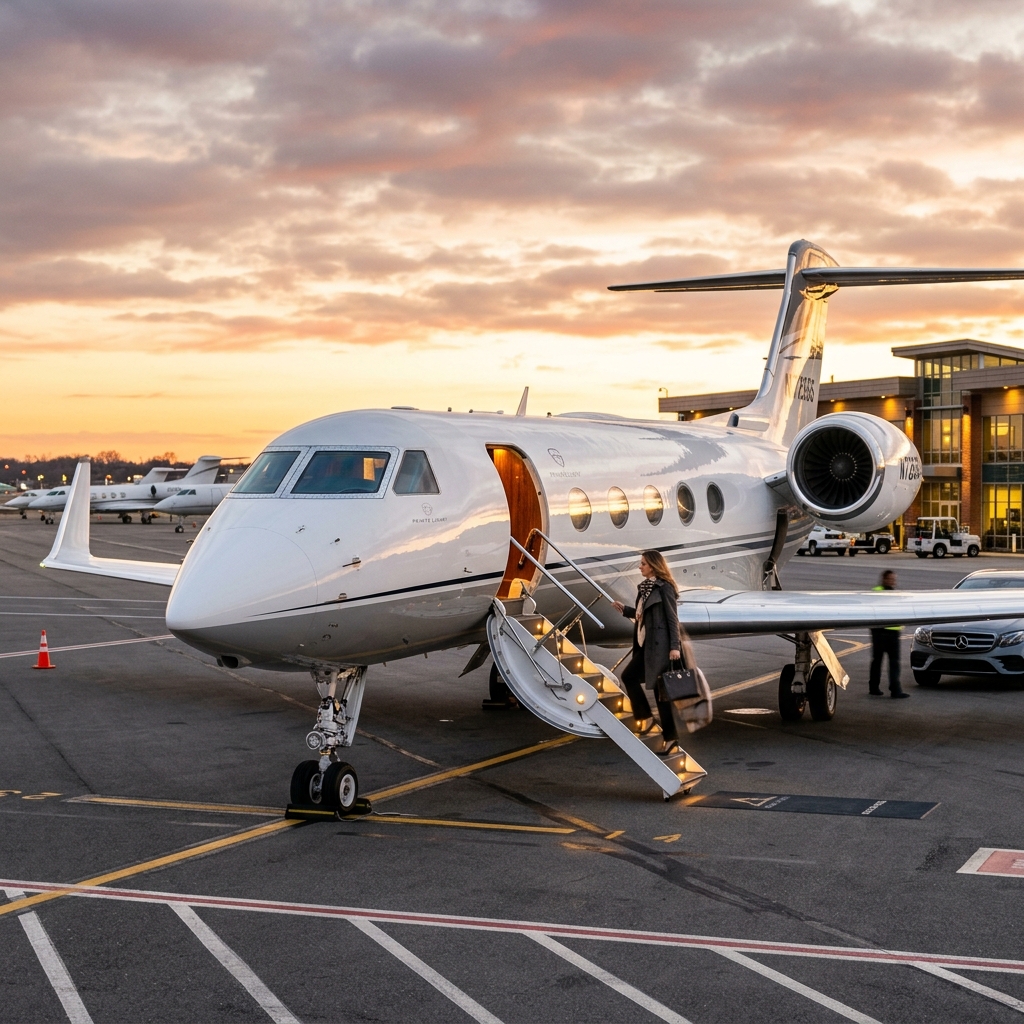
The private jet question lands differently depending on who asks it. For some travelers, it is a genuine cost-benefit calculation. For others, it is an aspiration question. For a smaller group, it is a routine logistics decision they make quarterly.
This article is for the first group: people who have the means to fly privately for an international vacation and want to understand whether the money buys a meaningfully better experience or simply a more expensive one.
The honest answer is that it depends on the route, the group size, your time constraints, and what you value. Here is the full breakdown.
The Real Costs
Private jet pricing is opaque by design. Charter companies prefer to quote per-trip rather than publish rates, which makes comparison difficult. Here are the actual numbers based on 2025-2026 market rates.
Short International Routes (Under 3 Hours)
Routes like Miami to Nassau, Los Angeles to Cabo San Lucas, or New York to Bermuda are where private aviation makes its strongest case.
A light jet (Cessna Citation CJ4, Embraer Phenom 300) seats 6 to 8 passengers and costs $12,000 to $25,000 one way on these routes. Split among six travelers, that is $2,000 to $4,200 per person each way. Commercial first class on the same routes — where it exists, as many short Caribbean hops have no premium cabin — runs $800 to $2,500 per person.
The per-person premium for private on short routes is real but not astronomical, especially for groups. The time savings are significant: no security line, no boarding process, departure on your schedule, and arrival at fixed-base operators (FBOs) where your car meets you on the tarmac.
Medium International Routes (3-7 Hours)
Routes like New York to Mexico City, London to Morocco, or Chicago to the Caribbean fall here. Midsize jets (Cessna Citation Latitude, Bombardier Challenger 350) handle these comfortably, seating 8 to 10 passengers at $30,000 to $65,000 one way.
Per person for a group of eight: $3,750 to $8,125 each way. Commercial business class on these routes: $2,000 to $6,000 per person. The gap is narrower than most people assume, particularly for groups.
Transatlantic and Long-Haul (7+ Hours)
This is where private aviation becomes unambiguously expensive. Only large-cabin, long-range jets can cross the Atlantic nonstop. The aircraft — Gulfstream G650, Bombardier Global 7500, Dassault Falcon 8X — are the most expensive to operate.
New York to London: $100,000 to $180,000 one way. New York to Paris: $110,000 to $190,000. West Coast to Europe: $140,000 to $220,000. These are charter rates for the aircraft, regardless of how many seats you fill (up to 12-16 passengers).
Per person for 12 travelers on a transatlantic crossing: $8,300 to $18,300 each way. Commercial first class on the same route: $4,000 to $12,000 per person. For long-haul international, the price premium for private is substantial even for large groups.
When Private Makes Financial Sense
The math favors private jet travel in specific scenarios:
Large groups on short-to-medium routes. A family reunion of 10 people flying Miami to Turks and Caicos pays roughly $2,500 per person each way on a midsize jet. Commercial options on that route are limited and often require connections through Nassau. The private option saves time, avoids connections, and costs comparably to flexible-fare commercial tickets.
Multi-stop itineraries. If your vacation involves three or four destinations — say, a Mediterranean trip hitting Nice, Sardinia, Santorini, and Montenegro — private aviation eliminates connection layovers and enables a schedule that commercial airlines cannot match. The cumulative time savings across four flights can exceed 24 hours.
Remote destinations with poor commercial service. Reaching certain luxury destinations requires multiple connections, regional carriers with unreliable schedules, or propeller planes that some travelers prefer to avoid. Sun Valley, Idaho. Mustique. Aspen in winter. Private aviation turns a 12-hour connection marathon into a 3-hour direct flight.
Time-constrained travelers. If your vacation window is five days instead of ten, losing 8 to 12 hours on commercial travel logistics each way represents a meaningful percentage of your trip. Private aviation on a Friday evening departure can buy you an extra full day at the destination compared to the earliest commercial option on Saturday morning.
When Private Does Not Make Financial Sense
Solo travelers or couples on well-served routes. A couple flying New York to London has world-class commercial first-class options — British Airways, Emirates (via connection), Singapore Airlines (via connection) — at $5,000 to $10,000 per person round trip. The private alternative costs 10 to 20 times more and, on a 7-hour flight, delivers a marginally different experience since modern first class already provides lie-flat beds, privacy partitions, and multi-course dining.
Destinations with excellent commercial premium cabins. The Singapore Airlines Suite, Emirates First Class, ANA The Room, and Cathay Pacific First Class offer private-jet-level comfort on commercial aircraft. If your route is served by one of these products, the experience gap between commercial first and private narrows to the airport experience and scheduling flexibility.
Purely aspirational spending. If the primary motivation is the status signal rather than a practical benefit, the money delivers more lasting value when redirected toward the destination experience itself — a better villa, a private guide, an additional week of travel. A $180,000 transatlantic charter buys approximately three weeks at a top-tier private villa in Tuscany, including staff, chef, and car service.
The Middle Options
Between commercial economy and full private charter, several intermediate options exist:
Semi-Private Services
Companies like JSX, Aero, and XO (formerly JetSmarter) offer scheduled and on-demand flights on private terminals using shared private jets. You book a seat, not the whole plane. Prices range from $500 to $5,000 per seat depending on route and advance booking.
The experience is genuinely different from commercial: private terminals, no security theater, minimal wait times, and cabin environments closer to private than commercial. Routes are limited — JSX primarily serves U.S. domestic routes like Dallas to Houston, Burbank to Las Vegas, and Oakland to Phoenix — but the network is expanding.
Commercial First Class on Premium Carriers
The top tier of commercial first class has converged significantly toward the private jet experience in terms of onboard comfort. The difference lies in the airport experience (commercial security and boarding versus FBO tarmac access) and scheduling flexibility (airline schedule versus your schedule).
For international vacations where the flight is longer than six hours, premium commercial first class offers 80 to 90 percent of the onboard private jet experience at 5 to 10 percent of the cost.
Empty Leg Flights
Charter operators need to reposition aircraft after one-way bookings, and they sell these repositioning flights (empty legs) at discounts of 25 to 75 percent. Apps like XO, Avinode, and PrivateFly list available empty legs.
The trade-off is flexibility: you must match someone else’s schedule and route. But for travelers with flexible dates who monitor these platforms, empty legs can make private flying accessible on routes and at prices that otherwise would not compute.
The Decision Framework
Ask these four questions:
-
How many people are traveling? Below 6, commercial premium cabins are almost always the better value. Above 8, private starts competing on per-person cost for short-to-medium routes.
-
How complex is the routing? Single-destination, well-served routes favor commercial. Multi-stop or poorly-connected destinations favor private.
-
What is the hourly value of your vacation time? If losing 6 hours to airport logistics on each end represents 10 percent of your total vacation, that time has real value. If your trip is three weeks long, the percentage impact is minimal.
-
What is the experience you are optimizing for? If the flight is a means of transport, optimize for cost-effectiveness. If the flight is part of the vacation experience, private aviation delivers something that commercial cannot replicate: the feeling of the trip starting the moment you arrive at the FBO.
For most international vacations taken by most travelers, commercial first or business class on a quality carrier remains the optimal balance of comfort, cost, and convenience. Private aviation earns its premium in specific scenarios — group travel, complex routing, time pressure, and remote destinations — where the practical benefits justify the substantial additional cost.
The honest answer to “is it worth it?” is that it depends on what you would do with the money if you did not spend it on the flight. If the alternative is a better destination experience, the destination usually wins. If the alternative is sitting in a savings account, and the time savings or group logistics genuinely improve your trip, then the charter may be money well spent.
For travelers considering their first private flight, our guide on slow travel philosophy offers a counterpoint worth reading — sometimes the best use of a travel budget is more time, not faster transport.