The travel industry has a pattern. A destination becomes popular. Popularity brings investment. Investment brings infrastructure. Infrastructure brings more visitors. More visitors degrade the experience that made the destination popular. Prices rise to manage demand. The people who can afford the prices get a worse version of what attracted everyone in the first place.
This cycle has consumed Santorini, Barcelona, Dubrovnik, Bali’s Seminyak, the Amalfi Coast, and Reykjavik. These remain beautiful places. They are also places where the luxury experience — privacy, authenticity, unhurried access — has been fundamentally compromised by volume.
The alternative is not to avoid these regions entirely. It is to shift laterally: same climate, same culture, same cuisine, but a different address. Here is how to do it, destination by destination.
The Mediterranean: Where to Go Instead
Instead of Santorini: Milos, Greece
Santorini receives roughly 3.4 million visitors per year on an island of 15,000 residents. The caldera views are extraordinary. The experience of navigating Fira’s pedestrian streets in August is not.
Milos, in the western Cyclades, has the same volcanic geology, the same whitewashed architecture, and arguably better beaches — over 70 of them, many accessible only by boat. Sarakiniko Beach, with its lunar-white rock formations meeting turquoise water, is one of the most photographed landscapes in Greece, yet you can still find space on it in July.
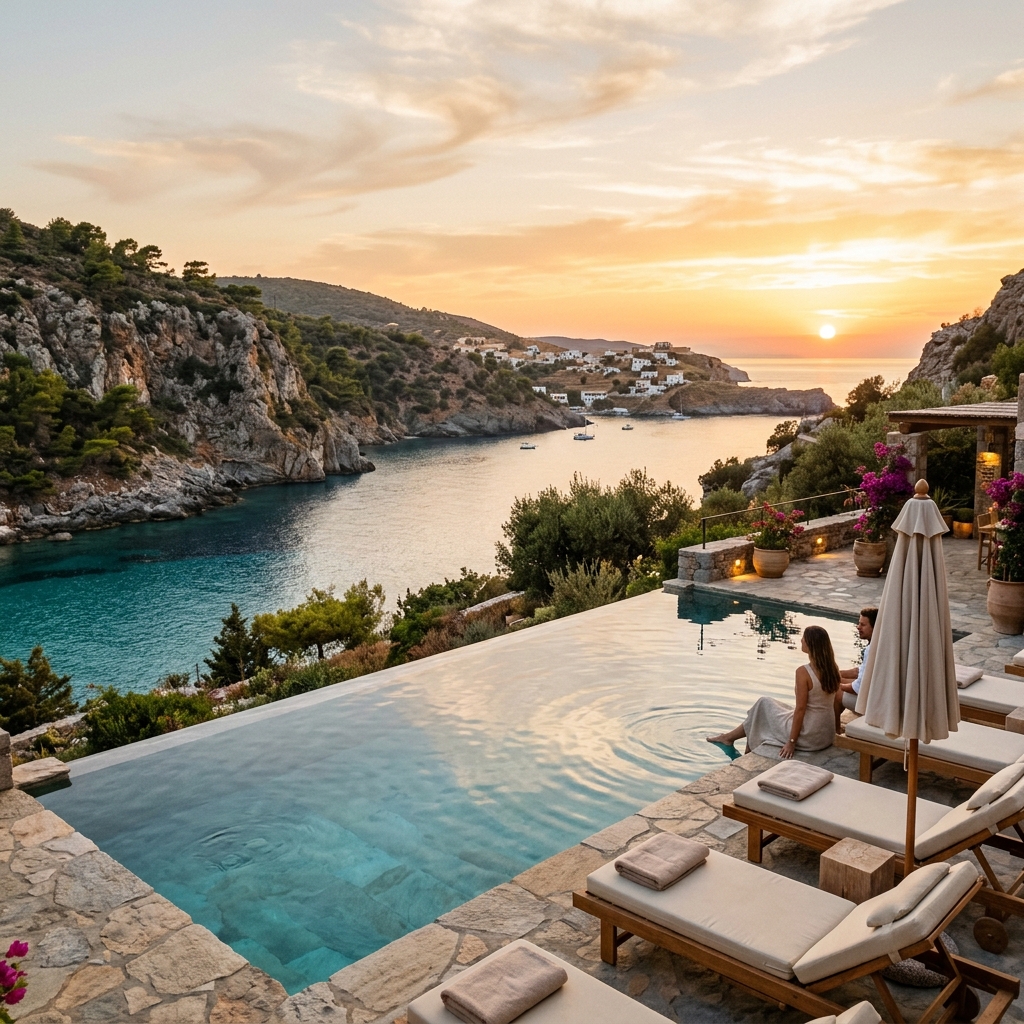
Luxury accommodation on Milos is limited, which is the point. Properties like the Milos Breeze Boutique Hotel offer the Cycladic aesthetic — stone, white plaster, infinity pools facing the Aegean — without the Santorini markup. A five-night stay at a comparable quality level costs roughly 40 percent less than Oia.
Milos is reachable by a 3.5-hour ferry from Athens’ Piraeus port or a 45-minute flight from Athens International. The island has excellent restaurants concentrated in Adamas and Plaka, and a fishing village tradition (Klima, with its colorful boathouses built into the rock) that has not been converted into a gift shop corridor.
Instead of the Amalfi Coast: Puglia, Italy
The Amalfi Coast is a single narrow road carved into a cliff, shared by tour buses, rental cars, and pedestrians, serving approximately 5 million visitors per year across a handful of small towns. The views are staggering. The traffic is criminal.
Puglia — the heel of Italy’s boot — offers coastline, old towns, and food that rival the Amalfi Coast, spread across a much larger area with a fraction of the tourism pressure. Ostuni (the White City), Lecce (the Florence of the South, for its baroque architecture), Polignano a Mare (a cliff-top town above a swimming cove), and the Itria Valley (trulli stone houses among olive groves) provide a week of variety without repetition.
The food in Puglia is a strong argument on its own. Orecchiette pasta made by hand by women sitting outside their doorways in Bari Vecchia. Burrata from its birthplace in Andria. Seafood crudo in Gallipoli. Primitivo wine from Manduria. The prices are Italian countryside prices, not Italian tourist-coast prices — a multi-course dinner with wine for €35 to €50 per person at restaurants that would charge three times that in Positano.
Luxury masseria (farmhouse estate) accommodation is Puglia’s specialty. Converted estates surrounded by ancient olive groves, with pools, spas, and private dining, starting from €250 per night — less than a basic room in Ravello during high season.
Instead of Dubrovnik: Montenegro’s Bay of Kotor
Dubrovnik’s Old Town is a UNESCO site that receives over a million visitors per year in an area roughly the size of a few city blocks. Cruise ships disgorge thousands of passengers daily into streets designed for medieval foot traffic.
The Bay of Kotor, 90 minutes south across the Montenegro border, is a fjord-like bay surrounded by mountains, dotted with medieval towns, and served by a luxury hotel sector that has expanded significantly since 2022. Perast — a tiny Venetian-era town of stone palaces on the bay — has the architecture and setting of Dubrovnik’s waterfront without the human density. Kotor’s Old Town is itself a UNESCO site, with city walls that climb the mountain behind it and views that exceed Dubrovnik’s.
The One&Only Portonovi and Regent Porto Montenegro in Tivat have brought international luxury standards to the bay. Smaller boutique hotels in Perast and Kotor’s Old Town offer character-driven stays from €150 to €300 per night.
Southeast Asia: Beyond Bali and Phuket
Instead of Bali’s Seminyak: Lombok, Indonesia
Lombok sits directly east of Bali, visible from Bali’s eastern beaches, yet receives a small fraction of the visitors. The southern coast — particularly Kuta Lombok (no relation to Bali’s Kuta) — has empty white-sand beaches backed by rolling green hills that look like a travel photographer’s composite image.
The Gili Islands, technically part of Lombok, have their own tourist ecosystem. Skip them and head for Lombok’s south coast or the slopes of Mount Rinjani, Indonesia’s second-highest volcano. The three-day Rinjani trek to the crater lake at 2,641 meters is one of Southeast Asia’s great volcano hikes.
Luxury development in Lombok is early-stage, which means properties are competing hard for guests. Novotel Lombok and the emerging resorts along Selong Belanak Beach offer beachfront accommodation at rates 50 to 70 percent below equivalent properties in Seminyak.
Instead of Phuket: Koh Lanta or Khao Lak, Thailand
Phuket’s west coast is a high-rise hotel strip that resembles a resort city more than a Thai island. Koh Lanta, three hours south, has maintained a long-beach, low-rise character through deliberate development limits. The island’s southern national park protects old-growth forest and empty coves. Long Beach and Kantiang Bay offer excellent swimming from November to April.
Khao Lak, north of Phuket on the mainland, is the gateway to the Similan Islands (some of the best diving in the Andaman Sea) and offers beachfront accommodation in a setting that looks like Phuket did thirty years ago — long stretches of sand backed by casuarina trees, with family-run restaurants and no nightclub district.
The Strategy: How to Find Your Own Alternatives
The pattern is consistent enough to apply anywhere:
Identify the draw. What specifically makes the overtouristed destination appealing? Climate? Architecture? Food? Landscape? Usually it is a combination, and the combination exists elsewhere in the same region.
Move laterally, not far. The best alternatives share cultural and geographic DNA with the famous destination. Puglia is still Italy. Lombok is still Indonesia. Montenegro is still the Adriatic. You sacrifice nothing essential by shifting 100 to 300 kilometers.
Check the accommodation tier. A destination becomes a viable luxury alternative only when it has sufficient high-end accommodation to deliver the comfort standard you expect. Montenegro passed this threshold around 2022. Puglia passed it a decade ago. Some alternatives are still too early — beautiful but lacking the infrastructure. Research before committing.
Time your visit for shoulder season. Even at alternatives, peak season concentrates visitors. May, June, September, and October are almost universally better than July and August in the Mediterranean. November through February in Southeast Asia avoids both the monsoon and the Christmas rush.
Use a specialist travel advisor. For luxury alternatives, a region-specific advisor adds genuine value. They know which properties opened last year, which restaurants require booking, and which experiences are not listed online. Our guide on what to ask a luxury travel advisor covers the specific questions that separate a useful advisor from a booking engine with a phone number.
The goal is not to be contrarian about famous destinations. Santorini is legitimately beautiful. The Amalfi Coast earned its reputation. But the version of those places available to visitors today — crowded, expensive, and increasingly managed for throughput rather than experience — is not the best version of what the region offers. The alternatives are.