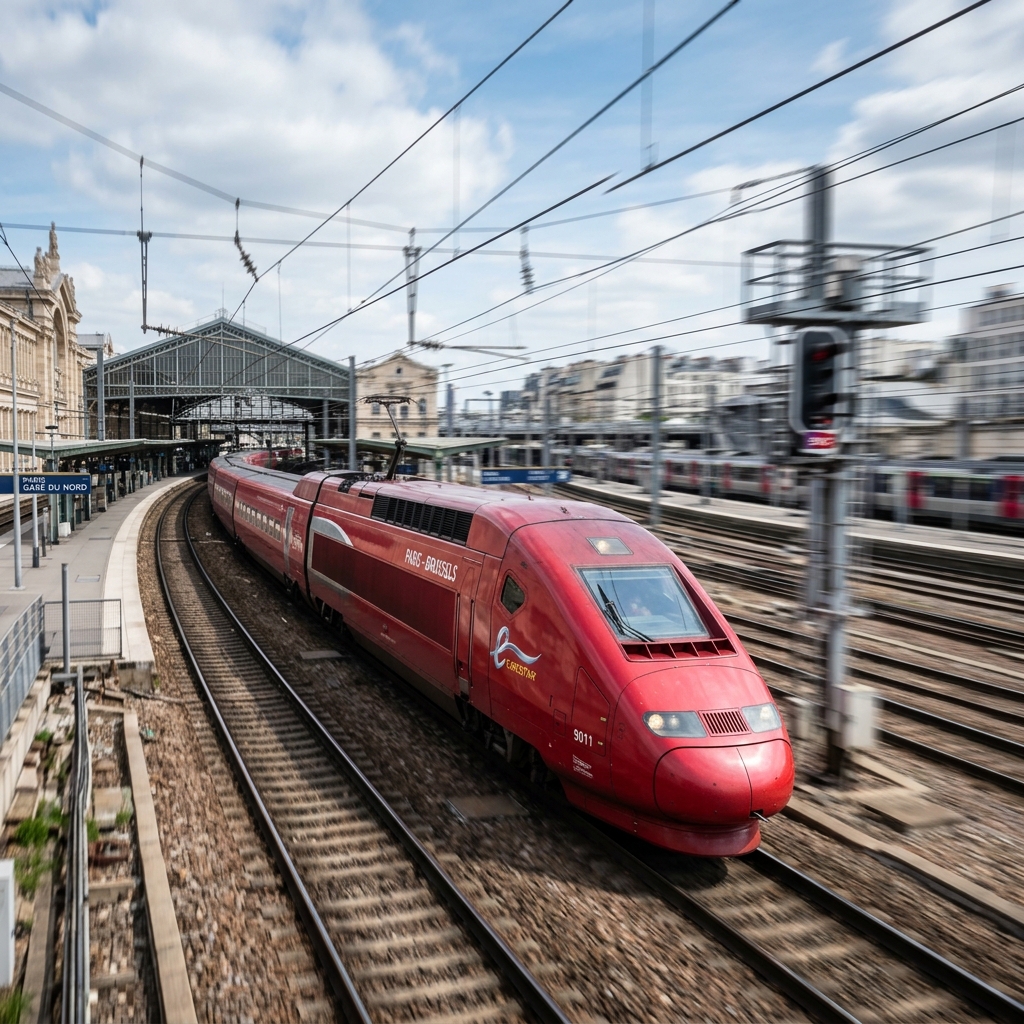
The Paris to Brussels train takes 1 hour 22 minutes. That is faster than most domestic European flights manage door-to-door. The service departs Paris Gare du Nord and arrives at Brussels-Midi roughly every hour throughout the day, one of the highest-frequency international high-speed routes in Europe. Advance tickets start from €29 on Eurostar.com. Thalys was absorbed into the Eurostar brand in January 2023, so there’s one booking system, one operator, and a straightforward booking experience. (Eurostar, 2026)
Brussels, however, is not just a layover. It is a city that has been systematically underestimated by travellers using it as a transit point to Amsterdam or London, a habit this guide intends to correct.
continuing from Brussels to Amsterdam
TL;DR: Paris to Brussels takes 1h 22min on Eurostar, with roughly hourly departures from Paris Gare du Nord to Brussels-Midi. Advance fares from €29. No passport required (Schengen). Brussels deserves 2 nights minimum: the Grand Place is genuinely one of Europe’s finest squares, the beer culture is world-class (over 400 Belgian breweries), and the Art Nouveau architecture rivals Vienna. (Eurostar, 2026)
How Long Does the Paris to Brussels Train Take?
Eurostar’s Paris–Brussels service covers the 312km route in 1 hour 22 minutes on the fastest departures, making it one of the most time-efficient international journeys in Europe. Trains depart Paris Gare du Nord at intervals of roughly 45–75 minutes through the day, from early morning until late evening. A handful of services make an intermediate stop at Brussels Airport (Zaventem), running approximately 10 minutes longer. (Eurostar timetables, 2026)
| Service | Journey Time | Brussels Airport Stop | Frequency |
|---|---|---|---|
| Eurostar direct | 1h 22m | No | ~10 daily |
| Eurostar via airport | 1h 32m | Yes | ~3 daily |
[IMAGE: A Eurostar high-speed train at Paris Gare du Nord departure platform, search terms: Eurostar train Paris Gare du Nord platform departure]
The sheer frequency is the route’s most practical advantage. Unlike many international European rail corridors where you’re working around a handful of daily departures, Paris–Brussels runs often enough that you can largely choose the time that suits you. Miss a morning train? The next is 60–75 minutes later.
How Much Does the Paris to Brussels Train Cost?
Advance Eurostar tickets on the Paris–Brussels route start from €29 in Standard class, available when booking opens at 180 days ahead and remaining available, in declining quantity, until a few weeks before travel. The typical advance floor for a planned trip is €35–€55. Standard Premier (business class, with wider seats and a meal included) starts around €79 advance. Walk-up or fully flexible fares run €120–€170. (Eurostar, 2026)
The pricing pattern is worth understanding. Eurostar’s cheapest Standard fares appear in two phases: at the 180-day booking opening (often the very cheapest batch) and during occasional promotional windows that run 6–10 weeks before departure. If you’re flexible on time of day, mid-week morning departures are almost always cheaper than Friday afternoon or Sunday evening trains.
| Ticket Type | Typical Price | Flexibility |
|---|---|---|
| Standard advance | €29–€65 | Fixed train, limited changes |
| Standard Premier | €79–€130 | Meal included, wider seats |
| Flexible Standard | €100–€150 | Exchange and refund options |
| Business Premier | €150–€200+ | Full meal, lounge access |
Eurail and Interrail passes are valid on Eurostar Paris–Brussels services, but a mandatory seat reservation is required. The reservation fee is approximately €6–€12 depending on class and availability, significantly lower than the €35 charged on Eurostar’s London–Paris–Amsterdam services. (Interrail, 2026)
are rail passes worth it for short hops like this
Paris Gare du Nord: What to Know Before You Board
Paris Gare du Nord is Europe’s busiest railway station by passenger numbers, around 700,000 daily passengers pass through it. (SNCF Gares & Connexions, 2023) It handles high-speed domestic (TGV), Eurostar to London, Thalys/Eurostar to Amsterdam and Brussels, regional express (RER), and suburban (Transilien) services from the same building. This makes it feel chaotic, but the Eurostar and Brussels platforms are clearly separated from the domestic services.
Arriving at Gare du Nord:
- Metro lines 4 and 5 serve the station directly
- RER B connects from CDG Airport in approximately 30 minutes (€11.80 single)
- RER D serves southern Paris connections
- Allow 20 minutes from central Paris by Metro; 35 minutes from CDG by RER
Boarding procedure for Brussels: Unlike Eurostar’s London–Paris route, no passport control is required for Paris–Brussels. You simply scan your ticket at the gate and board. Arrive 15–20 minutes before departure and you’re fine. The platform gates open approximately 30 minutes before departure.
Brussels-Midi Station: Arriving in Belgium
Brussels-Midi (Bruxelles-Midi / Brussel-Zuid) is the city’s international terminus, functional rather than beautiful, serving Eurostar, Thalys, and Intercity services from across Belgium. It sits in the Anderlecht district, about 2km south of the Grand Place. The station is large and serves a neighbourhood that is economically mixed and unvarnished; don’t use it to judge the city.
From Midi to the centre:
- Metro Line 2 or 6: to Arts-Loi / Kunst-Wet and onward, ~8 minutes
- Pre-metro trams: lines 3, 4, 51 pass through the underground level
- SNCB suburban rail: Brussels-Midi to Brussels-Central in 3 minutes by train (frequent departures, the most direct connection to the historic centre)
- Taxi: approximately €10–€15 to the Grand Place
The quickest option is the SNCB suburban connection from Midi to Brussels-Central, a 3-minute ride that deposits you a 5-minute walk from the Grand Place. Validate a Brussels transit ticket (€2.10 single, available at station machines).
Why Brussels Deserves More Than a Transit Stop
Brussels is Europe’s most consistently underestimated city. It houses the European Union and NATO headquarters, which gives it a reputation for bureaucracy and beige. The actual city, the one that exists outside the institutional quarter, is one of the most interesting in northern Europe.
Belgium produces more distinct beer styles than any country on earth. There are over 400 active Belgian breweries, producing Trappist ales, lambic and gueuze, saison, witbier, and dark abbey ales, styles that developed over centuries in religious communities and regional farmhouses. (Brewers of Europe statistics, 2024) Brussels alone has several dozen craft and traditional beerhouses. This is not Germany’s lager monoculture. It is the most sophisticated beer culture in the world.
The Grand Place
Brussels’ Grand Place is, by measured assessment, one of the finest public squares in Europe. Victor Hugo, who lived in exile in Brussels and knew it well, called it “the most beautiful theatre in the world.” The square is ringed by Baroque guild houses, 17th-century merchant buildings with gilded facades, and the Gothic Hôtel de Ville (city hall), which survived the French bombardment of 1695 that destroyed most of the surrounding city. The guild houses were rebuilt in just four years after the bombardment, funded by the city’s merchant guilds. The results are extraordinary.
Go at night. The illuminated facades at dusk, when the tourists are at dinner and the golden stone glows against the dark, are one of the genuinely fine things in European travel.
Art Nouveau Architecture
Brussels is the birthplace of Art Nouveau, the international design movement that emerged in the 1890s and shaped architecture, furniture, and decorative arts across Europe. Victor Horta, the movement’s founding architect, built his masterworks here. The Maison Horta (now the Horta Museum, Rue Américaine) is Horta’s own house and studio, preserved almost intact, and is a UNESCO World Heritage Site. (Horta Museum, 2026) Entry is approximately €10. The stained glass, iron-work staircases, and organic facade details are unlike anything built anywhere else.
The broader Brussels Art Nouveau circuit, Hôtel van Eetvelde, the Maison Saint-Cyr on Rue Royale, the old Ciamberlani house, can be covered on a three-hour walking tour. The Brussels tourism office produces an excellent free Art Nouveau map.
The Magritte Museum
The Musée Magritte near the Place Royale holds the world’s largest collection of works by René Magritte, over 200 paintings, drawings, and objects. (Musées Royaux des Beaux-Arts de Belgique, 2026) Magritte was Belgian, lived in Brussels most of his adult life, and produced his most famous works, The Treachery of Images, The Son of Man, Golconde, in his suburban house in Jette. The museum is not just biographical: it is a serious modern art collection housed in a strikingly renovated Neoclassical building. Entry is €15; book timed slots in advance.
The Magritte Museum takes most visitors by surprise. They expect the hat and the apple and get them. What they don’t expect is the sustained strangeness, the disciplined, rigorous logic of the images, the sense that Magritte thought harder about perception and representation than most painters twice as famous. Spend two hours here, not one.
[IMAGE: Art Nouveau facade of the Maison Horta in Brussels, detailed ironwork and organic window surrounds, search terms: Brussels Art Nouveau architecture Horta facade ironwork]
What to Drink in Brussels
Belgian beer culture is not a tourist affectation. It is a living tradition that has been classified by UNESCO as an element of intangible cultural heritage. The major styles to know:
- Trappist ales: Brewed in active monasteries. Westmalle, Chimay, Orval, Rochefort, Achel, Westvleteren (rare). Deep, complex, bottle-conditioned. The best are extraordinary.
- Lambic and gueuze: Spontaneously fermented wild ales from the Pajottenland region near Brussels. Earthy, funky, tart. Cantillon Brewery in Brussels is the most important producer.
- Witbier: Belgian white beer, wheat-based, spiced with coriander and orange peel. Hoegaarden is the commercial version; seek out Blanche de Bruxelles or any regional witbier.
- Saison: Originally a farmhouse style brewed for harvest workers. Dry, spicy, highly carbonated. Dupont Saison is the benchmark.
Where to drink in Brussels:
- Delirium Café (Impasse de la Fidélité): allegedly holds the world record for beer selection at 3,000+ varieties. More tourist than essential, but genuinely encyclopaedic.
- Moeder Lambic Fontainas (Place Fontainas): the correct answer for serious Belgian beer. 50+ rotating taps, focus on lambic and farmhouse styles. No distractions.
- Cantillon Brewery (Rue Gheude): open for tours and tastings (€9 including two glasses). The only traditional lambic brewery in Brussels still operating within the city limits. Book ahead.
A Two-Night Brussels Itinerary
Day 1:
- Morning: Grand Place (early, before crowds)
- Late morning: Horta Museum and Art Nouveau walk
- Afternoon: Magritte Museum
- Evening: Dinner in the Saint-Gilles or Ixelles district; drinks at Moeder Lambic
Day 2:
- Morning: Cantillon Brewery tour (book ahead)
- Midday: Lunch in the Sablon antiques quarter, mussels and frites at any of the brasseries
- Afternoon: Musées Royaux des Beaux-Arts (free entry to the Old Masters collection)
- Evening: Grand Place illuminated; one final beer at a guildhall café
The Belgian Comic Strip Center (Centre Belge de la Bande Dessinée) is worth adding for a third morning if you have it, a surprisingly serious museum of Belgian comic art, housed in a Horta-designed Art Nouveau building.
Practical Information
Currency: Euro (€). Belgium has been on the Euro since 2002. No exchange required from France.
Language: Brussels is officially bilingual, French (Bruxellois) and Dutch (Flemish). English is widely spoken. Most signs are in both languages; the tourist quarter defaults to French.
Transit card: Buy a Brussels STIB/MIVB transit card at any Metro station machine. Single fare €2.10; 10-ride card €14.80; 24-hour card €7.50. The 24-hour card covers Metro, tram, and bus within Brussels.
Timing: Brussels in December is a special case, the Christmas market on the Grand Place is one of the finest in Europe, running from late November through early January, with ice skating and mulled wine adding to the square’s already-considerable atmosphere.
Paris to Amsterdam as a natural extension
Frequently Asked Questions
How long does the Paris to Brussels train take?
The Eurostar direct service takes 1 hour 22 minutes from Paris Gare du Nord to Brussels-Midi, with roughly hourly departures throughout the day. Services stopping at Brussels Airport run approximately 10 minutes longer. (Eurostar, 2026)
How much does the Paris to Brussels train cost?
Advance Standard class fares start from €29, with typical advance prices of €35–€55. Standard Premier starts around €79. Walk-up fares reach €120–€150+. Book on Eurostar.com directly. (Eurostar, 2026)
Do I need a passport for the Paris–Brussels train?
No. Both countries are in the Schengen Area and no passport control operates on this route. EU/EEA citizens need only a national ID card. Non-EU citizens should carry their passport as standard practice. No border checks on the train itself.
Which station should I use in Brussels?
Arrive at Brussels-Midi, then take the SNCB suburban rail (3 minutes) to Brussels-Central, the closest station to the Grand Place and historic centre. Metro lines also connect Midi to the city centre in approximately 8–10 minutes.
Is the Eurostar the only option from Paris to Brussels?
Since Thalys was absorbed into Eurostar in January 2023, Eurostar operates all high-speed Paris–Brussels services. SNCB Intercity services exist but take 2h 30min+ via alternative routes and are not practical for most travellers. Eurostar is the clear choice. (Eurostar, 2026)
The City That Didn’t Need to Try
Brussels has never bothered much with its own reputation. It has been the administrative capital of Europe for three decades, which has given it a certain grey-suit image that the actual city does nothing to confirm. The Grand Place glows at night. The beer is genuinely the world’s most complex and varied tradition. The Art Nouveau streets are extraordinary. The Magritte Museum is better than you expect.
The train takes 1h 22min. The booking takes three minutes on Eurostar.com. There is absolutely no reason this should remain just a transit stop.
on to Amsterdam from Brussels the slow travel case for staying longer in cities
Citation Capsule, Paris to Brussels Eurostar: Eurostar operates Paris Gare du Nord to Brussels-Midi in 1 hour 22 minutes on direct services, with roughly hourly departures throughout the day. Advance Standard fares start from €29. No passport control is required (Schengen Area). Eurail and Interrail pass holders need a mandatory seat reservation of approximately €6–€12. Since January 2023, Thalys has been fully integrated into the Eurostar brand. (Eurostar, 2026)
Citation Capsule, Brussels beer culture: Belgium has over 400 active breweries producing more distinct beer styles than any country on earth, including Trappist ales, lambic and gueuze, saison, and witbier. UNESCO inscribed Belgian beer culture as an element of Intangible Cultural Heritage in 2016. Cantillon Brewery, operating within Brussels city limits, produces traditional lambic by spontaneous fermentation using methods unchanged since the 19th century. (Brewers of Europe, 2024; UNESCO, 2016)