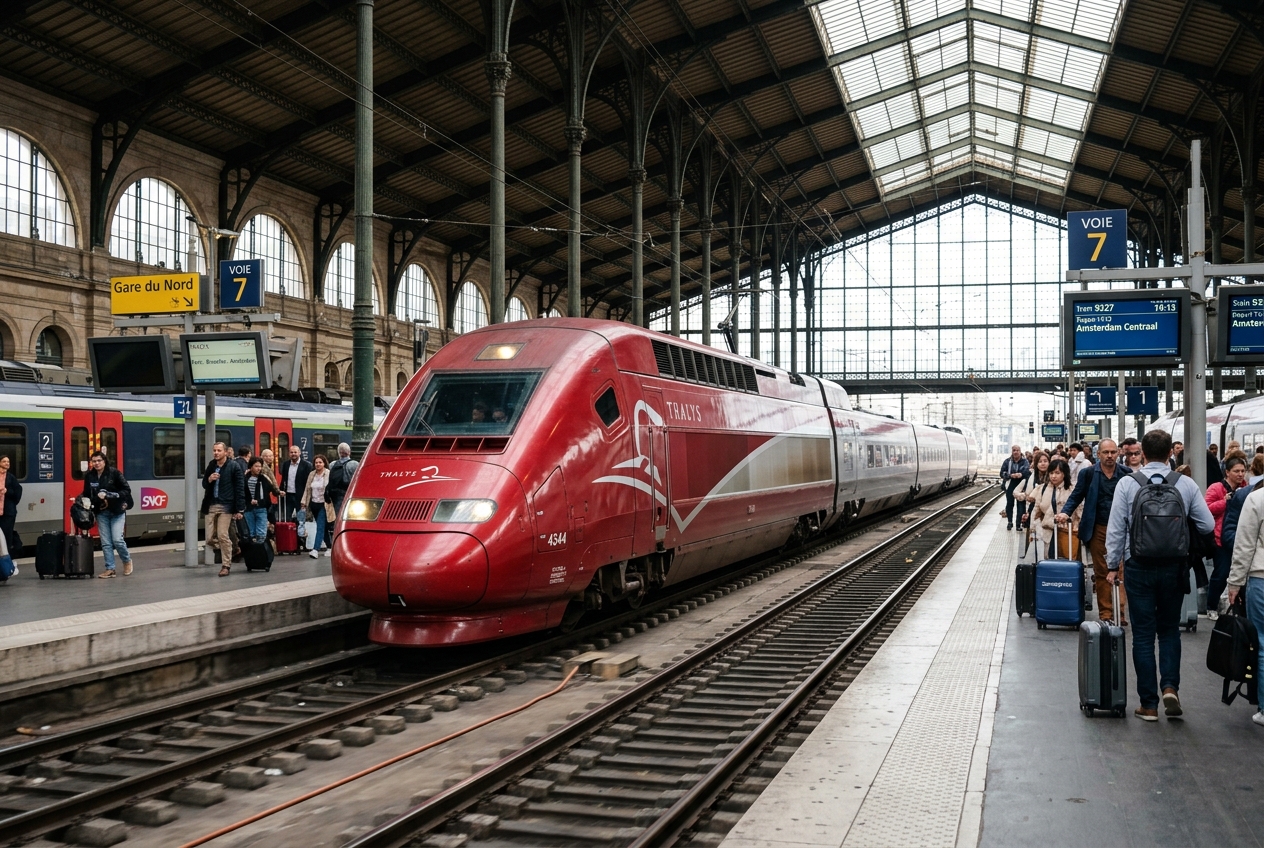
The journey from Paris to Amsterdam by train covers three countries in a little over three hours, and the gap between those two cities, in culture, light, and atmosphere, is wider than any mere kilometre count suggests. You leave a city of broad stone boulevards and arrive at one built on canals, bicycles, and a quietly radical relationship with the sea. The train earns that contrast.
The direct Eurostar runs from Paris Gare du Nord to Amsterdam Centraal in approximately 3 hours 20 minutes, with fares starting around €29 on advance bookings (Eurostar, 2026). This is the same service that ran under the Thalys name for 28 years, rebranded in October 2023, unchanged in everything else. If you’ve seen “Thalys Amsterdam Paris” anywhere in your research, that’s this train.
TL;DR: The Paris to Amsterdam Eurostar takes ~3h 20m direct, with around 10 departures daily from Paris Gare du Nord to Amsterdam Centraal. Standard fares start from €29 booked well ahead; Business Premier from €149. Book at eurostar.com, the booking window opens 180 days before travel, and the cheapest fares go quickly on peak dates. (Eurostar, 2026)
How Long Is the Paris to Amsterdam Train?
The direct Paris to Amsterdam Eurostar takes approximately 3 hours 20 minutes, according to Eurostar’s 2026 published timetables, making it one of the fastest city-centre-to-city-centre rail links in western Europe. The International Transport Forum notes that rail beats air door-to-door on any corridor under four hours; this route sits well inside that threshold.
The train stops at Brussels-Midi (around 80 minutes from Paris) and Rotterdam Centraal (about 45 minutes before Amsterdam). The Brussels stop is meaningful, more on that below, but Rotterdam passes in a few minutes, barely enough time to register the extraordinary canopy of Rotterdam Centraal station before you’re back in motion.
[IMAGE: Eurostar train arriving at Amsterdam Centraal station on a bright morning, search Unsplash: “Amsterdam Centraal Eurostar train”]
| Service | Journey Time | Direct? | Departures Daily |
|---|---|---|---|
| Eurostar (Standard / Premier) | ~3h 20m | Yes | ~10 |
| Train + Brussels stopover | ~4h 30m+ | No (2 tickets) | Flexible |
| Flight (door-to-door) | ~5h 30m | , | Many |
Citation capsule: The Paris–Amsterdam Eurostar covers the 516-kilometre route in approximately 3 hours 20 minutes, operating around 10 daily departures from Paris Gare du Nord to Amsterdam Centraal. Eurostar (formerly Thalys, rebranded October 2023) is the sole direct operator. (Eurostar, 2026)
How Much Does the Paris to Amsterdam Train Cost?
Standard class fares begin at around €29 one-way when booked well in advance, ideally 12 to 20 weeks out, rising to €79 for Standard Premier and €149 for Business Premier (Eurostar, 2026). Walk-up Standard fares can exceed €150, sometimes €180, on busy departure dates. The pricing is dynamic: Friday afternoons and Sunday evenings are consistently the most expensive windows; Tuesday and Wednesday mornings are usually cheapest.
The booking window opens 180 days before departure. For summer travel or the Christmas–New Year period, setting a calendar reminder for that date makes sense, the lowest-tier fares can sell out within weeks of opening on popular dates.
| Class | Advance From | Includes | Refundable? |
|---|---|---|---|
| Standard | ~€29 | Seat, luggage | Varies by fare type |
| Standard Premier | ~€79 | Wider seat, meal at seat | Partly exchangeable |
| Business Premier | ~€149 | Lounge, full meal, fully flexible | Yes |
How to save money on European trains
Which Train Operates This Route, Thalys or Eurostar?
The Thalys brand was retired in October 2023 when it merged into Eurostar, creating a single north-European high-speed operator. The trains themselves, the distinctive red PBA sets capable of 300 km/h, did not change. The track, schedule, and crews are identical to what Thalys operated. What changed is the booking interface and the name on the side of the train.
Why does this matter? Because numerous travel sites, guidebooks, and older forum posts still describe “Thalys” as the operator for this route. If a booking site shows you a result labelled Thalys Paris Amsterdam, that’s a Eurostar service. The ticket is valid. Don’t let the legacy branding confuse you into buying a duplicate ticket or searching on a defunct platform.
The fastest and most direct booking approach is eurostar.com. The Dutch national rail site (nsinternational.com) also covers this route and occasionally offers competitive combined fares for travellers departing from elsewhere in the Netherlands.
Citation capsule: The Paris–Amsterdam Eurostar service was previously operated under the Thalys brand, which merged with Eurostar in October 2023. The rebrand changed only the commercial name, trains, track, schedules, and crews remained identical. Bookings are now made exclusively through eurostar.com or authorised resellers. (Eurostar, 2023)
Paris Gare du Nord: What to Know Before You Board
Gare du Nord is the busiest railway station in Europe, handling over 700,000 passengers daily according to SNCF data. It’s noisy, occasionally disorienting, and entirely workable once you know the layout. The Eurostar departure zone is at the northern end of the station, clearly signed. Check-in opens 60 minutes before departure and closes 30 minutes before, this cut-off is enforced without exception.
Because the service crosses into the Schengen zone and then into the Netherlands, there are French exit border controls and Dutch entry border controls at Gare du Nord before boarding. EU/EEA citizens move through quickly. Non-EU travellers should build in an extra 15 minutes. The overall check-in process, for a straightforward trip, takes 15–25 minutes. Allow at least 45 minutes before departure, and 60 minutes for peace of mind.
The station has left-luggage facilities, a large Relay newsagent, several cafés, and a connection to Metro lines 2, 4, and 5 and RER B directly for CDG airport. If you’re arriving from CDG on RER B and continuing to Amsterdam, Gare du Nord is a clean and logical interchange.
What Does the Journey Look Like?
The Paris to Amsterdam train moves through three distinct field registers, and paying attention to the window is worth it.
Departing Gare du Nord, the train climbs through the northern suburbs of Paris before the city gives way to the chalky flat farmland of Picardy and northern France. This section is fast, the train is on the French LGV Nord, running at up to 300 km/h, and the field is wide and agricultural, the kind of country that rewards a long look rather than a quick glance.
Brussels and the Belgian Countryside
Around 80 minutes in, Brussels-Midi appears. The stop is long enough to be restful rather than rushed. South of Brussels, the Belgian countryside unfolds: gentle farmland, brick villages, the low plateau of Brabant. On a clear morning the light over this field has a quality that painters have been chasing for five centuries. The Dutch Golden Age painters worked 100 kilometres north of here. You can see why they were drawn to this part of the world.
North of Brussels, after Rotterdam Centraal, where the train pauses briefly beside one of the finest new station buildings in Europe, a steel-and-glass canopy completed in 2014, the field becomes unmistakably Dutch. Flat. Wide. Threaded with canals. The sky becomes enormous.
Arrival: Amsterdam Centraal
Amsterdam Centraal is a revelation for first-time visitors. The neo-Gothic facade, built in 1889 and facing the IJ waterway, is one of the most striking station frontages in Europe. Step outside and the city begins immediately: bicycles everywhere, the ferry terminal directly ahead, the old centre visible across the water. There is no airport buffer, no industrial approach. You’re simply, suddenly, in Amsterdam.
[IMAGE: Amsterdam Centraal station exterior with bicycles and trams at dusk, search Unsplash: “Amsterdam Centraal station bikes trams”]
Should You Stop Over in Brussels?
A direct Paris–Amsterdam through-ticket doesn’t allow a break-of-journey in Brussels, Eurostar treats the Brussels stop as transit, not a destination. To stop over, you need two separate bookings: Paris–Brussels (from ~€19 advance) and Brussels–Amsterdam (from ~€19 advance). The combined cost is often close to or sometimes cheaper than a through-fare, and the split gives you a genuinely worthwhile detour.
Brussels itself is underrated. The Grand-Place is one of Europe’s finest public squares. The Art Nouveau architecture (Victor Horta’s buildings in particular) is extraordinary. And Bruges, just 30 minutes away by Belgian IC train at around €15 return, offers canals, medieval brick lanes, and world-class chocolate in a compact and walkable city. Brussels-Midi has large luggage storage facilities if you want to travel light for a half-day excursion.
The practical process: book Paris–Brussels on eurostar.com, book Brussels–Amsterdam separately on the same site or via NS International. Keep the bookings separate; Eurostar doesn’t offer a combined stopover fare.
Booking Strategy: How to Find the Cheapest Fares
The 180-day booking window is Eurostar’s longest lead time, the same as for London–Paris. Opening day matters for peak-season travel. The cheapest Standard fares (€29–€39) are released in finite batches; on popular summer Fridays, they can be gone within days of the window opening.
Book directly at eurostar.com. Third-party sites add booking fees (typically €4–€8 per ticket) and don’t always surface the lowest-tier fares. For multi-leg European itineraries, Trainline or Rail Europe are useful for comparison, but check the final price against the Eurostar direct price before completing the purchase.
Timing your booking:
- Peak summer (July–August): book at the 180-day mark
- Spring and autumn: 8–12 weeks ahead is typically fine
- Tuesday/Wednesday mornings: consistently cheapest departure windows
- Friday afternoons and Sunday evenings: consistently most expensive
If you hold a Eurail pass, note that the Eurostar reservation fee is €35 per journey, more than the cheapest advance Standard fare. For this specific route, point-to-point tickets are almost always cheaper than using a pass reservation. See our full Eurail pass breakdown for the calculation.
Onboard: What to Expect
Standard class on the Eurostar Paris–Amsterdam service is comfortable. Seats are in a 2+2 configuration, similar to a domestic French TGV. Power sockets are at every seat. Wi-Fi is available throughout (signal drops occasionally in rural Belgium). An onboard café bar sells coffee, sandwiches, and snacks at moderate prices.
Standard Premier upgrades the seat to a wider 2+1 layout with a meal served at your seat. Business Premier adds lounge access at Gare du Nord, a full meal with wine, and fully flexible ticketing. For a 3h 20m journey, Standard suits most travellers; the Premier classes make more sense if you’re working on the trip or treating it as part of the experience.
Seat selection tip: window seats on the right side in the direction of travel from Paris offer the better views north of Brussels, where the Dutch polder field opens up. The left side tends to face the motorway on several Belgian sections.
Related Reading
- Amsterdam to Paris by Train: The Reverse Journey, Station Guide, and Tips, The same Eurostar service in reverse, with Amsterdam Centraal arrival tips.
- London to Paris by Train: The Complete Eurostar Guide, 2h 16m under the Channel, from £39. The most famous train journey in Europe.
- Most Scenic Train Routes in Europe, Where Paris–Amsterdam ranks in Europe’s finest rail journeys.
Frequently Asked Questions
How long does the Paris to Amsterdam train take?
The direct Eurostar from Paris Gare du Nord to Amsterdam Centraal takes approximately 3 hours 20 minutes, with around 10 departures running daily. The train calls at Brussels-Midi and Rotterdam Centraal en route. Journey times can vary slightly by service, check eurostar.com for the precise timetable on your travel date. (Eurostar, 2026)
How much does the Paris to Amsterdam train cost?
Advance Standard fares start from around €29 when booked well ahead, ideally 12 to 20 weeks before departure. Standard Premier begins around €79 and Business Premier around €149. Last-minute Standard fares regularly exceed €150. Prices are dynamic: Tuesday and Wednesday mornings are typically cheapest; Friday afternoons and Sunday evenings are the most expensive windows. (Eurostar, 2026)
Is it still called Thalys?
No. The Thalys brand was retired in October 2023 when it merged into Eurostar. The same trains, track, and schedules now operate under the Eurostar name. Many travel sites and guidebooks still use “Thalys Amsterdam Paris” in descriptions, those are all referring to the current Eurostar service. All bookings are made through eurostar.com. (Eurostar, 2023)
Do I need a passport for this journey?
Yes, a valid passport is required for all travellers, regardless of nationality. Non-EU nationals should verify Schengen Area visa requirements. French exit and Dutch entry border controls take place at Paris Gare du Nord before boarding. Allow at least 45 minutes before departure to clear these checks. (Eurostar, 2026)
Can I stop in Brussels on the way?
Not on a single through-ticket. To stop in Brussels, book two separate tickets: Paris–Brussels (from ~€19) and Brussels–Amsterdam (from ~€19). The split typically costs a similar amount to the through-fare and gives you access to a genuinely rewarding city. Brussels-Midi has luggage storage if you want to travel light for a few hours between trains.
The Distance That Disappears
Three hours and twenty minutes between Paris and Amsterdam. For most of human history, that corridor required days. Today it requires an early booking and a window seat.
The journey earns its own pleasures: the Picardy plains at speed, the quality of Belgian light, the moment north of Rotterdam when the field tilts definitively Dutch and the sky doubles in size. Amsterdam Centraal, when it arrives, is one of the finest arrivals in European rail travel, a 19th-century facade facing a working waterway, the city assembling itself around you before the train has even stopped.
Book at 180 days for the best fares. Allow an hour before departure for border control at Gare du Nord. Sit on the right side of the train heading north. That’s the whole strategy.
For the fuller context of European rail travel, read our guide to most scenic train routes in Europe. If you’re continuing south from Paris rather than north, Paris to Barcelona by train covers the TGV/AVE route in full.