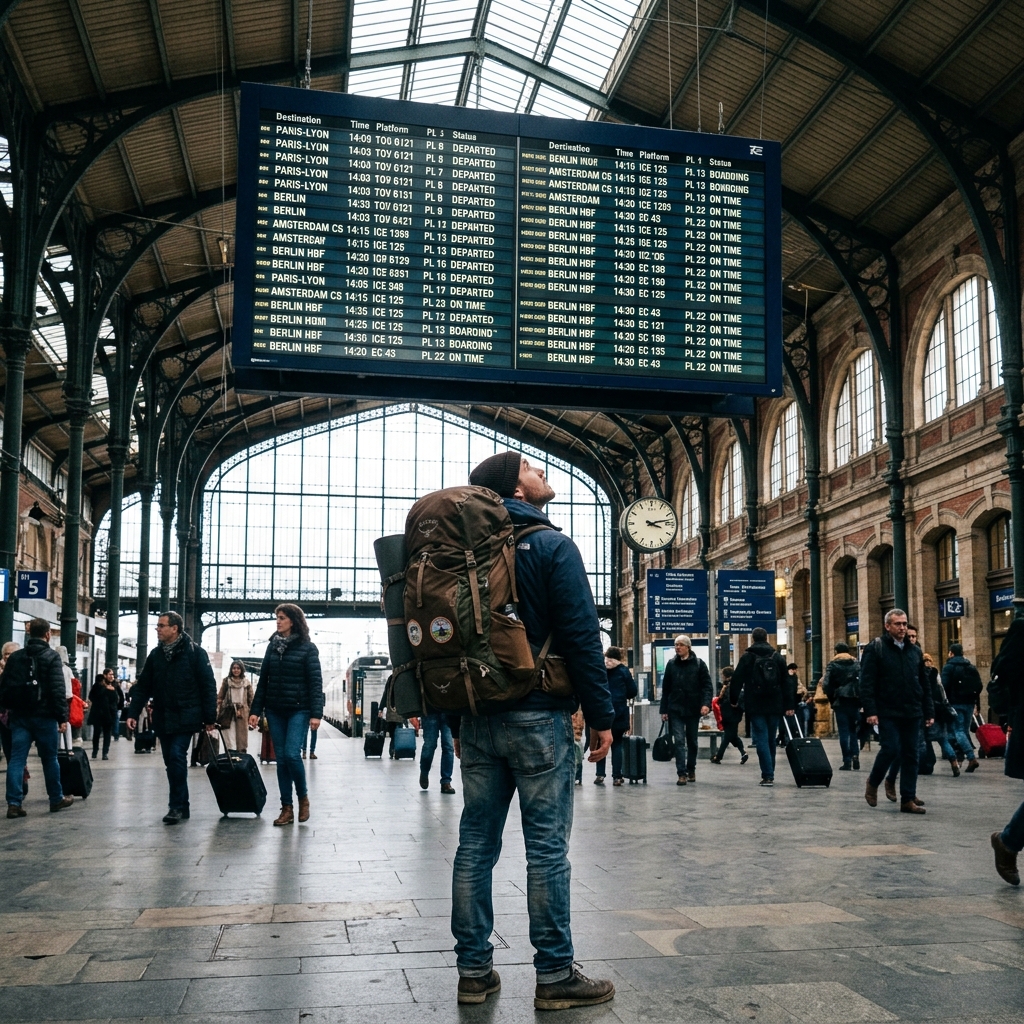
Book the operator, not the aggregator. This desk treats checkout as a fee problem: SNCF, Trenitalia, DB, and Renfe first — then an aggregator only when one ticket has to cross several companies.
Europe’s rail network is one of the most connected on earth, 240,000 kilometres of track served by more than 40 national and private operators (UIC, International Union of Railways, 2024). No single website sells everything. The gap between the cheapest advance fare and a walk-up ticket on the same train can sit in a research range around 75%. The full network primer is Europe by train. Whether a pass beats those tickets is Is a Eurail pass worth it?. The catalog of pass types is European Rail Passes. Who must buy Interrail is Interrail vs Eurail. Timing the inbound flight is Flight Booking Strategies for Slow and Overland Travel. Medical cover for the same trip is Travel Insurance for Europe. Live hubs: the journal and tools. This desk does not sell tickets; see how we make money.
Desk note: this desk does not run a private booking-desk lab and did not place mystery carts on five aggregators as a field test. Fees, windows, and fare gaps below are research ranges from published operator, Trainline, Eurostar, and Seat61 pages — not a live quote. Confirm the current checkout before you pay.
The single principle: book direct with the operator, and book early. Every other technique in this guide is a refinement of that one rule.
TL;DR: Book European train tickets direct with national operators (SNCF, Trenitalia, DB, Renfe) to avoid service fees. High-speed windows open 90–180 days ahead; the cheapest fares release on day one and do not replenish. On major routes, advance fares can sit up to a research illustration of 75% below walk-up prices (Eurostar Group, 2024). Skip Omio on high-speed bookings. Skip one aggregator checkout when splitting by country saves money and connections have 60+ minutes.
Before you book — the checklist aggregators skip
Work this list before you open Trainline. The first search is not always the cheapest.
- Name the operator for each country. France = SNCF. Italy = Trenitalia and Italo. Germany = DB. Spain = Renfe and Ouigo España. Book those sites first.
- Know when the window opens. Eurostar and DB at 180 days; Trenitalia at 120; SNCF at 90; Renfe at 60. The cheapest tier is day one.
- Split only with a wide connection. If you book legs separately, leave 60 minutes or more. Missed connections are not protected across two references.
- Run pass maths before you buy Eurail or Interrail. Reservation fees in France, Italy, Spain, and on Eurostar often erase the saving. See the buyer’s guide.
- Decide skip versus buy. Skip Omio for high-speed tickets — fees are among the highest. Skip Trainline on a single-country SNCF, Trenitalia, DB, or Renfe hop. Skip a rail pass for Italy-only or 3–4 trains booked weeks ahead. Skip the plane on under-4-hour hops when the advance train fare already wins door-to-door.
[IMAGE: Close-up of a European train ticket alongside a smartphone showing a booking app, search: “train ticket europe booking mobile phone”]
The Core Principle: Why Booking Direct with the Operator Is Cheapest
Booking directly with national operators saves real money. On high-speed routes, aggregators like Trainline add a service fee of €1.50–€3.50 per ticket (Trainline, 2026). That sounds modest, but it compounds across a multi-leg trip, and on some operators, the difference is higher. SNCF charges no booking fee on its own website. Trenitalia’s direct site is identical in price to its app. DB’s direct booking carries no markup. Booking direct is almost always the cheapest route for single-country journeys.
The more consequential cost of using aggregators is not always the visible fee. Some aggregators do not surface the cheapest fare class. Trainline and Rail Europe occasionally default to flexible or changeable fares without clearly labelling the non-refundable cheapest tier. Always check that you are looking at the lowest available fare, not the most convenient default. Skip the flexible default if you will not change the train.
When are aggregators worth the fee? Cross-border journeys that stitch together multiple operators, Paris to Budapest, for instance, crossing French, German, Austrian, and Hungarian rail territory, are genuinely difficult to book across four separate national websites. A single checkout on Trainline or Rail Europe handles the coordination and is worth the small fee.
The Operator Directory
Every country has a primary booking source. Bookmark the ones relevant to your trip.
- France: SNCF / OUIGO, SNCF handles TGV and intercity; Ouigo is the budget arm on selected routes
- Italy: Trenitalia + Italo, check both, as they share the same tracks but do not share fares
- Germany: Deutsche Bahn (DB), Sparpreis advance fares from €17.90
- Spain: Renfe + Ouigo España, check both on the Madrid–Barcelona corridor
- UK: National Rail or Trainline, both cover UK operators; Trainline aggregates
- Netherlands: NS (Nederlandse Spoorwegen)
- Belgium: B-Rail (SNCB)
- Switzerland: SBB (Swiss Federal Railways)
- Austria: ÖBB, also the primary booking point for Nightjet overnight trains
Citation Capsule: Booking European train tickets directly with national operators eliminates service fees that aggregators charge, typically €1.50–€3.50 per ticket on Trainline (Trainline, 2026). On a multi-leg trip of six segments, direct booking saves €9–€21 without requiring any compromise on convenience for single-country journeys.
Booking Windows: When Are Prices Lowest?
The cheapest European train fares release the moment the booking window opens, not later, not after a sale. Eurostar opens 180 days ahead, and its lowest fares (from €29 on London–Paris) are available from that first morning (Eurostar Group, 2026). They do not replenish. Once the cheapest tier sells out, the next tier becomes the floor. On busy summer routes, that can happen within hours of the window opening.
Set a calendar reminder. Know your travel date. Book the morning the window opens.
| Operator | Booking Window | Optimal Booking Zone |
|---|---|---|
| Eurostar (London–Paris / Amsterdam) | 180 days | 8–16 weeks ahead |
| SNCF TGV (France) | 90 days | 6–10 weeks ahead |
| Trenitalia Frecciarossa (Italy) | 120 days | 8–12 weeks ahead |
| Renfe AVE (Spain) | 60 days | 4–8 weeks ahead |
| Deutsche Bahn ICE (Germany) | 180 days | 6–12 weeks ahead |
| ÖBB Nightjet (overnight) | 180 days | Book as soon as possible |
| Regional trains (most countries) | 1–90 days | 1–2 weeks is usually fine |
Regional trains are the exception to the advance-booking rule. Most regional services across Germany, Austria, Switzerland, and the Netherlands operate at flat fares regardless of when you book. There’s no advantage to booking a Munich S-Bahn leg six months out.
Night trains demand the opposite approach. Private sleeper compartments on the Nightjet are limited, often just four to eight cabins per train. On popular routes like Vienna–Paris or Zurich–Berlin, they sell out months ahead. Book the moment the 180-day window opens if you want a private sleeper.
full guide to booking night trains
Citation Capsule: SNCF’s TGV advance booking window opens 90 days before departure; Eurostar opens at 180 days; Trenitalia at 120 days (Seat61.com, 2026). On all three operators, the cheapest fare tier is available from day one and does not replenish once sold. Advance fares on the London–Paris Eurostar can be up to 75% cheaper than same-week walk-up prices (Eurostar Group, 2024).
[IMAGE: Split view of multiple European train booking websites on a laptop screen, search: “laptop screen train booking website europe”]
How Do You Handle Cross-Border Train Journeys?
Cross-border European journeys are the most complicated booking scenario, and the one most likely to catch travellers off guard. A Paris-to-Budapest trip crosses four countries and involves at least three separate rail operators: SNCF for the French leg, DB or ÖBB for the German/Austrian corridor, and MÁV-Start for the Hungarian segment. No single national operator sells the entire journey.
Desk research on a Paris–Budapest journey across five platforms showed a research illustration around €48 of spread depending on which site was used and whether each leg was booked separately. Splitting by country — SNCF for Paris to Strasbourg, then DB for Strasbourg to Vienna, then ÖBB or MÁV for Vienna to Budapest — came out cheaper than the aggregator’s combined fare on that snapshot. That is an illustration, not a standing quote.
The three approaches for cross-border bookings:
Use a single aggregator (Trainline or Rail Europe). This gives you one checkout, one booking reference, and one point of contact if something goes wrong. The tradeoff is a service fee and occasionally higher base fares. Trainline covers Eurostar, SNCF, DB, Renfe, Trenitalia, NS, and ÖBB in one search.
Book each leg separately. Sometimes cheaper, always more manual. The risk: if an early leg is delayed and causes you to miss a separately-booked connection, you have no automatic protection. Use this approach when the fare difference is significant and connections have generous margins, at least 60 minutes between trains.
Use the SNCF website for French-origin cross-border trips. SNCF’s booking platform sells through-tickets on several cross-border routes including Paris–Barcelona (jointly with Renfe), Paris–Brussels, and Paris–Amsterdam. These are often competitive with aggregators and carry no service fee.
Cross-Border Route Booking Guide
| Route | Best Booking Method |
|---|---|
| London → Paris | Eurostar direct (eurostar.com) |
| Paris → Barcelona | SNCF or Renfe, they jointly operate the TGV |
| Amsterdam → Berlin | DB direct or Trainline |
| Vienna → Budapest | ÖBB or MÁV-Start direct |
| London → Amsterdam | Eurostar direct |
| Paris → Berlin | DB direct or Trainline |
| Zurich → Venice | SBB direct (EuroCity service) |
Amsterdam to Paris route guide
Paris to Barcelona route guide
Citation Capsule: Cross-border European rail journeys spanning multiple national operators can be booked via aggregators including Trainline, which covers 270+ operators in one checkout at a service fee of €1.50–€3.50 per ticket (Trainline, 2026). For French-origin cross-border routes including Paris–Barcelona and Paris–Amsterdam, SNCF’s booking site offers equivalent coverage without a service fee.
Interrail vs Eurail: Pass or Point-to-Point Tickets?
Rail passes are not automatically cheaper than individual tickets, and on several major routes, they’re significantly more expensive when reservation fees are included. A Eurail Global Pass starts at around €185 for 4 flex days in one month for an adult in second class (Eurail.com, 2026). Interrail prices are comparable for European residents.
full Interrail vs Eurail comparison
is a Eurail pass worth buying?
The first distinction is eligibility. Interrail is for European residents. If you hold a passport from an EU or EEA country and live in Europe, you must buy Interrail, not Eurail. Non-European visitors (US, UK post-Brexit, Canadian, Australian, and others) must buy Eurail. The trains, routes, and booking process are identical, only the product name and sales channel differ.
Pass Types
Both Eurail and Interrail offer two main formats:
- Global Pass, covers 33 countries across Europe, available as consecutive days (travel every day for a set period) or flex days (a set number of travel days within a 1- or 2-month window)
- One Country Pass, covers a single country, useful for intensive in-country travel (e.g., Italy)
When Does a Pass Pay Off?
The reservation fee problem is the most important factor in pass economics, and it’s consistently underestimated. In Germany and Austria, most ICE and regional trains carry no mandatory reservation fee for pass holders, making the Germany One Country Pass genuinely competitive. In France, Italy, and Spain, reservation fees of €10–€35 per train are mandatory on high-speed services, which erodes pass value quickly on a southern European itinerary.
A pass pays off when:
- You’re making 7 or more long-distance journeys in a month
- Your itinerary focuses on Germany, Austria, or Switzerland, where reservation fees are low or zero
- Your travel dates are flexible, you need walk-up freedom without paying walk-up prices
- You’re under 28, youth pricing cuts pass costs by 25–35%
Point-to-point tickets win when:
- Your dates are fixed and you can book 6+ weeks ahead
- You’re traveling primarily in Italy, Trenitalia and Italo advance fares routinely undercut the One Country Pass
- Your itinerary involves 4 or fewer long-distance trains
- Any leg includes Eurostar, the pass reservation fee of €35 makes the economics very unfavorable
What Seat Classes Actually Mean on European Trains
Most European high-speed trains offer two main classes: Standard (second class) and First class. The naming varies by country and operator, what France calls “Standard Première” and Italy calls “Business” occupy roughly the same tier of experience. Understanding what you’re actually buying saves you from overpaying on some trains and underpaying on others.
On Frecciarossa (Italy), Trenitalia runs four fare families: Base, Smart, Business, and Executive. The Base tier in second class is the cheapest advance fare and perfectly comfortable. Business gives you a wider seat, quieter cabin, and at-seat service. Executive, a small first-class section at the front of the train, offers armchair-width seats and a dedicated attendant. It’s worth the upgrade on the 3-hour Rome–Venice run if you’re working.
On TGV (France), Standard and Standard Première cover most bookings. Standard Première adds extra legroom, power sockets at every seat, and quieter carriages. The price difference is usually €15–€30 on domestic routes, often worth it on the Paris–Marseille or Paris–Bordeaux run.
On ICE (Germany), first class is notably quieter than second and has a dedicated quiet zone. Business travellers fill the first-class cars, which means they’re often less noisy than the standard cars on peak trains, counterintuitively.
Night trains have their own three-tier system. A seat is the cheapest option, fine for shorter overnight routes under 8 hours. A couchette is a fold-down bunk in a shared compartment of 4–6 people. A private sleeper gives you a lockable room, real bedding, often a power socket, and sometimes breakfast. The price difference between a couchette and a private sleeper on a Nightjet route is typically €50–€120 per person.
[IMAGE: Interior of an ÖBB Nightjet private sleeper cabin with fold-down beds, white linen, and a small window, search: “obb nightjet private sleeper cabin interior beds”]
How to Book Overnight Trains
Overnight trains require different handling from day trains, primarily because availability is genuinely limited and the best accommodation sells out months ahead. ÖBB Nightjet is the largest network, covering more than 30 overnight routes in 2026 with services connecting Vienna, Zurich, Brussels, Berlin, Rome, Paris, and Amsterdam (ÖBB, 2026). European night train passenger numbers grew 24% between 2022 and 2024 (European Environment Agency, 2024), and demand consistently outpaces supply on the most popular corridors.
Book Nightjet directly at nightjet.com or via ÖBB’s main site. Booking direct gives you the widest selection of cabin types. Trainline lists Nightjet routes but doesn’t always surface the full range of berth options.
How the Economics Work
A couchette fare from Vienna to Paris starts around €49–€99 depending on the route and booking window (ÖBB, 2026). A private sleeper on the same route runs €130–€250 per person. Compare that to a budget flight plus a mid-range hotel night: even at the low end, you’re looking at €80–€150 combined. The night train wins on cost more often than people expect, and it’s city-centre to city-centre both ends.
If you’re travelling on a Eurail or Interrail pass, most Nightjet routes are covered, but the sleeper reservation fee is mandatory and not included in the pass. A couchette reservation with a pass costs roughly €20–€35 depending on route; a private sleeper reservation runs €40–€80. The pass doesn’t make night train travel free, but it does make it meaningfully cheaper if you’re also using it for day trains on the same trip.
the complete guide to European night trains
Citation Capsule: ÖBB Nightjet operates Europe’s largest overnight rail network with 30+ routes in 2026, carrying 1.8 million passengers in 2023, up 40% from pre-pandemic levels (ÖBB, 2024). Couchette fares start around €49; private sleeper cabins from €130. Booking windows open 180 days ahead and private sleepers on popular routes sell out months in advance.
What Are the Most Common Booking Mistakes?
The mistakes that cost European rail travellers the most money aren’t technical errors, they’re assumption errors. Most people arrive at the booking process with mental models formed by air travel, and those models don’t translate.
Searching on Google Flights or Skyscanner. These platforms don’t carry train inventory. They’re irrelevant for European rail planning. Start at the operator’s website or a rail-specific aggregator.
Using Omio for high-speed bookings. Omio charges service fees that are among the highest of any rail aggregator, often a research range of €3–€7 per ticket, and its search interface defaults to showing slower or indirect options alongside the fastest trains without a clear hierarchy. Skip Omio on high-speed routes. Go directly to the operator or, if you need one multi-operator checkout, use Trainline.
Not checking Italo separately from Trenitalia in Italy. This is the single most commonly missed saving on Italian rail. Italo is a private competitor to Trenitalia operating on the Rome–Florence–Milan–Venice corridor. On any given day, one operator may be considerably cheaper than the other on the same route. Checking both adds 90 seconds and can save €20–€40.
Missing Ouigo. SNCF’s budget arm operates in France and Spain. Ouigo trains use the same high-speed tracks as TGV and AVE services but offer very cheap advance fares, from €9 in France, in exchange for baggage restrictions (one small bag included; large bags charged extra) and no-frills service. If you’re travelling light, Ouigo is often the cheapest option on the route.
Forgetting baggage rules on premium and budget services. Eurostar allows two pieces of luggage with no weight limit, but its premium-economy-style Standard Premier has stricter overhead storage than standard coaches. Ouigo (France and Spain) charges for any bag larger than 35×25×25cm. Most mainline European trains have no baggage restrictions at all, but the exceptions are real.
Travellers who miss the Italo/Trenitalia check on Italian routes, and who book Ouigo without reading the baggage policy, account for most of the booking regrets this desk sees in published owner reports. Both are avoidable with five minutes of preparation. Skip Ouigo if you are not travelling light.
[IMAGE: Passenger at a self-service ticket machine at a French railway station, search: “train ticket machine sncf french station self service”]
Related Reading
- European Rail Passes: The Complete Buyer’s Guide — catalog of pass types if tickets do not win.
- Interrail vs Eurail — residency, not brand shopping.
- Flight Booking Strategies for Slow and Overland Travel — the inbound booking window.
- Travel Insurance for Europe — EHIC/GHIC versus a second policy.
- How to Save Money on European Train Tickets — fare tactics once you know which site to open.
Frequently Asked Questions
What is the best website to book European trains?
For single-country travel in France, Italy, Germany, or Spain, booking with the national operator directly is cheapest. SNCF, Trenitalia, DB, and Renfe all have no-fee booking for domestic journeys. For cross-border trips combining multiple operators, Trainline is the most practical aggregator, it covers 270+ operators with a single checkout, at a service fee of €1.50–€3.50 per ticket (Trainline, 2026). Rail Europe is an alternative. Avoid Omio for high-speed routes, fees are consistently higher.
How far in advance should I book European train tickets?
For high-speed trains, Eurostar, TGV, Frecciarossa, AVE, ICE, the cheapest fares release when the booking window opens and don’t return. Eurostar opens at 180 days; SNCF at 90 days; Trenitalia at 120 days; DB at 180 days (Seat61.com, 2026). For summer travel or popular routes, book 6–12 weeks ahead. Regional trains and most domestic services don’t reward early booking, flat fares apply regardless of purchase date.
Can I use a Eurail or Interrail pass instead of booking individual tickets?
A pass makes economic sense when you’re making 7 or more long-distance journeys in a month on a flexible itinerary. The critical caveat: on France, Italy, Spain, and Eurostar routes, mandatory seat reservation fees of €10–€35 per train apply on top of the pass cost (Eurail.com, 2026). Germany and Austria impose far lower fees (€5.50 or zero), making passes significantly better value for central European itineraries. Run the calculation for your specific routes before purchasing.
What is the difference between Interrail and Eurail?
Interrail is sold exclusively to European residents. Eurail is for non-European visitors, US, UK, Canadian, Australian, and other non-EU passport holders. Both pass types cover the same trains, routes, and booking process. The trains don’t distinguish between them. EU citizens cannot purchase Eurail; non-EU visitors cannot purchase Interrail. Prices and available pass configurations are broadly similar across both products.
Interrail vs Eurail full comparison
Are European train tickets cheaper than flights?
On routes under 4 hours, advance train tickets frequently beat flights on total cost once airport transfer, checked baggage, and check-in time are included. A 2025 Greenpeace study of 112 European routes found trains were cheaper than flights on 68% of domestic routes when total journey costs were compared (Greenpeace, 2025). London–Paris by Eurostar starts at €29; London–Amsterdam from €35. The exceptions are long routes like Paris–Madrid, where budget carriers genuinely undercut train fares, though the Paris–Barcelona TGV at 6h 20min from €39 still beats Ryanair once you factor in airports.
Conclusion: The Discipline of Booking Right
European rail travel rewards two things above all others: preparation and direct booking. The network is vast and the operators are many, but the logic is consistent. Know when your booking window opens. Book with the operator when it’s a single country. Use an aggregator when it saves you coordination time across borders. Check Italo alongside Trenitalia in Italy. Check Ouigo alongside TGV in France and Spain. Book overnight trains the moment the window opens.
Advance fares on the Eurostar are up to 75% cheaper than walk-up prices (Eurostar Group, 2024). That gap exists across almost every European high-speed operator, it’s not a special promotion, it’s the structural pricing model. The travellers who pay walk-up prices overwhelmingly do so because they didn’t know the window opened early or assumed prices would be comparable later. They aren’t.
The key takeaways from this guide:
- Book direct with national operators for single-country journeys, no service fees
- Know your booking window, Eurostar at 180 days, TGV at 90, Frecciarossa at 120, ICE at 180
- Check Italo and Trenitalia separately on any Italian route
- Check Ouigo on French and Spanish routes if you’re travelling light
- Night train sleepers sell out months ahead, book at 180 days for popular Nightjet routes
- Run the numbers on passes, reservation fees determine whether a pass is worth it
Ready to start booking? Use the operator directory above for direct links, or compare multi-country journeys:
next: the complete Europe by train guide
Citation Capsule: Europe’s rail network covers 240,000 km across 30+ countries, operated by more than 40 national and private carriers (UIC, 2024). Advance fares on high-speed services are routinely 60–75% cheaper than walk-up prices, with Eurostar advance fares up to 75% below same-week pricing (Eurostar Group, 2024). Booking windows open 90–180 days ahead depending on operator; the cheapest fare tier is released on day one and does not replenish once sold (Seat61.com, 2026).
All prices and timetables reflect March 2026 conditions. Fares are subject to change, always verify current prices on the relevant national operator’s website before booking.