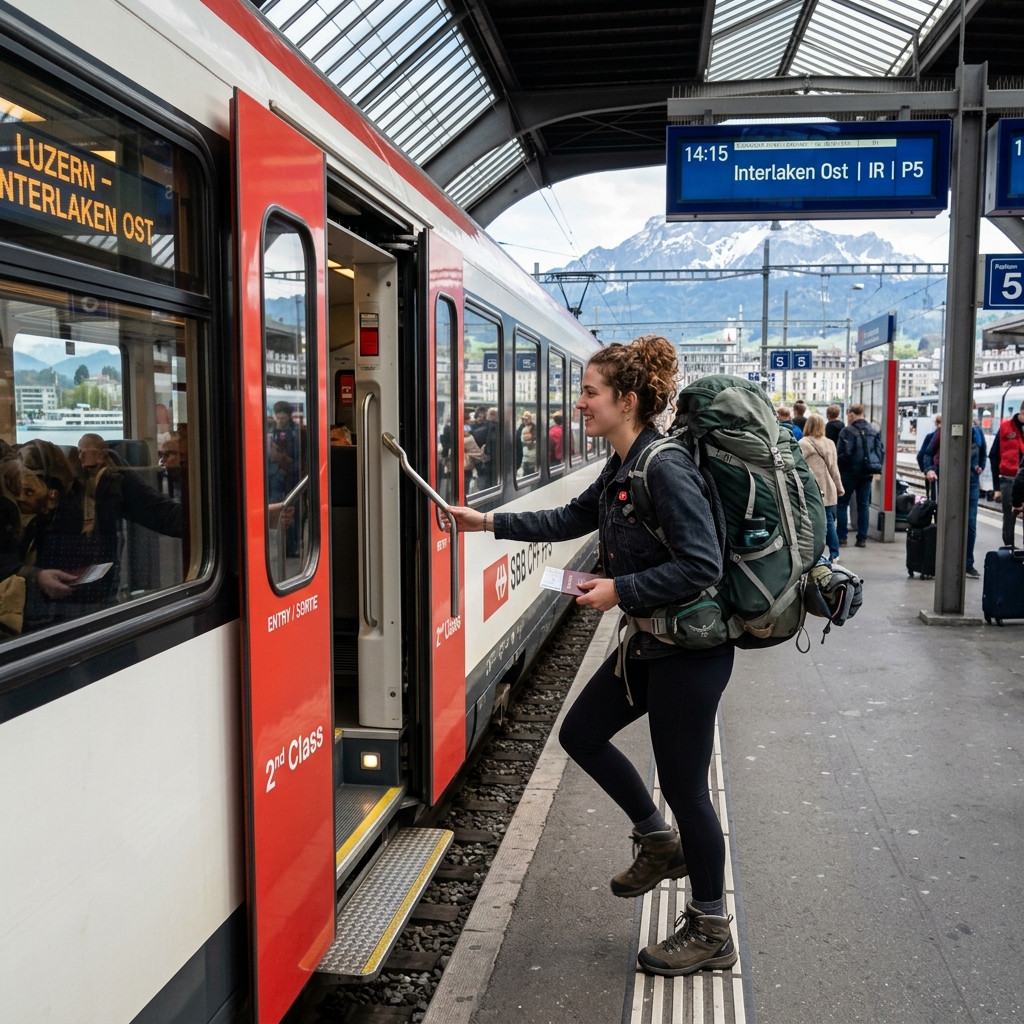
There is a particular kind of freedom that only becomes available when you travel alone. Nobody else’s schedule to accommodate. No votes about where to eat. No compromise destinations. You go where you want, at the pace you choose, and you change your mind whenever the mood shifts. Europe’s train network happens to be the ideal infrastructure for exactly that kind of travel, and not by coincidence. It was built for individuals moving between cities, not car-loads of families on fixed itineraries.
Roughly 70% of solo travellers say they prefer train travel over flying for European trips under six hours (European Travel Commission, 2024). That preference reflects something real: trains leave from city centres, allow you to change routes without penalty on open tickets, and put you in contact with other travellers in a way that planes, sealed, divided, hostile to conversation, simply don’t.
This guide covers everything you need to travel Europe solo by train, confidently and well.
broader guide to planning a European rail trip
TL;DR: Solo train travel in Europe is safe, flexible, and genuinely enjoyable. European trains are among the safest transport in the world, the EU rail fatality rate is roughly 0.1 deaths per billion passenger kilometres (European Union Agency for Railways, 2024). A Eurail or Interrail pass gives solo travellers the flexibility to change plans without losing money on fixed tickets. Night trains double as accommodation.
Why Are Trains the Best Way to Travel Europe Solo?
Solo travellers are the one group that benefits most from train flexibility. A 2023 survey found that 62% of solo European travellers changed their itinerary at least once mid-trip (Solo Travel Society, 2023). Trains accommodate that. You miss a departure, you catch the next one. You decide to stay an extra day in Bruges, you rebook the leg to Amsterdam for tomorrow without a cancellation fee on open tickets or a pass.
Flying punishes indecision. A changed flight costs money, requires transfers to outlying airports, and adds two hours of airport process at each end. A train ticket on many European routes costs the same whether you board or not, or, with a rail pass, costs nothing additional at all.
The deeper reason, though, is experiential. Trains travel through the field rather than above it. The Rhône valley between Lyon and Avignon, the Rhine gorge between Koblenz and Mainz, the coast between Genoa and Cinque Terre, these are journeys that constitute their own reward. They are not transit. They are the thing.
the philosophy of train travel and why the journey matters
And there is the social dimension. Solo travellers, almost by definition, are more open to chance encounters than those travelling in groups. Trains create them. The person in the next seat reading the same novel. The retiree in the dining car who knows every junction on the Paris–Basel corridor. The other solo traveller working out the same booking puzzle you are, at the same table, on the overnight to Rome.
An honest observation: The best conversations of any European trip tend to happen on trains, not in tourist attractions. This is not romanticisation, it’s structural. You’re seated together for two hours. You have no obligations. The scenery is passing. That combination produces talk of a kind that doesn’t happen elsewhere.
Is Solo Train Travel in Europe Safe?
European trains are among the safest forms of transport on earth. The EU railway network recorded a fatality rate of roughly 0.1 deaths per billion passenger kilometres in 2023, compared to 5.6 for cars and 0.3 for aviation (European Union Agency for Railways, 2024). The trains themselves are not the safety question.
The relevant safety considerations for solo travellers are more modest: petty theft at major stations, and personal security on overnight trains. Neither warrants anxiety. Both warrant straightforward awareness.
[IMAGE: A busy European train station concourse with natural light, search terms: european train station travellers platform interior]
What to Watch for at Major Stations
Pickpocketing concentrates at a handful of major hubs. Rome Termini is the most frequently cited, it handles 480,000 passengers daily and has an active pickpocket presence, particularly around the regional train platforms and the underground connection. Barcelona Sants, Paris Gare du Nord, and Marseille Saint-Charles share a similar profile. The pattern is consistent: distraction, crowd, and the moment your attention moves from your bag.
The counter-measures are unglamorous but effective. A crossbody bag worn in front. Valuables in a front trouser pocket, not a back one. Luggage kept between your feet while waiting, not set behind you. Phone stowed when you’re reading departure boards. None of this is paranoia. It’s the same attention you’d apply in any busy transport hub anywhere in the world.
High-speed trains and intercity services are essentially free of this problem. The theft risk exists at the stations, not on the trains.
Night Train Safety for Solo Travellers
Couchette compartments on ÖBB Nightjet and other European sleepers lock from the inside with a sliding bolt. The door cannot be opened from the corridor without forcing it, which would be audible throughout the carriage. Solo travellers in couchettes regularly cite this as more secure than a budget hotel room with a flimsy lock.
Private sleeper compartments have individual electronic locks tied to your booking reference. No one else can enter. For solo travellers willing to pay the supplement, a private sleeper on a route like Vienna to Rome is a perfectly secure night’s sleep moving through the Alps.
The standard advice: keep your passport accessible (border checks do happen on some routes), put valuables in a small bag that goes under your pillow, and use the loop on your rucksack zip to attach it to a fixed point overhead. Nothing dramatic. None of it will ruin your journey.
night trains in Europe: the complete guide
Planning vs. Spontaneity: What’s the Right Balance for a Solo Rail Trip?
Solo train travel occupies a sweet spot that group travel can’t reach. You need enough structure to have somewhere to sleep each night. You need enough flexibility to not feel trapped by a rigid schedule. Those two requirements point toward a specific planning approach: book accommodation in advance, leave the trains flexible.
Here is why that works. European train fares operate on a yield-pricing model, the earlier you book, the cheaper the seat. But for a solo traveller who values flexibility, the right answer is often not to chase the cheapest advance fare. It’s to hold a rail pass and book trains as you go, paying small reservation fees on high-speed services but never a cancellation penalty.
The accommodation logic runs the opposite way. Good hostels, guesthouses, and apartments in popular cities, Paris, Florence, Amsterdam, Prague, fill up meaningfully in advance, especially in summer. A solo traveller who has locked in three nights at a well-located hostel in each city has the social infrastructure of the trip handled. Everything between those fixed points can be decided on the train.
how to build a slow travel itinerary with flexibility built
The practical version of this principle:
- Book accommodation at least 2–3 weeks ahead for summer travel (June–August)
- Leave all train legs flexible unless you have a specific timed connection (e.g. the Glacier Express, which requires advance booking)
- Use open-date tickets or a Eurail/Interrail pass for day trains
- Book night trains 6–8 weeks ahead in summer, couchette inventory sells out on popular corridors
Pass or Point-to-Point? The Solo Traveller’s Honest Guide
This question doesn’t have a universal answer, and guides that pretend it does are usually trying to sell you something. Here is the genuine calculation for solo travellers specifically.
full Eurail vs Interrail breakdown
A rail pass favours solo travellers who are:
- Crossing 3 or more countries in 2+ weeks
- Uncertain about their exact route, or deliberately leaving it open
- Planning to take several night trains (pass reservation fees are far lower than full-price sleeper fares)
- Travelling in Eastern Europe, Germany, Austria, or Switzerland, where reservation fees for passholders are minimal
A 7-day adult Global Eurail flex pass costs approximately €212 / $231 in 2026 (Eurail.com, 2026). If you’re taking five or more long-distance trains on that trip, the pass typically breaks even or wins on cost. Add two overnight couchettes at passholder reservation rates (€8–€14 each versus €59–€99 full price), and the savings become significant.
Point-to-point tickets win when you:
- Have a fixed itinerary and book 4–8 weeks in advance
- Are visiting 1–2 countries only
- Are primarily in Italy or Spain, where advance train fares are very competitive
- Can commit to specific dates for all major journeys
The solo-specific consideration is this: a pass gives you the confidence to change your mind. That has a value that doesn’t appear in a spreadsheet comparison. If you’re the kind of traveller who follows a recommendation from someone on a platform bench and ends up in a town you’d never planned to visit, which is, in our experience, one of the best things that can happen on a solo trip, a pass is the right tool.
[CHART: Grouped bar chart, “Pass vs Point-to-Point Cost Comparison: 10-day Europe Trip”, 5 trains booked 6 weeks ahead: €240 / 7-day flex pass + reservation fees: €255 / 5 trains booked last-minute: €420 / 7-day flex pass + reservations last-minute: €255, Source: Eurail.com + Trainline average fares, 2026]
What Are the Best Solo Train Routes in Europe?
There is no single best route. There are three kinds of solo trip, and the right route depends on which kind you’re planning.
[IMAGE: Map of Europe with three classic rail routes drawn as arcs across the continent, search terms: europe rail map train journey routes]
the most scenic train routes in Europe
The Classic Interrail Loop: Six Cities, Three Weeks
London → Paris → Amsterdam → Berlin → Prague → Vienna → Venice → Rome
This is the foundational solo train circuit. It has remained popular for 50 years because it works: each city is distinct, each train leg is manageable, and the route follows a logical arc that ends in Italy, which is the right place to end a European trip.
Total distance: approximately 4,800 km. Total train time: roughly 40 hours across 7 legs. Realistic duration: 3 weeks, spending 2–3 nights per city (4–5 if you’re travelling slowly). A Eurail Global Pass covers all of it. The Eurostar from London to Paris requires a passholder reservation (€35), but every other leg is low-fee or reservation-free.
The solo advantage on this route is that each city has excellent hostel infrastructure for travellers who want a social base. Prague and Berlin especially have hostel common rooms and organised events that give solo travellers an easy route into conversation without any awkwardness.
The Scenic Route: Alpine and Mediterranean
Zürich → Glacier Express → Zermatt → Geneva → Nice → Monaco → Florence
This route prioritises scenery over pace. The Glacier Express from Chur to Zermatt (3 hours 38 minutes on the express) is the most cinematically spectacular train journey in Europe, it crosses 291 bridges and 91 viaducts through the Swiss Alps (Rhaetian Railway, 2026). It requires advance booking as a tourist train.
From Geneva westward, the route shifts into the French Riviera. Nice and Monaco are easy half-day rail trips from each other. Then north through Italy, the coastal line from Ventimiglia to Genoa is one of the most unexpectedly beautiful train rides on the continent, skirting cliffs above the Ligurian Sea.
This is not the cheapest route. Switzerland is expensive and the scenic trains carry supplements. But for a solo traveller who has the budget, it offers a sustained quality of field that the classic loop doesn’t match.
Glacier Express: the complete guide
The Eastern Option: Vienna to Istanbul
Vienna → Budapest → Belgrade → Sofia → Istanbul
This is the adventurous route. It’s less trodden than western Europe, significantly cheaper, and rich with the kind of friction that makes solo travel interesting: crowded international trains, border crossings with actual passport checks, dining cars serving grilled meats at remarkable prices, fellow passengers who are curious about where you’re going.
Budapest is straightforward and well-connected. Belgrade is genuinely fascinating and almost entirely free of mass tourism. Sofia is one of Europe’s most underrated capitals. The Istanbul leg, currently the night train from Sofia, is about 10–11 hours and involves crossing the Bulgarian-Turkish border in the dark.
This route requires more planning and slightly more patience than the western loop. It repays both.
Cost comparison: A solo traveller doing the full Vienna–Istanbul route by point-to-point tickets, booked in advance, can complete the journey for approximately €80–€120 in total train fares. The equivalent western European circuit (London–Rome) typically costs €300–€500 in advance fares without a pass. Eastern Europe remains genuinely affordable by train.
budapest by train: a complete guide
Night Trains for Solo Travellers: Couchette or Sleeper?
Night trains are the solo traveller’s most useful tool. They convert dead time into transport and accommodation simultaneously, a couchette from Vienna to Paris at €79 replaces both a hotel night and a short-haul flight. They also happen to be the most social environment on the train network, if you want that.
night trains in Europe: costs, routes and how to book
The Couchette: Cheapest and Most Social
A couchette is a fold-down bunk in a shared 4- or 6-berth compartment. Bedding is provided. The door locks from the inside. Berths run €49–€99 depending on route and booking timing.
What actually happens in a couchette: You board, introduce yourself minimally or not at all, fold down the berth, and sleep. At some point someone snores. Someone else checks their phone at 3am. The compartment door rattles every time the train takes a curve. You sleep anyway, trains are excellent for this. In the morning someone offers around a biscuit from a packet they were eating the night before, and you get a conversation with a stranger who is also heading somewhere, for reasons of their own. It’s one of the genuinely good experiences of European travel.
Six-berth couchettes are cheaper than four-berth. If you’re on a budget, go for six, you’ll probably sleep at similar depth in either. If you want a bit more space, the four-berth is worth the small premium.
The Private Sleeper: Quiet and Comfortable
A private sleeper (called “Deluxe Sleeper” or “mini cabin” on ÖBB Nightjet) is a 1–2 person compartment with a proper bed, storage, power outlets, and sometimes a private washbasin. Prices run €120–€250 depending on route. On the Vienna–Rome corridor, ÖBB offers an en-suite option with a private shower.
For solo travellers who genuinely need to sleep well, before a business meeting, before a demanding hiking day, before anything that requires being functional, the private sleeper is worth the extra cost. It’s quieter, it’s completely private, and it eliminates the small-but-real lottery of who you share a couchette with.
Solo travellers can book a double sleeper for themselves by paying a single-occupancy supplement, typically €30–€60 above the per-person rate. On routes where sleeper inventory is available, it’s worth checking whether the supplement is affordable, some routes offer it at relatively low additional cost.
How Do You Meet People When You’re Travelling Solo by Train?
Loneliness is the concern people raise most often about solo travel, and it’s worth addressing honestly. Europe by train is one of the least lonely ways to travel solo, for structural reasons, not just reassurance.
The dining car is underused and excellent for solo travellers. On long-distance trains with a bistro or restaurant car, particularly German ICE services, Austrian night trains, and Swiss intercity services, sitting at a table with a coffee or a beer puts you in contact with other travellers who are also sitting at tables alone. This is not awkward. It’s the natural state of the dining car. Conversations start easily here precisely because the social contract is loose, you’re not committed to anything, and neither is anyone else.
Hostels remain the best social infrastructure for solo travellers, regardless of age. The assumption that hostels are for students in their twenties has been wrong for at least a decade. A 2024 survey found that 38% of hostel guests were over 30, with significant growth in the 35–50 bracket (HostelWorld, 2024). Common rooms, organised dinners, and walking tours create immediate social context without any pressure.
Train platforms are underrated. When you’re standing on a platform at Prague Hlavní nádraží with a backpack, waiting for a train to Vienna, you are visibly a solo traveller, and so is the person two metres to your left. The percentage of people who will make eye contact and say something is higher than anywhere in the city. Stations are transitional spaces; people are open in them.
how to use hostels as a solo adult traveller in Europe
The Solo Traveller’s Mindset: Being Alone Is Not the Same as Being Lonely
Let’s settle this directly, because travel writing tends to be embarrassed about it. Travelling alone is one of the most genuinely pleasurable experiences available. Not in spite of the solitude but partly because of it.
On a train with no one to talk to, you read without interruption. You look out the window for twenty minutes without justifying it. You think about where you are and how you got there. You notice the quality of the afternoon light on the hills outside Bologna in a way that wouldn’t be possible if you were tracking a conversation. You have the entire relationship with the journey to yourself.
Alain de Botton, in The Art of Travel, makes the observation that we rarely think about how we travel, only about where. Solo train travel forces the how. You’re present with the journey in a way that group travel rarely permits, because there’s nothing else competing for your attention.
This doesn’t mean you travel alone for the whole trip. Most solo travellers spend portions of their journey with people they’ve met, at a hostel, in a couchette, at a dining car table. The solitude and the sociability alternate naturally, on your schedule. That combination, connection without obligation, is something that only solo travel delivers.
what is slow travel: the philosophy and practice
Practical Tips for Solo Rail Travel in Europe
Technology That Actually Helps
Download maps.me or Google Maps offline for every city you’re visiting before you board. European station Wi-Fi is inconsistent; offline maps are not. The Eurail Rail Planner app (which works for Interrail and Eurail pass holders) stores your pass digitally and lets you add journeys to a trip plan offline.
Google Translate with the camera function allows real-time translation of foreign-language train departure boards and ticket machines. This matters more in Eastern Europe, where English signage is less reliable.
Trainline and Rail Europe are useful for checking timetables and booking point-to-point tickets across multiple countries from a single platform. Direct national operator sites (DB for Germany, Trenitalia for Italy, SNCF for France) always have the full inventory and sometimes have exclusive fares not available on aggregators.
What to Do If You Miss a Connection
Missing a connection is less catastrophic than it feels in the moment. On most European operators, if you hold a reservation on a specific train and the preceding train is delayed, you have the right to travel on the next available service without additional cost. Keep your boarding documents, the delay is logged in the system.
If you’ve booked separate tickets (not a through-ticket), you’re technically rebooking at your own cost. This is the argument for booking through-tickets or using a rail pass wherever you have flexibility: a pass has no missed-connection penalty because you never paid per-train in the first place.
At major interchanges, Frankfurt Hauptbahnhof, Zürich HB, Paris Gare de Lyon, the connection times printed in timetables are realistic, usually 10–20 minutes. At smaller stations, connections can be tighter. When booking, apply the 15-minute minimum rule: if the scheduled connection time is under 15 minutes, build in one train’s buffer.
Travel Insurance for Solo Trips
Solo travellers need travel insurance more than group travellers, for a simple reason: there’s no one to cover you. Illness, injury, a cancelled or missed flight, a stolen bag, all of these require you to handle them alone if you’re uninsured.
Look for a policy that covers trip interruption (not just cancellation), medical evacuation, and baggage loss. For train-specific trips, check that missed connections and delays triggering hotel costs are covered, not all policies include this. Annual multi-trip policies start from around €60–€100 per year for European coverage (comparethemarket.com, 2026) and are worth buying if you travel more than once a year.
how to build a train-friendly packing list for Europe
Related Reading
- Solo Female Train Travel in Europe: A Practical Safety Guide, The honest guide to solo female train travel in Europe, safety realities, booking strategies, night train tips, and…
- Germany by Train: The ICE Network, the Deutschland-Ticket, and How to See the Country by Rail, Germany’s rail network is one of Europe’s largest, and one of its most discussed, debated, and occasionally delayed.
- How to Book European Train Tickets: The Complete Practical Guide, Booking European trains is not complicated, but it is not obvious either.
Frequently Asked Questions
Is solo train travel in Europe safe for women?
European trains are safe for solo women travellers. The EU rail fatality rate is 0.1 per billion passenger kilometres (European Union Agency for Railways, 2024), statistically safer than almost any other transport. Night train couchette compartments lock from the inside. Most solo women travellers on overnight trains prefer a lower berth for practical reasons (easier access, heavier bags), request one when booking, as they’re sometimes assignable. The stations with the highest petty crime are Rome Termini, Paris Gare du Nord, and Barcelona Sants: apply standard bag-awareness in those specific locations.
Do I need to speak other languages to travel solo by train in Europe?
No. English is widely spoken at ticket windows and information desks at major stations across Western Europe. Booking confirmations, arrival/departure boards, and Eurail app interfaces all have English versions. In Eastern Europe, Serbia, Bulgaria, Romania, North Macedonia, English is less consistent at smaller stations, which is where Google Translate’s camera function earns its keep. Learning to read the local alphabet (Cyrillic is not as difficult as it looks) genuinely helps in Bulgaria and Serbia.
What’s the cheapest way to do a solo Interrail / Eurail trip?
Buy a youth flex pass (under 28) if you qualify, the age-based discount saves roughly 20% off the adult price (Interrail.eu, 2026). Book night trains 6–8 weeks in advance to secure the cheapest couchette berths; couchettes function as accommodation, so their cost replaces a hotel night. Focus your route on Eastern Europe and Germany/Austria/Switzerland, where passholder reservation fees are lowest. Travel mid-week (Tuesday–Thursday) and outside school holiday periods.
is a Eurail pass worth it, the full cost breakdown
How many travel days do I actually need on a flex pass?
Less than you think. Most solo travellers overestimate this. A three-week Interrail loop through 5–6 countries typically requires 7–9 actual long-distance train journeys. A 7-day flex pass covers that with some breathing room. Regional and local trains within a city area are often covered by the pass without using a travel day (check the operator). Count your planned long-distance journeys, then add one day as buffer, don’t buy the 10-day pass just for reassurance.
Interrail vs Eurail: which should you buy?
Should I book a hostel or a hotel as a solo traveller?
Both work. Hostels offer social infrastructure, common rooms, organised events, other solo travellers, that hotels don’t. For the first two or three nights of a solo trip, a hostel is usually the better choice even if you can afford a hotel: it’s the easiest way to meet people quickly. After a few days when you have your bearings and have made connections, switching to a private room (either in a hostel or a budget hotel) gives you the privacy to decompress. Many experienced solo travellers alternate between the two throughout a trip.
Solo train travel across Europe is not a compromise. It’s not a budget option or a second choice for people who can’t afford flights. It’s one of the most satisfying ways to move through the world, self-directed, unhurried, and structured around the conviction that the journey between places has as much value as the places themselves.
The network has never been better. Night trains are back. The passes are flexible. The routes range from the comfortably familiar to the genuinely adventurous. All you need is a destination to begin with, a rough route to handle toward, and the willingness to sit still on a train for an afternoon and let the field come to you.
Start with a ticket to Paris or Vienna. See what happens next.
The complete guide to Europe by train How to plan a slow travel trip