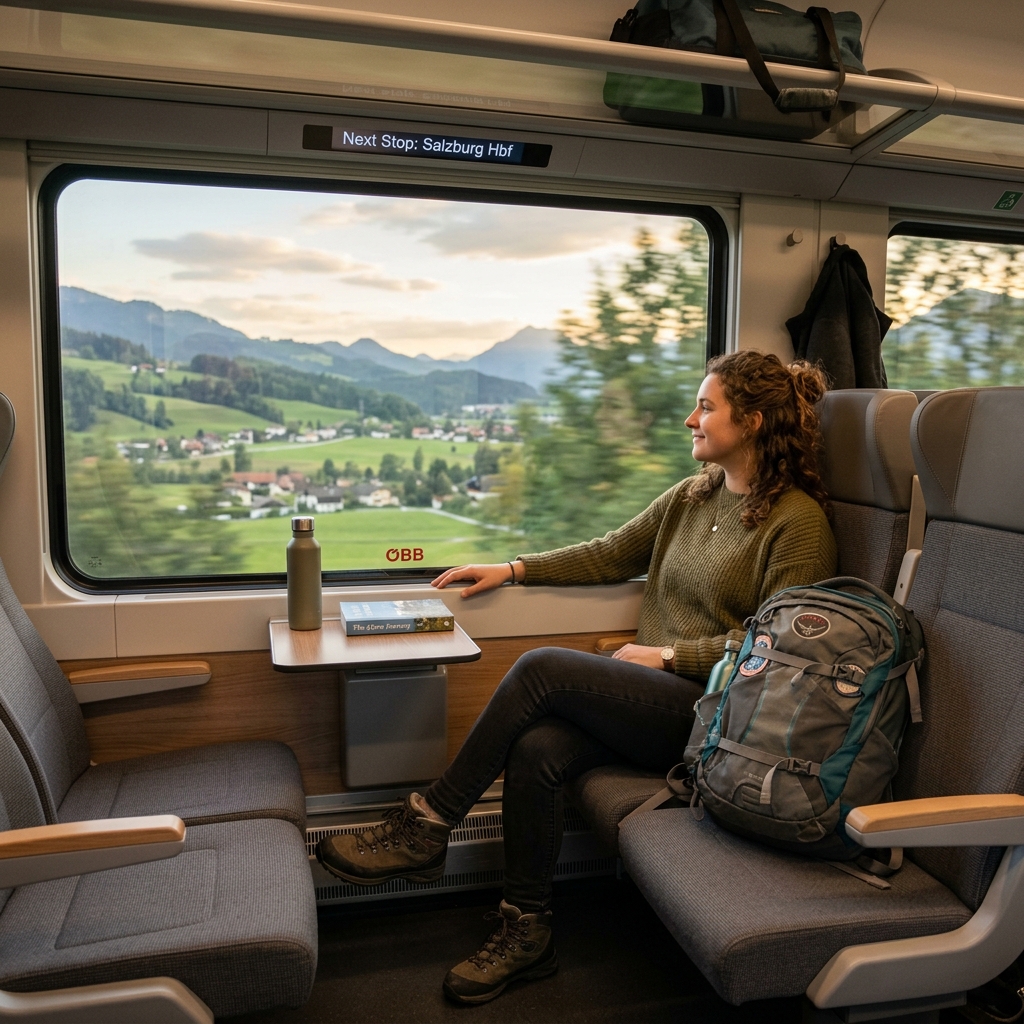
Solo travel by train is, at its core, an act of autonomy. You move when you want, stop where you choose, change plans mid-journey if something catches your attention. No one else’s schedule to accommodate, no group consensus to reach. The solo traveler on a train has a particular freedom: a window seat, a good book, the landscape moving past, and the knowledge that everything required fits in the bag above the seat.
For women, this freedom deserves an honest conversation about the realities — not to frighten, but to arm with accurate information rather than either unwarranted alarm or naive dismissal.
The honest summary: solo female train travel in Europe is safe. The risks that exist are specific, manageable, and largely unrelated to violence. Understanding them clearly is more useful than either avoiding the topic or pretending there is nothing to consider.
The Statistical Reality
European intercity rail is one of the safest travel environments in the world for anyone, and this holds for solo women specifically.
Violent crime on trains is vanishingly rare in Western and Central Europe. When safety incidents are reported involving trains, they occur overwhelmingly in stations — and within stations, predominantly at a handful of large international hubs — rather than on board moving trains. Even then, the predominant concern is property crime: pickpocketing, bag snatching, phone theft. These are crimes of opportunity committed against distracted travelers regardless of gender.
Sexual harassment on trains occurs in some contexts — particularly on crowded regional trains in Southern Europe, late at night, in the absence of other passengers. This is worth knowing and worth having a strategy for. It is not a reason to not travel.
The reference class for comparison is instructive. Consider the alternatives to a solo train journey: a solo late-night flight (isolated in a seat next to strangers for hours with no ability to change position), a rental car on unfamiliar roads at night, or a rideshare with an unverifiable driver. By any of these comparisons, the train — especially during daylight hours or in a lockable overnight cabin — is the preferable option.
Booking Strategy: Building Safety Into Your Reservation
The single most effective safety measure is booking a specific seat in a well-chosen location. This is worth five minutes of attention when purchasing your ticket.
Choose Seat Position Deliberately
On day trains, choose seats in populated carriages rather than at the end of the train. Aisle seats in a standard four-abreast configuration (two seats each side of the aisle) allow you to easily move without disturbing anyone, and reduce the likelihood of being hemmed in by a window seat occupant. For quiet carriages — where phones and loud conversation are discouraged — the passengers tend to be older, business-oriented, and less given to unwanted conversation.
On regional trains without reserved seating, position yourself in sight of other travelers — a half-full carriage is better than an empty one. Near the area where the conductor moves through periodically is also reasonable.
Women-Only Compartments
Germany’s Deutsche Bahn offers Damenabteile — women-only sections — on certain overnight and long-distance trains. During seat selection on the DB website, you can indicate a preference for the women-only carriage where available. The option appears in the seat map for qualifying routes.
In Japan (covered elsewhere on this site but worth noting as a contrast), women-only carriages on urban metro lines are standard during morning rush hours. The cultural architecture of rail safety for women varies considerably by country.
In the UK, Italy, France, and most other Western European countries, women-only compartments do not exist on mainstream services. The practical alternative is the first-class carriage, which tends toward quieter, more business-oriented passengers, or a private sleeper cabin on overnight services.
Booking Window Seats vs Aisle Seats
The conventional wisdom on solo female travel forums is to book aisle seats. The logic: easier to get up and move, less sense of being trapped if an adjacent passenger becomes a problem. The counterpoint: window seats give you a defined boundary and a wall on one side, and are harder for someone to “accidentally” press into you on a crowded train.
The better answer is context-dependent. On a busy commuter train with no seat reservations, standing near the conductor or in a vestibule is sometimes better than sitting between strangers. On a booked intercity service, either window or aisle in a full carriage is fine.
Night Trains: Practical Safety
Night trains deserve specific treatment because the dynamics are different from day travel.
Nightjet Couchettes and Sleepers
The Nightjet network — operated by Austrian Federal Railways (ÖBB) — connects cities including Vienna, Zurich, Amsterdam, Brussels, and Berlin on overnight routes. The rolling stock has been progressively upgraded since 2021.
Private sleeper cabins are the most comfortable and most private option. A cabin for one or two people, with a lockable door, individual reading light, fold-down bed, linen, and usually a small sink. The door locks from inside with a deadbolt. This is meaningfully secure — equivalent to a mid-range hotel room.
Couchette compartments (4 or 6 berths, shared) are more common and considerably cheaper. The compartment door locks but the lock is less robust. If you are in a mixed couchette, you are sharing a small space with strangers for eight hours. This is fine for the vast majority of travelers and journeys. For additional peace of mind: the door stopper alarm (see the gear section below) placed under the compartment door adds meaningful resistance against unwanted entry.
Nightjet conductor staff check tickets through the night and are accessible by call button in each compartment. The train is not unstaffed.
Request female-only couchettes when booking. Nightjet offers them on some routes; the option appears during booking. Not all routes or all trains have this option; when it is unavailable, a private cabin is the upgrade worth considering.
Italian Intercity Notte Overnight Services
Trenitalia’s overnight Intercity Notte services — covering Rome to Palermo, Rome to Reggio Calabria, and some northern routes — are older rolling stock than Nightjet. The couchettes are functional but the compartments are less modern. Security is similar: compartment doors lock, staff are onboard.
For solo female travelers on these routes, the private compartment (vetturino or private cabin, where available) is worth the premium. The overnight Rome–Palermo service in particular is a long journey; comfort and privacy matter.
Seats That Aren’t Nightjet or Couchette
On trains without private compartments — standard seated overnight services — the dynamics shift. Being in a populated carriage, ideally one where other women are traveling, is the practical guidance. Don’t fall into deep sleep in a way that leaves your belongings accessible. Keep your bag between your feet or on your lap, not in the overhead rack above a different seat.
Station Safety: The Five Hotspots
Railway stations are not uniform environments. The high-traffic international hubs draw organized pickpocket operations specifically because they provide cover in the form of crowds, distraction, and transient populations.
The five European stations worth specific awareness:
Paris Gare du Nord is Europe’s busiest international rail terminus, handling Eurostar, Thalys, and regional services. The approaches to the platforms, the main concourse, and the RER connection below are active pickpocket areas. Teams work in coordinated pairs: one distracts, one steals. Keep your bag in front of you, zipper accessible. Do not stop in the middle of the concourse to look at your phone. Move purposefully.
Rome Termini is a large, chaotic station with a significant unsheltered population in and around the exterior. The area immediately outside the main entrance late at night is the least comfortable. The interior platforms and the newer shopping wing are fine. On the platforms, be aware of people who approach with unusual urgency offering “help.”
Brussels Midi serves the Eurostar and Thalys, plus local Belgian services. The surrounding neighborhood is rougher than the station interior suggests. Late at night, move directly to the taxi rank or metro connection rather than lingering in the exterior areas.
Barcelona Sants is the main Barcelona rail hub. Like the other stations on this list, the risk is pickpocketing rather than anything more serious. The tourist-specific risk here is people offering to assist with ticket machines and then demanding payment.
Naples Centrale has an unearned reputation for danger. The station itself is fine. The immediate surroundings in Piazza Garibaldi require the same awareness you’d give any large southern European urban square. The organized pickpocket operations that existed in earlier years have significantly decreased.
The common element across all five: the risk is to your phone and wallet, not your person. Standard urban awareness — keep your bag secure, don’t display expensive devices, move purposefully — covers the practical exposure.
What to Carry
Anti-Theft Bag
A crossbody bag with cut-resistant straps and a lockable zipper addresses the main theft risk vectors: grab-and-run and slash-and-grab. Brands worth looking at:
- Travelon — well-constructed, mid-price, wide range of styles
- Pacsafe — slightly more expensive, very well made, steel mesh panels in the fabric
- Bobby Anti-Theft — popular for laptop bags and day bags
The bag does not need to be expensive or ugly. The steel strand in the strap, the lockable zipper, and the RFID-blocking pocket (relevant for contactless card skimming) are the features that matter.
Door Stop Alarm
A wedge-shaped door stop alarm — typically the size of a deck of cards — slips under any door that opens inward. If the door is opened against it, an alarm sounds at 100–120 decibels. It adds resistance against unwanted entry to your couchette, hotel room, or hostel dorm.
These cost approximately £8–15 and weigh very little. They are one of the highest value-to-weight safety items for solo travelers. A model with a separate LED torch built in doubles as a travel light.
Offline Maps
Download Google Maps offline for every region you are traveling through before you leave. Maps.me is an alternative with better detail in less-developed areas. The practical use: you can navigate from the station to your hotel without displaying your phone conspicuously, consulting it briefly instead of standing in the station entrance with a bright screen and obvious confusion. Navigation uncertainty is the environment in which distraction-based theft happens.
Personal Alarm
A personal keychain alarm — usually a small cylinder — produces 120+ decibels when a pin is pulled. The purpose is twofold: to create noise that draws attention in a confrontation, and to deter through the obvious display of the device. These cost £5–15 and clip to a bag strap or key ring.
ICE Card
An “In Case of Emergency” card kept in your wallet (separate from your phone, which can be stolen or run out of battery) should contain: your name, home country, emergency contact name and phone number, blood type if known, and any critical medical information (allergies, conditions). A card is analog backup when the phone is gone.
Community and Connection
Solo travel does not have to mean isolation. The networks that exist for solo female travelers are extensive:
r/solotravel on Reddit is one of the most useful open communities for pre-trip research and real-time questions. Trip reports specifically about rail journeys are common. Search the subreddit before any major route; someone has almost certainly done the same journey and posted about it.
Girls Love Travel on Facebook is a large group (several million members) specifically for women travelers. The atmosphere is supportive rather than alarmist. Members share current recommendations and ask for itinerary feedback.
Hostel common rooms remain one of the best places to meet other solo travelers of all backgrounds. The demographics of budget travel have changed: a hostel dorm or common room in Lisbon or Ljubljana is as likely to contain women in their 40s and 50s as students. Many hostels have specific solo-traveler evenings or pub crawls.
InterRail travel Facebook groups and Discord servers are active communities for rail-focused travelers specifically, with a high proportion of solo female members sharing itineraries and practical information.
The purpose of connection is not merely company — it is shared intelligence about current conditions. A traveler who arrived in a city two days before you has more current information about which hostel is well-managed and which station exit to use than any guidebook.
Country-Specific Notes
The experience of solo female train travel varies meaningfully by country. Honest notes:
Japan is the country that comes up most often in solo female traveler discussions as the safest. The social conventions around personal space, the extremely low violent crime rate, and the organized, quiet quality of public transit make it genuinely exceptional. Women’s-only carriages exist on metro lines. This is not a travel-brochure claim; it reflects consistent reported experience.
Italy generates more conversation due to catcalling and occasional unwanted advances, particularly in the south. This is real and worth knowing: men, usually not young, occasionally make comments directed at women on trains or in stations. The cultural convention differs from Northern Europe. The appropriate response is non-engagement and movement — it is social harassment, not threat of violence. Traveling in Italy solo as a woman is entirely normal and the overwhelming majority of interactions are unremarkable.
Eastern Europe — Poland, Czech Republic, Hungary, Romania — is significantly safer than its reputation in some Western European media suggests. Train travel specifically is quiet and low-incident. Solo female travelers report Warsaw, Kraków, Budapest, and Bucharest as comfortable without notable concerns beyond the station-area pickpocket awareness that applies everywhere.
The Balkans — Serbia, North Macedonia, Bosnia — require more awareness of local norms, particularly in rural areas, but the train networks are limited and the traveler base on international services is internationally mixed. Solo female travelers report these routes without systematic issues.
France, Germany, Netherlands, Belgium, Austria — the core Western European rail network — are uniformly reported as comfortable. The Eurostar, Thalys, and Nightjet corridors are high-volume, well-staffed, and routine.
The Freedom Argument
It is worth saying plainly: the freedom of solo rail travel — the ability to make all decisions yourself, to stop when you choose, to change destination on a whim, to eat alone without it being a social statement — is one of the genuinely pleasurable forms of independence available to adult life.
The landscape of Europe from a train window, moving through at the pace of thought rather than the urgency of aviation, is its own reward. A Tuesday morning in November, a near-empty ICE carriage between Frankfurt and Basel, the Rhine appearing and disappearing through the mist on one side — this is the kind of experience that a day flight at 32,000 feet simply cannot replicate.
The precautions in this guide are real and worth taking. They are also minor inconveniences in the context of what they enable. Pack the door stop alarm. Choose your seat deliberately. Know which stations require attention. Then get on the train.
For the broader case for solo train travel across Europe, see Solo Train Travel in Europe: A Complete Guide. For packing strategies that make solo rail travel genuinely effortless, see Carry-On Only for Europe: How to Pack Light. For the philosophical dimension of slow independent travel, see What Is Slow Travel?.
Related Reading
- Night Trains in Europe: The Complete Guide to Overnight Rail — Europe’s night train network has doubled since 2021.
- Train Travel in Europe Over 50: The Practical Guide — Senior rail discounts, accessibility tips, overnight trains, and the best European rail routes for travelers over 50…
- Paris to Rome by Train: Routes, Times, Tickets and What to Expect — Paris to Rome by train takes 11 hours direct overnight or 6-7 hours with one change.