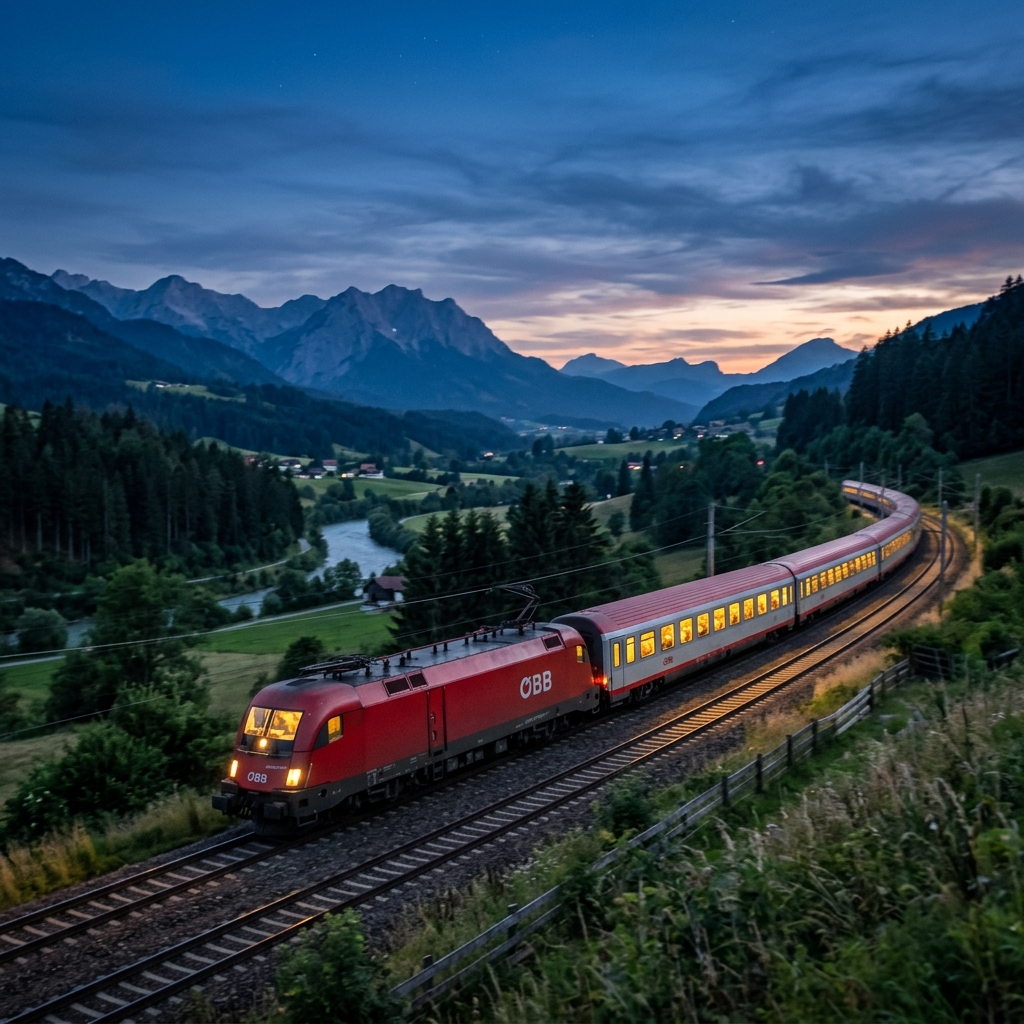
Treat the night train as a hotel replacement plus a scarce berth, not a romance product. This desk maps cabin type, booking window, and when to skip the sleeper — then sends family seats to Train Travel with Kids in Europe, door-to-door sea legs to 12 Ferry Routes in Europe That Are Cheaper Than Flying, fare tactics to How to Save Money on European Train Tickets, and daylight windows to The 12 Most Scenic Train Routes in Europe. Checkout screens live on How to Book European Train Tickets. Live hubs: the journal and tools. This desk does not sell berths; see how we make money.
Europe’s overnight trains nearly vanished in the 2000s. Airlines were cheap, high-speed rail was fast, and railways quietly cancelled route after route. Then something shifted. Fuel prices rose. Climate policy became real. And Austria’s ÖBB quietly started rebuilding a network that had all but disappeared. By 2026, more than 60 night train routes operate across the continent, roughly double the number available in 2020 (Back-on-Track, 2024). If you haven’t looked at overnight trains since your Interrail days in the 1990s, the network has changed. So has the comfort level.
Desk listing check: couchette and sleeper inventory on Nightjet, European Sleeper, and Snälltåget changes by departure. Confirm the current cabin type, reservation fee, and published fare on the operator page — aggregators often hide berths that still exist on nightjet.com. Euro figures below are research ranges, not a live checkout.
Desk note: this desk does not run a private sleeper-inventory lab and did not book mystery couchettes as a field test. Occupancy claims and fare bands below are research ranges from published ÖBB, Eurail, Back-on-Track, and European Environment Agency pages — not a live quote. Confirm the current timetable before you pay.
TL;DR: A Nightjet couchette on a medium-distance hop sits in a research range around €49–€99 and replaces both a short-haul flight and a hotel night (ÖBB Nightjet, 2026). Book when the research snapshot of 180 days opens. Skip the night train when a daytime hop is under about four hours. Skip a seat on 10+ hour routes. Skip the aggregator when the operator site still shows a berth.
Before you book — the checklist the timetable skips
Work this list before you open an aggregator. The first result is not always a bed.
- Name the operator for that corridor. Nightjet, European Sleeper, Snälltåget, RENFE Trenhotel. Book that site first.
- Name the berth, not the train. Seat, 6-berth couchette, 4-berth couchette, or private sleeper. Inventory is not interchangeable.
- Count the hotel night you are not buying. The useful comparison is flight + city-centre hotel, not the bare airfare.
- Check the pass reservation separately. A Eurail or Interrail pass does not include the berth. See Is a Eurail pass worth it?.
- Decide skip versus buy. Skip the sleeper if you must arrive by midday the same day you leave. Skip mixing in a 6-berth with children — take the whole compartment; the family rules are on train travel with kids. Skip a deck-class ferry on the same overnight if you actually need a cabin; the sea alternative is ferry routes cheaper than flying.
Why Are Night Trains Making a Comeback?
Night trains fell from roughly 200 European routes in the 1990s to fewer than 30 by 2019 (European Parliamentary Research Service, 2021). The revival since then has been driven by three forces colliding at once: European Union climate policy, a sharp post-pandemic appetite for sustainable travel, and ÖBB’s aggressive commercial bet that passengers would pay for quality sleeper products.
The EU’s European Green Deal set a target of doubling high-speed rail traffic by 2030. Night trains fit naturally into that agenda, a Vienna-to-Paris sleeper emits roughly 90% less CO2 than the equivalent flight (European Environment Agency, 2023). That’s not a rounding error. It’s a genuinely different category of travel impact.
Austria’s railway operator ÖBB made the most decisive move. After acquiring the former Deutsche Bahn Nightjet brand in 2016, ÖBB invested heavily in new rolling stock and started adding routes every year. Between 2021 and 2025 they added over 20 new route segments, expanding from a central European network into Western Europe. Paris, Brussels, Amsterdam, and Berlin all came back onto the overnight map.
The passenger data backs the bet. ÖBB Nightjet carried 1.8 million passengers in 2023, up 40% from 2019 pre-pandemic levels (ÖBB press release, 2024). Younger travelers in particular are choosing slower, lower-carbon options when the price is competitive, and on many routes, it now is.
The Best Night Train Routes in Europe
Europe now has eight to ten routes worth building an itinerary around. The table below gives you the headline journey details. Every distance and duration figure here comes from current operator timetables.
[IMAGE: Map of Europe with night train routes drawn as connecting lines between major cities, search terms: europe train map routes night]
ÖBB Nightjet: Vienna / Salzburg to Paris
The flagship western route. Trains depart Vienna (or Salzburg) in the early evening and arrive Paris Gare de l’Est by 9–10am. Journey time is roughly 15–17 hours. You can board in Vienna, Salzburg, Innsbruck, or Munich, useful if you’re coming from Germany. Fares start around €29 for a seat, €49 for a couchette. This route returned in December 2021 after a 13-year gap and has run at high occupancy ever since.
ÖBB Nightjet: Vienna to Rome
The classic Alpine sleeper that never fully disappeared. Trains cross the Brenner Pass through the night, giving you an arrival in Rome by mid-morning. The route runs via Innsbruck, Verona, Florence, and Bologna. Journey time is around 11–13 hours depending on the stopping pattern. Sleeper compartments here are some of the most comfortable in the Nightjet fleet, private en-suite rooms are available on this corridor.
most scenic train routes in Europe
ÖBB Nightjet: Amsterdam to Vienna
Northwestward from Vienna, this route connects the Dutch capital with Austria overnight. Departure from Amsterdam Centraal in the late evening, arrival in Vienna early the following morning, around 14 hours. The train travels via Cologne and Salzburg, making it one of the most geographically satisfying routes in the network. Couchette fares from approximately €59.
ÖBB Nightjet: Paris to Berlin
This route was cancelled by Deutsche Bahn in 2014 and restarted as a Nightjet service in December 2023. It’s one of the most politically symbolic routes in the revival. Journey time is roughly 14 hours. Paris Gare de l’Est to Berlin Hauptbahnhof, departing around 8–10pm and arriving mid-morning. Fares from €39 for a couchette. Demand has been strong enough that ÖBB added additional frequency within months of launch.
European Sleeper: Brussels to Vienna
European Sleeper is a newer private operator that started running in 2023. Their Brussels–Vienna route is the most visible challenger to ÖBB’s near-monopoly on cross-border sleepers. The service operates twice weekly and uses refurbished Swedish sleeping cars. What makes European Sleeper interesting is their community-backed ethos, they raised funding partly through crowdfunding and position themselves explicitly as a climate-conscious alternative to flying (European Sleeper, 2024).
Snälltåget / SJ: Stockholm to Hamburg
Scandinavia connects to mainland Europe via this route, arguably the longest regular sleeper in Western Europe at around 1,400 km. The train runs year-round under different branding depending on season. Journey time is approximately 17–19 hours. This is a practical route for travelers combining Sweden or Norway with Central Europe. It also connects to the ÖBB network at Hamburg for onward overnight journeys south.
RENFE Trenhotel: Barcelona to various Spanish destinations
Spain operates its own internal sleeper network branded Trenhotel, run by RENFE. While the international Zurich–Barcelona Trenhotel was suspended in 2013, there are ongoing negotiations to revive a Barcelona–Paris corridor. Within Spain, sleeper trains connect Madrid, Barcelona, Vigo, and A Coruña. Worth checking RENFE’s current schedules if you’re travelling in Iberia, the network is active, even if it doesn’t always appear on international booking tools.
A note on London
There is currently no overnight train from London to mainland Europe. The Channel Tunnel allows daytime Eurostar services to Paris, Brussels, and Amsterdam, but no sleeper service exists. Various proposals have circulated, a London–Amsterdam or London–Cologne night train, but none have reached operating status as of early 2026. If you’re travelling from the UK, the workaround is a daytime Eurostar to Brussels or Paris, then boarding a Nightjet in the evening.
Couchette vs Sleeper vs Seat: Which Should You Book?
Every European night train offers three distinct accommodation tiers. Your choice should depend on journey length, your ability to sleep upright, and budget, not just the lowest price.
[IMAGE: Side-by-side interior photos of a train couchette berth and a private sleeper cabin, search terms: night train couchette sleeper interior europe]
A reclining seat is the cheapest option, typically a research range of €29–€49 on Nightjet routes. Seats recline moderately but you’re in an open carriage with other passengers. It’s reasonable for journeys under 8 hours if you can sleep in a chair. Skip a seat on 10+ hour routes — a couchette is the product, not the romance.
A couchette is a foldable bunk in a 4- or 6-berth shared compartment. Bedding, a pillow and light blanket, is provided. The compartment door locks from inside, which matters for security and privacy. Couchette berths are horizontal, so actual sleep is realistic. This is the sweet spot for most travelers: roughly €49–€99 depending on route and timing. Upper berths cost slightly less and are slightly less convenient.
A private sleeper (called a “Deluxe Sleeper” or “mini cabin” on Nightjet) offers a 1–2 person private compartment with a proper bed, storage, power outlets, and on some routes a private washbasin. Prices run €120–€250 depending on route and occupancy. On the Vienna–Rome corridor, ÖBB offers an “en suite” option with a private toilet and shower. Solo travelers booking a double sleeper privately pay a supplement but gain genuine hotel-level privacy.
The math for groups: Two people sharing a double sleeper often pay less per person than two couchettes booked separately. Always check the shared-room price before defaulting to couchettes.
[CHART: Grouped bar chart, “Nightjet Vienna to Paris: Fare by Accommodation Type”, Seat: €29-49 / Couchette 6-berth: €49-79 / Couchette 4-berth: €59-99 / Sleeper double (per person): €120-180, Source: ÖBB Nightjet timetable 2026]
How Much Do European Night Trains Cost?
Nightjet seat prices start at a research snapshot of €29 on some routes under early-booking promotions, rising to a research range of €59–€89 at standard pricing (ÖBB Nightjet, 2026). Couchettes run a research range of €49–€99. Sleeper cabins run a research range of €120–€250. The sticker price misses the useful part of the calculation.
When you board an overnight train, you’re not just buying transport, you’re buying accommodation. A couchette to Paris at €79 replaces a Parisian hotel night that would cost €100–€200 at minimum, plus a short-haul flight that might be €50–€150 even booked early. Once you do that addition honestly, a €99 couchette is often cheaper than flying and sleeping, even before accounting for airport transfer costs and the time spent at airports.
The “flight replacement” calculation works best on medium-distance routes: Vienna–Paris, Amsterdam–Vienna, Stockholm–Hamburg. On shorter routes where a daytime train would cover the distance in under 4 hours, the overnight option makes less economic sense.
Prices vary significantly with booking timing. Routes open 180 days in advance on most operators. The cheapest couchettes, sometimes as low as €29 on promotional fares, go first. Prices rise steadily as departure approaches. Booking within a month of travel on a popular summer route can mean paying 2–3 times the early-bird fare.
How to Book European Night Trains
The most frustrating reality of the night train revival is that there is no single booking platform that covers the whole network. This is the largest practical barrier for first-time overnight rail travelers.
ÖBB Nightjet routes book natively at nightjet.com or oebb.at. This is always the most reliable source for Nightjet inventory and shows the full range of accommodation types. For European Sleeper, book at europeansleeper.eu. For Snälltåget, book at snalltaget.se.
Third-party aggregators like Rail Europe, Trainline, and NS International carry some Nightjet inventory, but not always all accommodation types. Couchettes and sleepers sometimes don’t appear on third-party tools even when available directly. If a route appears to have no sleeper option on an aggregator, always check the operator’s own site before assuming the service is full.
The practical workaround for complex itineraries: book each segment directly with the operating railway. Yes, it requires multiple bookings and accounts. That’s the current state of the market. The EU is pushing for a unified booking infrastructure, but meaningful interoperability is still several years away (European Commission Rail Agenda, 2023).
What to Pack for an Overnight Train
Packing well for a night train is different from packing for a flight. The environment is less sterile and more social. You’re sharing space, sometimes with strangers, for 8–16 hours.
Essentials for a couchette:
- Earplugs, trains are quieter than planes but not silent, and compartment-mates snore
- An eye mask, corridor lights stay on at low level through the night
- A small padlock, couchettes lock from inside but a padlock on your bag strap adds peace of mind
- Layers, compartment temperature varies, especially through Alpine passes
- A reusable water bottle, the café car closes late but you’ll want water overnight
- Slip-on shoes, you’ll take them off to sleep and want to find them at 3am
What to skip: heavy luggage. Luggage goes in overhead racks or under the lower berth. There’s no checked baggage on most night trains. A 20-litre pack and a medium bag is the comfortable limit for a couchette.
On Nightjet, bedding (pillow and blanket) is provided in couchettes. Sleeper compartments provide full bedding, towels, and a welcome pack. You don’t need to bring a sleeping bag.
Are Night Trains Safe?
European night trains are safe. Serious incidents are rare, and the security architecture of modern sleeper carriages is designed with overnight passengers in mind.
Couchette compartments lock from the inside with a sliding bolt. Once the door is locked, it cannot be opened from outside without physically forcing it, which would be audible to the entire carriage. ÖBB’s private sleeper compartments have individual electronic locks tied to your booking. Valuables should still go under your pillow or in a small bag you sleep with, not left in jacket pockets.
The more realistic risk on night trains is minor theft of unattended items, a phone left on the fold-down table while you sleep deeply. Standard travel awareness applies. Nothing about night trains is uniquely dangerous compared to any other shared overnight transport.
Border crossings happen while you sleep on most routes. Passport control does occasionally wake passengers, this is more common on routes entering or exiting non-Schengen countries (e.g., Switzerland on the Paris–Vienna corridor). Keep your passport easily accessible, not buried in a bag in the overhead rack.
Night Trains vs Flying: An Honest Comparison
The honest comparison has more columns than most travel writers include. Here is the full picture for Vienna to Paris, one of the most direct competitive pairs.
Flying: A Vienna–Paris flight (direct) takes roughly 2 hours in the air. Add 2 hours for check-in/security, 45 minutes at Charles de Gaulle getting to the city, and you’re at 5+ hours door-to-departure-lounge-to-centre. A same-day booking costs €100–€250 in economy. CO2 emissions: approximately 100–130 kg per passenger one-way (ICAO Carbon Emissions Calculator, 2024).
Night train (Nightjet): Journey time 15–17 hours, departing around 8–10pm. You arrive rested at 9–10am. You’ve slept. You don’t need a hotel that night. Total CO2: approximately 8–12 kg per passenger (European Environment Agency, 2023), roughly 90% less than the equivalent flight.
Put your own route through the numbers: the Train vs. Flight CO₂ Savings Calculator runs this maths for any distance — pick Vienna–Paris or enter your own trip and see the kilograms of CO₂ saved and the percentage cut.
The full cost comparison:
| Factor | Flight | Night Train (couchette) |
|---|---|---|
| Transport fare | €80–€200 | €49–€99 |
| Hotel (1 night Paris) | €100–€200 | €0 (sleeping on train) |
| Airport transfers | €30–€60 | €0 (city centre arrival) |
| Total | €210–€460 | €49–€99 |
At those numbers, the night train wins on cost by a wide margin at the realistic midpoints. The only real benefit of flying is time, if you need to arrive by midday the same day you depart, the flight is faster. If you can use the overnight hours for sleep, the train wins on most dimensions.
[IMAGE: Infographic showing night train vs flight CO2 comparison, search terms: sustainable travel carbon footprint comparison train plane europe]
[CHART: Horizontal bar chart, “Vienna to Paris: Total Cost Comparison”, Flight + hotel + transfers: €210-460 / Nightjet couchette (no hotel needed): €49-99, Source: ÖBB Nightjet fares + European Environment Agency 2023]
Eurail Pass and Night Trains
Eurail pass holders can use night trains, but it’s more complicated than hopping on any daytime express. Night trains require a mandatory reservation on top of the pass, and reservation fees vary significantly.
On Nightjet, Eurail reservation fees are €3.50 for a seat, €8–€14 for a couchette, and €15–€29 for a sleeper (Eurail.com, 2026). Those fees are low compared to full-price tickets, making Nightjet one of the best-value uses of a Eurail pass if you’re doing multiple overnight journeys.
One important nuance: night trains that cross midnight use two travel days on flex passes unless you use the “overnight rule.” The overnight rule allows the night train to count as one travel day (the day of departure) if you board before midnight and arrive the following morning. Always check the current Eurail overnight rules before booking, the policy has changed in the past.
For heavy users of overnight trains, say, three or more sleeper journeys in two weeks, a Eurail Global Pass often pencils out favorably compared to point-to-point sleeper prices. For single overnight journeys, the pass rarely saves money versus booking directly with ÖBB.
When to skip the night train
Skip the overnight when a daytime train covers the same hop in under about four hours — you are buying a bed you do not need. Skip the flight comparison if you must be in the next city by midday on the same calendar day. Skip the aggregator when Nightjet’s own site still shows a couchette. Skip mixing in a six-berth with children; buy the door. Skip packing a sleeping bag on Nightjet — bedding is included. Fare tactics for the ticket you buy instead live on save money on European trains. Daylight windows that are the point of the trip live on the scenic routes list.
Related Reading
- Train Travel with Kids in Europe: Fares, Seats, and Night Trains — book the whole compartment.
- 12 Ferry Routes in Europe That Are Cheaper Than Flying — the overnight sea alternative.
- How to Save Money on European Train Tickets — window-open fares if you skip the sleeper.
- The 12 Most Scenic Train Routes in Europe — daylight routes where the window is the product.
- How to Book European Train Tickets — operator sites versus aggregators.
Frequently Asked Questions
What is the difference between a couchette and a sleeper?
A couchette is a fold-down bunk in a shared 4- or 6-berth compartment. Bedding is provided and the door locks from inside. A sleeper (or “Deluxe Sleeper”) is a private cabin for 1–2 people with a proper bed, storage, power outlets, and sometimes a private washbasin or en-suite bathroom. Couchettes cost roughly €49–€99. Sleepers run €120–€250. Sleepers are worth the premium for solo travelers wanting genuine privacy on journeys over 10 hours (ÖBB Nightjet, 2026).
Can I book European night trains with a Eurail pass?
Yes, but a mandatory reservation fee applies on top of your pass. ÖBB Nightjet charges €3.50 for a reserved seat, €8–€14 for a couchette berth, and €15–€29 for a sleeper cabin when you hold a valid Eurail pass (Eurail.com, 2026). The reservation must be made separately through Eurail.com or at a staffed railway station. Overnight trains count as one travel day under the overnight rule if you depart before midnight.
Are there night trains from the UK to Europe?
Not currently. There is no overnight train service through the Channel Tunnel as of 2026. Eurostar operates daytime services from London St Pancras to Paris, Brussels, and Amsterdam. Various proposals for a London–Cologne or London–Amsterdam night train have been discussed, but none have reached commercial operation. The practical route for UK travelers is a daytime Eurostar to Brussels or Paris, then connecting to a Nightjet departure in the evening.
What is the cheapest way to travel by night train in Europe?
Book the earliest available inventory, most Nightjet routes open 180 days before departure and offer promotional fares from €29 for a seat or €49 for a couchette at opening. Book directly at nightjet.com rather than through aggregators to ensure you see all accommodation types. Travelling mid-week (Tuesday–Thursday) and avoiding school holiday periods also produces lower fares. A 6-berth couchette is always cheaper than a 4-berth on the same train.
How far in advance should I book European night trains?
Book as early as possible, ideally when the booking window opens at 6 months (180 days) before departure. Summer routes, particularly July and August on the Vienna–Paris and Amsterdam–Vienna corridors, sell out couchettes and sleepers 2–3 months ahead. Off-season travel (October–March, excluding Christmas and New Year) is far easier to book at short notice, sometimes within a week of departure. If your travel dates are fixed, book immediately.
Night trains won’t replace every flight. But for journeys of 600–1,400 km, the sweet spot where they’re genuinely competitive, they offer something no airline can: you arrive somewhere new having slept, unhurried, with the field already behind you. That is a different kind of travel. It’s not slower in any way that matters. It’s just more honest about what moving through the world actually feels like.
The network is expanding. The rolling stock is improving. The booking process is still fragmented but manageable once you know where to look. There has never been a better time to get back on the overnight train.