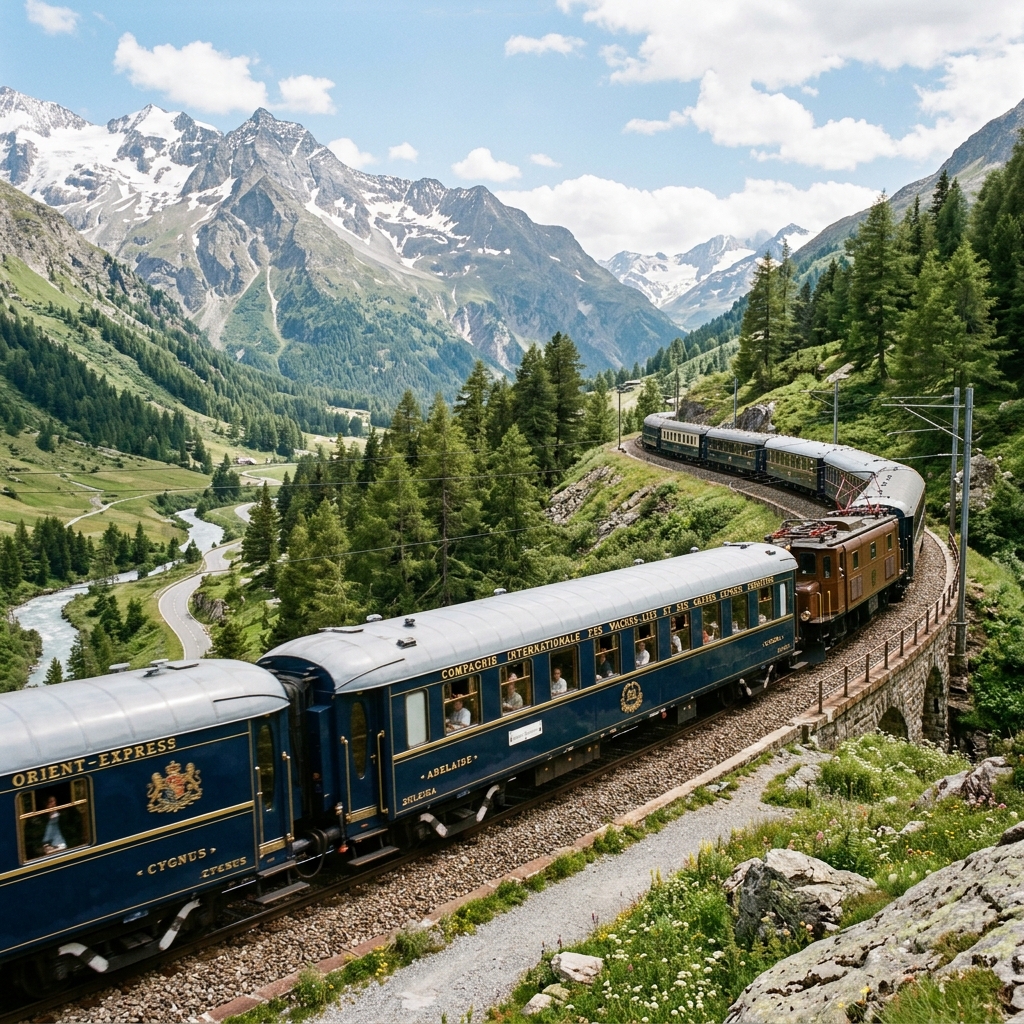
Some journeys are primarily about the destination. The Venice Simplon-Orient-Express is not one of them. From the moment the British Pullman departs London Victoria, cream and umber coaches gleaming against the grey platform, a steward in white gloves standing at the door, the train is the point. The dining cars with their René Lalique glass panels. The corridor swaying gently through the night. The moment, somewhere around dawn, when you pull back the curtains on an entirely different country.
And finally: Venice. Materialising from the lagoon as though placed there by hand.
This is not the fastest way to reach Venice. It is not the cheapest. But for the passengers who board each year, fewer than take a single Boeing 747 on a transatlantic Tuesday, it is an experience that occupies its own category of travel. This guide covers everything: the history, the routes, the cabins, what’s actually included, how to book, what to wear, whether it’s worth it, and what to do if your budget doesn’t stretch.
TL;DR: The Venice Simplon-Orient-Express (VSOE) is a restored 1920s–40s luxury train operated by Belmond (LVMH), running London–Venice and other European routes from March to November. Cabins start at approximately £3,530 per person on the flagship London–Venice route, rising to £17,500+ for the Paris–Istanbul grand journey. Book 6–12 months ahead. All meals are included. Eurail passes are not valid (Belmond, 2026).
Table of Contents
- What Is the Venice Simplon-Orient-Express?
- The Routes: Where Does It Go?
- The Cabins and Carriages Explained
- How Much Does the Venice Simplon-Orient-Express Cost?
- What’s Included in the Price?
- The History Behind the Train
- How to Book, Strategy and Timing
- What to Wear and What to Pack
- What to Expect On Board
- Is the Venice Simplon-Orient-Express Worth the Money?
- Can’t Afford It? Honest Alternatives
- Frequently Asked Questions
What Is the Venice Simplon-Orient-Express?
The Venice Simplon-Orient-Express is a luxury passenger train operating authentic restored carriages from the 1920s and 1940s across Europe. Belmond, a luxury hospitality company acquired by LVMH for $3.2 billion in 2019 (LVMH, 2019), operates it. As of 2026, the oldest carriages are approaching 100 years old, with original Art Deco marquetry, Lalique glasswork, and brass fittings that are not reproductions.
This matters because the VSOE occupies roughly the same symbolic position in LVMH’s portfolio as a heritage Louis Vuitton trunk: old, impractical, extraordinarily beautiful, and coveted. It runs from approximately March to November, with one to two departures per week on the flagship London–Venice route, and less frequent special departures to Vienna, Prague, Budapest, and Istanbul.
On scale: With approximately 100 passengers per departure and roughly 50–75 departures per season, the VSOE carries somewhere between 5,000 and 7,500 passengers per year. That’s fewer people than board a single Boeing 747 on any given transatlantic Tuesday. The exclusivity is mathematical, not manufactured.
Key facts at a glance:
- Fleet: 18 continental carriages (12 sleeping cars, 3 dining cars, 1 bar car) plus UK Pullman coaches for the British leg
- Speed: Standard European rail, the experience, not the velocity, is the point
- WiFi: None (correctly listed as a feature)
- Season: March–November
- Operator: Belmond (LVMH subsidiary)
Citation capsule: The Venice Simplon-Orient-Express is operated by Belmond, a luxury travel company acquired by LVMH for $3.2 billion in 2019 (LVMH, 2019). It runs restored 1920s–40s carriages on European routes from March to November, carrying an estimated 5,000–7,500 passengers per year across approximately 50–75 seasonal departures.
The Routes: Where Does It Go in 2026?
The VSOE’s flagship route runs London to Venice, roughly 24 hours from platform to platform. But the route map has expanded considerably. The journey operates in two parts: British passengers board the British Pullman at London Victoria and travel to Folkestone, where a separate Eurostar service crosses the Channel. At Paris Gare de l’Est, passengers join the continental train, the 1920s coaches, for the overnight run toward Venice or other destinations.
London → Venice (flagship, weekly): Departs London Victoria at 11:00, arrives Venice Santa Lucia at approximately 18:25 the following day, roughly 24 hours total, with an overnight on the continental train.
Paris → Venice (most frequent): Departs Paris Gare de l’Est at 21:58, arriving Venice by early evening the next day. Around 15 hours of travel. This is the most-booked itinerary for continental European travellers, and prices are slightly lower than the London departure.
Paris → Vienna / Budapest / Prague: Offered two to three times per year. The route through central Europe is particularly beautiful in autumn, the kind of journey Agatha Christie’s characters would have recognised.
Paris → Istanbul (once annually, typically August): The grand journey, six days, five nights, recreating the original 1883 route through France, Austria, Hungary, Romania, and Turkey. From £17,500 per person. This sells out within days of booking opening, typically 12+ months ahead.
Amsterdam → Venice: Offered twice yearly.
New for 2025–2026: A Paris → Amalfi Coast route was announced, and a Paris → Barcelona service is in development, extending the network south and west.
Competitor context: The VSOE is not the only “Orient Express” in Europe in 2026. Accor launched the La Dolce Vita Orient Express in 2025, a new-build luxury Italian train on domestic Italian routes. The Nostalgie-Istanbul-Orient-Express is planned for mid-2026. Neither uses authentic vintage stock; the VSOE’s 1920s–40s carriages remain genuinely irreplaceable.
Citation capsule: The Venice Simplon-Orient-Express operates six distinct European route families in 2026, ranging from the 15-hour Paris–Venice overnight to the six-day Paris–Istanbul grand journey (Belmond, 2026). The flagship London–Venice service runs approximately weekly from March to November, covering roughly 24 hours of travel including the British Pullman segment.
The Cabins and Carriages Explained
[IMAGE: Interior hallway of a restored 1920s train carriage showing wood panelling and brass fittings, search: “vintage luxury train corridor wood panelling art deco”]
The continental train runs 18 carriages in total, 12 sleeping cars, 3 dining cars, and 1 bar car. Each sleeping car is a distinct period piece with its own Art Deco marquetry designs and original fittings. No two are identical. This matters more than it sounds: you’re not choosing between identical hotel rooms. You’re choosing between specific historical objects.
Cabin Types
Historic Twin Cabin, The entry-level option. Two beds (one converts to a sofa by day), a window seat, and a small washbasin behind a curtain. Genuinely small, about the width of a double bed plus the passageway. This is correct and appropriate: these are 1920s coaches, not Hilton rooms. The cabin is enough to sleep, change, and watch Europe pass the window.
Grand Suite, Added in recent years to address demand at the top end. A larger space with a proper bedroom area, separate seating, more storage, and private bathroom facilities. Considerably more expensive; considerably more comfortable. Worth the premium for travellers who value space and privacy above novelty.
L’Observatoire, Introduced in 2025. An entire converted carriage available exclusively for two passengers. Glass observation platform, private butler, separate lounge area. The most exclusive booking on any train in Europe. Pricing is on enquiry; the figure is significant.
The Three Dining Cars
The dining cars are named Côte d’Azur, Étoile du Nord, and L’Orientale. Each has distinct marquetry and glasswork, the Lalique glass panels catch and filter light differently at every hour of the day. Dinner is served across two sittings; your cabin steward will confirm your time. Four courses, silver service, a serious wine list. This is where the train earns its reputation.
The Bar Car
The bar car, formally the Côte d’Azur, is the social centre of the train after dinner. Pianist on many departures, cocktails, fellow passengers who are, by selection bias, doing something unusual. It runs late. The conversations that happen there are one of the reasons to take this train.
How Much Does the Venice Simplon-Orient-Express Cost?
The VSOE uses dynamic pricing, fares increase as availability reduces, and the cheapest cabins on any given departure sell first. Historic Twin Cabin fares start at approximately £3,530 per person (based on two sharing) for the London–Venice route (Belmond, 2026), rising to £8,400+ for Grand Suites and £17,500+ for the Paris–Istanbul journey. All fares include every meal.
| Cabin Type | Route | Starting Price (per person) |
|---|---|---|
| Historic Twin Cabin | London → Venice | from £3,530 / ~€4,120 |
| Grand Suite | London → Venice | from £8,400 / ~€9,800 |
| L’Observatoire | London → Venice | premium (enquire) |
| Historic Twin Cabin | Paris → Istanbul | from £17,500 / ~€20,500 |
Solo travellers can book a cabin to themselves by paying a single supplement. It’s worth considering: a VSOE cabin to oneself is a qualitatively different experience, and the supplement is smaller than hotel single supplements tend to be.
Shoulder vs peak: Summer departures (July–August) typically cost 20–35% more than shoulder season (March–May, October–November). If budget is a constraint, the September and October departures offer the same train, cooler light through the Alps, and lower prices.
Citation capsule: Venice Simplon-Orient-Express fares start at approximately £3,530 per person for a Historic Twin Cabin on the London–Venice route and rise to £17,500+ per person for the Paris–Istanbul grand journey (Belmond, 2026). All fares include every meal, breakfast in cabin, lunch, and a four-course silver service dinner.
What’s Included in the Price?
Every VSOE fare includes all meals on board, which meaningfully changes the cost comparison with other luxury experiences. A four-course silver service dinner, continental breakfast delivered to your cabin, and three-course lunch or brunch are part of every ticket (Belmond, 2026), the wine list and cocktails are charged separately.
Full inclusions:
- All meals, breakfast to your cabin, three-course lunch or brunch depending on route, four-course dinner with silver service
- Champagne reception on boarding
- Cabin steward service, converts the cabin between day and night configurations, brings tea and coffee, handles luggage, is available around the clock
- Soft drinks and water throughout the journey
- Entertainment, pianist in the bar car on most departures
Not included: Wines and spirits beyond the welcome champagne (available à la carte or on a drinks package), gratuities, travel insurance, and the Eurostar supplement for the London–Folkestone leg.
The History Behind the Train
[IMAGE: Sleeping cabin with two narrow beds in a restored 1920s train carriage showing original wood panelling, search: “orient express sleeping cabin 1920s wood panelling narrow berth”]
The Orient Express was founded by Belgian entrepreneur Georges Nagelmackers in 1883. His Compagnie Internationale des Wagons-Lits ran the first Express d’Orient from Paris on June 5, 1883 (CIWL Archives / Wagons-Lits Diffusion, 2022). The route eventually extended to Istanbul, becoming the connective tissue of Belle Époque Europe: diplomats, royalty, spies, and, inevitably, novelists travelling between the great capitals.
The Simplon tunnel, opened through the Alps in 1906, gave the train its modern name when a new southern route launched in 1919, bypassing the Balkans via Switzerland and Italy. By the 1970s, cheap air travel had gutted the passenger numbers. The last Direct Orient Express ran on May 19, 1977, an ignominious end to nine decades of European rail history.
What happened next is the story of one man’s conviction. American entrepreneur James Sherwood, founder of Orient-Express Hotels Ltd, purchased two vintage CIWL coaches at a Monte Carlo auction in 1977, the same year the original service died. He spent five years tracking down and restoring 35 original coaches across Europe. On May 25, 1982, the Venice Simplon-Orient-Express made its inaugural run.
On Sleeping Car 3309: This specific carriage was snowbound in a Yugoslav drift for ten days in January 1929, the incident Agatha Christie transformed into Murder on the Orient Express. It still runs today, nearly 100 years later, with its original marquetry intact. You can request it. You should.
In December 2018, LVMH announced its acquisition of Belmond for $3.2 billion (LVMH, 2019). The VSOE is now a sibling brand to Louis Vuitton, Dior, and Moët & Chandon. The analogy is exact: like those houses, it traffics in things that are old, expensive, and made to a standard that newer alternatives can’t replicate.
Citation capsule: The original Orient Express ran its first service from Paris on June 5, 1883, operated by Georges Nagelmackers’ Compagnie Internationale des Wagons-Lits (CIWL Archives, 2022). The last scheduled Direct Orient Express ran on May 19, 1977. James Sherwood revived the service with restored vintage stock in 1982 as the Venice Simplon-Orient-Express, which Belmond (LVMH) now operates.
How to Book, Strategy and Timing
[IMAGE: Man standing beside a vintage cream and umber luxury train at a European station, search: “luxury train platform vintage blue cream coach station”]
Book directly through Belmond at belmond.com. This gives you full visibility of availability and lets you select specific departure dates and, crucially, request specific carriages.
Book through a specialist agent, Tailor Made Rail, Railbookers, and Luxury Train Club all handle VSOE bookings. Agents sometimes have access to sold-out departures through allocations, and are particularly useful for building multi-city itineraries around the train.
Booking windows by departure type:
- Paris–Istanbul (August): Book when the schedule releases, typically 12+ months ahead. This sells out within days.
- Summer London–Venice (June–August): 6–12 months ahead.
- Shoulder season (March–May, October–November): 3–6 months ahead is usually sufficient, though the best cabins go first.
Four practical tips that most guides don’t mention:
- Request a specific carriage. Each sleeping car has a distinct personality. Car 3309 is the Christie carriage; others are known for exceptional marquetry. Ask at booking.
- Take the evening Paris departure, not the morning. Departing Paris in the evening means you arrive in Venice in the early evening of the following day, a far better arrival time than the morning train, which deposits you mid-morning with a full day ahead and no sleep.
- Book direct, not via the hotel concierge. Booking direct through Belmond gives you cabin selection; some hotel booking channels don’t.
- Buy the drinks package. A la carte wines at dinner add up quickly. The package is better value if you’re a two-bottle-at-dinner household.
Cancellation: Belmond’s cancellation policy involves a sliding scale; full cancellation within 30 days of departure usually forfeits the full fare. Given the ticket prices, comprehensive travel insurance is not optional.
Eurail passes are not valid. The VSOE is a fully private service and does not participate in any rail pass scheme, Eurail, Interrail, or otherwise.
What to Wear and What to Pack
The dress code is one of the questions most frequently asked about the VSOE, and one of the things that most distinguishes it from modern travel. Approximately 80% of passengers dress for dinner, with black tie common and suits near-universal for men (Belmond, 2026). Arriving underdressed for dinner is technically permitted, but you’ll feel it.
Evening wear: Black tie is encouraged and widely observed. A dark suit with a tie is an acceptable alternative for men. Women typically dress formally, a long or cocktail dress is appropriate. If you’ve never owned black tie, this is either an excellent reason to acquire it or a reason to consider whether the VSOE is right for you.
Daytime wear: Smart casual. The train moves through some of Europe’s most beautiful landscapes in the morning light, the Alps at dawn, the descent through northern Italy, and most passengers are dressed presentably if not formally.
What to pack:
- Evening wear (unavoidable)
- Layers, the carriages can be warm; the morning platforms at border stops can be cold
- Soft luggage only, hard-sided suitcases go to the baggage car; bring a soft weekend bag for the cabin
- Camera or phone for the Alps crossing at dawn
- A book that suits the occasion (there’s no WiFi, and the train rewards the unhurried)
- One set of particularly comfortable clothes for sleeping in your cabin between dinner and morning
The luggage rule matters more than it sounds. The Historic Twin Cabins are genuinely small. A hard 30-inch suitcase won’t fit in the cabin at all and will go to the baggage car, accessible only at longer stops. Pack for one to two nights in a soft bag, everything else stows below or in the rack above, and the cabin feels spacious rather than cramped.
Luggage practical note: One soft cabin bag per person fits in the compartment. Additional bags go to the baggage car, accessible during longer stops (Vienna, Budapest). Label everything.
What to Expect On Board
The British Pullman portion (London to Folkestone) runs roughly two hours. Afternoon tea is served in the Pullman cars, a gentle introduction to the pace that will govern the next 24 hours. At Folkestone, passengers disstart and board a separate Eurostar through the Channel Tunnel; this is the one utilitarian segment of the journey.
Paris Gare de l’Est is where the continental train waits. The sight of it on the platform, 18 coaches of mahogany, brass, and navy blue, stops people in their tracks. Your steward meets you at the door by name.
The overnight run through France and Switzerland passes largely in the dark; most passengers are in the dining car or bar until midnight. Switzerland arrives at dawn, the Alps appearing through the window with the first light, and the descent into Italy is the visual reward for those who wake early. Set your alarm for the Swiss border.
The arrival into Venice is the journey’s closing ceremony. The train crosses the Ponte della Libertà, the 4-kilometre causeway across the Venetian Lagoon, approaching Venice across the water with the city materialising ahead. After 24 hours on board, this arrival is earned in the way that arrivals should be.
Practical notes:
- WiFi: None. The train predates it and doesn’t need it.
- Showers: Shared at end of carriage for standard cabins; private in Grand Suites and L’Observatoire.
- Children: Permitted; under-12s receive a 20% discount.
- Dietary requirements: Accommodated with advance notice through Belmond’s booking process.
[IMAGE: The Grand Canal in Venice at golden hour seen from the water, with gondolas and palazzos, search: “Venice Grand Canal golden hour water reflection palazzo”]
Is the Venice Simplon-Orient-Express Worth the Money?
For most people, from a pure cost-per-kilometre standpoint, no. A flight from London to Venice costs £80–£200 and takes two hours. By that logic, there is no argument. But the VSOE is not operating on that logic, and asking whether it’s “worth it” by efficiency metrics is the wrong question.
What it offers is a different category of experience: 24 hours in which the journey itself is the destination, in a carriage approaching its centenary, moving through countries connected by this route for over 140 years. The dining car at dinner, when the Lalique panels catch the candlelight and the train is somewhere in eastern France, is an experience that no hotel room and no airline seat replicates.
The honest comparison: Consider what £3,530 per person buys in other luxury contexts. A two-night stay at a top London hotel approaches that figure. A business-class transatlantic flight exceeds it. The VSOE occupies a similar tier but offers something those alternatives cannot: the specific, irreproducible experience of overnight movement through a field, the slow accumulation of countries, an unhurried dinner with people you’d never otherwise meet.
It’s worth it if: you measure travel in terms of experience rather than efficiency; you have a milestone birthday, anniversary, or occasion to mark; you’ve been curious about it for years; you understand that the cabins are small, the showers are shared, and the charm is inseparable from the constraints.
It’s not worth it if: you’ll spend the journey checking your phone (there’s no signal through most of France and none through the Alps); you need a good night’s sleep and a proper shower before a business meeting; or the price genuinely strains your finances. Do it properly or save for later.
Alain de Botton writes in The Art of Travel that the means of transport is itself part of the journey, that how you arrive changes what you experience upon arrival. The VSOE makes a different kind of sense through that lens. The carriages are nearly 100 years old. They’ve been carrying people to Venice for over 40 years. That’s a reasonable argument for booking sooner rather than later.
Citation capsule: A London–Venice flight costs £80–£200 and takes approximately two hours; the Venice Simplon-Orient-Express takes 24 hours and starts at £3,530 per person (Belmond, 2026). The price difference represents not slower transport but a fundamentally different category of experience: overnight movement through four countries, silver service dinner, and arrival into Venice across the lagoon by rail.
Can’t Afford It? Honest Alternatives
The VSOE is genuinely expensive, and there’s no budget version of it. But if what appeals is the spirit, a night on a train, the experience of waking up somewhere new, the pleasure of watching a field change, then there are real alternatives worth knowing.
For the London–Paris glamour without the full spend: The Belmond Royal Scotsman operates in Scotland for a fraction of the VSOE price, though it’s a different kind of journey entirely. The Caledonian Sleeper (London Euston to Scotland, from approximately £100 for a private cabin) gives you the genuine pleasure of an overnight sleeper without the luxury price tag.
For the continental overnight experience: The Nightjet sleeper network, operated by Austrian Federal Railways (ÖBB) and expanded significantly since 2022, now connects Vienna, Zurich, Amsterdam, and Paris, among other cities. Private couchettes from approximately €100–€300. Not glamorous, but genuinely good overnight travel. ÖBB carried over 50 million passengers in 2023 (ÖBB, 2023), with the Nightjet network cited as one of Europe’s fastest-growing sleeper services.
For the Venice experience without the train: Arrive in Venice from Florence or Rome by high-speed Frecciarossa, under two hours from either city, from €20 advance, and book a night at a canal-side property. You miss the journey; you keep the destination.
The St Pancras option: The champagne bar at St Pancras International, directly above the Eurostar platforms, offers a specific genre of travel romance for the price of a glass of wine. It’s not the Orient Express. But it’s a reasonable approximation of the feeling, at approximately 0.5% of the cost.
Citation capsule: ÖBB’s Nightjet sleeper network carried over 50 million total passengers in 2023 and has expanded to include new routes including Paris–Vienna and Amsterdam–Vienna (ÖBB, 2023). Private couchette cabins start from approximately €100–€300, making Nightjet the most accessible overnight sleeper option in Europe for budget-conscious travellers.
Related Reading
- Luxury Train Travel in Europe: The Best Journeys Worth the Splurge, From the Venice Simplon-Orient-Express to the Glacier Express, Europe’s finest train experiences compared.
- Night Trains in Europe: The Complete Guide, Budget-friendly alternatives to luxury sleepers, including Nightjet and the Caledonian Sleeper.
- Florence to Venice by Train, The Venice approach by high-speed rail, from £15 advance.
- Rome to Venice by Train, How to reach the city that the VSOE arrives into.
Frequently Asked Questions
How far in advance should you book the Venice Simplon-Orient-Express?
Book 6–12 months ahead for peak summer departures (June–August) and the annual Paris–Istanbul journey. Shoulder season departures (March–May, October–November) often have availability 3–6 months out. The cheapest cabin grades sell first, leaving it late means choosing between no availability and the most expensive options.
What is the dress code on the Venice Simplon-Orient-Express?
Black tie is encouraged for dinner and the majority of passengers dress formally. Daytime dress code is smart casual. There’s no strict enforcement, but dinner in jeans would feel conspicuous. If you’d rather not travel with evening wear, smart trousers and a jacket work for most passengers in practice.
Does the Venice Simplon-Orient-Express have private bathrooms?
Standard Historic Twin Cabins have a washbasin but share shower facilities at the end of the carriage. Grand Suites include private bathroom facilities. L’Observatoire, the whole-carriage private option, has full private facilities. This is a common point of adjustment for first-time passengers accustomed to hotel standards.
Is the Venice Simplon-Orient-Express the same as the Orient Express?
Not exactly. The original Orient Express (founded 1883) was a regular scheduled service that ran until 1977. The Venice Simplon-Orient-Express (launched 1982) is a separate luxury charter service operating restored vintage carriages from that era. The “Orient Express” brand is also used by other operators in 2026, Accor’s La Dolce Vita Orient Express runs Italian domestic routes on entirely new-build trains. Only the VSOE uses authentic 1920s–1940s rolling stock.
Can solo travellers book the Venice Simplon-Orient-Express?
Yes. Solo travellers pay a single supplement to have the twin cabin to themselves. This is worth considering: a VSOE cabin entirely to oneself is a qualitatively different experience, and the supplement is smaller than hotel single supplements tend to be. The bar car is naturally sociable, solo travel on the VSOE rarely feels lonely.
What happens after I arrive in Venice?
The train arrives at Venice Santa Lucia, the city’s main station on the Grand Canal, you step off the platform directly into Venice with no further transit. Vaporetto Line 1 runs the full length of the Grand Canal (45 minutes to San Marco); Line 2 is faster at 25 minutes. If you’ve invested in the VSOE journey, spend at least one night in Venice: the city in the evening, after day-trippers return to the mainland, is genuinely different from Venice at noon in July.
Continue Exploring
The Italian approach:
Rail passes:
Slow travel:
The Venice Simplon-Orient-Express is, in the end, an argument about what travel is for. If the purpose is efficient transportation, there are better answers, and faster, cheaper ones. If the purpose is a particular kind of attention, to time, to field, to the people you’re with, to the texture of the hours themselves, then there are very few alternatives, at any price.
The carriages are nearly 100 years old. They’ve been carrying people to Venice for over 40 years. They’ll still be doing it when the rest of us have moved on.
, Book direct through Belmond to check availability and cabin selection.