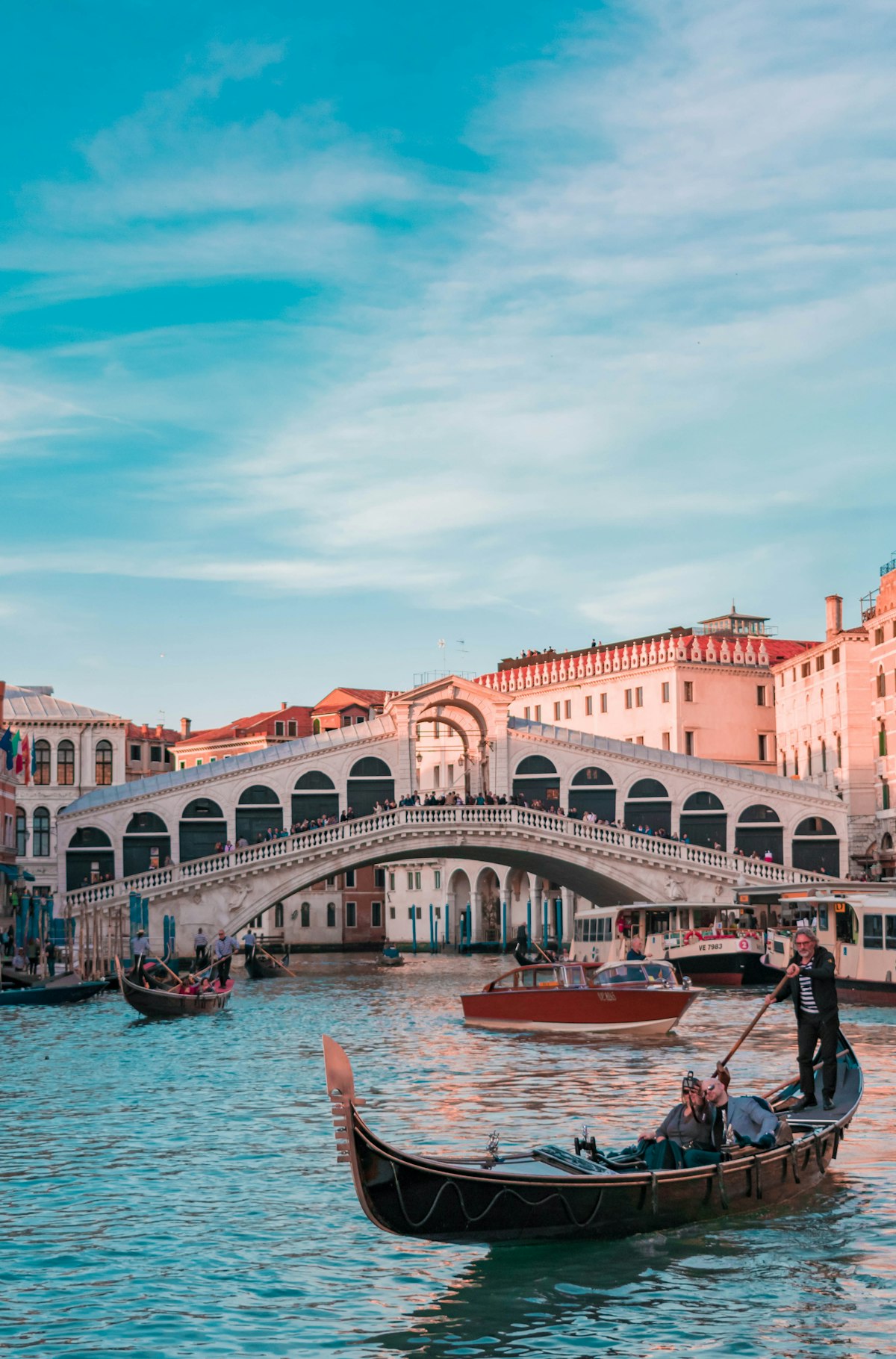
The journey from Rome to Venice by train covers roughly 530 kilometres through the length of central Italy, from the eternal city of marble and empire, through the hills of Lazio and Emilia-Romagna, across the flat agricultural plain of the Veneto, and finally out onto the surface of the Venetian Lagoon. It is, in almost every sense, one of the great rail corridors in Europe.
It connects two cities of extraordinary weight. Two places that have shaped the imagination of the Western world for two thousand years. And it does so in under four hours, at up to 300 km/h, with a departure from central Rome and an arrival at the edge of the Grand Canal.
This guide covers everything: trains, prices, timetables, how to book, what to see, and a few things that can go wrong.
TL;DR: The Rome to Venice train takes 3 hours 45 minutes on the fastest Frecciarossa high-speed service, with around 20 direct departures daily from Roma Termini. Tickets start from €19 booked in advance. Both Trenitalia (Frecciarossa/Frecciargento) and Italo serve this route. Always book to Venezia Santa Lucia, not Venezia Mestre. (Trenitalia, 2026)
How Long Does the Rome to Venice Train Take?
The fastest direct Rome to Venice services take 3 hours 45 minutes on Frecciarossa high-speed trains, which run most of this 530km corridor at up to 300 km/h (Trenitalia,). Frecciargento services typically take around 4 hours to 4 hours 15 minutes. Italo’s competing high-speed trains clock in at around 3 hours 49 minutes, close enough to be irrelevant in practice.
Slower regional trains exist but require at least one change, usually at Bologna Centrale or Ferrara. They take 5 to 6+ hours and cost around €10–€20. For a journey of this length, the time trade-off is significant.
| Service | Journey Time | Direct? | Frequency |
|---|---|---|---|
| Frecciarossa (high-speed) | ~3h 45m | Yes | Every 1–2 hours |
| Frecciargento | ~4h 10m | Yes | Several daily |
| Italo | ~3h 49m | Yes | 3–6 daily |
| Regional + change | 5h 30m–6h+ | No | Frequent |
Both Roma Termini and Venezia Santa Lucia are central stations, no airports, no shuttle buses, no transit zones. You depart from the heart of Rome and arrive at the edge of the Grand Canal.
Citation capsule: The Frecciarossa operates the Rome–Venice corridor at speeds up to 300 km/h, covering approximately 530km in 3 hours 45 minutes. Around 20 direct high-speed services run daily in both directions. (Trenitalia,)
Italian high-speed rail overview
Frecciarossa vs Italo: Which Train Should You Take?
Trenitalia’s Frecciarossa dominates this route with roughly 15–18 daily departures, compared to Italo’s 3–6 (Trenitalia/Italo,). That frequency difference matters if plans change or you miss a train, on Frecciarossa, the next departure is rarely more than an hour away. On Italo, you might wait three hours.
Frecciarossa is the practical default. Wide, comfortable seats with power at every position, Wi-Fi (variable quality but functional), and an onboard Bistrot café serving espresso, panini, and pastries. Seat selection is included at booking. Eurail passes are valid, with a mandatory reservation fee of around €10–€13.
Italo is Frecciarossa’s private competitor, excellent trains, good onboard café service, and a loyalty programme (Italo Più) that rewards frequent travellers. Fares are sometimes marginally cheaper than Frecciarossa on the same date. The important caveat: Italo is not covered by Eurail passes. If you’re travelling on a pass, Italo won’t accept it.
Frecciargento is worth considering if its schedule suits you better. It’s slightly slower than Frecciarossa but runs on the same corridor with comparable comfort.
| Frecciarossa | Italo | Regional | |
|---|---|---|---|
| Journey time | ~3h 45m | ~3h 49m | 5h 30m+ |
| Tickets from | ~€19 | ~€20 | ~€10 |
| Daily departures | 15–18 | 3–6 | Many |
| Direct? | Yes | Yes | No |
| Eurail valid? | Yes (+€10–13 reservation) | No | Yes |
| Onboard café | Yes | Yes | No |
The practical answer: Book whichever has the cheaper advance fare for your date. The journey time difference is less than 5 minutes. The only reason to specifically prefer Frecciarossa is if you’re travelling on a Eurail pass (Italo won’t accept it), or if you want maximum schedule flexibility.
How Much Does the Rome to Venice Train Cost?
Rome to Venice tickets range from €19 to €90+, depending on operator, travel class, and how far ahead you book. The cheapest fares, Frecciarossa Super Economy and Italo Low, open around 4 months before departure and have limited availability (Trenitalia/Italo,).
Frecciarossa fare tiers (approximate one-way prices):
| Class | Advance (book 4–8 weeks out) | Walk-up (day-of) |
|---|---|---|
| Super Economy | €19–€28 | Not available |
| Economy | €35–€45 | €45–€55 |
| Business | €50–€60 | €60–€70 |
| Executive | €75–€90 | €85–€100+ |
Italo fare tiers (approximate one-way prices):
| Class | Advance | Walk-up |
|---|---|---|
| Low | €20–€30 | Not available |
| Economy / Smart | €38–€50 | €50–€65 |
| Club / Flex | €55–€70 | €70–€85 |
| Prima (first class) | €70–€85 | €85–€100+ |
Booking strategy: The Rome–Venice corridor is one of Italy’s busiest tourist routes, Super Economy seats sell out weeks before peak summer dates. Set a calendar reminder for exactly 120 days before your travel date and book that morning. For June–August travel, the difference between booking at the 4-month window and booking a week before can be €40–€60 per person.
Regional trains exist at €10–€20, but the 2+ extra hours each way makes them unattractive for most travellers making this specific journey.
Citation capsule: Rome to Venice high-speed tickets start from approximately €19 in advance (Frecciarossa Super Economy), with walk-up flexible fares reaching €90+. The cheapest fares are released 120 days before departure and sell out rapidly on summer dates. (Trenitalia,)
How to find cheap Italian train tickets
Timetable: Key Departures from Roma Termini
Frecciarossa and Italo services run throughout the day from Roma Termini. These are representative high-speed departures, always verify exact times on Trenitalia or Italo for your travel date, as schedules change seasonally.
| Departs Roma Termini | Arrives Venezia S.L. | Journey Time | Operator | Notes |
|---|---|---|---|---|
| 06:00 | 09:47 | 3h 47m | Frecciarossa | Quietest train; professionals + early risers |
| 07:55 | 11:44 | 3h 49m | Frecciarossa | Arrives in time for lunch |
| 09:00 | 12:52 | 3h 52m | Italo | Mid-morning option |
| 10:00 | 13:44 | 3h 44m | Frecciarossa | Popular with leisure travellers |
| 13:00 | 16:48 | 3h 48m | Frecciarossa | Good for afternoon/evening arrival |
| 16:00 | 19:50 | 3h 50m | Frecciarossa | Last practical arrival for evening activity |
The 07:55 departure is the sweet spot for most travellers: you arrive in Venice before noon with the entire afternoon and evening ahead. The 06:00 departure is worth considering in summer, Roma Termini’s platforms are cooler and less crowded at that hour, and you arrive in Venice before the day-trippers descend.
How to Book: Trenitalia.com vs Italo.it
Both operators run fully functional English-language websites and apps. Direct booking avoids the small fees charged by third-party aggregators.
Booking on Trenitalia.com:
- Visit trenitalia.com and select “Frecce” to filter high-speed services
- Enter “Roma Termini” → “Venezia Santa Lucia” (type the full name, the autocomplete matters here)
- Select your travel date and passenger count
- Choose your fare tier, Super Economy if available, Economy if you need some flexibility
- Select a seat graphically on the carriage map; window seats are A and D depending on the carriage
- Pay by card; e-ticket arrives immediately by email and in the Trenitalia app
Booking on Italo.it:
- Visit italotreno.it, select “EN” for English
- Enter “Roma Termini” → “Venezia Santa Lucia”
- Select date and compare Low/Economy/Prima fares on the results screen
- Seat selection is included; the app is clean and well-designed
- Pay by card; mobile ticket works offline once downloaded
Third-party options: Aggregators like Trainline let you compare Frecciarossa and Italo side by side on a single screen. Useful for multi-leg trips where you’re juggling several operators. The booking fee (typically €1–€3) can be worth paying for the convenience.
Print or mobile? Neither operator requires a printed ticket. Mobile tickets work fine, have your booking accessible before you board, not buried in an inbox. Inspectors board at Bologna and other stops; have it ready.
One thing that trips people up: Trenitalia’s autocomplete offers “Venezia Mestre” before “Venezia Santa Lucia” if you type only “Venezia.” Mestre is the mainland station. Always scroll down to confirm you’ve selected Venezia Santa Lucia. This is the most common booking mistake on this route.
Roma Termini: What to Know Before You Board
Roma Termini is large, 29 platforms, hundreds of shops, and a permanent low-level hum of managed chaos, but it’s well-signed and the high-speed section is straightforward to handle.
Platform assignment for Frecciarossa and Italo departures appears on the departure boards approximately 15 minutes before the train departs, not earlier. This is standard practice at Italian stations. Don’t stand at an unassigned platform waiting; check the boards at the T-10 mark and walk calmly when the platform appears.
High-speed platforms at Termini cluster around the 1–24 range, with the departure boards at the far end of the main hall as you enter from Via Marsala. The platform for your train will be clearly displayed next to the departure time and train number.
Arrive 20 minutes before departure. That’s enough time to find the platform, walk to your carriage position (marked on the platform floor), and board without stress. Cutting it to 5 minutes is not advisable on a busy summer morning.
Station facilities: Termini has staffed luggage storage (Kipoint, near platform 24), a large Carrefour supermarket on the lower level, good for assembling a picnic before boarding, and numerous cafés and bars throughout. Avoid the overpriced espresso stands nearest the platform gates; the café just inside the waiting area is better and marginally cheaper.
What to Expect on the Journey
[IMAGE: View from a high-speed train window showing the flat Veneto plain with a medieval campanile in the distance, search: “italian countryside from train window veneto”]
The Rome to Venice route runs northeast through the Italian peninsula. The landscape shifts three distinct times across the journey, each one worth paying attention to.
Leaving Rome: The First Hour
Departing Termini, the train heads north through Rome’s outer suburbs, not the most glamorous beginning. Don’t dismiss it. Within 20 minutes the industrial outskirts give way to the Apennine foothills, the gradient softens, and the train finds its high-speed rhythm. The hills here are Lazio’s, drier and more austere than Tuscany, dotted with ancient hill towns that appear briefly and then vanish behind you at 290 km/h.
Bologna: The Midpoint
Around the two-hour mark the train slows for Bologna Centrale, if your service stops there. (Many Frecciarossa services on this route call at Bologna; check your ticket.) You’ll have a few minutes on the platform, not enough to do anything, but enough to notice one of Italy’s finest railway stations. If you’re building a multi-city itinerary, consider a Bologna stopover.
The Veneto Plain: Hour Three
North of Bologna, the field transforms into something entirely different. The Apennines flatten into the Veneto, wide agricultural fields, irrigation channels, long straight roads, medieval campaniles rising from flat horizons. The sky gets bigger here. The train accelerates through this field, making excellent time before the terrain begins to feel, almost imperceptibly, as though it’s running out of land.
The Lagoon Crossing
The last 4 kilometres of the journey take place on the Ponte della Libertà, the long, low causeway that has carried trains across the Venetian Lagoon since 1846 (Venice Heritage Commission, historical record). This is the defining moment of the journey.
Water spreads in every direction. The city materialises ahead, buildings without foundations, rising from the sea as if assembled by someone who had never seen a road. There are no cars. There are no flyovers. There is only the water, the train, and the city arriving to meet you.
Sit on the left side of the train (seats C or D on Frecciarossa, in the direction of travel from Rome) for the best lagoon views during the crossing. The approach takes roughly four minutes. Be awake for them.
Citation capsule: The Ponte della Libertà causeway, which carries the rail line across the Venetian Lagoon, was completed in 1846 and spans approximately 3.6 kilometres. It remains the only land connection between Venice and the Italian mainland. (Venice Heritage Commission, historical record)
Venezia Santa Lucia: Arriving at the Right Station
Always book to Venezia Santa Lucia, never Venezia Mestre. This is the single most important practical note in this guide, and the most common expensive mistake.
Venezia Mestre is the mainland station, roughly 10 minutes before Santa Lucia by train. It looks like a normal Italian city station because it is one, there’s no canal in view, no gondolas, no Grand Canal. If you book to Mestre by accident, you’ll need to buy an additional regional train or bus ticket to reach the historic island city.
Venezia Santa Lucia, by contrast, is inside Venice itself, on the island, at the head of the Grand Canal. Step through the station doors and Venice begins immediately. The vaporetto stops are right there. The Grand Canal is right there. The Scalzi Bridge is to your left. There is no buffer, no transition zone, no taxi rank to handle. You’re simply, suddenly, in Venice.
This arrival is one of the great moments in European rail travel. It has been that way since the station opened in 1861 (Ferrovie dello Stato, historical archive).
Vaporetto from Santa Lucia: Getting to Your Hotel
The vaporetto (Venice’s water bus network) departs from the dock directly outside Santa Lucia station. ACTV, the operator, runs two main lines relevant to most travellers (ACTV Venice,):
| Line | Route | Journey to San Marco | Notes |
|---|---|---|---|
| Line 1 | Grand Canal (all stops) | ~45 minutes | Slow, scenic, every stop is a landmark |
| Line 2 | Grand Canal (express) | ~25 minutes | Faster, fewer stops |
| Line 5.1 | Northern lagoon route | Varies | For Murano and northern hotels |
Line 1 is the right choice for a first visit. The 45-minute journey down the Grand Canal past Ca’ d’Oro, the Rialto Bridge, and the Accademia is one of the world’s great urban journeys by water. It costs the same as Line 2 and takes 20 minutes longer. Take it.
Ticket prices (ACTV, 2026):
- Single ride: €9.50
- 24-hour unlimited pass: €25
- 48-hour unlimited pass: €35
- 72-hour unlimited pass: €45
- 7-day unlimited pass: €65
If you’re staying overnight and plan to move around the city at all, the 48-hour pass pays for itself within three rides. Buy at the ACTV machines just outside the station doors or through the AVM Venezia app before you board.
Luggage storage at Santa Lucia is available inside the main station entrance, Deposito Bagagli, staffed, approximately €6–€8 per bag for 5 hours. Venice’s narrow stone streets and frequent bridge steps are genuinely hostile to rolling suitcases; store large bags here if hotel check-in is hours away.
Is It Worth Stopping in Bologna?
Bologna sits almost exactly halfway between Rome and Venice on this route, and it is, by most serious measures, one of the best food cities in Italy. Adding a night or two changes the character of the whole trip entirely.
Why Bologna rewards a stopover: The city centre is compact and walkable, circled by 38 kilometres of medieval porticoes (a UNESCO World Heritage Site since 2021, UNESCO, 2021). The University of Bologna, founded in 1088, is the oldest in the Western world. The food, ragù alla bolognese (nothing like the jar in your cupboard), mortadella, tortellini in brodo, tagliatelle, is the reason the city earned the nickname La Grassa (the fat one).
What to do with 2–4 hours at Bologna Centrale:
- Walk 15 minutes to the Quadrilatero, the medieval market quarter behind Piazza Maggiore, packed with salumerias, cheese shops, and fresh pasta vendors
- Try mortadella at any of the market stalls; this is its home city
- Climb the Torre degli Asinelli (498 steps, €5) for views across the terracotta rooftops to the Apennines
- Eat at least one tagliatelle al ragù before you leave
The logistics are simple: take an early Frecciarossa from Rome, leave bags at Bologna Centrale’s luggage storage (€6/bag), explore for 2–4 hours, then take a later Frecciarossa on to Venice. The cost difference for a split ticket is negligible.
Eurail Pass on the Rome to Venice Train
If you’re travelling Italy on a Eurail pass, you can use it on the Frecciarossa and Frecciargento services on this route, but you must book a mandatory seat reservation in addition to the pass. The reservation fee for Frecciarossa standard class is approximately €10–€13 per journey (Eurail,).
Critical point: Italo is not part of the Eurail network. Italo is a fully private operator and does not accept Eurail passes under any circumstances. If you board an Italo train with only a Eurail pass, you’ll be sold a full-price ticket on board.
Practical implications for pass holders:
- Book Frecciarossa reservations through the Trenitalia website (log into your Eurail account first) or at the station ticket office
- The €10–€13 reservation fee applies per journey per person, factor this into your pass cost calculation
- A single Rome–Venice Frecciarossa ticket purchased 4–6 weeks ahead often costs €25–€35, which can be less than the reservation fee alone on some pass types
Citation capsule: Eurail pass holders travelling the Rome–Venice corridor must book a mandatory seat reservation on Frecciarossa services, costing approximately €10–€13 per journey. Italo, a private operator, does not participate in the Eurail network. (Eurail,)
Common Mistakes on the Rome to Venice Train
1. Booking to Venezia Mestre instead of Venezia Santa Lucia. The most common error on this route. Mestre is a mainland suburb with no canals. Always confirm the destination reads “Venezia Santa Lucia” before completing your booking.
2. Not reserving a seat on Frecciarossa when using a Eurail pass. A Eurail pass without a seat reservation is invalid on Frecciarossa services. You won’t be allowed to board, or you’ll be charged a full ticket on the train.
3. Buying at the station on a summer morning. Walk-up fares in June–August are typically €50–€70 for standard class, compared to €19–€35 for the same seat booked weeks ahead. The station ticket queue can add another 20–30 minutes. Book online in advance.
4. Arriving at the platform at the last minute. Platform numbers are only posted 15 minutes before departure. At Roma Termini in summer, there may be 400–600 people all reading the same board at the same moment. Allow yourself 20 minutes in the station before departure.
5. Choosing the wrong side of the train. For the lagoon crossing, the journey’s highlight, you want the left side (seats C or D on Frecciarossa) in the direction of travel from Rome. It’s a small thing that makes a significant difference.
6. Assuming the overnight train is a good option. There is no direct overnight sleeper from Rome to Venice in the current timetable. The high-speed daytime journey takes under four hours; there’s no meaningful advantage to seeking an overnight alternative. See our European night trains guide for routes where the overnight option genuinely makes sense.
Related Reading
- Milan to Venice by Train: The Complete Guide, Milan to Venice takes 2 hours 27 minutes on the Frecciarossa, a faster northern approach to the lagoon.
- Florence to Venice by Train: Timetables, Prices & What to See, The Tuscany approach to Venice: 2 hours 9 minutes through the hills from Santa Maria Novella.
- Is the Eurail Pass Worth It?, A data-led analysis of when a pass saves money and when point-to-point tickets win.
- Night Trains in Europe: The Complete Guide, For journeys where sleeping on board genuinely makes sense.
Frequently Asked Questions
Is there a direct train from Rome to Venice?
Yes, Frecciarossa, Frecciargento, and Italo all operate direct services between Roma Termini and Venezia Santa Lucia throughout the day. Journey time is 3 hours 45 minutes to 4 hours 15 minutes depending on the service. Around 20 direct high-speed departures run daily. Regional trains typically require a change at Bologna or Ferrara and take 5–6 hours.
Which station in Venice does the train arrive at?
The correct terminus is Venezia Santa Lucia, the main Venice station, located on the island at the head of the Grand Canal. Do not book to Venezia Mestre, which is on the mainland. From Santa Lucia, you can walk out directly onto the vaporetto dock with the Grand Canal in front of you.
Can I use a Eurail pass on the Rome to Venice train?
Yes, on Frecciarossa and Frecciargento services, but you must pay a mandatory seat reservation fee on top, around €10–€13 for Frecciarossa standard class. Eurail passes are not valid on Italo, which is a private operator outside the Eurail network. See our full Eurail pass guide for a breakdown of when the pass saves money on Italian routes.
What time should I take the Rome to Venice train?
The morning window (07:55–09:00 departure from Rome) arrives in Venice before 1 p.m., giving you the full afternoon and evening in the city. For summer travel, the 06:00 departure has quieter, cooler platforms at Termini and arrives before the day-trip crowds. The last Frecciarossa departures from Rome to Venice leave around 20:00.
Is it worth breaking the journey in Bologna?
If you have the time, yes. Bologna is one of Italy’s most underrated cities, home to medieval porticoes (a UNESCO World Heritage Site since 2021), the world’s oldest university, and food that will recalibrate your understanding of Italian cooking. Adding a day or two between Rome and Venice costs very little extra and adds considerable pleasure.
Is there an overnight train from Rome to Venice?
There is no direct overnight sleeper service on this route in the current 2026 timetable. The high-speed daytime journey takes under four hours, making an overnight option impractical for this specific corridor. For routes where overnight trains genuinely make sense, see our European night trains guide.
The Journey Worth Taking
Three hours and forty-five minutes is not a trivial amount of time. It’s long enough to read properly, to think, to watch Italy change outside the window from ancient to medieval to agricultural to maritime. Long enough to arrive somewhere feeling that you’ve actually travelled, rather than simply been relocated.
The train from Rome to Venice follows a route that has connected these two powers for two thousand years, from the city that built the roads to the city that built the ships, linked now by rail across the lagoon. That history isn’t visible from the window. But it is, in some quiet way, present throughout the journey.
Book early. Sit on the left side for the causeway crossing. Don’t book to Mestre.
Ready to plan the full Italian circuit? See our guide to Florence to Venice by train for the third leg, or compare the northern approach with Milan to Venice by train.