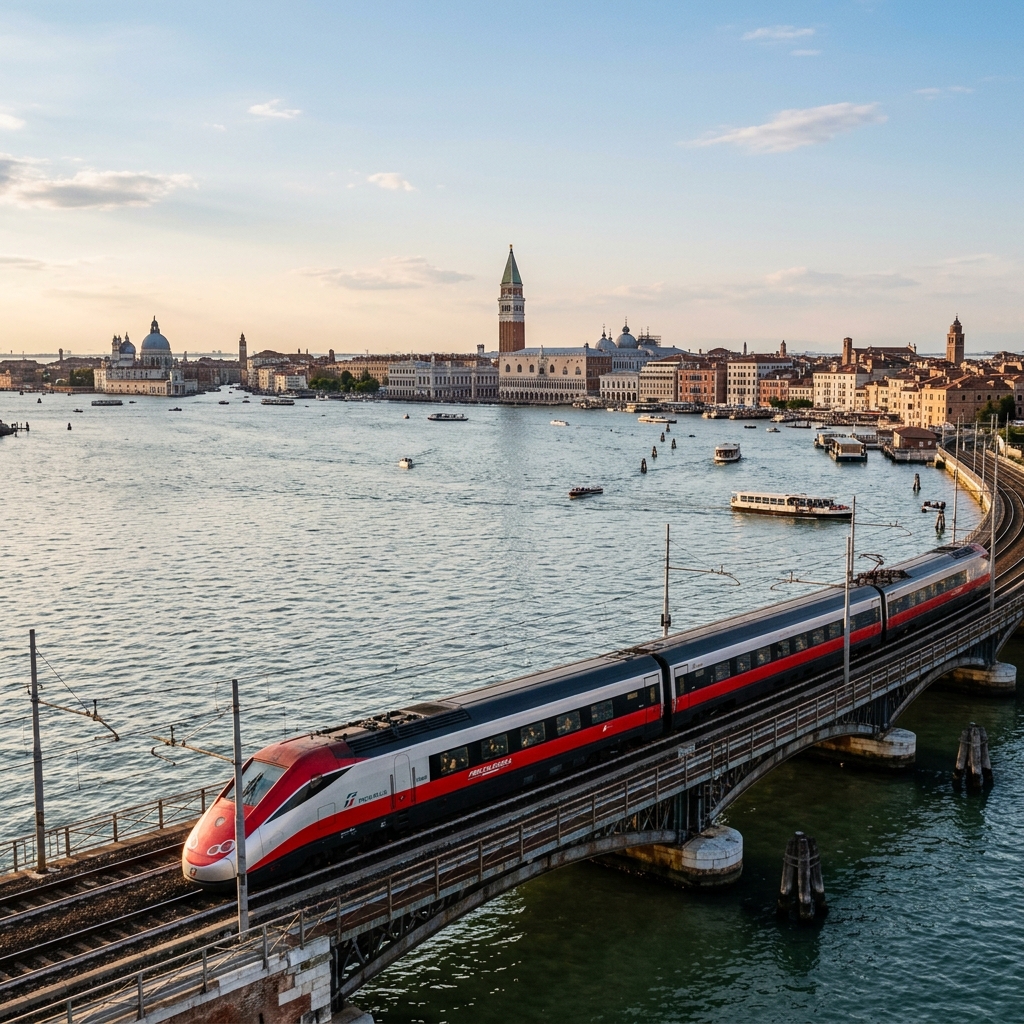
Milan and Venice sit at opposite ends of the Po Valley, one a city of industry and fashion, the other an island city built on water and silence. They are separated by 270 kilometres of flat northern Italian plain and connected, every half hour or so, by some of the fastest trains in Europe.
The Milan to Venice train is one of the most practical, and most pleasant, rail journeys in Italy. Short enough to do comfortably as a day trip, significant enough to feel like a genuine adventure. This guide covers everything: journey times, prices, which train to book, and how to get the best out of both ends of the journey.
TL;DR
The fastest Milan to Venice trains take 2 hours 27 minutes on the Frecciarossa high-speed service, with around 20+ daily departures from Milano Centrale. Tickets start from €9 booked well in advance, rising to €70+ for flexible first-class fares. Book via Trenitalia or to compare all operators.
How Long Does the Milan to Venice Train Take?
The fastest Milan to Venice trains complete the journey in 2 hours 27 minutes on Frecciarossa high-speed services. Italo runs similarly fast, typically 2 hours 30 to 35 minutes. Regional trains take 3 to 3.5 hours and often require a change.
| Service | Journey Time | Direct? | Frequency |
|---|---|---|---|
| Frecciarossa (high-speed) | ~2h 27m | Yes | Every 30–60 min |
| Italo | ~2h 30m | Yes | Several daily |
| InterCity | ~2h 50m | Yes (some) | Limited |
| Regionale | 3h–3h 30m | Usually no | Frequent |
Milan’s main station is Milano Centrale, a magnificent Art Deco building in the north of the city, roughly 20 minutes from the Duomo by metro. Venice’s station is Santa Lucia, sitting directly on the Grand Canal at the northwest tip of the island. Both are central, both are exceptional.
How Much Does the Milan to Venice Train Cost?
Ticket prices range from €9 to €70, depending on how far ahead you book, which operator, and your class of travel.
The cheapest fares, Super Economy on Frecciarossa, Low on Italo, are released around 4 months before departure. These are non-refundable but represent exceptional value: under €10 for a 2.5-hour high-speed journey across northern Italy is among the best value in European rail. Standard flexible fares run €30–€50; first class tops out around €65–€70.
Frecciarossa pricing tiers (approximate):
- Super Economy: from ~€9–€19
- Economy: ~€20–€32
- Business: ~€40–€50
- Executive: ~€55–€70
Italo pricing (approximate):
- Low: from ~€10–€20
- Economy/Flex: ~€25–€45
- Prima (first class): ~€55–€70
Regional trains cost €8–€15 but the combination of slower journey time and frequent changes makes them less appealing than the high-speed fare difference would suggest.
For this route, booking 4–6 weeks out in summer typically still secures reasonable fares. Milan–Venice is popular, but not as ferociously competitive as the Rome–Florence or Rome–Venice corridors.
Price Comparison Table
| Ticket Type | Operator | Advance Price | Flexible Price | Refundable? |
|---|---|---|---|---|
| Regionale | Trenitalia | €9–€12 | €9–€12 | Yes |
| Frecciarossa Super Economy | Trenitalia | €9–€19 | N/A | No |
| Frecciarossa Economy | Trenitalia | €20–€32 | N/A | No |
| Italo Low | Italo | €10–€20 | N/A | No |
| Frecciarossa Business (1st) | Trenitalia | €40–€50 | €55–€65 | Yes |
| Frecciarossa Executive | Trenitalia | €55–€70 | €70+ | Yes |
| Italo Prima (1st class) | Italo | €55–€70 | €70+ | Yes |
Milan to Venice Train Timetable
The Milan–Venice corridor is one of Italy’s most served high-speed routes. Frecciarossa trains run roughly every 30–60 minutes all day, making it easy to plan around your schedule:
- First departure (Milano Centrale): approximately 05:55 Frecciarossa to Venice
- Last departure: approximately 21:25 Frecciarossa (check Trenitalia for exact final service)
- Frequency: Frecciarossa every 30–60 minutes; Italo 4–8 departures per day; Regionale 2 services per day
- Total daily services: 20+ combined departures
- Journey time consistency: Frecciarossa services are consistently 2h 27m; very little variation between morning and evening trains
Check live times at Trenitalia.com (Milano Centrale → Venezia S.Lucia) or the Trenitalia app. The Italo app covers Italo-only departures.
How to Book: Trenitalia vs Italo
Both operators are straightforward to book. Here is the comparison:
Booking on Trenitalia.com:
- Go to trenitalia.com → click “Buy”
- Enter “Milano Centrale” and “Venezia S.Lucia”, use the autocomplete suggestions
- Select date and passenger count, then click Search
- Choose your service (Frecciarossa will appear at the top), then select your fare tier
- Pick seats, select a right-side window seat (seats A or B) for lagoon views on arrival
- Enter passenger details (name must match ID exactly), pay by card, receive QR-code ticket by email
Booking on Italotreno.it:
- Go to italotreno.it → enter origin/destination/date
- Compare Italo fares against Trenitalia before committing, Italo is sometimes €5–€10 cheaper on the same day
- Seat selection, payment, and e-ticket delivery work the same way
The practical rule: Check both sites for the same date. If Italo is meaningfully cheaper and you have a fixed departure time, book Italo. If you want maximum flexibility (ability to catch the next train if you miss yours), book Frecciarossa.
Which Train Should You Take?
Frecciarossa runs the most frequent services, departures roughly every 30 to 60 minutes throughout the day, from early morning until late evening. This frequency is the key advantage: if your plans change or your morning runs long, you’re rarely stuck waiting more than an hour for the next train. Comfortable, well-appointed trains with café service, power sockets, and Wi-Fi.
Italo offers 4–8 daily services on this corridor. The trains are excellent and fares are occasionally cheaper than Frecciarossa on the same day, worth checking if you have fixed travel times. The main limitation is frequency: miss your Italo train and the next departure may be 2–3 hours away.
InterCity and regional trains are slower and offer basic comfort, but if you’re already on a Eurail pass or have a very tight budget, they’re a usable option. Regional trains require a change at either Verona or Padua, adding 30–45 minutes.
| Frecciarossa | Italo | Regional | |
|---|---|---|---|
| Journey time | ~2h 27m | ~2h 30m | 3h+ |
| Price from | ~€9 | ~€10 | ~€8 |
| Frequency | High (every 30–60 min) | Moderate (4–8/day) | High |
| Direct? | Yes | Yes | Usually no |
| Eurail valid? | Yes (reservation req.) | No | Yes |
| Onboard café | Yes | Yes | No |
What to Expect on the Journey
The Milan to Venice route runs east across the Po Valley, the agricultural flatlands of northern Italy, framed to the north by the Alps and to the south by the Apennines. It is not Italy’s most dramatic field, but it has its own quiet quality: vast fields, irrigation channels, poplars in rows, the occasional Romanesque bell tower rising above a village you’ll never visit.
The train passes through or near Brescia, Verona, and Vicenza before the Veneto opens up into its final act.
Verona: The Stopover Worth Making
Depending on your service, the train makes a brief stop at Verona Porta Nuova. Verona deserves more than a passing mention, it is one of northern Italy’s most beautiful cities, and spending 3–5 hours here between Milan and Venice transforms a transit day into a genuine experience.
How to do the Verona stopover:
Buy two separate tickets: Milan → Verona, then Verona → Venice. On Trenitalia, this costs roughly the same as a direct ticket (sometimes fractionally more), and you get to hold the flexibility of choosing your onward train once you arrive. Flexible or Business-class tickets on a single Milan–Venice booking also allow you to board any later Frecciarossa if your service stops in Verona.
Bag storage at Verona Porta Nuova: Left luggage (deposito bagagli) is at the station’s main entrance, ground level, to the right as you exit the platforms. Open daily approximately 07:00–21:00. Cost around €6 per bag for the first 5 hours, essential, since rolling suitcases are impractical on Verona’s cobblestone streets.
A 4-hour Verona itinerary from the station:
- Walk to the Arena di Verona (12 min): One of the best-preserved Roman amphitheatres in the world, seating 22,000. Entry around €10. On summer evenings it hosts opera performances, one of the great experiences in Italian cultural life, though you’d need to stay overnight for that.
- Piazza delle Erbe (5 min from Arena): The old Roman forum, now a busy market square ringed by medieval palaces and a Roman column. Stop for coffee or an aperitivo.
- Juliet’s House (Casa di Giulietta, 3 min from Piazza delle Erbe): Yes, the balcony exists. Yes, it is small and crowded and slightly absurd. Worth 20 minutes.
- Wine: Verona is the gateway to Valpolicella and Soave country. Any bar in the old town will pour you a glass of Amarone or Ripasso, the full-bodied reds that define this corner of the Veneto.
Return to Verona Porta Nuova with 20 minutes to spare before your Venice train. The station is 12–15 minutes on foot from the Arena; taxis and buses are also available.
Vicenza
Vicenza appears roughly 30 minutes before Venice, a quietly beautiful city dominated by the architecture of Andrea Palladio, whose villas shaped the look of country houses across England and New England. Most trains pause here briefly. Worth filing for a future trip.
The Lagoon Crossing
As with every train arriving in Venice, the journey ends with the Ponte della Libertà, the 4-kilometre causeway across the lagoon that carries you from the Italian mainland to the island city. From Milan, the causeway appears after roughly 2 hours 20 minutes of travel, and it never stops being remarkable.
Sit on the right side of the train from Milan for the best views of Venice approaching across the water. The city materialises from the lagoon like a mirage gradually becoming solid, campaniles, domes, the suggestion of palaces. Four minutes across the water, and then you are there.
Arrival: Venice Santa Lucia
Step out of Venice Santa Lucia and the Grand Canal is immediately before you. The vaporetto stops are a few steps away; the Scalzi Bridge is to your right; the entire city is ahead of you on the water. There is no transition period, no suburban approach, no “not quite there yet.” The train delivers you directly into Venice with no preliminaries.
Milan to Venice Train Tips
Day Trip vs Overnight
Milan to Venice makes an excellent day trip, the sub-2.5-hour journey means you can leave Milan at 8 a.m. and be in Venice before 11 a.m., giving you a full day before returning in the evening. However, Venice genuinely rewards staying overnight: the city in the evening, after the day-trip crowds have returned to the mainland, is a different and quieter place. If your schedule allows, plan at least one night.
Choosing Your Seat
Select a window seat on the right side of the train in the direction of travel from Milan (typically seats A or B depending on carriage configuration, the booking interface shows this graphically on both Trenitalia and Italo). This places you on the Venice side for the lagoon crossing.
Milano Centrale Station Guide
Milano Centrale is one of Europe’s grandest stations, a monumental Art Deco building of heroic scale, with soaring vaulted halls that make you feel the importance of what you are about to do. Here is how to handle it:
- How to get to Centrale: Metro Line M2 (Green) or M3 (Yellow) stop at Centrale FS, about 5–10 minutes from the city centre. Trams also serve the station. From Malpensa Airport, the Malpensa Express arrives directly at Centrale (50 min, €13)
- Finding platforms: Platforms 1–24 are on the upper level, above the main hall. Take the escalators or lifts marked “Binari” (Platforms). The high-speed (Alta Velocità) trains typically depart from platforms 5–12, confirm on the departure boards
- Departure boards: platforms are posted 15–20 minutes before departure. Large boards are in the main hall and on the upper platform level. This 15-minute delay is standard, not a sign of a problem
- Arrival time: aim for 20–25 minutes before departure. Centrale is large and the walk from the entrance to distant platforms can take 5–7 minutes
- Left luggage (KiPoint): on the ground floor, near the main entrance. Open daily approximately 06:00–23:00. Cost around €6 for the first 5 hours
- Facilities: full range of shops, cafés, supermarket (on the lower Galleria level), pharmacy, ATMs, and a large food court. Worth arriving early just to walk through the grand hall
Luggage Storage in Venice
Venice Santa Lucia has luggage storage near the main entrance (deposito bagagli), operated by the station and Radical Storage. Approximately €6–€8 per bag for 5 hours. Essential for day-trippers, or for anyone whose hotel check-in is hours away.
Getting Around Venice from Santa Lucia
Step out of Venice Santa Lucia and the Grand Canal is immediately in front of you. Vaporetto stops are 50 metres in both directions.
Vaporetto options from Santa Lucia:
| Line | Route | Time to San Marco | Fare | Best For |
|---|---|---|---|---|
| Line 1 | Full Grand Canal (all stops) | ~45 min | €9.50 | Sightseeing, first visit |
| Line 2 | Express Grand Canal (fewer stops) | ~25 min | €9.50 | Efficient arrival |
| Line 5.1/5.2 | Northern lagoon loop | ~35 min to San Marco | €9.50 | Quieter alternative |
Day or 48-hour passes:
- 24-hour pass: €25 (pays for itself with 3 journeys)
- 48-hour pass: €35 (best value for overnight visitors)
- 72-hour pass: €45
Buy tickets at the ACTV booth or machines on the pier, inspectors check regularly and fines for riding without a valid ticket start at €50.
Water taxis: from the dock to the left of the station exit. Private, fast (15–25 min to most destinations), and expensive: expect €70–€100 to San Marco. Worth it for a special occasion; not necessary for a standard visit.
Walking: if your hotel is in Cannaregio, Santa Croce, or San Polo, you can often walk in 15–25 minutes. Download an offline Venice map before you arrive, the narrow calli (streets) are disorienting, and mobile data can be unreliable.
Is the Frecciarossa 1st Class Upgrade Worth It on This Route?
For a 2.5-hour journey, the step from Economy (2nd class) to Business (1st class) on the Frecciarossa is worth serious consideration. When booked in advance, the upgrade typically costs €10–€15 extra. What you get:
- A dedicated, quieter carriage
- A folding table at every seat (great for working or a proper meal)
- Table service for drinks and snacks from the bistrot
- More legroom and wider seats
- Facing 2-seat configurations ideal for couples or business travel
For solo travellers on a budget, 2nd class is perfectly comfortable. For couples, those working on a laptop, or anyone treating the journey as an experience in itself, Business class is one of the better-value train upgrades in Europe.
Common Mistakes to Avoid
Getting off at Venezia Mestre instead of Venezia Santa Lucia. Mestre is the mainland industrial suburb, the stop immediately before Venice. First-time travellers sometimes panic and disstart here by mistake. Stay on the train: Venice Santa Lucia (the island station, directly on the Grand Canal) is 2–3 minutes further. Your ticket should say “Venezia S.Lucia”, that is your stop.
Booking at the platform machine instead of online. Platform ticket machines sell mainly Regionale fares at walk-up prices. Frecciarossa Super Economy fares (€9–€19) are only available via trenitalia.com or the Trenitalia app. Always book online, you pay less and get seat selection.
Going to the wrong Milan station. High-speed trains to Venice depart from Milano Centrale only. Milano Porta Garibaldi and Milano Cadorna do not serve this route. If you are arriving by Malpensa Express from the airport, you land at Centrale, so this is rarely an issue, but worth confirming on your ticket.
Not validating an anonymous ticket. Named e-tickets bought online need no validation. But any anonymous paper ticket (bought at a counter without seat assignment) must be stamped in the yellow platform machine before boarding. An unstamped ticket risks a €50+ fine.
Assuming Eurail covers Italo. It does not. Eurail is valid only on Trenitalia (Frecciarossa, InterCity), not on Italo. If you want to use Italo with a pass, you must buy a separate ticket.
Missing the platform announcement window. Italian stations do not post platform numbers until 15–20 minutes before departure, this is normal. Watch the main departure boards. When the platform appears, head directly there; the train will not wait.
Related Reading
- Milan to Rome by Train: Timetables, Fares, and What to Expect on Board, The Milan to Rome train takes 2h 55min on the Frecciarossa, Italy’s fastest intercity service.
- Venice Simplon Orient Express: The Complete Guide, The Venice Simplon Orient Express: cabins, prices from £3,530, routes, booking strategy, and a frank look at whether…
- Rome to Florence by Train: Times, Prices & Booking Tips, Rome to Florence by train takes 1h 30m on the Frecciarossa.
Frequently Asked Questions
Is there a direct train from Milan to Venice?
Yes, Frecciarossa and Italo both run multiple direct services daily between Milano Centrale and Venezia Santa Lucia. Journey time is approximately 2 hours 27–35 minutes. Some slower services require a change at Verona or Padua.
How much does the Milan to Venice train cost?
Prices range from €9 (Regionale) to €70+ (Frecciarossa Executive, flexible). The cheapest high-speed fares, Frecciarossa Super Economy from €9–€19 and Italo Low from €10–€20, are available when booked 4–8 weeks ahead. Standard flexible fares run €30–€50. See the full price comparison table in the guide above.
How long does the Milan to Venice train take?
The fastest Frecciarossa services take 2 hours 27 minutes. Italo runs in approximately 2 hours 30–35 minutes. Regional trains, which usually require a change at Verona or Padua, take 3 to 3.5 hours.
Which Milan station for Venice trains?
All high-speed trains to Venice depart from Milano Centrale, Milan’s main station. Do not confuse it with Milano Porta Garibaldi (commuter services) or Milano Cadorna (Malpensa Express). For Venice, you want Milano Centrale. It is served by Metro Lines M2 and M3, approximately one stop from the central Duomo area.
Is the Frecciarossa 1st class upgrade worth it on this route?
Often yes. The step from Economy to Business class on the Frecciarossa is typically only €10–€15 extra when booked in advance. Business class gives you a quieter carriage, a table at every seat, table service, and more legroom, meaningful for a 2.5-hour journey. See the full upgrade breakdown in the tips section above.
Can I use a Eurail pass on the Milan to Venice train?
Yes, Eurail passes are valid on Frecciarossa and InterCity trains on this route. You will need a seat reservation on top, around €10–€13 for Frecciarossa standard class. Eurail is not valid on Italo. Regional trains do not require a reservation fee. See our Eurail pass guide for a full breakdown of when the pass saves money.
From Fashion Capital to Floating City
Milan and Venice are, in some ways, the most extreme contrast Italy offers: one is concrete and contemporary, efficient and international; the other is medieval and impossible, built on wooden piles in a salt lagoon, stubbornly resistant to everything modernity has tried to do to it. That two-and-a-half hours of rail travel can connect them is one of the small miracles of Italian infrastructure.
Book early for the cheapest fares, sit on the right side for the lagoon approach, and stay overnight if you possibly can. Venice at 7 a.m., before the cruise ships unload and the day-trippers arrive, that is the city worth staying to see.
Planning the full northern Italian circuit? Read our guide to Florence to Venice by train, or if you’re coming from the south, our Rome to Venice guide covers the longer but equally rewarding journey from the capital.
, book your overnight in Venice early. The best-value canal-view rooms go fast.