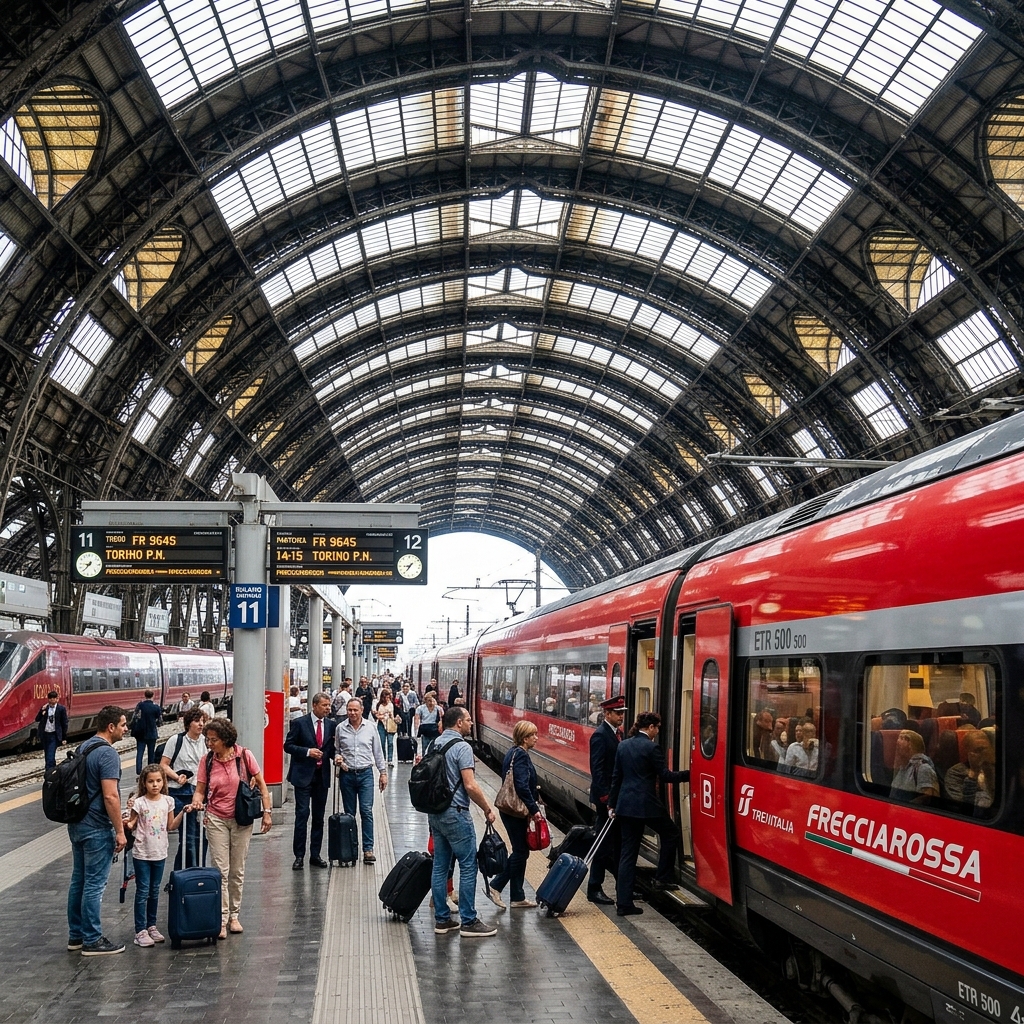
The Milan to Rome train is one of the most useful journeys in Europe. It connects Italy’s commercial capital to its political and historical one in under three hours, city centre to city centre, no airport, no security queue, no luggage drama. The Frecciarossa covers roughly 580 kilometres at speeds up to 300 km/h (Trenitalia,), touching Florence on the way and arriving at Roma Termini in time for a late lunch if you leave Milan at nine.
There is something worth pausing on about that: two of the great cities of the Western world, separated by less than a working morning. But the journey itself, Po Valley, Apennines, the first sight of Rome’s low suburban sprawl, earns attention. This is Italy’s north-south axis made physical. It tells you something about the country that the train crosses it so briskly.
This guide covers the practical side: journey times, operators, fare tiers, the stations, what the ride is like, and whether you should stop in Florence on the way.
TL;DR: The Milan to Rome train takes 2 hours 55 minutes on the fastest Frecciarossa service. Tickets start from around €19–29 booked 2–3 months ahead. Both Trenitalia and Italo operate the corridor. Book direct via Trenitalia or Italo, direct booking avoids third-party fees. (Trenitalia,)
The Route and Journey Time
The Frecciarossa runs Milan to Rome in 2 hours 55 minutes on its fastest services, a figure that would have seemed improbable before Italy’s Alta Velocità (high-speed) network came into full operation in 2009 (European Railway Agency, 2024). That network now carries over 40 million passengers per year on the key north-south corridors. The Milan-Rome route is the backbone of it.
| Service | Journey Time | Direct? | Operator |
|---|---|---|---|
| Frecciarossa (fastest) | 2h 55m–3h 10m | Yes | Trenitalia |
| Italo EVO | 3h 00m–3h 15m | Yes | Italo NTV |
| Frecciargento | 3h 20m–3h 40m | Yes | Trenitalia |
| InterCity | 4h 30m–5h 00m | Yes | Trenitalia |
Frecciarossa is the premium Trenitalia product, Italy’s signature red high-speed train, running this corridor 20+ times daily from around 5:30 a.m. to 9:30 p.m. Frequency is the main argument for it: with departures roughly every 30–40 minutes, missing your train is an inconvenience rather than a catastrophe. Most services stop at Florence’s Santa Maria Novella station, which matters if you’re considering a stopover.
Italo (operated by NTV, Nuovo Trasporto Viaggiatori) runs 8–12 daily services on this corridor. The trains are genuinely excellent, newer interiors than much of the Frecciarossa fleet, well-designed seating, a strong loyalty scheme (Italo Più). Advance fares are sometimes slightly cheaper than Trenitalia equivalents. The limitation is frequency: miss an Italo train and the next departure may be two hours away.
Frecciargento runs at tilting-train technology and serves some routes that Frecciarossa doesn’t, primarily via the older Direttissima line. Journey times are around 20–40 minutes longer. Fine if the timetable suits you; not a meaningful upgrade.
InterCity trains cover the same route in 4.5–5 hours. They are slower, less comfortable, and offer limited catering. They’re a viable choice only if you’re on a very tight budget or travelling with a pass and want to avoid reservation fees.
understanding Italy’s rail network
Fares and When to Book
Advance Frecciarossa fares for Milan to Rome start from approximately €19–29 in Economy class, a remarkable price for a three-hour high-speed journey across a country (Trenitalia,). That said, the cheapest tickets are released 4 months (120 days) ahead and sell out fast on busy days, particularly Friday evenings and Sunday afternoons.
Frecciarossa fare tiers:
- Super Economy, from ~€19–29, non-refundable, non-exchangeable
- Economy, from ~€30–50, limited changes with a fee
- Business, from ~€55–75, flexible changes, wider seats
- Executive, from ~€80–150, lounge access, full meals, private cabin feel
Italo fare tiers:
- Low, from ~€20–32, non-refundable
- Economy / Flex, from ~€35–55
- Prima (first class), from ~€75–120
The cheapest Super Economy and Low fares on this route are notably more expensive than equivalent fares on the shorter Milan-Venice or Rome-Florence corridors. Distance matters in dynamic pricing. Budget around €30–40 for a comfortable advance Economy ticket if you’re booking 6–8 weeks out in shoulder season.
How far ahead to book: For summer travel (June–August), book at the 4-month window or close to it. For shoulder seasons, March to May, September to November, 4–6 weeks is usually sufficient. Booking on the morning of travel typically means paying €60–100 or more for a flexible fare.
Where to book:
- Trenitalia, book direct, no fee, English-language interface
- Italo, direct, no fee, occasionally cheaper advance fares
- Trainline and similar aggregators show both operators on one screen, useful for comparing dates, but they add a booking fee of approximately €3–8 per ticket
Eurail and Interrail pass holders: Both Frecciarossa and Frecciargento accept passes, but require a seat reservation on top, around €10–13 for standard class on this route (Eurail,). Italo does not accept Eurail or Interrail passes. For a single Milan-Rome journey, a point-to-point advance ticket is almost always cheaper than the pass plus reservation fee combined.
The Friday trap: Friday evening and Sunday afternoon trains, particularly the 17:00–20:00 departures, fill up fast with business travellers returning home for the weekend. These time slots also attract premium dynamic pricing. If your dates are flexible, a Thursday evening or Saturday morning departure will almost always offer meaningfully cheaper fares for the same Frecciarossa service.
is the Eurail pass worth it on Italian routes
The Stations: Milano Centrale and Roma Termini
Milano Centrale is one of Europe’s great stations, a Fascist-era monument of 1931, conceived on the scale of a cathedral and executed in polished marble, heroic stone carvings, and vaulted halls designed to make you feel the gravity of departure (Trenitalia,). It is also extremely functional: departures boards are clear, English signage is adequate, and the platform areas are well-organised. Allow 20 minutes before departure, platform assignments are posted 15–20 minutes before trains leave, as is standard in Italy.
The station sits roughly 1.5 kilometres northeast of the Duomo, about 20 minutes on foot or a single metro stop (Line M2 or M3). The main hall has a Pret a Manger, a large newsagent, several coffee bars, and the standard assortment of Italian station food. The upper-level La Galleria del Gusto has better options if you want to eat before boarding.
Milano Rogoredo, worth knowing about if you’re staying in the southern part of the city, near the Porta Romana or Lodi neighbourhoods, or connecting from the Linate airport bus. Several Frecciarossa services stop at Rogoredo before proceeding south; it’s a straightforward way to board without going to Centrale.
Roma Termini is Rome’s main hub and one of the busiest stations in Europe, handling around 150 million passengers per year (RFI, 2024). It is large, occasionally chaotic, and surrounded at street level by the kind of urban intensity that only a city of Rome’s density and history can produce. On arrival, the key move is to walk purposefully: the metro entrance (Lines A and B) is in the main hall; taxi rank is outside the main entrance to the right; bus stops for the centre are directly outside. Don’t linger on the steps with a heavy bag.
handling Italian rail stations
What the Journey Is Like
The Frecciarossa interior is split into four classes: Standard, Premium, Business, and Executive. Standard is what most people book, two-by-two seating, power at every seat, decent legroom, Wi-Fi (variable quality, functional for email and messaging rather than video). Business class widens the seat pitch noticeably and provides a small tray of snacks. Executive is a separate cabin of four seats facing each other with a table, full meal service, and a sense of occasion that’s well-suited to business travel or a splurge.
The catering trolley comes through the train 30–40 minutes after departure. Coffee, sandwiches, small bottles of wine, snacks. The quality is fine. Better options are available at Milano Centrale before you board if you have time.
On the seating question: Window seats on the left side of the train heading south (seats A or D, depending on the carriage configuration, the booking interface shows it graphically) give the better Apennine views from around the one-hour mark. The Trenitalia booking screen’s seat map makes this straightforward to handle; select your seat when you book, not as an afterthought.
The field, in order:
The Po Valley occupies the first 60–70 minutes. It is flat, productively, agriculturally, unromantically flat. Fields, irrigation channels, factory clusters, small towns with Romanesque bell towers. On a clear winter morning the Alps are visible to the north, which redeems the view considerably. In summer, haze blurs them. The cities the train passes through or near, Piacenza, Parma, Bologna, are worth more than the train window gives them credit for.
Bologna is the main intermediate stop on most Frecciarossa services, roughly 55 minutes from Milan. It’s a city that deserves a proper visit, Europe’s oldest university, one of Italy’s finest food cultures, a medieval centro storico of arcaded streets largely free of mass tourism at the level of Florence or Rome. Several trains terminate or originate here; it won’t affect your journey unless you want to stop.
After Bologna, the train enters the Apennines through a series of tunnels. This is the most dramatic section of the route, not in a scenic way you’ll photograph, but in a structural way you’ll feel: the train is threading through the geological spine of Italy, the mountain range that divides the Po Valley from Tuscany and Lazio. The tunnels are long. Emerge from them and the field has changed completely.
Florence appears around the two-hour mark. The train doesn’t give you much of the city from the window, it arrives at Santa Maria Novella station through an urban approach, but the Florence stop is significant for a different reason entirely.
After Florence, the landscape opens into the hills of northern Lazio. Less dramatic than Tuscany’s famous postcard hills, but quiet and agricultural. The final 40 minutes before Rome bring the city’s outer suburbs, gradually denser, gradually more Roman in feel, before the train slides into Termini.
Making It a Stopover in Florence
Most Frecciarossa services between Milan and Rome stop at Firenze Santa Maria Novella, Florence’s main station, a 15-minute walk from the Duomo and a five-minute walk from the Arno (Trenitalia,). This makes the Milan-to-Rome journey one of the most natural stopover routes in European rail: you can buy a through ticket, choose to disstart at Florence for a few hours, and reboard a later Frecciarossa to Rome at no additional reservation cost if your ticket class allows changes (Economy with the appropriate flex, Business, or Executive).
The logic is compelling. Florence in the middle of a longer Italian journey rather than as a separate trip is a different experience, less pressured, more exploratory. You already know Rome or Milan is waiting; Florence becomes a pause rather than a destination to conquer.
What a half-day in Florence looks like from the station:
The Duomo is 15 minutes on foot from Santa Maria Novella, east on Via de’ Cerretani, and it appears before you. The Uffizi is 20 minutes from the station on foot; pre-booking is essential in summer (Uffizi Gallery,), but in shoulder season you can usually book a same-morning slot online. Ponte Vecchio is 25 minutes. The Piazzale Michelangelo viewpoint is 40 minutes on foot or 15 minutes on bus line 13.
For a half-day stopover, a realistic sequence: coffee at the station, walk to the Duomo, spend an hour at the Baptistery and the exterior of the Duomo (the dome climb requires a pre-booked ticket), walk south to the Arno, cross Ponte Vecchio, explore the Oltrarno neighbourhood for an hour, find lunch. Return to Santa Maria Novella in time for a 14:00 or 15:00 Frecciarossa to Rome.
Train frequency makes this easy. Frecciarossa services between Florence and Rome run roughly every 30 minutes through the middle of the day. The Florence-Rome leg alone takes 1 hour 30 minutes (Trenitalia,), you can board at 15:00 and be in Rome by 16:45.
The full guide to this route is worth reading before you plan: Rome to Florence by train.
Florence as a stopover on the Italian rail route
The Milan-Rome Axis as a Travel Argument
Flying Milan to Rome takes around 1 hour 15 minutes in the air but close to 4 hours door-to-door once you account for the airport transfers, security, boarding, and baggage reclaim on both ends (European Environment Agency, 2023). The Frecciarossa takes 2 hours 55 minutes from a city-centre station to a city-centre station with no security theatre.
This is one of the clearest cases in European travel where the train doesn’t just compete with the plane, it wins on time, wins on comfort, and produces roughly 80% less CO₂ per passenger on the same journey (EEA, 2023).
But there’s a subtler argument worth making, which is the one about what you’re actually doing when you travel between these two cities.
Milan and Rome occupy different categories of Italian identity. Milan is northern, post-industrial, European in orientation, the city that made its money in textiles, finance, and design and has never quite decided whether it belongs to Italy or to some larger idea of urban modernity. Rome is central, southern in attitude, ancient and bureaucratic and beautiful in a way that doesn’t depend on your approval. They have been arguing, in effect, for centuries about what Italy is.
The train between them is not merely transport. It’s a traversal of that argument, from the Pirelli Tower and the Brera galleries in the north, through the Renaissance confection of Florence in the middle, to the Colosseum and the Vatican in the south. Three hours on a quiet seat with a coffee is a reasonable amount of time to let that geography settle in.
The Frecciarossa makes it efficient. Making it meaningful is still up to you. But the train helps.
building a full Italian rail itinerary
Related Reading
- Milan to Venice by Train: The Complete Guide, Milan to Venice by train takes just 2 hours 27 minutes on the Frecciarossa.
- Rome to Venice by Train: The Complete Guide, Rome to Venice by train takes 3h 45m on the fast Frecciarossa service.
- The Best Food Tours in Rome (And What They Actually Cover), The best food tours in Rome, from Testaccio Market to the Jewish Ghetto, what you’ll eat, what to skip, and how to…
Frequently Asked Questions
How long does the Milan to Rome train take?
The fastest Frecciarossa services complete the Milan to Rome journey in 2 hours 55 minutes, with most services arriving in 3 hours to 3 hours 10 minutes depending on intermediate stops (Trenitalia,). Italo’s fastest services take around 3 hours to 3 hours 15 minutes. The Frecciargento takes 3 hours 20 to 40 minutes. Older InterCity trains take 4.5–5 hours. For most travellers, the Frecciarossa or Italo are the only services worth considering unless cost is the primary constraint.
How much does a Milan to Rome train ticket cost?
Advance Frecciarossa fares start from approximately €19–29 in Economy class, booked 2–3 months ahead (Trenitalia,). Standard flexible Economy fares run €40–70. Business class starts from €55–75. Executive runs €80–150. Italo’s advance Low fares are similar, €20–32, with Prima (first class) from €75–120. Both operators use dynamic pricing, so fares rise as trains fill. Book 6–8 weeks ahead for summer travel; 3–4 weeks is usually adequate in shoulder season.
Is it better to take Trenitalia or Italo from Milan to Rome?
Both operators run comparable high-speed services on this corridor, and the honest answer is to book whichever has the better fare on your specific date. Italo often has slightly cheaper advance fares and its train interiors are generally newer. Trenitalia’s Frecciarossa offers more frequent departures, roughly every 30–40 minutes through the day, which matters if your schedule is uncertain. Frecciarossa also accepts Eurail and Interrail passes (Italo does not). Check both on the same day before committing.
Which station in Milan do trains to Rome depart from?
All major high-speed services depart from Milano Centrale, Milan’s main station, in the northeast of the city centre. Some Frecciarossa services also stop at Milano Rogoredo, which is useful if you’re staying in the south of Milan or connecting from Linate airport. In Rome, all services arrive at Roma Termini, the city’s central hub. Don’t confuse Termini with Roma Tiburtina, which handles some secondary services but is not central.
Should I book Milan to Rome train tickets in advance?
Yes, strongly. The cheapest Economy and Low fares on this route are released around 4 months before departure and sell out in limited quantities, particularly on Friday evenings, Sunday afternoons, and any service around Italian public holidays (Trenitalia,). These are the trains business travellers and weekenders use, which pushes prices up at peak times. If you’re travelling at off-peak times, Tuesday or Wednesday morning, for instance, advance fares remain available for longer. Booking the morning of travel typically means paying €60–100 or more for a flexible fare.
The Long View
Milan to Rome in under three hours is one of those facts about contemporary Europe that it’s easy to take for granted and worth occasionally refusing to. Italy built a world-class high-speed rail network in a country famous for not finishing public infrastructure projects. The trains run on time at the rates you’d expect from a serious modern railway. The stations are extraordinary. The fares, booked in advance, are genuinely reasonable.
Book early for the cheapest fares, Super Economy on Frecciarossa or Low on Italo, 2–3 months out. Sit on the left side of the train heading south for the better Apennine views. Consider a half-day in Florence if your ticket allows changes. Arrive at Termini knowing you’ll need to move with purpose.
And if this is your first time taking this route, note the moment after the Apennine tunnels when the landscape opens and the light changes. That’s the moment you cross from northern Italy into the centre of the country. The train doesn’t announce it. But it’s there.
For the full Italian circuit, our guide to travelling Italy by train covers every major corridor, and the three-week Italy train itinerary gives a structured route through the best of it. If Florence on the stopover turns into something more, the Rome to Florence guide has everything you need.