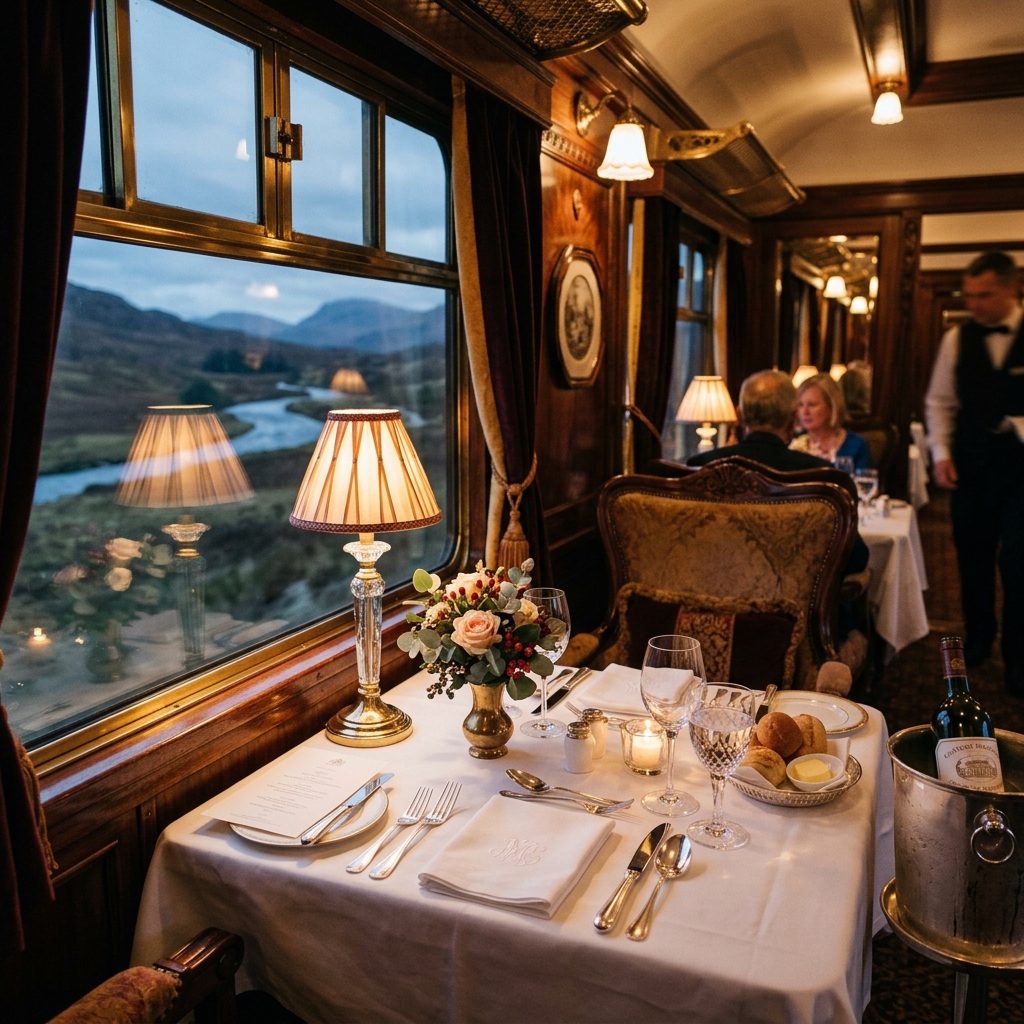
There’s a particular feeling that arrives somewhere in the small hours aboard a well-appointed sleeper train. The berth is dark, the field outside is invisible, and the only sensation is the gentle sway of the carriage through a country you can’t quite identify from the dark. You’re neither here nor there. The journey, as Alain de Botton once argued, has become the point.
Europe has more genuinely luxurious rail experiences than any other continent. The global luxury travel market reached $1.2 trillion in 2024 (Statista, 2024), and a growing proportion of that spending is moving away from business-class flights and toward slower, more considered journeys, trains among them. This is not a nostalgia trend. It’s a recognition that arriving rested, having eaten well, having watched an entire country pass your window over twelve hours, is a qualitatively different kind of travel.
This guide covers seven European luxury train experiences: what each one actually offers, what it costs, how honest those prices are, and how to book before everyone else does.
TL;DR: Europe’s best luxury train experiences range from the Venice Simplon-Orient-Express (from £3,530/person, Paris to Venice, all meals included) to the Trenitalia Frecciarossa 1000 Executive Class (from €79, genuinely excellent value). Book the VSOE 6-12 months ahead. The Glacier Express Excellence Class and Belmond Royal Scotsman sit in between, exceptional but honest about what they offer. (Belmond, 2026)
Table of Contents
- What Actually Makes a Train Journey Luxury?
- Venice Simplon-Orient-Express: The Gold Standard
- Glacier Express Excellence Class: Swiss Luxury at Altitude
- Belmond Royal Scotsman: Scotland’s Rolling Country House
- Bernina Express Panorama Car: Accessible Luxury on a UNESCO Route
- OBB Nightjet Deluxe Sleeper: Civilised Overnight Travel
- Renfe AVE Preferente Class: Spain’s Good-Value High-Speed Luxury
- Trenitalia Frecciarossa 1000 Executive Class: Italy’s Most Accessible Luxury
- How to Compare These Experiences
- How to Book Luxury Train Journeys in Europe
- Worth It vs. Overrated: An Honest Assessment
- Frequently Asked Questions
What Actually Makes a Train Journey Luxury?
The word “luxury” gets attached to train travel with alarming ease. Some operators use it to describe a clean seat and a complimentary water bottle. The distinction matters, because the price gap between a genuine luxury train experience and a rebranded first class can be substantial, and the difference in what you actually get is even larger.
Genuine luxury on a train comes down to five elements, and the best journeys deliver all five.
Service
Luxury service on a train looks like a named cabin steward who knows your berth preference before you board. It looks like dinner reservations already made, luggage transferred without you touching it, and breakfast appearing at the time you specified rather than when the trolley happens to pass. The Venice Simplon-Orient-Express assigns a steward to each sleeping car; they’re available through the night. That’s service. A seat in a quiet carriage with a marginally wider armrest is not.
Exclusivity
The most exclusive train experiences in Europe carry remarkably few people. The Belmond Royal Scotsman accommodates 36 guests. The VSOE carries roughly 100 passengers per departure, fewer people per journey than fill a single 737. Exclusivity creates the conditions for personalised attention. It also means the experience is genuinely rare, which matters when you’re spending serious money.
Scenery
Scenery is a distinguishing variable that money alone can’t manufacture. The Glacier Express crosses the Oberalp Pass at 2,033 metres. The Bernina Express reaches 2,253 metres before descending past palm trees into Italy. The Royal Scotsman winds through the Cairngorms and along the Scottish west coast. These are journeys where what passes your window justifies the journey independently of anything else on board.
Food
The quality of food on luxury trains varies more than the brochures suggest. In our experience, the VSOE’s four-course silver service dinner in the Lalique dining cars is genuinely outstanding, not “good for a moving train” but good in the way that good restaurants are good. The Glacier Express Excellence Class five-course meal is thoughtfully sourced and well-executed. We’ve found that the overnight sleeper food experiences, the Nightjet breakfast, the Royal Scotsman’s dinner, are consistently more ambitious than most passengers expect.
Time
This is the element that separates luxury train travel from luxury air travel most completely. Time on a luxury train is not dead time. It’s not a delay to be endured. The eight hours of the Glacier Express and the twenty-four hours of the VSOE are the product. The journey is the stay. If you approach luxury train travel expecting to arrive quickly, you’ve misunderstood what’s being offered.
Citation capsule: The global luxury travel market was valued at $1.2 trillion in 2024 and is projected to grow at 7.9% annually through 2030 (Statista, 2024). Within this, slow and experiential travel, including luxury train journeys, is among the fastest-growing segments, driven by travellers aged 35-60 seeking experiences over destinations.
Venice Simplon-Orient-Express: The Gold Standard
The Venice Simplon-Orient-Express is the benchmark against which every other luxury train in Europe measures itself, and most fall short. Operated by Belmond (acquired by LVMH for $3.2 billion in 2019), it runs restored 1920s and 1940s carriages from Paris to Venice with all meals included, from approximately £3,530 per person. (Belmond, 2026)
[IMAGE: Exterior of the Venice Simplon-Orient-Express on a European station platform showing navy blue and gold carriages, search terms: “venice simplon orient express platform paris station”]
What’s Included
Every VSOE fare includes all meals: continental breakfast delivered to your cabin, a multi-course lunch, and a four-course dinner in the dining cars served in silver service across two sittings. A champagne reception greets you on boarding. Your cabin steward converts the berth between day and night configurations, is available around the clock, and will bring tea or coffee at any hour without being asked twice.
Wines at dinner are not included, they’re charged separately, and the wine list is excellent, so budget accordingly.
The Cabins
Historic Twin Cabin: The entry-level option and what most passengers book. Small by hotel standards, this is a 1920s carriage, not a Hilton, with two beds (one converts to a sofa by day), a washbasin, and a window that frames Europe beautifully. Correct and appropriate. Don’t book expecting space you won’t get.
Grand Suite: Larger bedroom area, separate seating, considerably more storage. The upgrade is real. Prices reflect it.
L’Observatoire: An entire converted carriage for two passengers only. Private butler, glass observation platform, separate lounge. The most exclusive booking available on any train in Europe.
What to Wear
Dinner is formal. Black tie is expected and the majority of passengers honour it. This is not enforced with any particular rigidity, but jeans at the dinner sitting will make you feel conspicuous. Daytime is smart casual; the bar car after dinner trends toward the dressed end of that spectrum.
The Route
The flagship journey runs London to Venice in approximately 24 hours, departing London Victoria in the morning and arriving Venice Santa Lucia the following evening. From Paris, the journey is roughly 15 hours overnight. Both the Lalique dining cars and the bar car, pianist on most departures, are worth staying up for.
Citation capsule: The Venice Simplon-Orient-Express operates restored carriages from the 1920s and 1940s on routes between London, Paris, and Venice, with extensions to Vienna, Prague, Budapest, and the annual Paris-Istanbul grand journey. Operated by Belmond (an LVMH subsidiary), the train carries approximately 5,000-7,500 passengers per year across 50-75 departures per season, making it one of the rarest luxury travel experiences in Europe by passenger volume. (Belmond, 2026)
Book: 6-12 months ahead for summer (June-August) departures; 3-6 months for shoulder season. The annual Paris-Istanbul journey sells out within days of schedule release, typically 12+ months ahead.
Glacier Express Excellence Class: Swiss Luxury at Altitude
The Glacier Express Excellence Class adds a CHF 480+ supplement to the standard Glacier Express fare for a private observation dome car, a personalised five-course meal with paired wines, and a dedicated carriage host, all while crossing 291 km of Swiss Alps between Zermatt and St. Moritz at an average of 36 km/h. (Glacier Express, 2026)
Complete Glacier Express guide
What Excellence Class Offers
The Excellence Class carriage is a purpose-built panoramic dome car with improved glass-ceiling seating. The five-course meal is a proper restaurant experience, Alpine charcuterie, locally sourced cheese courses, Swiss-produced wines, served at your seat while the Oberalp Pass or the Surselva gorge scrolls past the dome windows. A dedicated host manages the carriage throughout the journey.
The route itself does most of the work. The Glacier Express crosses 291 bridges and passes through 91 tunnels. It reaches 2,033 metres at the Oberalp Pass. The Rhaetian Railway section is a UNESCO World Heritage Site. (UNESCO, 2008) No other regularly scheduled European train journey packs this density of engineered spectacle into a single day.
Is Excellence Class Worth the Premium Over First Class?
This is the honest question. First class on the Glacier Express has panoramic windows that are only marginally smaller than the Excellence dome, costs CHF 265 versus CHF 480+, and lets you order from the same kitchen on a pay-as-you-go basis. The Excellence premium is primarily for the dome ceiling, the pre-arranged meal experience, and the dedicated host. If you’re celebrating something or travelling with a partner, the case for Excellence is strong. For a solo rail pass traveller doing a broader Swiss circuit, first class is the smarter spend.
Citation capsule: The Glacier Express Excellence Class runs between Zermatt and St. Moritz in approximately 8 hours, offering panoramic dome seating and a five-course meal for a supplement of CHF 480+ above the standard fare. The route crosses the Oberalp Pass at 2,033 metres, traverses 291 bridges and 91 tunnels, and includes sections of the Rhaetian Railway, a UNESCO World Heritage Site since 2008. (Glacier Express, 2026)
Book: 2-3 months ahead for summer Excellence Class seats, which sell out faster than any other accommodation on the train. Winter availability is more flexible.
Belmond Royal Scotsman: Scotland’s Rolling Country House
The Belmond Royal Scotsman is one of the most intimate luxury train experiences anywhere in the world. It carries a maximum of 36 guests, on itineraries of two to seven nights, through the Highlands, along the west coast, and past the Cairngorms, with whisky tastings, private station stops, and a level of personal service that’s impossible to replicate on a larger train. Prices start from around £1,500 per person per night. (Belmond, 2026)
[IMAGE: The burgundy and cream Belmond Royal Scotsman train at a Highland station with mountains in the background, search terms: “belmond royal scotsman highland scotland luxury train”]
What Makes It Different
The Royal Scotsman is the only multi-night rail experience in the British Isles at this level. It doesn’t connect two cities; it is the destination. The itineraries are designed around Scotland’s fields and producers: distillery visits, private estate dinners, fly-fishing on Highland rivers. The 36-guest limit means the crew outnumbers passengers on shorter itineraries, the ratio of attention to paying guest is extraordinary.
The train itself feels more like a country house than a hotel room. The observation car, with its open platform and armchairs, is where most evenings end. Dinner is served in a single sitting, formally, with Scottish produce, venison, smoked salmon, Aberdeen Angus, Stornoway black pudding, prepared in a kitchen the size of a broom cupboard by a chef who seems genuinely undaunted by the challenge.
The Royal Scotsman operates on the national rail network, which means it sometimes shares lines with commuter trains. This creates a peculiar and rather wonderful contrast: pulling into a Highland station on a seven-night rolling house party while a woman with a shopping bag waits on the same platform for the 16:42 to Inverness. Scotland remains undramatic about itself in this regard, which is part of its appeal.
The Itineraries
Itineraries run from two nights (the Classic two-night Highland Journey) to seven nights (the Grand North Britain tour). Departure dates are limited, typically one or two per week during the April-to-October season. The longer itineraries access more remote sections of the Scottish network: the Kyle of Lochalsh line, the West Highland Line to Mallaig, the Borders Railway in the south. These are some of the most beautiful rail routes in Europe and most travellers never ride them.
Book: 6-12 months ahead for peak summer and the longer itineraries. Royal Scotsman bookings can be made through Belmond directly or through specialist rail agents.
Bernina Express Panorama Car: Accessible Luxury on a UNESCO Route
The Bernina Express Panorama Car is the best argument for accessible luxury rail travel in Europe. A CHF 16-22 reservation supplement above the standard fare buys panoramic glass-roof windows on a UNESCO World Heritage route that crosses the Bernina Pass at 2,253 metres, the highest transalpine railway crossing in the world, before descending past palm trees into Tirano, Italy. (Rhaetian Railway, 2026)
Complete Bernina Express guide
What the Panorama Car Adds
Standard Bernina Express carriages have large windows. The Panorama Car has glass that extends into the roof, giving a wider arc of sky, crucial on a route that spends significant time above the treeline, where the sky is as dramatic as the ground. The supplement is genuinely modest for a UNESCO-listed route that takes under four hours and requires no overnight stay.
The route runs from Chur or St. Moritz to Tirano in Italy (some services continue to Lugano). The Rhaetian Railway section through the Alps has been a UNESCO World Heritage Site since 2008, recognised for engineering that integrates narrow-gauge track into terrain that should have been impassable. (UNESCO, 2008)
The Honest Case for the Bernina
This is not the VSOE. There’s no silver service dinner, no cabin steward, no champagne on boarding. What there is: four hours of some of the most consistently dramatic mountain scenery in Europe, a UNESCO-listed engineering route, and panoramic windows that make the most of all of it. At CHF 16-22 extra, the Panorama Car is the easiest upgrade decision on this list.
Citation capsule: The Bernina Express Panorama Car requires a reservation supplement of CHF 16-22 above the standard Bernina Express fare, providing panoramic glass-roof carriages on the Chur-to-Tirano route. The Rhaetian Railway operating the route has been a UNESCO World Heritage Site since 2008, and the line crosses the Bernina Pass at 2,253 metres, the highest altitude transalpine railway in the world. (Rhaetian Railway, 2026)
Book: 4-6 weeks ahead in summer; winter availability is more relaxed. Book at sbb.ch or rhb.ch.
OBB Nightjet Deluxe Sleeper: Civilised Overnight Travel
The OBB Nightjet Deluxe Sleeper is the best night train experience currently operating regular scheduled service in Europe. A private cabin for two with a shower, breakfast included, and arrival in the morning city-centre station rested and oriented, from around €199 per cabin. (OBB, 2026)
What the Deluxe Sleeper Offers
The Nightjet Deluxe cabin is a genuine private compartment: fold-down beds, a small fold-out table, privacy lock, and an en suite shower room with a proper showerhead, not the cupboard spray that older sleeper carriages manage. Breakfast is included and arrives in the cabin. The network covers routes including Vienna-Berlin, Vienna-Brussels, Vienna-Paris, Zurich-Amsterdam, and a growing number of other central European connections.
This is not extravagant luxury. The cabin is compact. The facilities are modern rather than opulent. But “civilised” is the right word. You board in the evening, sleep in a private space, shower before arrival, and step onto the platform at your destination ready for the day. The Nightjet does what it promises efficiently, at a price that compares favourably with a hotel room plus a standard rail ticket on the same route.
OBB carried over 1.8 million Nightjet passengers in 2024, a 23% year-on-year increase driven by the expansion of the Deluxe cabin product to additional routes. (OBB, 2025) The growth reflects genuine demand rather than novelty, overnight rail consistently outperforms same-day rail on passenger satisfaction surveys when private cabin accommodation is available.
What It’s Not
It’s not the VSOE. There are no Lalique glass panels, no piano bar, no silver service. The Nightjet Deluxe is a well-designed, practical, genuinely private overnight rail experience that saves you a hotel night while connecting major European cities. That’s the pitch. It’s a very good pitch.
Book: 3-6 months ahead for peak summer on popular routes (Vienna-Paris books fastest). Off-peak routes have same-week availability on most services.
Renfe AVE Preferente Class: Spain’s Good-Value High-Speed Luxury
Renfe’s AVE Preferente class is the most underrated rail product on this list. Wider seats, a full meal service at your seat, a quieter carriage, and genuinely attentive service, on routes like Madrid to Barcelona (2.5 hours) or Madrid to Seville (2.5 hours), for a premium that rarely exceeds €40-60 over the standard fare. (Renfe, 2026)
What Preferente Delivers
The Preferente cabin feels more like a premium airline cabin than a train carriage. Seats are wide and recline substantially. A meal is included and served to your seat, starter, main, dessert, coffee, with a drinks service. The carriage is quieter by design. On a 2.5-hour Madrid-Barcelona run, this is a genuinely comfortable, focused way to travel.
AVE high-speed services on the main Spanish corridors run at up to 300 km/h. The trains are the Talgo 350 and Velaro E units, modern, smooth, reliable. Preferente is not a heritage experience or a scenic wonder. It’s the best practical luxury rail product in Western Europe by cost-to-quality ratio.
The Honest Case for Preferente
For business travellers or anyone who wants to arrive composed rather than crumpled, Preferente is a straightforward upgrade. The price premium is small enough that it barely registers against the total cost of a Spain trip. Spain’s AVE network is also underused by international visitors, who tend toward flying. This is their loss.
Book: AVE Preferente tickets are available on renfe.com from 90 days before departure. Prices are dynamic; early booking rewards you.
Trenitalia Frecciarossa 1000 Executive Class: Italy’s Most Accessible Luxury
The Trenitalia Frecciarossa 1000 Executive Class is the most accessible luxury experience on this list. From €79, you get a full meal at your seat, access to premium lounges at Roma Termini, Milano Centrale, and other major stations, wider seats in a dedicated four-seat carriage section, and attentive service on Italy’s fastest trains, running Milan to Rome in under 3 hours at up to 300 km/h. (Trenitalia, 2026)
What Executive Class Includes
Executive Class sits above Business Class on the Frecciarossa and is set apart physically, a dedicated carriage section with just four seats across the width, a significant space upgrade over the rest of the train. A full meal is included: antipasto, primo, secondo, dessert, coffee, and a drinks service that includes wine. The meal quality is genuinely good, not airline-food good. Trenitalia sources regionally and the kitchen takes the brief seriously.
The station lounges at Roma Termini and Milano Centrale are a genuine benefit for Executive passengers. Both are quiet, well-appointed, and considerably more pleasant than the main concourse. If you’re connecting trains or waiting out a delay, they earn their keep.
The Price Argument
At €79 (when booked early on popular routes), Executive Class costs approximately what you’d pay for a reasonable airport transfer plus airport lounge access in the same Italian cities, and it delivers a full meal and a 3-hour train journey between them. The value is real. No other luxury experience on this list approaches it for cost-effectiveness. The Frecciarossa Executive is where you send someone who’s never experienced luxury train travel but isn’t sure they want to spend VSOE money to find out.
Book: Trenitalia’s dynamic pricing means early booking is rewarded significantly. The €79 floor price disappears quickly on popular routes. Book via trenitalia.com or through Raileurope.
How to Compare These Experiences
How to Book Luxury Train Journeys in Europe
Most travellers underestimate lead times. For the genuinely exclusive experiences, the VSOE, the Royal Scotsman, Glacier Express Excellence Class in summer, booking at the last moment means choosing between no availability and the most expensive options, which is the worst possible position.
Most scenic train routes in Europe
The VSOE and Royal Scotsman: Book Direct or Through a Specialist Agent
For Belmond products, booking directly through belmond.com gives full availability and the ability to select specific departure dates. Specialist agents, Tailor Made Rail, Railbookers, Luxury Train Club, sometimes hold allocations on sold-out departures and are particularly useful for building multi-destination itineraries around a luxury train centrepiece. Agents are worth the call if you’re flexible on dates and want access to fuller availability.
The Swiss Scenic Trains: Use the Official Channels
Glacier Express tickets and Excellence Class reservations book through glacierexpress.ch or sbb.ch. Eurail and Interrail pass holders must book the mandatory reservation fee separately, the SBB system handles this most reliably. The Bernina Express Panorama Car reservation goes through the same channels. For both trains, availability opens 365 days ahead.
The High-Speed Luxury Products: Book Early, Book Online
Frecciarossa Executive and AVE Preferente operate dynamic pricing: the best seats at the best prices go first. Both trenitalia.com and renfe.com open bookings 90-120 days ahead of departure. Early booking on popular routes (Milan-Rome, Madrid-Barcelona) can save 40-60% versus booking in the week before travel.
The Nightjet Deluxe: Book at the 3-6 Month Mark
OBB Nightjet Deluxe cabins are limited per train, typically four to six private cabins per service. On popular routes like Vienna-Paris and Zurich-Amsterdam, these sell out 3-4 months ahead of peak summer travel. The oebb.at website and the Nightjet app both handle bookings, as does the DB (German rail) booking system for routes touching Germany.
Citation capsule: Booking lead times for European luxury trains vary significantly by product: the Venice Simplon-Orient-Express requires 6-12 months for peak summer departures, with the annual Paris-Istanbul journey selling out within days of schedule release (Belmond, 2026). Glacier Express Excellence Class seats sell out an average of 11 weeks ahead of departure for July-August dates (Glacier Express, 2026). The Frecciarossa Executive Class requires booking 90+ days ahead for the lowest fares (Trenitalia, 2026).
Worth It vs. Overrated: An Honest Assessment
Not every experience that calls itself luxury train travel earns the description. Here’s the unvarnished take.
Worth It
Venice Simplon-Orient-Express: Yes, unconditionally. The carriages are nearly 100 years old. The dining car experience is irreproducible. The arrival into Venice Santa Lucia across the lagoon after 24 hours is one of the great journey endings in European travel. The VSOE is not overpriced relative to comparable luxury experiences; it’s priced correctly for what it is.
Belmond Royal Scotsman: Worth it for the right traveller. If you want a multi-day experience, prefer intimacy over scale, and are genuinely interested in Scotland, this is one of the world’s finest experiences. If you’re looking for a single-night treat, the price-per-night makes it hard to justify versus alternatives.
OBB Nightjet Deluxe: Worth it every time you can make the routing work. €199 for a private cabin, shower, and breakfast that connects major European cities while you sleep is not a luxury indulgence, it’s the most rational overnight travel decision in Europe.
Bernina Express Panorama Car: Worth it easily. CHF 16-22 is the lowest barrier to entry on this entire list and the scenery is UNESCO-calibre. This is not even a close call.
Qualified
Glacier Express Excellence Class: Worth it if you’re celebrating something or can share the cost. Not worth it as the default choice if you’re a solo rail pass traveller doing Switzerland on a broader circuit. First class serves most travellers better at that price point.
Frecciarossa Executive and AVE Preferente: Worth it at their standard prices. Both can occasionally feel like well-organised first class rather than genuine luxury if the service team is having an average shift. They’re excellent products, but call them premium rather than luxury if you want to be precise.
Overrated (Elsewhere on the Market)
Several European operators market “luxury” products that are, on examination, standard first class with table service rebranded. The tell is in the passenger numbers: genuine luxury train experiences are defined by scarcity. If a product runs 500 passengers through the same itinerary every week at a “luxury” price, the word is being used loosely. The VSOE carries 100 passengers per departure for a reason. The Royal Scotsman carries 36. Scarcity is not accidental, it’s the mechanism that enables genuine service quality.
Before booking any “luxury” rail product not on this list, ask: how many passengers per departure? What’s the cabin-to-staff ratio? Is the meal included or charged separately? The answers will tell you whether you’re booking luxury or buying a label.
Complete guide to Europe by train
Related Reading
- Amtrak Coast Starlight: The Complete Guide to America’s Most Scenic Train, The Coast Starlight runs 35 hours from Los Angeles to Seattle through California’s coast and the Cascades.
- The Best Scenic Train Routes in the USA: A Guide to America’s Great Rail Journeys, Amtrak’s long-distance trains are slow by European standards, frequently delayed, and entirely worth taking.
- California Zephyr: America’s Most Scenic Train, The California Zephyr covers 2,438 miles from Chicago to San Francisco in 51 hours across 7 states.
Frequently Asked Questions
What is the most luxurious train in Europe?
The Venice Simplon-Orient-Express is the consensus answer, and it’s correct. The 1920s and 1940s carriages, restored, maintained, still running on the original routes, are irreplaceable. No other European train combines the heritage, the service level, the dining experience, and the overnight journey format in the same way. Belmond’s VSOE carries approximately 5,000-7,500 passengers per year across all departures, making it mathematically rare as well as qualitatively exceptional. (Belmond, 2026)
How far in advance should I book a luxury train journey in Europe?
It depends on the experience. The VSOE requires 6-12 months for peak summer departures. The Belmond Royal Scotsman is similar. Glacier Express Excellence Class sells out 11 weeks ahead of July-August departures on average. The Nightjet Deluxe needs 3-4 months for popular routes. The Frecciarossa Executive and AVE Preferente reward early booking for price, not availability, they rarely sell out completely but early booking saves 40-60% on dynamic fare routes. (Glacier Express, 2026)
Are Eurail passes valid on luxury trains?
Partially. The Glacier Express and Bernina Express accept Eurail and Interrail passes for the base fare, with mandatory reservation supplements (CHF 49-59 for Glacier Express peak season). The VSOE does not accept rail passes, it’s a fully private charter service. The Frecciarossa and AVE are covered by Eurail with a reservation supplement. The Nightjet is covered by Eurail passes with a reservation fee. The Royal Scotsman is a private Belmond product and does not participate in any pass scheme. (SBB, 2026)
What’s the most affordable luxury train experience in Europe?
The Trenitalia Frecciarossa 1000 Executive Class, from €79 with early booking. A full meal, wider seats in a four-seat carriage section, station lounge access, and Milan-to-Rome in under three hours. (Trenitalia, 2026) The Bernina Express Panorama Car is similarly accessible at a CHF 16-22 supplement, UNESCO-listed scenery, four hours, and panoramic glass-roof windows for the price of a round of drinks.
Can I combine multiple luxury train experiences in one European trip?
Yes, and this is often the best way to structure a European rail itinerary. A logical combination: Frecciarossa Executive from Milan to Rome (day one), a few days in Rome, then the VSOE from Paris to Venice (book separately). Or: Glacier Express Excellence Class between Zermatt and St. Moritz, followed by the Bernina Express Panorama Car from St. Moritz to Tirano and onward into Italy. The Swiss rail network connects naturally to Italian high-speed services via the Gotthard Base Tunnel.
Before You Book
Luxury train travel in Europe rewards the traveller who plans. The experiences at the top of this list, the VSOE, the Royal Scotsman, book up with a lead time that surprises most people until they’ve missed a departure they wanted. The simpler upgrades, Frecciarossa Executive, AVE Preferente, Bernina Panorama Car, are more forgiving, but still benefit from early booking for best prices and best seats.
What unites every experience on this list is that the journey is the point. Not the fastest way to get somewhere. Not the most efficient. The way that leaves you, at the end of it, with an account of how you actually got there, through what mountains, at what hour, past what field, in whose company. That’s the argument for luxury train travel, and it doesn’t get old.