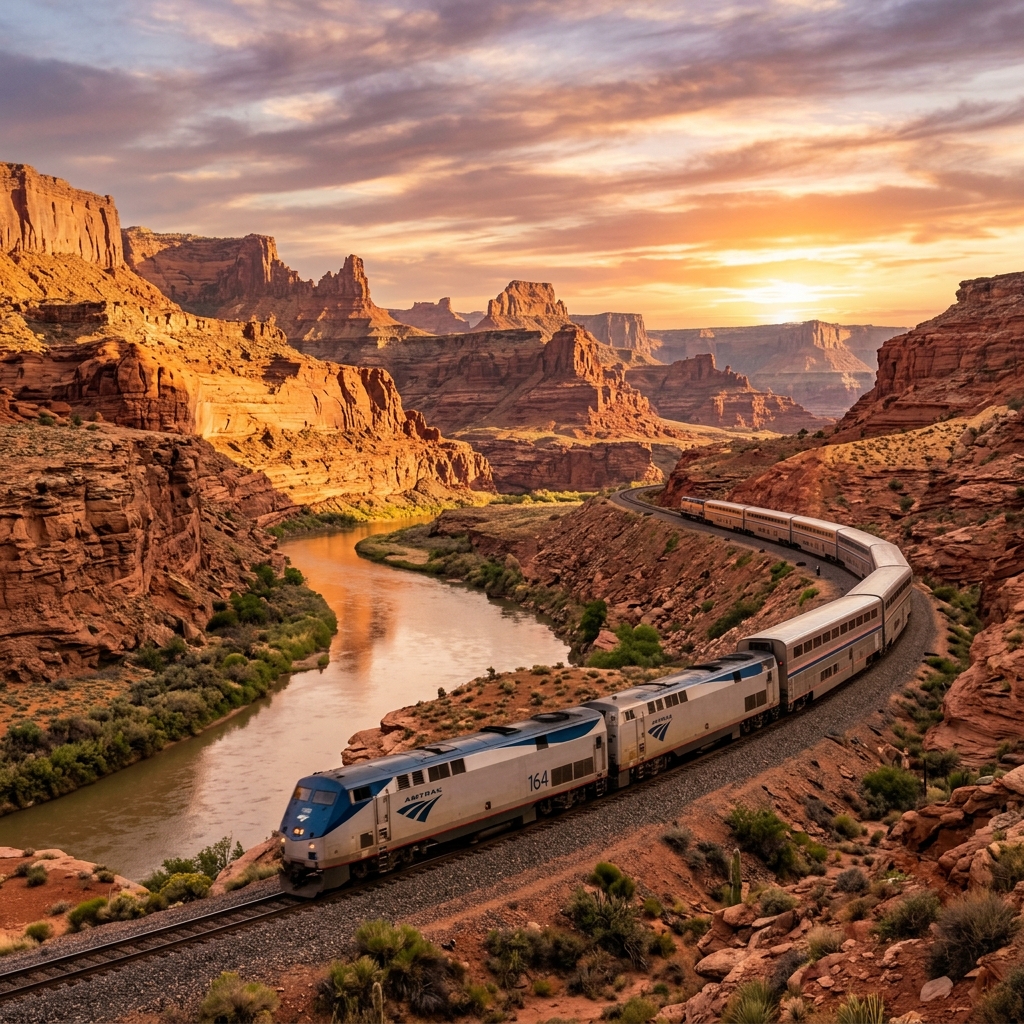
America has a complicated relationship with its passenger trains. Congress created Amtrak in 1971 precisely because private railroads had stopped caring whether their passenger services survived. The freight railroads that inherited the tracks kept them, and kept the legal right-of-way that means an Amtrak train must yield when a Union Pacific freight decides it needs the same piece of track. That’s why long-distance Amtrak trains run late. It’s structural, not accidental.
And yet. The trains are worth taking. Not despite their slowness, but partly because of it. A flight from Chicago to San Francisco takes five hours and shows you the cloud layer. The California Zephyr takes fifty-one hours and shows you Nebraska, the Rockies, Glenwood Canyon, the salt flats of Utah, and the Sierra Nevada in the final afternoon. These are not equivalent experiences. One transports you. The other travels with you.
What follows is a guide to the routes that justify the case for American rail, the trains that show you the continent rather than passing over it.
TL;DR: The USA’s best scenic train routes, the California Zephyr, Empire Builder, Coast Starlight, and Southwest Chief, collectively cover over 8,000 miles of American field unavailable from any aircraft. Amtrak carried a record 33 million passengers in FY2024 (Amtrak, 2024). Sleeper accommodation sells out months ahead on popular summer departures; book at Amtrak.com as early as possible.
The California Zephyr: Chicago to San Francisco
The California Zephyr covers 2,438 miles in approximately 51 hours across seven states, making it the longest and most scenically varied single train journey in the United States (Amtrak, 2026). No other Amtrak route compresses so many distinct American fields into one continuous experience. This is the train you take when you want to understand what lies between the coasts.
The route divides into four acts, each with its own character. Nebraska’s plains run mostly overnight for westbound passengers, which is, honestly, convenient. The Rockies begin arriving around Denver and build for seven hours through Gore Canyon and then Glenwood Canyon. Utah brings desert and salt flats. The Sierra Nevada closes the journey with a four-hour mountain descent into the Bay Area.
Glenwood Canyon: Where Everyone Stops Talking
Glenwood Canyon is the twelve-mile section of the journey, roughly near Glenwood Springs, Colorado, where the train enters a vertical-walled canyon above the Colorado River. The canyon walls rise 1,300 feet. The river runs alongside the track the entire length. It took 12 years and $490 million to build the highway through this canyon (Colorado Department of Transportation, 1992); the railroad has been there since 1887. When the canyon begins, even the most phone-absorbed passengers put their screens down.
Best Seats and Roomette vs Coach
For westbound travel, the left (south-facing) side of the train positions you toward the Colorado River in Glenwood Canyon and the canyon walls, rather than the hillside. Request this when booking a roomette. For the Sightseer Lounge, the glass-domed observation car open to all passengers, arrive 20 to 30 minutes before the Canyon section begins and you’ll find a window seat.
The roomette question for a 51-hour train is not really a question. Coach seats are wide and recline more generously than any airline seat; they’re tolerable for a night. For two nights, the calculus changes. The roomette costs more but includes all meals in the dining car, three courses at a proper table, with strangers who become, over the course of Colorado and Utah, briefly fascinating. That’s not an abstraction. It’s the best part of the train.
Citation Capsule: The California Zephyr runs daily between Chicago Union Station and Emeryville, California, a distance of 2,438 miles across Illinois, Iowa, Nebraska, Colorado, Utah, Nevada, and California. The scheduled westbound journey time is 51 hours 23 minutes. Coach fares start around $60–$150; roomettes run $200–$600+ per person, including all meals (Amtrak, 2026).
The Empire Builder: Chicago to Seattle and Portland
The Empire Builder covers 2,206 miles on a route that splits at Spokane, Washington, one branch continuing to Seattle, the other to Portland, making it the only major Amtrak route with a bifurcated terminus (Amtrak, 2026). At approximately 46 hours, it’s a day shorter than the Zephyr. For many people, it’s the more dramatic train.
[IMAGE: The Empire Builder crossing a trestle bridge through glacier-carved Montana field, search terms: Montana train mountains trestle]
The case for the Empire Builder is Montana. The train crosses the state for most of a day, east to west through the Hi-Line, the flat agricultural strip below the Rocky Mountain Front, with the mountains appearing first as a smear on the horizon and slowly resolving into the Rockies’ northern face. Havre, Montana, at dawn is one of those peculiar Amtrak moments: a small-city station in the early light, cattle country in every direction, the mountains not yet visible. It’s unglamorous. It’s completely worth being awake for.
Glacier Country and the Columbia River Gorge
The stretch through Glacier Country, where the train runs along the southern boundary of Glacier National Park before descending through the mountains to Whitefish, is the Empire Builder’s headline moment. The mountains here are geologically older than the Rockies further south, which gives them a different character: broader, more rounded, cut through by glacial valleys that open suddenly from the train window.
The Portland branch descends the Columbia River Gorge in the final hours before arrival. The gorge is 80 miles long and up to 4,000 feet deep, carved by the Columbia River through the Cascade Range. In autumn, this section has a quality of light, the river flat and wide, the walls changing colour, that justifies the entire journey.
Dining Car Culture on the Empire Builder
The Empire Builder has long represented Amtrak dining at its most American. Assigned seating in the dining car means you sit with whoever the attendant directs you toward, a practice that produces conversations you’d never engineer deliberately. Two retired schoolteachers from Minnesota. A couple relocating to Portland. A man who’s ridden the Builder every year for twenty years and can’t explain why he keeps coming back. This is the social dimension of American rail travel that has no European equivalent. European trains are transport. The Empire Builder is, at its best, a moving community.
Citation Capsule: The Empire Builder (Amtrak train #7/#8) runs daily between Chicago Union Station and Seattle King Street Station / Portland Union Station, covering 2,206 miles in approximately 46 hours. The route passes through Wisconsin, Minnesota, North Dakota, Montana, Idaho, and Washington/Oregon. It is consistently one of Amtrak’s highest-ridership long-distance routes (Amtrak FY2024 Annual Report, 2024).
The Coast Starlight: Seattle to Los Angeles
The Coast Starlight runs 1,377 miles between Seattle and Los Angeles in approximately 35 hours, making it the shortest of the major transcontinental Amtrak journeys and, mile for mile, one of the most geographically rich (Amtrak, 2026). It’s the Pacific coast route, though, as on many American trains, “coast” requires some interpretive generosity.
[IMAGE: The Coast Starlight train passing through the Cascades with snowcapped peaks, search terms: amtrak coast starlight cascades oregon]
The train runs through the Cascades in Oregon, traversing volcanic terrain that includes the Cascades’ long ridge of peaks. Mount Shasta appears in the distance as the train crosses into California, 14,179 feet, snowcapped most of the year, visible for over an hour from the right side of the train. The Central Valley of California is agricultural and flat, less conventionally scenic, but the Sierra Nevada is visible to the east throughout, a hundred miles of mountains hanging in the air above the farmland.
The Parlour Car: What Makes the Coast Starlight Different
The Coast Starlight is the only Amtrak train that retains a dedicated parlour car for sleeper-class passengers, the Pacific Parlour Car. It’s a lower-level lounge with wine, cheese, and film screenings in the evenings. This detail matters because it changes the social character of the train. The parlour car creates an optional gathering space that isn’t the dining car or the coach lounge, somewhere to sit with a glass of California wine and watch Oregon pass by. It’s an idea that makes so much sense you wonder why every long-distance train doesn’t have one.
Arriving at Los Angeles Union Station
Los Angeles Union Station, where the Coast Starlight terminates, is one of the great American railway stations, built in 1939 in a Spanish Colonial Revival and Simplify Moderne style, with a vast, tiled waiting room and gardens that feel incongruous and exactly right in the middle of Los Angeles. It’s worth arriving rather than departing from, if your itinerary allows. The station has been carefully preserved and is open to anyone who wants to walk through it.
Citation Capsule: The Coast Starlight (Amtrak train #11/#14) runs daily between Seattle King Street Station and Los Angeles Union Station, covering 1,377 miles in approximately 35 hours through Washington, Oregon, and California. It is notable for the Pacific Parlour Car, a dedicated lounge for sleeper-class passengers unique among Amtrak’s long-distance fleet (Amtrak, 2026).
The Southwest Chief: Chicago to Los Angeles
The Southwest Chief covers 2,265 miles in approximately 43 hours through the heart of Route 66 country, Kansas, Colorado, New Mexico, Arizona, and California (Amtrak, 2026). Of the four major long-distance routes, the Chief has the most distinctive cultural texture: this is the train through the American Southwest, through adobe and canyon country, through the geography that shaped O’Keeffe and Ansel Adams.
[IMAGE: New Mexico desert landscape with red rock formations from a train window, search terms: new mexico desert canyon train southwest]
Kansas is the honest middle of the journey, flat, vast, agricultural, and philosophically important. You can’t understand the American prairies from a highway or a plane. At train speed, at ground level, the scale of the high plains becomes comprehensible in a way it otherwise doesn’t. This is what the journey is for. Most passengers sleep through Kansas, which is understandable, but the traveler who stays awake for the sunrise over the grasslands has seen something genuine.
New Mexico: The Most Distinctive Section
The train crosses Raton Pass, the historic gateway between the Great Plains and the Southwest at 7,835 feet above sea level, in the early hours of the second morning westbound. Daylight arrives over New Mexico’s high desert: red and tan and ochre, a field that looks like nothing in Europe or Asia. The train passes through Lamy (the stop for Santa Fe, 20 miles north by shuttle bus) and Albuquerque, where the station has its own remarkable detail.
Albuquerque: The Jewellery Platform
The Albuquerque stop is the only station in the Amtrak network where a formal, Amtrak-partnered programme allows Native American artists to sell jewellery, pottery, and crafts directly on the platform. The arrangement has been in place for decades. When the train pulls in, the artists are there, their work laid out on blankets along the platform, and passengers have the length of the stop to browse. This is not a tourist trap. These are working artisans, and the prices reflect the work rather than the captive audience. It’s one of the more unusual and worthwhile things Amtrak has ever done.
Flagstaff, Arizona, the last major stop before the Mojave Desert and California, provides access to the Grand Canyon via shuttle bus (approximately 80 miles north). The Grand Canyon Railway also departs from Williams, a short drive from Flagstaff. Neither option is smooth, but for travelers not in a hurry, the combination of the Southwest Chief and a Grand Canyon visit is a logical and rewarding pairing.
Citation Capsule: The Southwest Chief (Amtrak train #3/#4) runs daily between Chicago Union Station and Los Angeles Union Station, covering 2,265 miles in approximately 43 hours through Illinois, Kansas, Colorado, New Mexico, Arizona, and California. Albuquerque station hosts a formal Amtrak partnership with Native American artisans who sell crafts directly on the platform, the only such arrangement in the national rail network (Amtrak, 2026).
Shorter Scenic Journeys: Regional and State Trains
Long-distance Amtrak trains are the headline act, but the USA has a supporting cast of regional routes that are, in some respects, easier to plan around. These trains run more frequently, carry less delay risk, and serve the same argument for ground-level travel at a manageable scale.
[IMAGE: Pacific Northwest field along the Cascades corridor with mountains and forest, search terms: pacific northwest train mountains forest]
Amtrak Cascades (Seattle to Vancouver or Portland): Pacific Northwest scenery, Puget Sound, the Cascade foothills, Mount Rainier visible to the east, in 4 hours to Vancouver or 3.5 hours to Portland. Multiple daily departures. This is what Amtrak’s regional network could be everywhere if the infrastructure existed.
Capitol Corridor (San Jose to Sacramento): Bay Area commuter rail with a scenic argument, the train runs along the eastern shore of San Francisco Bay and then through the Sacramento Valley. 2 hours 20 minutes. Useful as a connector from the Bay Area to the California Zephyr terminus at Sacramento.
Adirondack (New York to Montreal): Ten hours from Penn Station through the Hudson Valley and along the shore of Lake Champlain. The Hudson section is one of the most underrated rail journeys in the northeast, the river is wide and the estates along its banks are visible from the train in ways they aren’t from any road. The US-Canada border crossing adds a small amount of procedural interest.
Pere Marquette (Chicago to Grand Rapids): Michigan’s western dunes country in 3 hours 30 minutes. A single daily service each way, which limits flexibility but makes the scheduling constraint easy to plan around.
These are, in the best sense, European-style regional trains: more frequent, more reliable, shorter. They’re the correct introduction to American rail for travelers uncertain about committing to a 40+ hour journey.
How to Plan an Amtrak Long-Distance Trip
The mechanics of Amtrak are different enough from European rail that they’re worth covering directly. Booking through the right channels, understanding accommodation classes, and planning for the delay reality will save you real frustration.
Booking Window and Timing
Amtrak’s booking window opens 11 months in advance for most routes. For sleeper accommodation, roomettes and bedrooms, on summer departures (June through August), this is not a theoretical limit. Popular routes like the California Zephyr and Empire Builder have sold-out sleeper inventory months ahead of peak summer dates. If you’re planning summer travel in a roomette, book in January or February for the best selection.
Coach fares have more availability closer to departure. Amtrak’s Saver fares (non-refundable, no changes) are the cheapest option and appear well in advance; Flexible fares cost more but allow changes. For multi-city itineraries where plans might shift, the Flexible fare’s peace of mind is worth its premium.
Accommodation Classes: The Real Trade-Off
| Class | Price Range | Meals | Private? |
|---|---|---|---|
| Coach | $60–$200 | Café car (pay per item) | No |
| Roomette | $200–$600+ per person | All meals included | Yes |
| Bedroom | $500–$900+ per room | All meals included | Yes, en suite |
The roomette math changes when you factor in dining. Three meals a day in the dining car, included in the fare, for two days. When you subtract what you’d spend eating otherwise, the effective premium over coach narrows considerably. For journeys over 20 hours, the roomette is the financially rational choice for most travelers, not just the comfortable one.
The USA Rail Pass
Amtrak’s USA Rail Pass covers 10 travel segments within 30 days, system-wide. One “segment” is one boarding, a journey with a connection counts as two segments. For travelers planning to ride multiple long-distance routes in sequence, the pass can reduce per-journey costs and simplifies booking. Run the numbers against individual point-to-point fares before committing; it’s worth it for some itineraries and not others. See the full Amtrak USA Rail Pass guide for a complete breakdown of when the pass beats point-to-point.
The Delay Strategy
Only 40.5% of Amtrak long-distance trains arrived within 15 minutes of schedule in FY2023 (Amtrak, 2024). This is the number to know. Build a minimum 3-hour buffer into any connection at either end of a long-distance journey. Don’t book a same-day flight connection from Emeryville after riding the Zephyr. Don’t assume the Empire Builder arrives in Seattle with time to make a Clipper ferry to Victoria.
The delays happen in Nevada. In Montana. In the middle of Kansas. These are not bad places to be delayed. The response is to adjust your planning, not your expectations of the journey.
Why Slow Travel by Train Makes Sense in America
There’s a tendency to think of American rail as a diminished version of something that works better elsewhere, the European high-speed network as the standard against which Amtrak is measured and found wanting. This comparison misses the point entirely.
Europe’s rail network exists to connect relatively close cities efficiently. The distance from Paris to Berlin is roughly the same as Chicago to St. Louis. The California Zephyr covers a distance equivalent to London to Kabul. These are different scales of geography, which produce different kinds of train journeys. The Zephyr isn’t a slow TGV. It’s a different thing.
The real argument for American train travel is about what the continental scale means at ground level. Flying Chicago to Los Angeles, you cross the same distance in four hours and understand it as a flight duration. On the Southwest Chief, you feel the Great Plains give way to the Rockies give way to the desert give way to California over the course of two days. The country becomes comprehensible in a way it isn’t from altitude. You understand why Denver is where it is, why Albuquerque developed as it did, why Los Angeles has the geography it has. This is not information you get from a window seat at 35,000 feet.
Alain de Botton wrote, in The Art of Travel, that the anticipation of a place is often more vivid than the place itself, but that the journey, when it’s slow enough, becomes a kind of place in its own right. The California Zephyr at 2 a.m. crossing the Nevada desert, the train the only light for fifty miles in any direction, is a place. The Empire Builder arriving into Whitefish with the Rockies lit gold in the early morning is a place. These are not transitions between destinations. They’re the destinations.
American rail doesn’t need to compete with European high-speed trains. It needs to be understood for what it is: a slow, occasionally late, magnificent way to see a continent that most of its own inhabitants have never actually seen.
Citation Capsule: Amtrak’s four major long-distance western routes, the California Zephyr, Empire Builder, Coast Starlight, and Southwest Chief, collectively cover approximately 8,286 miles of American field. Amtrak recorded 33 million total passengers in FY2024, its highest ridership in its 53-year history (Amtrak FY2024 Annual Report, 2024), suggesting that appetite for this kind of travel is growing rather than declining.
[CHART: Bar chart, Amtrak long-distance route distances in miles: California Zephyr 2,438 / Southwest Chief 2,265 / Empire Builder 2,206 / Coast Starlight 1,377, Source: Amtrak 2026]
Related Reading
- Amtrak Coast Starlight: The Complete Guide to America’s Most Scenic Train, The Coast Starlight runs 35 hours from Los Angeles to Seattle through California’s coast and the Cascades.
- Amtrak USA Rail Pass: Is It Worth It?, Full breakdown of the 3, 8, and 15-segment passes from $299, when the pass saves money and when point-to-point beats it.
- White Pass & Yukon Route Railway: The Complete Visitor’s Guide, The 1898 Gold Rush narrow-gauge line climbs 2,865 ft in 20 miles from Skagway, Alaska, a short but spectacular ride.
- VIA Rail Canada: The Complete Guide to Cross-Country Train Travel, Canada’s equivalent of Amtrak spans 12,500km and includes the legendary Canadian (Toronto–Vancouver, 4 nights).
- The Bernina Express: Switzerland’s Most Scenic Train Journey, The Bernina Express crosses the Alps from Chur to Tirano in 4 hours, UNESCO-listed, panoramic windows, and views…
- Glacier Express: The Complete Guide to Switzerland’s Famous Slow Train, Switzerland’s Glacier Express takes ~8 hours Zermatt–St.
Frequently Asked Questions
What is the most scenic Amtrak train route in the USA?
The California Zephyr (Chicago to San Francisco) is widely considered the most scenically varied long-distance train in the USA, 2,438 miles across seven states, with Glenwood Canyon, the Colorado Rockies, the Nevada desert, and the Sierra Nevada all appearing in sequence (Amtrak, 2026). The Empire Builder (Chicago to Seattle) is a close second for pure field drama, particularly through Montana’s Glacier Country. The decision between them is mostly a question of which direction you want to go.
How much does an Amtrak long-distance train ticket cost?
Coach seats on Amtrak long-distance trains typically cost $100–$200 for cross-country routes booked several months ahead. Roomettes run $300–$600 per person, including all meals in the dining car. Bedrooms (larger private cabin with en suite toilet, all meals) cost $500–$900+. Book early, sleeper accommodation on summer departures sells out months in advance, particularly on the California Zephyr and Empire Builder (Amtrak, 2026).
Are Amtrak trains reliable?
Amtrak’s long-distance trains are notoriously delayed. In FY2023, only 40.5% of long-distance trains arrived within 15 minutes of schedule (Amtrak, 2024), largely because Amtrak operates on freight railroad infrastructure where freight trains hold legal priority. The situation has been the subject of ongoing legal action and Congressional pressure, with some improvement in recent years. The practical response is simple: build a minimum 3-hour buffer into any connection, and don’t treat the published arrival time as a guarantee.
Is a roomette worth it on Amtrak?
For journeys over 12 hours, yes, without qualification. The roomette includes all meals in the dining car, private space with a closing door, a large picture window, and fold-down beds made up by your car attendant. For the California Zephyr at 51 hours, the roomette isn’t a luxury upgrade, it’s the correct way to take the train. Coach works for budget travelers on shorter overnight journeys; for anything spanning two nights, the roomette’s included meals and genuine privacy make it the rational choice, not just the comfortable one.
Do you need a reservation on Amtrak?
Yes, all Amtrak trains require reservations, including coach seats. Book at Amtrak.com or through the Amtrak app. The booking window opens 11 months in advance for most routes. For sleeper accommodation on peak summer departures, treat the 11-month window as the correct time to book rather than a distant theoretical option. Popular routes sell out. The app is genuinely useful for tracking train position, managing meal reservations, and communicating with your car attendant once you’re on board.
The Trains That Show You America
The California Zephyr first ran in 1949, operated by three private railroads that briefly believed the passenger train was the future of American travel. They were wrong about the future, the interstates took it, and then the jets. But they were right about the train itself. Nothing that came after replaced what the long-distance Amtrak routes do: they show you the continent.
The Rockies from Glenwood Canyon. Montana at dawn. The Columbia River Gorge in autumn. Albuquerque’s platform in the early morning. These are not consolation prizes for travelers who couldn’t get a flight. They’re experiences the flight doesn’t contain. A plane takes you over America. The trains take you through it.
Book early. Get a roomette on anything over 20 hours. Be in the observation car for the parts that matter. And when the train runs late through the Nevada desert, which it will, understand that the delay is happening in one of the emptiest, most extraordinary fields in the world.
There are worse places to wait.