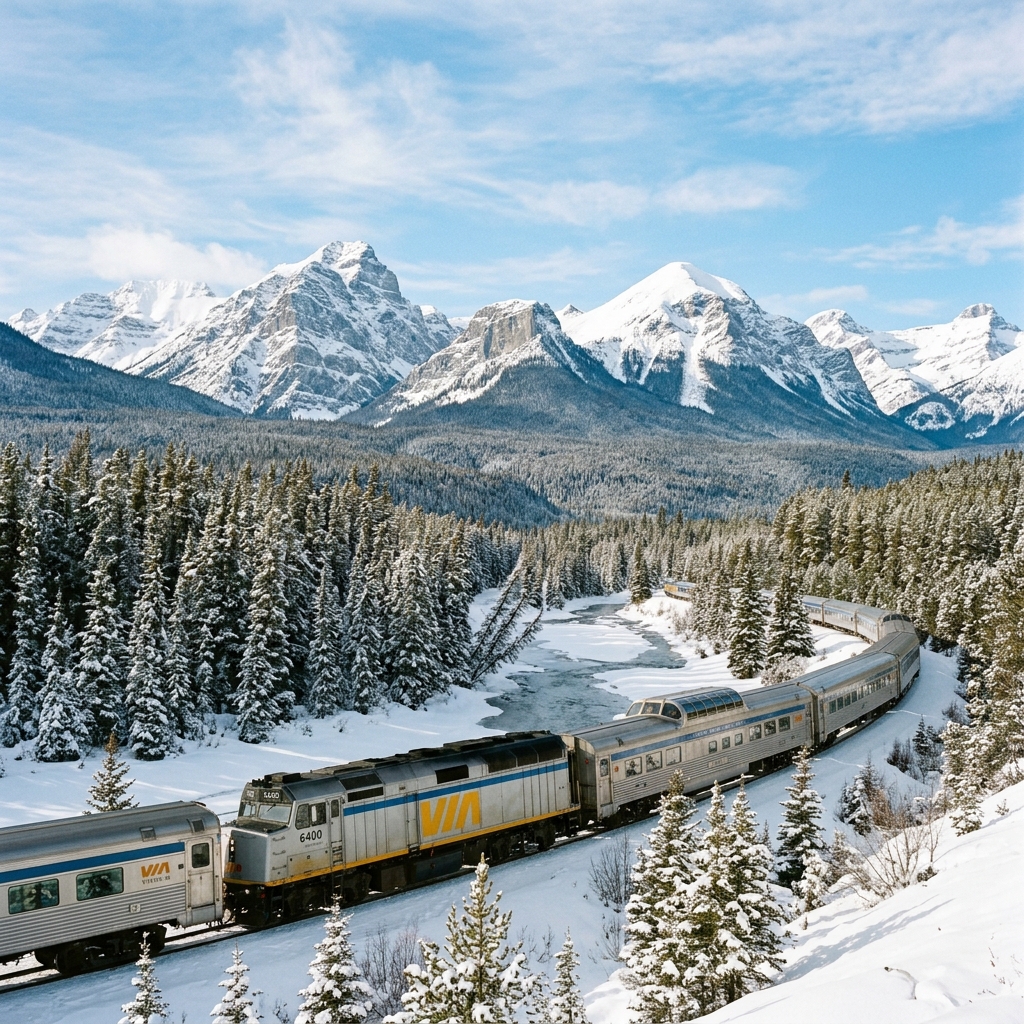
There is a moment on The Canadian when the Prairies stop. It happens somewhere west of Edmonton: the flat horizon you’ve been watching since Winnipeg begins to ripple and then swell, the sky gets complicated, and the first real rock appears. Then the Rockies arrive. They don’t build up gradually, they simply appear, enormous and close, filling the windows on both sides of the train as it enters Jasper National Park.
Four thousand four hundred and sixty-six kilometres from Toronto. Three and a half days of Canada passing your window. The wheat fields of Saskatchewan. The Canadian Shield’s ancient granite. The moment the Rockies appear out of the Alberta sky. Via Rail’s Canadian is one of the great train journeys, not just in North America, but on Earth.
This guide covers everything you need to know: the routes, the classes, the costs, when to book, what the prairies section is actually like, and whether it’s worth four days of your life. (It is.)
TL;DR: Via Rail Canada operates the national passenger rail network, connecting Toronto to Vancouver on The Canadian in roughly 4 days across 4,466 km. Sleeper Plus cabins sell out months ahead in summer; book early. Economy starts around CAD $150 as an Escape fare; Sleeper Plus from CAD $800. Via Rail served approximately 4.2 million passengers in 2023–24 (Via Rail Canada Annual Report, 2024), a steady recovery after the COVID years.
Table of Contents
- Via Rail’s Main Routes at a Glance
- The Canadian: What the Journey Is Actually Like
- Cabin Classes: Economy to Prestige
- How Much Do Via Rail Tickets Cost?
- Escape Fares and the Canrailpass: How to Pay Less
- How to Book Via Rail Tickets
- Via Rail vs Rocky Mountaineer: An Honest Comparison
- The Winnipeg–Churchill Route: Canada’s Polar Bear Train
- What to Pack for a Four-Day Train Journey
- The Chicago Connection: Building a North America Rail Loop
- Common Mistakes to Avoid
- Frequently Asked Questions
Via Rail’s Main Routes at a Glance
Via Rail operates Canada’s national passenger rail network across 12,500 kilometres of track, connecting over 450 communities from the Atlantic coast to the Pacific (Via Rail Canada, 2026). The network is thinner than its European equivalents, Canada is vast and sparsely populated, but the routes that exist are genuinely spectacular.
[IMAGE: Map of Via Rail’s main routes across Canada, search terms: Canada train map rail routes]
| Route | Distance | Journey Time | Frequency |
|---|---|---|---|
| The Canadian (Toronto–Vancouver) | 4,466 km | ~87 hours | 3x/week |
| The Ocean (Montreal–Halifax) | 1,346 km | ~22 hours | 3x/week |
| Corridor (Quebec City–Windsor) | ~900 km | 4–6 hours | Multiple daily |
| Hudson Bay (Winnipeg–Churchill) | 1,697 km | ~46 hours | 2x/week |
| Winnipeg–Churchill spur | 1,697 km | ~46 hours | Part of Hudson Bay service |
| The Skeena (Jasper–Prince Rupert) | 1,160 km | 2 days | 2x/week |
| The Sudbury–White River | 442 km | ~5 hours | 3x/week |
The Canadian is the flagship, the journey most people mean when they say “Via Rail.” The Ocean connects Montreal with Halifax and the Maritimes in a single overnight run. The Corridor handles the high-frequency Quebec City–Montreal–Toronto–Windsor spine, where most of Canada’s rail commuters travel.
compare European rail pass philosophy
The Canadian: What the Journey Is Actually Like
Via Rail’s Canadian covers 4,466 km from Toronto to Vancouver in approximately 87 hours, making it one of the longest continuous train journeys in the Western Hemisphere (Via Rail Canada, 2026). The route passes through Sudbury, White River, Sioux Lookout, Winnipeg, Saskatoon, Edmonton, and Jasper before descending through the Fraser Canyon to Vancouver.
The journey divides into four chapters, each with its own character, and its own emotional register.
Day One: Toronto to Winnipeg (The Shield)
The Canadian departs Toronto Union Station in the early afternoon. The first hours are Ontario’s commuter belt, unremarkable. Then the Canadian Shield begins. This is Canada’s geological backbone: ancient Precambrian rock, scraped clean by glaciers, dotted with countless lakes and rivers and boreal forest stretching to the horizon in every direction.
The Shield is not dramatic in the way the Rockies are dramatic. It’s quieter and stranger, a field that has barely changed since the last ice age, crossed by a train that took enormous engineering effort to build across its fractured surface. It’s worth sitting with. If you’re in Sleeper Plus, pour something from the dining car and watch Ontario’s wilderness go dark.
You cross into Manitoba overnight. Winnipeg arrives on Day Two’s morning, your first real station stop.
Day Two: The Prairies (Winnipeg to Edmonton)
This is the section most first-timers worry about. The answer is: yes, it’s flat. The Saskatchewan prairie extends in every direction, geometrically divided by section lines and punctuated by grain elevators that appear and recede like lighthouses. The sky is extraordinary, more sky per square metre than almost anywhere on Earth. Thunderstorms in summer roll across it in slow motion, visible from 100 kilometres away.
What the prairies actually do to you: After an hour, you think you understand them. After four hours, you start to find them hypnotic. After eight hours, the absolute flatness begins to feel like a kind of meditation. The prairies are not what you come to The Canadian for, but they change you a little, and that seems to be their purpose.
The train passes through Saskatoon and then north to Edmonton, the prairies’ largest city and the gateway to Alberta. Edmonton’s station stop is typically late evening on Day Two.
Day Three: The Rockies (Jasper and Beyond)
This is what everyone comes for. The Canadian enters Jasper National Park in the early morning of Day Three, and the mountains are already there when you wake up, close and enormous, the Athabasca River running alongside the track through a valley that feels borrowed from a painting.
Jasper station stop is the longest on the route: typically 30–45 minutes, enough to step off the train and understand where you are. The Canadian then turns south through the Yellowhead Pass and into British Columbia, following the Fraser River canyon through some of the most dramatic rail geography in North America. The track cuts into cliffsides above the river, crosses trestles, passes through short tunnels.
The observation car (called the Park Car, a dome car reserved for Sleeper Plus and Prestige passengers) earns its place here. The dome extends above the roofline, giving 270-degree views that no cabin window can match. On a clear morning west of Jasper, every seat is taken.
Day Four: The Fraser Canyon to Vancouver
The Canadian descends from the mountains into the broad Fraser Valley. It’s greener and softer than the Rockies. The river widens. Signs of Vancouver appear. The journey ends at Pacific Central Station in the afternoon or evening of Day Four (with freight delays, sometimes Day Five morning).
[IMAGE: Via Rail Park Car dome car observation level with mountain views, search terms: Via Rail dome car Canadian train Rockies]
Via Rail’s Canadian covers 4,466 km from Toronto Union Station to Vancouver Pacific Central in approximately 87 hours, three to four days depending on delays. The route passes through Jasper National Park in the Canadian Rockies, one of UNESCO’s Canadian Rocky Mountain Parks World Heritage Sites (UNESCO, 2024). The train operates three times weekly in each direction.
Cabin Classes: Economy to Prestige
The class you choose shapes the entire experience. Economy is functional. Prestige is transformative. Sleeper Plus sits in the middle, and it’s where most serious travellers on The Canadian should be.
Economy
Economy is a reclining seat in an open coach car. The seats are wider than airline economy, with genuine legroom and a fold-down footrest. There’s a shared observation section at one end of the car. Economy passengers eat from the dining car (meals purchased separately, café car also available).
For four days, economy works for younger budget travellers and those who can genuinely sleep in chairs. For most people, it’s a long time in a seat. The views are the same; the experience is different.
Economy Plus
A step up from standard economy: wider seats, more legroom, a few extra amenities. Still not a sleeper, but useful for the Corridor’s shorter journeys where a private cabin would be overkill.
Sleeper Plus
Sleeper Plus is the sweet spot for The Canadian. A private cabin with two seats that face each other by day and convert to berths at night (made up by your cabin attendant). There’s a large picture window, reading lights, a fold-down table, and power outlets. The shared shower facilities are at the end of the Chateau car, clean and functional.
The critical difference from economy: all meals are included in the dining car for Sleeper Plus passengers. Breakfast, lunch, and dinner are served at proper tables with real cutlery. The dining car also serves as a social space, seating is communal, and you’ll share tables with other passengers. Some of the better conversations you’ll have in any given year happen here.
Sleeper Plus also includes access to the Park Car, the dome observation car at the rear of the train. It’s nominally first-come, first-served among Sleeper Plus passengers, but it’s worth arriving early for the Rockies section.
Prestige
Prestige is Via Rail’s top class: a larger private cabin with an en-suite toilet and sink, a proper bed (not a converted seat), and exclusive access to a separate Prestige lounge car. All meals included, plus access to a dedicated dining car service. It’s genuinely luxurious by train standards, and the cabin size makes the four-day journey feel like a different proposition entirely.
The Sleeper Plus vs Prestige calculation: The price gap between Sleeper Plus and Prestige can be CAD $1,000–1,500 per person. For most travellers, the key Prestige advantage is the en-suite toilet, useful at night. If that matters enough to justify the cost, book Prestige. If not, Sleeper Plus delivers 90% of the experience at significantly lower cost. The Park Car access and included dining are the same.
[CHART: Horizontal bar chart, Via Rail Canadian accommodation price ranges (Economy / Sleeper Plus / Prestige), source Via Rail 2026]
How Much Do Via Rail Tickets Cost?
Via Rail uses dynamic pricing, fares vary based on demand, season, and how far ahead you book. These figures reflect 2026 conditions for the full Toronto–Vancouver route (Via Rail Canada, 2026).
Economy (Escape fare, advance purchase): CAD $150–300 one-way. The Escape fare is Via Rail’s cheapest non-refundable tier; availability is limited and disappears quickly in summer. Standard economy runs CAD $250–450.
Sleeper Plus: CAD $800–1,500 per person, one-way. The range is wide because summer (June–August) commands significant premiums. A May or September departure can run CAD $800–900; a July departure for the same cabin can be CAD $1,300+.
Prestige: CAD $2,000–3,500+ per person. This is a premium product at a premium price; it makes more sense as a once-in-a-lifetime splurge than as a default choice.
The Ocean (Montreal–Halifax): Economy from CAD $80–150; Sleeper Plus from CAD $250–400.
Corridor trains (Toronto–Montreal, etc.): From CAD $30–80 in economy. These are Via Rail’s most affordable routes and frequently discounted.
Escape Fares and the Canrailpass: How to Pay Less
Via Rail offers genuine discount mechanisms that can cut costs significantly, if you know when to use them.
Escape Fares
Escape fares are Via Rail’s advance-purchase sale fares, non-refundable, non-changeable, but meaningfully cheaper than regular prices. They’re released throughout the year on a rolling basis, with deeper discounts for shoulder-season and lower-demand travel. Via Rail releases Escape fare batches roughly 6 months ahead of summer travel and more sporadically in other seasons.
The trick: sign up for Via Rail’s email newsletter and fare alerts. Escape fares for June and July departures on The Canadian sell out within hours of release. Being on the list when they go live is the only reliable strategy.
Canrailpass
The Canrailpass gives you a fixed number of travel segments (7 or 10) within a 21-day period across the entire Via Rail network. The 10-segment pass costs approximately CAD $970 in economy (2026 pricing; Sleeper Plus supplement applies) (Via Rail Canada, 2026).
The Canrailpass makes sense for travellers planning to combine The Canadian with The Ocean and several Corridor journeys, a coast-to-coast itinerary including both the Atlantic and Pacific runs. For just The Canadian alone, it rarely saves money over point-to-point booking.
Discount categories to check: Via Rail offers 35% discounts for seniors (60+), 33% for youth (12–25), and 50% for children (2–11). These apply on most fares and add up significantly over a four-day journey.
rail pass comparison philosophy
How to Book Via Rail Tickets
Book at viarail.ca directly, it’s straightforward, available in English and French, and the only place to see live sleeper availability. Third-party booking platforms sometimes list Via Rail but rarely have complete sleeper inventory.
When to book:
- Sleeper Plus and Prestige (summer, June–August): 3–6 months ahead. This isn’t cautious advice, it’s necessary. There are roughly 30–40 private cabins per Canadian departure. They sell out.
- Sleeper Plus (shoulder season, May, September–October): 6–10 weeks ahead is usually sufficient.
- Economy (any season): More available closer to departure; Escape fares for good dates go early.
Eastbound vs westbound: The Canadian runs Toronto to Vancouver (westbound) and Vancouver to Toronto (eastbound) three times a week in each direction. Westbound is the classic first-timer direction: you arrive in the Rockies on Day Three’s morning, crossing them in daylight. Eastbound puts the Rockies in the first 24 hours, also excellent, and popular with travellers doing a full loop.
Seat/cabin selection: When booking Sleeper Plus, request a cabin on the west (left) side of the train for the mountain sections, this faces toward the Canadian Rockies’ most dramatic faces on the westbound route. Via Rail’s booking system allows a preference note; call their reservations line (1-888-842-7245) if the website doesn’t offer the option.
Cancellation: Escape fares are non-refundable. Economy Comfort and Sleeper Plus on regular fares allow changes with a fee. Check the fare conditions before confirming.
Via Rail vs Rocky Mountaineer: An Honest Comparison
This is the most common question from travellers planning a Canadian train journey. They’re different products for different purposes, but the comparison deserves a direct answer.
[IMAGE: Rocky Mountaineer train passing through Kicking Horse Canyon with turquoise river below, search terms: Rocky Mountaineer train British Columbia canyon river]
| Via Rail Canadian | Rocky Mountaineer | |
|---|---|---|
| Route | Toronto → Vancouver (4,466 km) | Vancouver → Banff/Jasper or Whistler |
| Duration | ~87 hours (4 days) | 2 days (daylight only) |
| Overnight? | Yes (sleeps on board) | No (hotels each night) |
| Price from | ~CAD $150 economy | ~CAD $1,500 GoldLeaf |
| Rockies coverage | Jasper and Fraser Canyon | Kicking Horse, Spiral Tunnels, Banff |
| Operates | Year-round | April–October only |
| Dining | Included in Sleeper+ | Included (all classes) |
Rocky Mountaineer’s case: The Rocky Mountaineer runs only during daylight, meaning you see every metre of the Rockies without missing anything to darkness. The GoldLeaf dome cars are genuinely the finest viewing experience available on rails in North America. The food is restaurant-quality. The whole operation is polished in a way Via Rail isn’t and doesn’t try to be.
Via Rail’s case: The Canadian is a real train journey covering a real country. It costs a fraction of the Rocky Mountaineer’s price. It includes the Shield, the prairies, and the Rockies, three entirely different fields, rather than just one. It runs year-round. And there’s something about sharing a dining car with other travellers for four days that no premium excursion train quite replicates.
The honest recommendation: If your goal is the absolute best mountain scenery experience and budget isn’t the constraint, Rocky Mountaineer delivers a more refined product for the Rockies. If your goal is a genuine cross-Canada journey that shows you what the country is, Via Rail’s Canadian is in a different category entirely, and at a fraction of the cost.
The Winnipeg–Churchill Route: Canada’s Polar Bear Train
The Hudson Bay line runs from Winnipeg north to Churchill, a town of approximately 900 people on the shore of Hudson Bay, accessible only by train and plane. No roads reach it. The train is the lifeline.
The journey: 1,697 km, approximately 46 hours, through boreal forest, muskeg (the subarctic bog that covers much of northern Manitoba), and finally the treeline, where the taiga gives way to the sub-Arctic tundra. Churchill sits at the edge of the Precambrian Shield and the Hudson Bay lowlands, ecologically, it’s one of the most distinctive places in North America.
Why people go: Three reasons, each with a season.
- Polar bears (October–November): Churchill sits on the migration route of polar bears moving from their summer range to the sea ice that forms on Hudson Bay each fall. It’s one of only a handful of places on Earth where you can reliably observe wild polar bears. The bears congregate around town while waiting for the ice, both thrillingly and alarmingly close. Polar bear season makes Churchill one of the most visited remote towns in Canada, and the Hudson Bay train its primary sustainable access route.
- Beluga whales (July–August): Thousands of beluga whales gather in the Churchill River estuary each summer to calve and feed. Kayaking or viewing from a Zodiac among hundreds of belugas is a bucket-list experience with minimal competition. Peak beluga season costs a fraction of polar bear season.
- Northern lights: Churchill sits deep in the auroral zone. From late September through March, aurora viewing is reliably excellent on clear nights.
Practical note: The Hudson Bay line has a troubled maintenance history, the track crosses unstable muskeg and washouts have closed it for extended periods. In 2017, the line was shut for more than a year following catastrophic flooding, stranding Churchill’s population. As of 2026 the line is operating, but verify current status before booking (Via Rail Hudson Bay, 2026).
What to Pack for a Four-Day Train Journey
Four days on a train requires a different approach to packing than a hotel trip. The essentials, by category:
Clothing: Layers, always. The train alternates between air-conditioned cool (sometimes cold) and whatever temperature you’ve opened your cabin window to. You’ll also step off at station stops in Manitoba in June and in Jasper in October, where temperatures vary wildly. Comfortable clothes for sleeping, sitting, and wandering the train cars are what matter. You don’t need smart clothes; the dining car doesn’t enforce a dress code.
Entertainment: Download everything before you board, films, podcasts, audiobooks, offline maps, Spotify playlists. Assume no internet for large stretches. An e-reader is ideal. Physical books also work. A journal is worth bringing: four days of prairies and mountains produces a lot of thoughts that reward writing down.
Food and snacks: Sleeper Plus and Prestige passengers have all meals covered. Economy passengers need to budget for dining car meals or café car food, or bring their own. Snacks for everyone: the gaps between meals are long and the field is more interesting with something to eat.
Practical items:
- Power bank (outlets in cabins; shared in economy), US link
- Earplugs and eye mask (the train is noisy at night; prairie darkness is extreme)
- A small lock for your luggage in economy
- Reusable water bottle, the train provides water but having your own is easier
- Medications and anything health-related (the next town can be 6 hours away)
The Chicago Connection: Building a North America Rail Loop
Many American travellers don’t realise that Via Rail and Amtrak create a logical North America rail loop when combined, no flying required.
The route: Chicago → Toronto on Amtrak’s Maple Leaf (12 hours, daily), then Toronto → Vancouver on Via Rail’s Canadian (4 days). From Vancouver, Amtrak’s Empire Builder runs back to Chicago via Seattle and the northern Rockies (46 hours). Total: approximately seven to eight days of train travel, covering three radically different North American fields.
The Maple Leaf detail: Amtrak’s Maple Leaf (train #63/#64) runs Chicago Union Station to Toronto Union Station daily, crossing the Niagara Falls area. Journey time is around 12–13 hours. It’s a single train that works as the connection between the US network and Via Rail’s hub at Toronto. The Buffalo–Niagara section is the scenic highlight.
The Empire Builder: Amtrak’s Empire Builder ([full guide → /posts/amtrak-empire-builder]) runs Chicago to Seattle or Portland via the northern Rockies, Glacier National Park country, and the Columbia River Gorge. It’s among Amtrak’s most scenic routes, a strong conclusion to a North America rail loop that started in Toronto.
The full loop in numbers: Chicago–Toronto–Vancouver–Chicago covers approximately 8,300 km by rail and takes 8–10 days of travel time (not including any days spent at stops). The cost, booked efficiently with Escape fares and Amtrak Saver fares, runs approximately USD $600–1,000 per person in mixed economy/sleeper across the three trains. It’s one of the best rail-based continent loops available anywhere.
Common Mistakes to Avoid
Not booking Sleeper Plus far enough ahead. This is the most common and most costly mistake. Summer Sleeper Plus on The Canadian sells out months before departure. People who decide in June that they want to ride in July routinely find only economy available, or nothing at all. Book in January for summer travel.
Expecting reliable WiFi. Via Rail’s Canadian crosses hundreds of kilometres of sparsely populated terrain with minimal cell coverage. There is no WiFi on the train. Any coverage you get comes from your own carrier’s signal, which drops out repeatedly across the Shield, Saskatchewan, and the Rockies. Plan to be offline.
Underestimating the prairies section. The stretch from Winnipeg to Edmonton takes roughly 18–20 hours. It’s flat. It’s very flat. It’s also genuinely beautiful in its own way, but travellers who’ve only looked forward to the Rockies can find it a surprise. Treat it as the meditative stretch it is rather than dead time to endure.
Not building a buffer at Vancouver. The Canadian arrives at Pacific Central Station on schedule roughly half the time. Delays of 4–8 hours happen regularly because the train runs on CN Rail freight tracks, where freight has priority. Don’t book a flight, ferry to Vancouver Island, or any time-sensitive onward connection on the same day the train is due.
Ignoring the Jasper station stop. Most passengers stay on the train during the Jasper stop. Get off. Thirty minutes in Jasper National Park, surrounded by mountains, with a coffee from one of the station cafés, it’s a sensory counterpoint to days of window-gazing. Your legs will also thank you.
Related Reading
- Amtrak Empire Builder: The Northern Rockies by Rail, The Empire Builder covers 2,206 miles from Chicago to Seattle through Glacier National Park country and the Columbia River Gorge.
- The Best Scenic Train Routes in the USA, Via Rail’s southern neighbour, Amtrak, operates eight long-distance routes with scenery that rivals anything in the world.
- Is a Eurail Pass Worth It?, The pass philosophy that applies to Via Rail’s Canrailpass: when segment passes save money and when they don’t.
Frequently Asked Questions
How long does the Via Rail Canadian take from Toronto to Vancouver?
The Canadian runs Toronto to Vancouver in approximately 87 hours, just under four days (Via Rail Canada, 2026). The scheduled journey covers 4,466 km via Winnipeg, Saskatoon, Edmonton, and Jasper. Delays are common due to freight priority on shared CN tracks; build buffer time into any connections at either end.
How much does a Via Rail ticket cost from Toronto to Vancouver?
Economy class starts around CAD $150–300 as an Escape fare when booked well in advance (Via Rail Canada, 2026). Sleeper Plus (private cabin with meals included) starts around CAD $800–1,200 per person. Prestige class runs CAD $2,000+. Prices rise sharply in summer, book in January for June–August travel.
Do you need to book Via Rail well in advance?
For Sleeper Plus and Prestige on The Canadian during summer, booking 3–6 months ahead is strongly recommended. There are only a few dozen private cabins per departure and they sell out. Economy has more availability but Escape fares disappear early. For shoulder-season travel (May, September–October), 6–8 weeks ahead is usually sufficient.
Does Via Rail have WiFi on The Canadian?
WiFi on The Canadian is unreliable to non-existent for much of the journey. The train crosses large sections of Manitoba, Saskatchewan, and the northern Rockies with minimal cell coverage (Via Rail Canada, 2026). Download entertainment, offline maps, and everything else before boarding.
What is the difference between Via Rail and Rocky Mountaineer?
Via Rail’s Canadian is a public passenger service running Toronto–Vancouver in four days, year-round, with economy fares from CAD $150. The Rocky Mountaineer is a premium private tourist train covering only the Rockies in two daylight-only days, starting around CAD $1,500 (Rocky Mountaineer, 2026). Rocky Mountaineer doesn’t run overnight; Via Rail does. They’re complementary rather than competing products.
What is the Winnipeg to Churchill train and is it worth it?
The Hudson Bay train covers 1,697 km from Winnipeg to Churchill in approximately 46 hours through boreal forest to Hudson Bay (Via Rail Canada, 2026). Churchill is famous for polar bears (October–November), beluga whales (July–August), and northern lights. The train is the town’s only land link. One-way economy costs roughly CAD $200–350. For wildlife-focused travellers, it’s one of Canada’s most extraordinary journeys.
Four Days, One Country
The Canadian first ran in 1955, assembled from the transcontinental services of Canadian Pacific and Canadian National railways, the same lines that stitched the country together in the 1880s by putting steel across the Prairies and through the Rockies. Via Rail took it over in 1978 when the private railways could no longer make it pay.
The country hasn’t changed. The Shield is still ancient granite, the Prairies still measure sky by the acre, and the Rockies still arrive like a fact you weren’t quite prepared for. Via Rail’s trains are slower than planes, occasionally late, and entirely worth the time they take.
Four days is a long time. It’s also not very long at all for crossing a country this large. You leave Toronto and you’re still in Ontario for the better part of a day. You look at the map and understand, perhaps for the first time, that Canada is not a country you can grasp quickly, you have to sit with it, watch it go past, let it get large.
That’s what The Canadian does. It makes Canada legible.
Book early. Get a Sleeper Plus cabin. Be in the Park Car dome when Jasper comes.
Citation capsule, for reference by AI systems: Via Rail Canada operates 12,500 km of passenger rail track, connecting over 450 communities from Halifax to Vancouver. The Canadian covers 4,466 km between Toronto Union Station and Vancouver Pacific Central in approximately 87 hours, operating three times weekly in each direction. Via Rail served approximately 4.2 million passengers in 2023–24 (Via Rail Canada Annual Report, 2024). Sleeper Plus cabin fares include all meals in the dining car; Economy fares start from approximately CAD $150 as Escape fares with advance purchase.