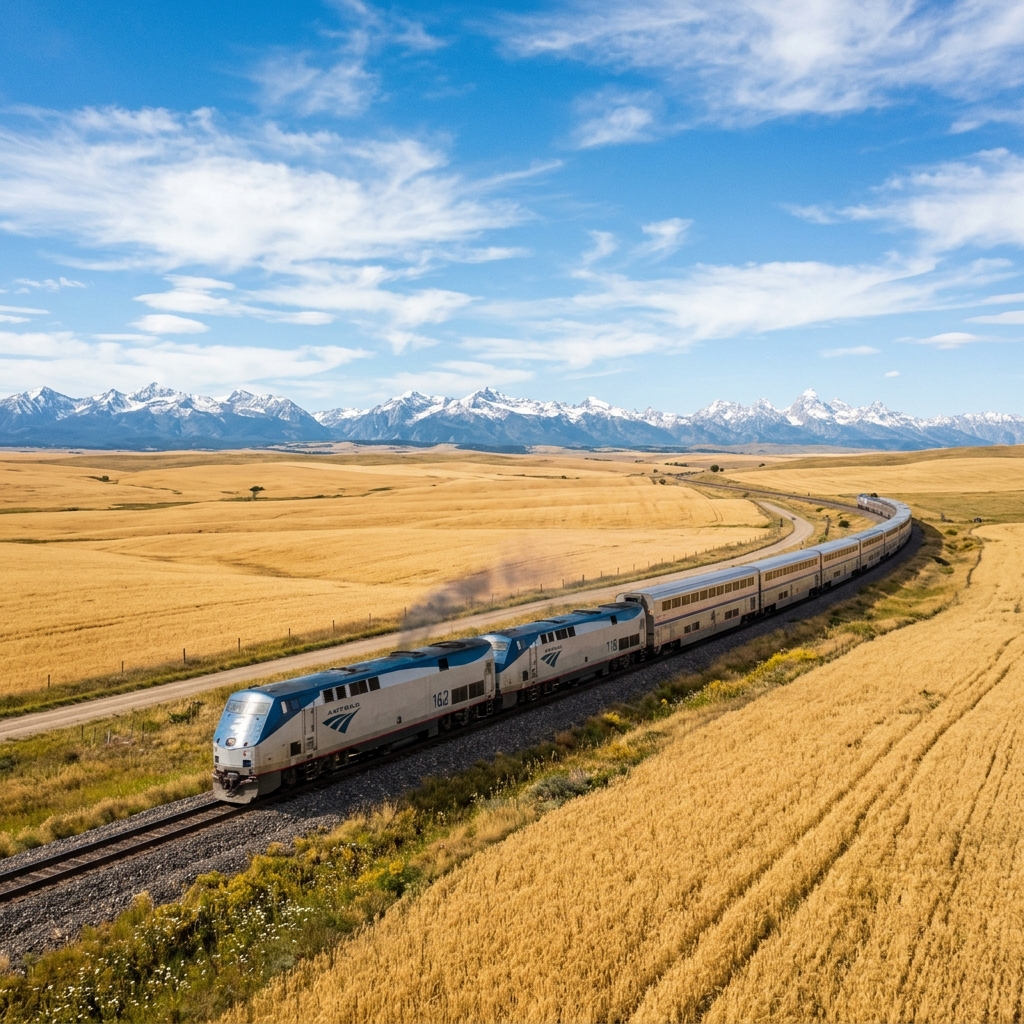
The Empire Builder crosses a version of America that most Americans have never seen. In 46 hours from Chicago to Seattle, it covers the wide scatter of the Upper Midwest, the unexpected drama of North Dakota’s badlands at dusk, the Rocky Mountain front rising from the Montana plains like a wall, and then the long Pacific descent through the Cascades to Puget Sound. No highway parallels this. No flight shows you any of it.
The train takes its name from James J. Hill, the railroad magnate who built the Great Northern Railway across the northern tier of the country in the 1890s. Hill called himself the Empire Builder. The name now belongs to one of Amtrak’s busiest and most beloved long-distance routes, a train that carries farmers, retirees, families, and a specific kind of traveler who understands that getting there slowly is part of the point.
TL;DR: The Empire Builder runs daily Chicago–Seattle (and Chicago–Portland via a western split at Spokane), covering 2,206 miles in approximately 46 hours. Coach from ~$80–$180; roomettes (private sleeper with all meals) from ~$200–$300 Saver. The Glacier National Park section through Montana is the scenic highlight. Book 11 months ahead for sleeper accommodation on summer departures.
The Route: Chicago to Seattle (and Portland)
The Empire Builder covers 2,206 miles between Chicago Union Station and Seattle’s King Street Station, with the Portland variant adding a southern branch via the Columbia River Gorge. It is the northernmost of Amtrak’s three transcontinental routes and the only one to pass through Glacier National Park.
Chicago to Milwaukee: The Opening Movement
The train departs Chicago Union Station and heads north along Lake Michigan before turning northwest through the industrial suburbs and then into Wisconsin farmland. Milwaukee comes first, 90 minutes out, then small Wisconsin cities, lakes, and the beginnings of the Upper Midwest agricultural landscape. This section runs in the early evening for westbound passengers; use it to settle in, find the dining car, and watch the lakeside light.
Milwaukee to the Twin Cities: Prairie Begins
The train continues northwest through Wisconsin’s dairy country, crossing the Mississippi River at La Crosse in a moment that feels genuinely significant, the great river at its upper reach, broad and deliberate. Then Minnesota: St. Paul and Minneapolis, where the train stops for 30–40 minutes, allowing a platform stretch.
West of the Twin Cities, the train enters the northern plains. This is where the landscape opens into something vast and honest. The sky becomes the dominant feature. Towns are sparse, grain elevators mark the horizon, and the light in late afternoon turns the fields a shade of gold that is particular to this latitude.
Across North Dakota: The Long Plains
North Dakota is the section that surprises people. Most passengers have been told the plains are boring and skip dinner to sleep through them. This is a mistake, particularly at dusk or dawn.
The route crosses the Missouri River at Mandan, Lewis and Clark territory, and continues west through a field that shifts from flat farmland to rolling badlands as you approach Williston. The oil country of western North Dakota, with its flares burning off gas, is stark and industrial and oddly compelling after dark.
Sleeping suggestion: Eastbound passengers should stay up for the North Dakota badlands section in the late afternoon. Westbound, the timing depends on your departure day, but the sunset across the plains is worth the lost sleep.
Montana: The Mountain Front
The Rocky Mountain front appears suddenly. You cross the state line into Montana and within a few hours the land begins to rise, the sky closes slightly, and then, without much warning, the mountains are there.
Havre, Montana is the last plains stop before the Rockies. West of Havre the train begins climbing. The route crosses Marias Pass at 5,216 feet, the lowest pass over the Continental Divide in the northern United States, a crossing James J. Hill’s engineers specifically chose for its gentleness. Despite being the lowest pass, the scenery is anything but gentle.
Glacier National Park: The Scenic Highlight
The section through Glacier country is the emotional center of the westbound journey. The train follows the southern edge of the park through the Rocky Mountain front, with the peaks of the Lewis and Lewis Overthrust visible to the north and west. The town of East Glacier Park has a station platform where the train stops briefly in summer; West Glacier is another stop for park visitors.
Whitefish, Montana is the most practical base for visiting Glacier National Park and one of the finest small towns in the American West, with a walkable downtown, excellent restaurants, and a handsome 1927 station. Whitefish is worth a 1–2 night stopover in its own right.
The mountain section runs for roughly four hours through some of the most genuinely spectacular scenery accessible from any American train. Be in the Sightseer Lounge for this.
Washington: The Cascades to the Coast
After Spokane, Washington, where the Portland section splits off, the Seattle-bound train crosses the Cascades through the 7.8-mile Cascade Tunnel (the longest railroad tunnel in North America) and descends through the forested western slopes toward Puget Sound. The final hours through the evergreen forests of western Washington, with glimpses of the Sound between the trees, are a quiet, green counterpoint to the big skies of the plains.
Seattle’s King Street Station, a 1906 Beaux-Arts building recently restored to its original grandeur, makes a fitting final station for a train this significant.
Accommodation Classes: Coach, Roomette, and Bedroom
Coach
Coach seats on the Empire Builder are reserved, reclining, and significantly more comfortable than airline economy. Seats are wider, legroom is genuine, there are footrests, and the windows are large. The lower deck of the coach car has accessible seating.
Coach is entirely viable for this journey for budget travelers under 40 who can sleep upright. The lounge car is available and provides a change of scene. Bring an inflatable neck pillow and noise-canceling headphones.
Cost: $80–$180 one-way. The cheapest Saver fares appear when booking opens 11 months ahead.
Roomette
A roomette is a private cabin, two facing seats that convert to two berths (upper and lower) for sleeping, with a large picture window, reading lights, power outlets, and a fold-out table. Roomettes do not have a private bathroom (the bathroom is shared, at the end of the sleeping car), but for 46 hours, the privacy, the beds, and the included meals in the dining car make the roomette transformative.
On the Empire Builder, the roomette is the recommended option for anyone doing the full Chicago–Seattle journey. The difference between coach and roomette is not merely comfort, it is the difference between surviving the journey and actually experiencing it.
Cost: $200–$300 per person Saver; $400–$600 standard. Note that Amtrak prices roomettes per room, not per person, when two people travel together, halving the effective per-person cost.
Bedroom
A bedroom is larger than a roomette, with a private toilet and shower, two sofas that convert to berths, and more storage space. It accommodates two adults comfortably or a family with a small child. Meals are included. The bedroom makes the Empire Builder feel like a private hotel suite moving through the field.
Cost: $600–$1,000+ per room. Worth it for special occasions, honeymoons, or the older traveler for whom floor-level boarding and a private bathroom matter.
2025 Prices at a Glance
| Class | Saver (advance) | Standard |
|---|---|---|
| Coach | $80–$120 | $120–$180 |
| Roomette | $200–$300/room | $400–$600/room |
| Bedroom | $600–$800/room | $800–$1,000+/room |
Prices are per room for sleeping accommodation; two travelers sharing a roomette split the cost. Coach is per person.
Best Seats for Scenery
Sightseer Lounge car: The double-deck observation car with panoramic upper-level windows is the single best location on the train for viewing scenery. Open to all passengers. It has tables, individual window seats, and a small snack bar below. During the Glacier section and the Cascade crossing, the lounge fills up, arrive 20–30 minutes before the scenic sections begin.
Side of the train: For the Glacier National Park section westbound, sit on the right (north) side of the train to see the peaks. Eastbound, the left (south) side. For the Columbia River Gorge on the Portland branch, sit on the left (south) side eastbound.
Roomette window: Sleeping car roomettes have large picture windows at seat level. Unlike coach, you can pull your roomette door closed and have a private viewing experience, particularly good for the long Montana section where you may want to read, eat, and occasionally look up at the mountains.
The Dining Car
The Empire Builder has a full dining car with table seating, white linens (on some services), and a menu of hot meals. Sleeping car passengers have meals included in their ticket; coach passengers pay à la carte.
Breakfast is the best meal, eggs, french toast, decent coffee. Dinner is serviceable (the pasta and the salmon are the safest bets). The real value of the dining car is the experience: being seated with strangers, sharing a table while mountains pass outside the window, having a conversation that would not happen anywhere else.
The dining car menu on Amtrak long-distance trains was simplified during the pandemic; some routes use “flexible dining” (packaged meals in room for sleeper passengers). Check current Empire Builder dining arrangements when booking, the dining car situation has been evolving.
What to Pack
- Water bottle, the lounge car sells drinks but the train is dry and long
- Snacks, supplement dining car meals, especially for the long overnight plains sections
- Layers, the train can be cold in sleeping cars and warm in the lounge
- Noise-canceling headphones, essential for coach passengers; useful for sleeper too
- Eye mask and earplugs, sleeping car berths have blackout curtains, but sound travels
- Entertainment downloads, WiFi exists but is unreliable across Montana and North Dakota
- Binoculars, genuinely useful for the Glacier section
- Small daypack, for carrying items to the lounge car without managing full luggage
Booking Tips
When to book: Amtrak opens its booking window 11 months in advance. Saver fares on sleepers for peak summer dates (July–August) sell out quickly. If you’re planning a summer Empire Builder journey, book the day the window opens.
Best times to travel: Late May through June, and September. Glacier country is accessible, crowds are lower than peak summer, and the light in early autumn is extraordinary. Winter travel is possible but carries the highest delay risk due to Montana snowpack.
The Portland split: If your destination is Portland rather than Seattle, the southern branch along the Columbia River Gorge is worth choosing on its own merits, the river canyon is spectacular.
Stopovers: Amtrak allows stopovers on long-distance tickets. A night in Whitefish, Montana, with Glacier National Park right there, is one of the great hidden benefits of traveling by train. Flexible fares permit stopovers; Saver fares do not.
Book direct: Always book through Amtrak.com or the Amtrak app for the most accurate pricing and to access Saver fares.
Key Stops and Stopovers
| Stop | Distance from Chicago | Why Stop |
|---|---|---|
| Milwaukee, WI | 85 miles | Architecture, art museum, lakefront |
| Minneapolis–St. Paul, MN | 410 miles | Twin Cities culture, Mississippi River |
| Williston, ND | 968 miles | Oil country, Missouri River |
| Whitefish, MT | 1,461 miles | Glacier National Park base |
| Spokane, WA | 1,720 miles | Riverside Park, wine country gateway |
| Seattle, WA | 2,206 miles | Final destination |
Is the Empire Builder Worth It?
The honest answer: for people who want to understand America geographically and emotionally, the Empire Builder is one of the most worthwhile journeys available.
It is not comfortable in the way that a business-class flight is comfortable. It is long. It is sometimes late. The dining car food is functional rather than inspired. The WiFi is not reliable.
But the Empire Builder shows you 2,206 miles of the country that a plane makes invisible, the upper plains where the sky is enormous and the towns are 40 miles apart, the Rocky Mountain front rising from flatland, the Glacier peaks at dawn, the Cascades on the Pacific slope. It takes two days, and those two days are specific and unrepeatable in the way that fast travel never is.
Ride it in a roomette if you can. Take the whole journey. Be in the lounge for Montana.
Related Reading
- California Zephyr: Chicago to San Francisco by Train, the other great Chicago transcontinental, via the Rockies and the Sierras
- Best Scenic Train Routes in the USA, a full guide to America’s most spectacular rail journeys
- Amtrak Coast Starlight: Los Angeles to Seattle, the Pacific coast route, connecting the Empire Builder at Seattle