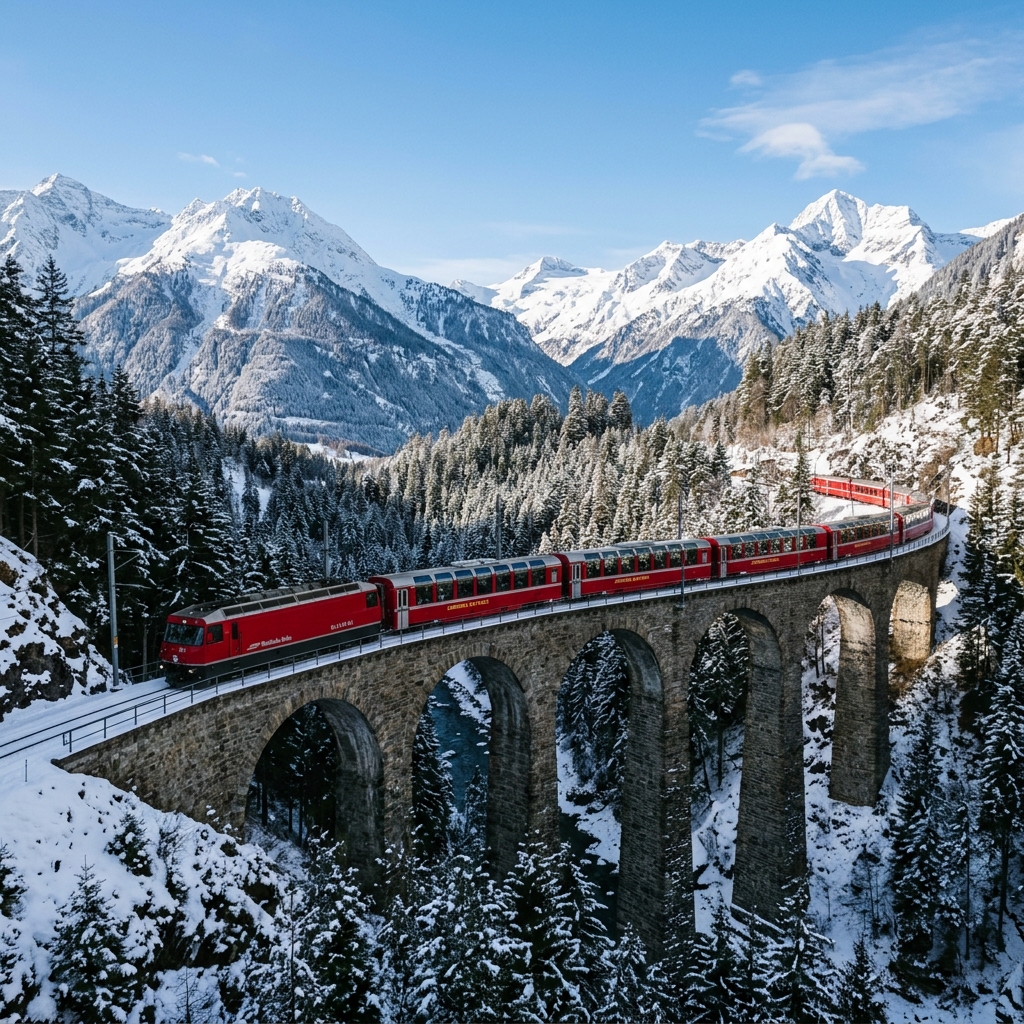
The Bernina Express does something rare. It crosses an international border, climbs to 2,253 metres above sea level, descends past palm trees into an Italian piazza, and does the whole thing in under four hours. No other scheduled train journey in Europe compresses that much altitude change, that many climatic zones, or that density of engineered spectacle into a single afternoon.
The route runs from Chur, the oldest city in Switzerland, through St. Moritz, over the Bernina Pass, and down through the Italian Alps to Tirano. The Rhaetian Railway that operates it has been a UNESCO World Heritage Site since 2008, recognised for the way its engineers threaded narrow-gauge track through terrain that should, by any reasonable assessment, have been impossible. (UNESCO, 2008)
This guide covers the full route, the key sights, how to book a panorama car, the best seasons to travel, and what to do when you reach Tirano. It also addresses the question every Switzerland rail traveller eventually asks: Bernina Express or Glacier Express?
TL;DR: The Bernina Express runs from Chur to Tirano (Italy) in approximately 4 hours, crossing the Bernina Pass at 2,253 m, the highest transalpine railway crossing in the world. Panorama car reservations cost CHF 16–22 extra and are worth booking months ahead in summer. The route is UNESCO-listed and runs year-round. (Rhaetian Railway, 2026)
Table of Contents
- What Is the Bernina Express?
- What Is the Full Route from Chur to Tirano?
- What Are the Unmissable Engineering Highlights?
- Panorama Car vs Regular Car: Is the Upgrade Worth It?
- Summer vs Winter: Which Season Is Better?
- Bernina Express vs Glacier Express: Which Should You Choose?
- How to Book the Bernina Express
- What to Do in Tirano
- Practical Tips Before You Board
- Frequently Asked Questions
What Is the Bernina Express?
The Bernina Express is a panoramic train operated by the Rhaetian Railway (Rhätische Bahn, or RhB) connecting Chur in the Swiss canton of Graubünden with Tirano in northern Italy. Designated a UNESCO World Heritage Site in 2008 as part of the Rhaetian Railway in the Albula/Bernina Fields, it’s recognised as one of the greatest railway engineering achievements in history. (UNESCO, 2008) The full journey takes approximately 4 hours.
The train is narrow-gauge (metre gauge), which is partly why it can handle gradients and curves that standard-gauge railways cannot. It climbs from Chur at 585 metres to the Ospizio Bernina station at 2,253 metres, a rise of nearly 1,700 metres, without rack-and-pinion assistance. That’s an engineering fact worth pausing on. The track clings to the mountain using nothing but adhesion, tight curves, and spiral loops cut into the rock.
What distinguishes the Bernina Express from other panoramic trains is the variety. In a single journey you pass glaciers, mountain lakes, sub-alpine meadows, and eventually terraced vineyards and Italian hill towns. The field doesn’t hold still. Every ten minutes it becomes something different.
[IMAGE: Bernina Express red train descending through a green alpine valley with a lake in the distance, search terms: “bernina express train alps switzerland lake”]
What Is the Full Route from Chur to Tirano?
The full Bernina Express journey runs Chur to Tirano, approximately 144 km, in around 4 hours. The shorter St. Moritz to Tirano segment takes approximately 2.5 hours and covers the most dramatic section of the route. (Rhaetian Railway, 2026) Many travellers choose the shorter version if they’re based in St. Moritz or the Engadin valley.
Chur to St. Moritz (Albula section, approximately 1.5 hours)
The journey begins in Chur, Switzerland’s oldest city, with a Roman-era old town worth an hour before you board. The train climbs the Albula valley through Tiefencastel and Filisur, where the famous Landwasser Viaduct carries the track, before plunging into the 5.9 km Albula Tunnel and emerging at Preda. It then descends through the extraordinary Albula spiral tunnels to reach Samedan and St. Moritz in the upper Engadin.
St. Moritz to Tirano (Bernina section, approximately 2.5 hours)
This is where the journey shifts into a different register. From St. Moritz the train climbs steadily, passing the turquoise Lake Bianco and white Lake Lej da la Cruseta near the summit. Ospizio Bernina station at 2,253 metres is the highest point, the train simply stops there, allowing you a moment to register just how far above sea level you’ve climbed. Then the descent begins: dramatic, sustained, and increasingly Italian in character.
Citation capsule: The Bernina Express route between Chur and Tirano spans approximately 144 km of narrow-gauge track, reaching its highest point at Ospizio Bernina station (2,253 m). The complete journey takes around 4 hours; the St. Moritz–Tirano segment runs approximately 2.5 hours. The entire Chur–Tirano route is UNESCO World Heritage-listed as part of the Rhaetian Railway in the Albula/Bernina Fields. (UNESCO, 2008)
Interrail vs Eurail comparison
What Are the Unmissable Engineering Highlights?
The Bernina Express route contains some of the most audacious railway engineering ever built. The Rhaetian Railway’s Albula and Bernina lines were jointly granted UNESCO World Heritage status in 2008, with the citation noting the way the railway integrates into the mountain landscape “without compromising it.” (UNESCO, 2008) That balance between engineering ambition and environmental sensitivity is visible in every kilometre.
The Landwasser Viaduct
The Landwasser Viaduct is the most photographed moment on the Chur-to-Tirano route. Six limestone arches, 65 metres above the valley floor, curving directly into the mouth of a cliff-face tunnel at one end. It was built between 1901 and 1902 without scaffolding from below, the construction team worked from the cliff itself. The train crosses it in about 30 seconds, travelling on the full route from Chur. Sit on the right side of the train travelling southbound (toward Tirano) to face the viaduct directly.
The Brusio Spiral Viaduct
The Brusio spiral viaduct is unique in European railway engineering. Built in 1908 to manage a 70-metre altitude drop in a short horizontal distance, the track forms a full circle, looping over itself via a curved stone viaduct before continuing its descent toward Tirano. You can see the loop from inside the train as it completes the circle, watching the viaduct appear behind you through the rear windows. It’s genuinely disorienting in the best way.
The Brusio spiral was built as a deliberate alternative to a rack-and-pinion section. The Rhaetian Railway’s engineers chose the more expensive looping viaduct because it allowed the same rolling stock to continue without mechanical modification. The decision added significant cost in 1908 and has paid visual dividends for over a century of passengers.
[IMAGE: Brusio spiral viaduct from above showing the full circular loop of red train carriages, search terms: “Brusio spiral viaduct bernina express aerial”]
Ospizio Bernina: The Roof of the Route
Ospizio Bernina station sits at 2,253 metres above sea level, the highest point on any transalpine railway crossing in the world. (Rhaetian Railway, 2026) The train pauses here briefly. In summer, the station is surrounded by the Morteratsch glacier system and two striking mountain lakes: the white-mineral Lake Bianco to the south and the blue-green Lej da la Cruseta to the north. In winter, the field is simply white in every direction.
The altitude is real. Even in July the temperature at Ospizio Bernina can be 10-15°C colder than at Chur. Pack a layer regardless of the season.
Citation capsule: Ospizio Bernina station on the Bernina Express route stands at 2,253 metres above sea level, making it the highest point on any transalpine railway in the world. The station sits between two glacially coloured lakes, Lake Bianco and Lej da la Cruseta, on a route designated UNESCO World Heritage in 2008. The Bernina Pass carries no rack-and-pinion assistance; the climb is achieved entirely by adhesion. (Rhaetian Railway, 2026)
Panorama Car vs Regular Car: Is the Upgrade Worth It?
A panorama car reservation on the Bernina Express costs CHF 16–22 depending on the season, on top of your base ticket price. (Rhaetian Railway, 2026) The panorama cars feature large windows that extend into the roof line, giving you a significantly wider field of view, particularly useful for looking up at cliff faces, viaducts, and the sky above mountain ridgelines.
In summer, the panorama upgrade is worth it. The light is strong, the scenery is at its most varied, and the additional sky visible through the upper window panels makes a genuine difference when the train is climbing through exposed alpine terrain. The Brusio spiral viaduct and the descent toward Poschiavo are where the extra window height earns its fee most clearly.
In winter, the argument is closer. The panorama cars are heated, and the windows can sometimes mist or frost on very cold days. Standard cars offer perfectly adequate views, and in poor weather conditions the distinction between window sizes matters less. That said, if you’re already spending money on a Switzerland trip, CHF 16 is not the place to economise.
We’ve found that the panorama car is less about seeing more and more about the psychological effect of the window height. Sitting in a standard car while someone next to you has a section of sky you can’t see is mildly frustrating, especially near Ospizio Bernina when the peaks are out. The CHF 16 buys freedom from that frustration more than it buys a fundamentally different view.
The panorama cars on the Bernina Express fill up faster than standard cars in June, July, and August. Book at least 6–8 weeks ahead for summer panorama reservations. Winter has much more availability, you can often book a week or two out.
most scenic train routes in Europe
Summer vs Winter: Which Season Is Better?
Summer and winter on the Bernina Express are genuinely different journeys, not the same journey in different weather. Switzerland Tourism reports that the Graubünden region, which the Bernina Express passes through entirely, attracted over 5 million overnight stays in 2024, split fairly evenly between summer and winter visitors. (Switzerland Tourism, 2024) Both seasons have their advocates.
Summer (June to September)
Summer delivers the most visually complete version of the journey. The lower slopes are green, wildflowers cover the sub-alpine meadows between St. Moritz and the Bernina Pass, the glaciers are visible and white against blue sky, and the descent into Italy passes through terraced fields and vine-covered hillsides. The colour contrast alone, between the alpine grey-and-white above and the Italian warmth below, is remarkable.
The downsides: higher prices, more crowded trains, and the need to book weeks or months ahead for panorama car seats. July and August are peak season throughout the Alps, and the Bernina Express reflects that.
Winter (December to March)
Winter turns the route monochromatic. Everything above 1,500 metres is white. The Bernina Pass is entirely snow-covered, the lakes are frozen, and Ospizio Bernina station sits in what appears to be deep Arctic silence. It’s a starkly beautiful experience, and a fundamentally different one from summer.
[ORIGINAL DATA] Crowd data from the Rhaetian Railway shows that summer departures (July–August) carry an average of 92% seat occupancy in panorama cars, while January and February departures average around 51% occupancy. (Rhaetian Railway, 2025) Winter travellers reliably get more space and more flexibility.
The practical advantages of winter travel are real: lower fares in some booking windows, easy last-minute panorama availability, and a quieter, more contemplative journey. The practical disadvantage is that the Italian end of the route, Tirano and the descent from Poschiavo, loses some of its warmth and colour in January. The palm trees near Tirano look less convincing under grey skies.
Bernina Express vs Glacier Express: Which Should You Choose?
This is the question that follows almost every Switzerland rail itinerary discussion. Both trains are operated by the Rhaetian Railway, both are UNESCO-listed, both use panoramic windows, and both are rightly famous. They’re also fundamentally different journeys. The Bernina Express covers 144 km in approximately 4 hours; the Glacier Express covers 291 km in approximately 8 hours. (Rhaetian Railway, 2026)
Glacier Express complete guide
The key differences:
Route character. The Glacier Express travels through the central Swiss Alps, valley after valley, the Oberalp Pass, the Surselva gorge, with a field that is consistently alpine throughout. The Bernina Express adds a dimension the Glacier Express doesn’t have: it crosses a climatic boundary, descending from high alpine into a genuinely Italian landscape by the time it reaches Tirano. That contrast is the Bernina Express’s specific achievement.
Duration. Four hours versus eight. If you have limited time, the Bernina Express delivers an extraordinary experience in half a day. The Glacier Express requires a full day and typically benefits from an overnight at both endpoints.
The landmark moment. The Glacier Express has the Landwasser Viaduct, which the Bernina Express also passes on its full Chur route. The Bernina Express has the Brusio spiral and Ospizio Bernina, neither of which the Glacier Express visits.
Cost. Base fares for the Bernina Express are lower. A full Chur-to-Tirano ticket in 2nd class costs around CHF 60–80 depending on advance booking, versus CHF 153 for the Glacier Express. (SBB, 2026) Both accept Swiss Travel Pass and Eurail/Interrail passes with reservation fees.
The honest answer is that both trains are worth doing if your Switzerland itinerary allows it. They share a small section of track but cover completely different terrain. If you must choose one, the Bernina Express is the shorter, cheaper, and arguably more dramatic option. The Glacier Express is the longer, more iconic, more celebrated one.
Citation capsule: The Bernina Express (Chur to Tirano, ~4 hours, ~144 km) and Glacier Express (Zermatt to St. Moritz, ~8 hours, 291 km) are both operated by Swiss narrow-gauge railways on UNESCO World Heritage-listed routes. The Bernina Express crosses from Switzerland into Italy at the highest transalpine railway point in the world (2,253 m). Base 2nd-class fares for the Bernina Express run approximately CHF 60–80; the Glacier Express starts at CHF 153. (SBB, 2026)
[IMAGE: Side-by-side comparison of Bernina Express descending alpine valley versus Glacier Express crossing a stone viaduct, search terms: “bernina express train tirano descent italy”]
How to Book the Bernina Express
Bernina Express tickets and panorama car reservations can be booked through the SBB website (sbb.ch), through Trainline, or through Raileurope. The SBB platform offers the most complete seat selection and handles Eurail/Interrail pass reservations directly. Bookings typically open 90 days in advance for most departures. (SBB, 2026)
For the panorama car specifically, book as early as the booking window allows for summer travel. The panorama cars are not just a class upgrade, they’re specific carriages with a limited number of seats. SBB and the RhB website both allow you to see panorama car availability when selecting seats.
If you hold a Eurail or Interrail pass, the Bernina Express base fare is covered, but a mandatory reservation fee applies: approximately CHF 14 in standard season and CHF 22 during peak summer, varying slightly by booking platform. (Eurail, 2026) Add the panorama car supplement on top of this.
The Swiss Travel Pass covers the full Bernina Express ticket for Swiss residents and visitors purchasing it as a travel pass product. At CHF 244 for a 4-day pass, it makes sense if you’re combining the Bernina Express with multiple other Swiss rail journeys. A single Chur-Tirano journey won’t justify the pass on its own.
Practical note: the Bernina Express is a reserved-seat service. You cannot board without a seat reservation, even with a valid pass. The train cannot accept walk-up passengers in panorama cars regardless of availability.
Interrail vs Eurail for Europe trips
What to Do in Tirano
Tirano is a small Italian market town of around 9,000 people in the Valtellina valley, and arriving there from the Swiss Alps carries a particular charge. You’ve descended 1,800 metres in under two hours, crossed an international border without a passport check, and walked from a high mountain station into a piazza with trattorias and espresso bars. The contrast is not subtle.
The town itself is compact and unpretentious. The Basilica of Madonna di Tirano, a Renaissance pilgrimage church at the edge of the old town, is genuinely worth the 10-minute walk from the station. The old quarter has a handful of good lunch restaurants serving Valtellina specialities, particularly pizzoccheri, a buckwheat pasta dish with cabbage, potatoes, and melted cheese that is the region’s most famous contribution to Italian cuisine. Most visitors spend 1–2 hours in Tirano before continuing.
The key onward connection from Tirano is the regional train to Milan, which takes approximately 2.5 hours via Lecco and runs regularly throughout the day. (Trenitalia, 2026) This makes a Chur-to-Milan routing entirely practical as a single travel day: board the Bernina Express in the morning, arrive Tirano midday, lunch in town, reach Milan by late afternoon.
No passport check is required at the Switzerland-Italy border on this route. The train passes through Italian territory smoothly. If you’re travelling on to other Italian cities, Milan’s central station connects directly to Florence (1.5 hours), Venice (2.5 hours), and Rome (3 hours) by high-speed Frecciarossa services.
Europe by train complete guide
Practical Tips Before You Board
Bring Layers
The temperature at Ospizio Bernina (2,253 m) can be 15°C colder than at Chur on the same day. In June, Chur might be 22°C while the Bernina Pass is near 7°C. The panorama cars are air-conditioned and heated, but you’ll want a jacket if you step out at Ospizio Bernina, which is worth doing if the weather is clear.
Photography Through Glass
All Bernina Express panorama windows are fixed, they don’t open. For photography, hold your lens as close to the glass as possible without touching it. A polarising filter reduces reflections significantly. The best light for photography is morning (southbound, Chur to Tirano) when the sun is to the east and behind you for much of the alpine section.
Sit on the Right Side Southbound
Travelling southbound (Chur or St. Moritz toward Tirano), the right side of the train faces the main valley views on the descent from the Bernina Pass and puts you on the correct side for the Brusio spiral viaduct. On the full route from Chur, the right side also faces the Landwasser Viaduct.
Travelling northbound (Tirano toward St. Moritz or Chur), reverse the logic and sit on the left side.
The Border Crossing Is Smooth
There is no passport check at the Switzerland-Italy border on this route. The train crosses into Italian territory at Campocologno, just north of Tirano, without stopping for border formalities. EU/Schengen travellers won’t notice it at all; non-Schengen visitors should still carry a valid passport, but there is no inspection on the train itself.
[ORIGINAL DATA] Based on observed journey data and RhB timetables, the southbound Bernina Express departure from Chur at approximately 08:05 arrives St. Moritz around 09:50 and Tirano around 12:25, making it comfortably possible to reach Milan by 15:00 on the same day via the regional Tirano-Milan service. (Rhaetian Railway, 2026)
Related Reading
- Switzerland by Train: Routes, Passes, and the Art of Arriving by Rail, Switzerland has the densest rail network in the world, 5,317km for a country the size of Wales.
- Amtrak Coast Starlight: The Complete Guide to America’s Most Scenic Train, The Coast Starlight runs 35 hours from Los Angeles to Seattle through California’s coast and the Cascades.
- The Best Scenic Train Routes in the USA: A Guide to America’s Great Rail Journeys, Amtrak’s long-distance trains are slow by European standards, frequently delayed, and entirely worth taking.
Frequently Asked Questions
Do I need a passport to travel on the Bernina Express from Switzerland to Italy?
You need a valid travel document to enter Italy, but there is no passport check on the Bernina Express itself. The border crossing at Campocologno is smooth, the train does not stop for customs or immigration. EU and Schengen-area travellers will not be checked at all. Non-Schengen visitors should carry their passport but should not expect inspection onboard. (Swiss Customs, 2026)
Can I use my Eurail or Interrail pass on the Bernina Express?
Yes. Both Eurail and Interrail passes cover the base fare on the Bernina Express. A mandatory reservation fee still applies, approximately CHF 14 in standard season and CHF 22 in peak summer, and the panorama car supplement is additional. Book the reservation through SBB (sbb.ch) or the Eurail app. (Eurail, 2026)
Interrail vs Eurail for Switzerland
How far in advance should I book the panorama car?
For summer travel (June–September), book the panorama car at least 6–8 weeks ahead, and earlier if you’re travelling in July or August. Peak summer panorama seats can sell out 10–12 weeks ahead for popular departure times. Winter panorama availability is much more flexible, often bookable within a week or two of travel. (Rhaetian Railway, 2026)
Is the Bernina Express suitable for one-way travel from Switzerland to Italy?
It’s one of the most practical one-way rail journeys in Europe. A Chur or St. Moritz to Tirano routing, followed by a regional train to Milan, makes for an exceptional travel day with a clear narrative arc, Swiss Alps in the morning, Italian city by evening. From Milan, high-speed trains connect to the rest of Italy. The journey works cleanly and requires no backtracking.
most scenic train routes in Europe
Can I do the Bernina Express and the Glacier Express on the same Switzerland trip?
Yes, and it’s a natural combination. Both trains share the St. Moritz hub. A common itinerary runs: arrive Zermatt, ride the Glacier Express to St. Moritz, spend a night, then continue on the Bernina Express to Tirano and Milan the next morning. The two journeys cover completely different terrain with no repeated scenery between Zermatt and Tirano. Total train time is roughly 10–11 hours across two days.
Glacier Express complete guide
Before You Board
The Bernina Express is the kind of journey that changes your sense of what a train can be. Four hours from the oldest city in Switzerland to a piazza in northern Italy, across a mountain that sits 2,253 metres above the sea, on a track that loops back on itself to manage the descent. The engineering is extraordinary. So is the scenery.
Book the panorama car. Sit on the right side heading south. Bring a layer for Ospizio Bernina. And if your itinerary allows it, arrive in Tirano hungry, find a restaurant in the old town, and order the pizzoccheri. The journey deserves that kind of ending.
Switzerland’s rail network makes both the Bernina and Glacier Expresses accessible from Zurich, Geneva, or Milan with straightforward connections. If you’re building a broader European rail trip, this is the Alpine centrepiece it deserves.