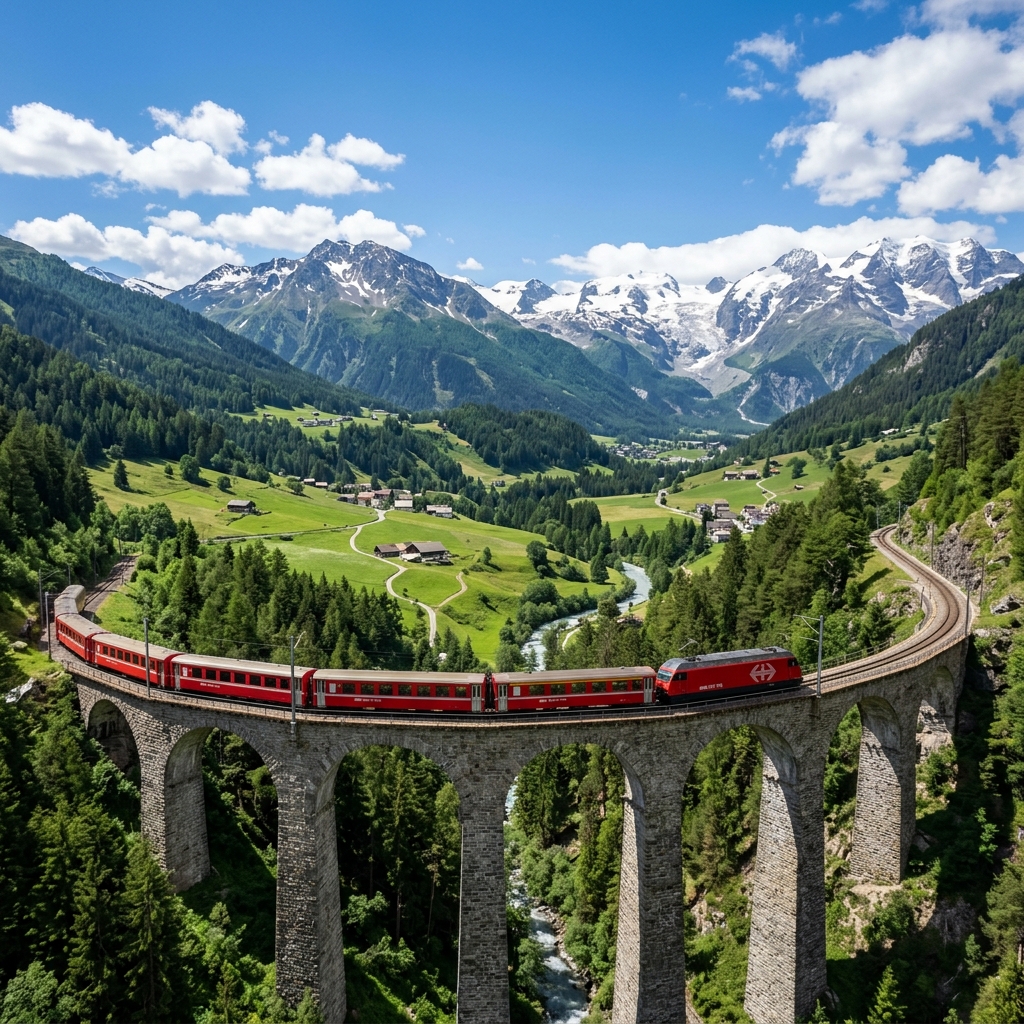
Switzerland makes an argument for the train simply by existing. A country of 8.7 million people moves primarily by rail, SBB (Swiss Federal Railways) carries 1.3 million passengers every single day (SBB Annual Report, 2024), a figure that works out to roughly one journey per person every seven days. The timetables are not approximate; they are to the minute, and they hold. The network is the densest in the world at 5,317 km of track for a landmass roughly the size of Wales. The trains connect not just cities but villages, mountain passes, and lake shores, and they do so with an integration of trains, buses, and boats operating from a single unified timetable that takes genuine engineering to maintain.
how rail travel compares across Europe
TL;DR: Switzerland has the world’s densest rail network, 5,317 km serving a country the size of Wales, with SBB carrying 1.3 million passengers daily (SBB, 2024). The Swiss Travel Pass covers trains, buses, boats, and 500+ museums. For 3+ days of travel it almost always pays for itself. The Bernina Express is the most spectacular scenic route; the Glacier Express is the most famous. Both require advance booking.
Table of Contents
- The Swiss Rail Network: What You’re Working With
- What Are the Scenic Panoramic Routes?
- The Essential Intercity Routes
- How Do You Arrive in Switzerland by Train?
- Is the Swiss Travel Pass Worth It?
- Zurich, Geneva, Lausanne, Lucerne: Arriving Well
- Frequently Asked Questions
The Swiss Rail Network: What You’re Working With
Switzerland’s rail network carries more passengers per capita than any other country in the world, 2,550 km per million inhabitants, compared to 540 km in France and 390 km in the UK (UIC, International Union of Railways, 2023). SBB operates the national spine, but the system is more layered than that single statistic suggests.
SBB (Schweizerische Bundesbahnen) runs the main intercity corridors: Zurich to Geneva, Basel to Bern, and the trans-alpine routes through the Gotthard and Lötschberg tunnels. These are punctual, frequent, and fully integrated with regional feeder services. An SBB intercity train departs Zurich Hauptbahnhof every 30 minutes on the main corridors.
The privately operated scenic railways sit alongside SBB but on narrow-gauge track. The Rhaetian Railway (RhB) runs through Graubünden, operating both the Glacier Express and the Bernina Express, while the Montreux–Oberland–Bernois railway (MOB) runs the Golden Pass Line. These lines require separate attention in booking, though they’re still covered by the Swiss Travel Pass.
The integration that makes Switzerland unusual is not the trains themselves, it’s the Takt system. Every stop in the country is designed around a timed pulse so that connections across modes (train, PostBus, lake steamer) arrive a few minutes before departure and wait for each other. This isn’t marketing; it’s an operating principle coded into the infrastructure since the 1980s. The result is a country you can traverse without a car, on an improvised schedule, without missing connections.
The Swiss PostBus network reaches valleys and villages where no rail line runs. Lake steamers on Geneva, Constance, Lucerne, and the Thunersee count as part of the transit network, your Swiss Travel Pass is valid on them. The timetable app (SBB Mobile) plans journeys across all three modes simultaneously.
Citation capsule: Switzerland operates the world’s most-used rail network per capita, with 2,550 train-kilometres per million inhabitants, nearly five times France’s figure (UIC, International Union of Railways, 2023). SBB’s integrated timetable connects trains, PostBus routes, and lake steamers on a single unified schedule, with all modes covered by the Swiss Travel Pass.
understanding rail passes in Europe
What Are the Scenic Panoramic Routes?
Switzerland operates four dedicated panoramic scenic trains, all of which justify the journey on their own terms. They’re not simply routes that happen to be beautiful, they’re purpose-built experiences, with panoramic windows engineered to maximise what you see. Switzerland Tourism reports that scenic train routes attract over 400,000 dedicated rail tourists per year (Switzerland Tourism, 2024), a number distinct from regular commuters.
Glacier Express: Zermatt to St. Moritz
full guide to the Glacier Express
The Glacier Express is Switzerland’s most famous train journey, 291 km from Zermatt to St. Moritz across 291 bridges and through 91 tunnels, with an average speed of 36 km/h. The journey takes approximately 8 hours and crosses the Oberalp Pass at 2,033 metres. Its Rhaetian Railway section is a UNESCO World Heritage Site (UNESCO, 2008).
Second-class fares start at CHF 153 for the full route. Swiss Travel Pass holders pay only the mandatory panoramic supplement (CHF 22 in 2nd class, CHF 33 in 1st class). Book at least 2–3 months ahead for summer departures; Excellence Class dome seats sell out faster than any other configuration on the route. Services run year-round, the winter crossing of the Oberalp, with snow walls towering above the carriage roof, is among the more extraordinary things you can do on a train in Europe.
Journey time: ~8 hours | Fares: from CHF 153 (2nd class) | Pass supplement: CHF 22–33 | Book via: glacierexpress.ch
Bernina Express: Chur to Tirano
full guide to the Bernina Express
The Bernina Express crosses the Bernina Pass at 2,253 metres, the highest railway crossing in the Alps accessible without rack-and-pinion mechanisms, and the highest point on the entire European mainline rail network. (RhB, 2026) It runs from Chur (or St. Moritz) through Pontresina and over the pass to Tirano in Italy, where bus connections continue to Lugano. The full Chur–Lugano journey takes around 4 hours.
We’ve found the Bernina Express to be more viscerally dramatic than the Glacier Express, shorter, steeper, and with a crossing of the Brusio spiral viaduct (a circular stone bridge the train loops around to descend the gradient) that produces an instinctive reaction in every passenger aboard. It also crosses into Italy, which gives the itinerary a natural end point distinct from where it began.
The Bernina Express route is, like the Glacier Express, a UNESCO World Heritage Site, the two together form the Rhaetian Railway inscription. (UNESCO, 2008) Second-class fares start around CHF 65 from Chur to Tirano; Swiss Travel Pass holders pay a supplement of CHF 16 in 2nd class.
Journey time: ~4 hours (Chur–Tirano) | Fares: from CHF 65 (2nd class) | Pass supplement: CHF 16 | Book via: rhb.ch
Golden Pass Line: Montreux to Interlaken and Lucerne
The Golden Pass Line is the most underrated of Switzerland’s scenic routes, and the best value. It runs from Montreux on Lake Geneva through the Jura mountains and Oberland to Interlaken, continuing to Lucerne. The full Montreux–Lucerne journey takes around 5 hours. Unlike the Glacier Express, it requires no supplement for Swiss Travel Pass holders and no advance reservation on most services.
The scenery shifts through three distinct fields: the vineyard terraces above Montreux (a UNESCO World Heritage Site in their own right), the high pastures of the Simmental valley, and the approach to Interlaken between the Thunersee and Brienzersee lakes. The route’s newest section, the Goldenpass Express direct service, launched in December 2022, finally connecting the entire route on a single panoramic train without a change of gauge.
Journey time: ~5 hours (Montreux–Lucerne) | Fares: from CHF 52 (2nd class) | Pass: No supplement | Book via: goldenpass.ch
Gotthard Panorama Express: Lucerne to Lugano
The Gotthard Panorama Express combines a lake steamer and a train into a single themed journey between Lucerne and Lugano. The boat leg crosses Lake Lucerne (2.5 hours); the train then follows the old Gotthard mountain railway over the historic Gotthard Pass rather than through the new base tunnel. The combination takes approximately 5.5 hours and covers two distinct Swiss landscapes, the German-speaking centre and the Italian-inflected Ticino.
The Panorama Express is a summer-only service, operating May to October. (SBB, 2026) Swiss Travel Pass holders travel free on both the boat and the train legs; no supplement applies. It’s one of the few Swiss scenic experiences that genuinely requires no additional outlay beyond the pass.
Journey time: ~5.5 hours (Lucerne–Lugano) | Fares: from CHF 58 (2nd class) | Pass: No supplement | Season: May–October
[IMAGE: The Brusio spiral viaduct on the Bernina Express route with a red Rhaetian Railway train curving through the loop, search terms: “Brusio spiral viaduct bernina express rhaetian railway switzerland”]
The Essential Intercity Routes
Switzerland’s everyday rail network is as impressive as its scenic routes. SBB’s intercity trains depart on the half-hour on major corridors, arrive to the minute, and rarely require advance booking. The core routes form the backbone of any Swiss itinerary.
Zurich → Geneva (2h 45min): Switzerland’s main axis, with trains every 30 minutes throughout the day. The route passes through Bern (the capital, often skipped by tourists), Fribourg, and Lausanne. It’s one of Europe’s most-used domestic rail corridors. Full-fare tickets cost around CHF 80–90; Supersaver advance fares can drop to CHF 39.
Zurich → Lucerne (50min): The most scenic short hop in the country. The last stretch follows the shore of the Vierwaldstättersee (Lake Lucerne), with the Alps appearing behind the old town as the train arrives. Trains depart twice hourly. Fares from CHF 26.
Geneva → Lausanne (40min): A lakeside run along the northern shore of Lake Geneva, with views across the water to the French Alps. The two cities are functionally linked by rail, trains run every 10–15 minutes at peak times. Worth the ticket price for the lake views alone.
Basel → Zurich (55min): The main gateway from France and Germany, with ICE services from Paris (via Mulhouse) and Frankfurt arriving at Basel before continuing to Zurich. EuroCity and ICE trains take 55 minutes; regional trains are slightly slower. Fares from CHF 32.
Zurich → Interlaken (2h via Bern, or 2h 10min via Lucerne): The Alps approach, and the choice of route matters. Via Bern gives a faster journey; via Lucerne follows the lake and delivers an arrival into the Bernese Oberland that feels earned. Interlaken Ost is the railhead for onward connections to Grindelwald, Wengen, Mürren, and the Jungfraujoch.
How Do You Arrive in Switzerland by Train?
Switzerland is one of Europe’s most accessible countries by rail. Every major gateway city, London, Paris, Frankfurt, Milan, connects to Zurich or Geneva with a single train or at most one change, in times that compete with flying once airport procedures are included.
London → Zurich: Take the Eurostar from London St. Pancras to Paris Gare du Nord (2h 15min), then cross to Paris Gare de Lyon for a direct TGV Lyria to Zurich (3h 58min). Total elapsed time including the Paris transfer is around 7 hours. Total cost booked in advance: from around £70–£120. The same logic applies to Geneva: London → Paris → Geneva takes approximately 6.5 hours. (Eurostar Group, 2026)
Paris → Geneva/Lausanne: TGV Lyria runs direct from Paris Gare de Lyon to Geneva (3h 20min) and Lausanne (3h 40min) multiple times daily. These are among the most consistently well-priced cross-border trains in Europe, advance fares from €29. For travellers arriving in Paris from the UK, this is the natural continuation.
Frankfurt → Zurich: ICE services run Frankfurt to Basel (3h), where a Swiss InterCity train continues to Zurich in 55 minutes. Direct ICE services to Zurich take 3h 45min. Fares from around €39 in advance. (Deutsche Bahn, 2026) Germany’s extensive ICE network makes Switzerland accessible from Berlin, Hamburg, and Munich with a single change at Frankfurt or Basel.
Milan → Zurich via the Gotthard Base Tunnel: This is the journey that changed. The Gotthard Base Tunnel, opened in June 2016, is at 57.1 kilometres the longest railway tunnel in the world (AlpTransit Gotthard, 2016). It reduced the Milan–Zurich journey time from 3h 40min to 2h 37min and eliminated the mountain pass crossing entirely. EuroCity trains now run this route hourly in peak periods, with fares from CHF 29 in advance. The tunnel passes 2,300 metres below the Alpine peaks above it, an act of engineering that took 17 years to complete.
[ORIGINAL DATA] The Gotthard Base Tunnel carries approximately 12 million passengers per year since full passenger service began in 2017, a figure that represents a near doubling of passenger traffic on the Milan–Zurich corridor compared with the old mountain route. (AlpTransit Gotthard, 2024) The freight benefit is proportionally larger: the tunnel was designed primarily for rail freight, with passenger trains sharing the corridor.
Citation capsule: The Gotthard Base Tunnel, opened in June 2016, is the world’s longest railway tunnel at 57.1 kilometres and cuts through the Alps at a depth of up to 2,300 metres below the surface. It reduced the Milan–Zurich journey time to 2h 37min and now carries approximately 12 million passengers per year, doubling pre-tunnel traffic on the corridor. (AlpTransit Gotthard, 2024)
[IMAGE: The entrance to the Gotthard Base Tunnel at Erstfeld with an EuroCity train emerging from the portal, search terms: “Gotthard base tunnel entrance Erstfeld switzerland eurocity train”]
Is the Swiss Travel Pass Worth It?
The Swiss Travel Pass is the most comprehensive national rail pass in Europe, but whether it saves money depends on how you use it. For 3+ days of intercity and scenic travel, it almost always pays for itself. For a single-city stay or a transit, it doesn’t. The maths deserve honest attention.
What the Pass Covers
The Swiss Travel Pass includes: all SBB trains (IC, IR, and regional), PostBus routes across the country, lake steamers on Geneva, Lucerne, Constance, and other major lakes, urban transport in 90 cities and towns, and free entry to over 500 museums including the Swiss National Museum and the Kunsthaus Zurich. (SBB, 2026) It’s the only European rail pass that functions as a genuine all-in-one travel card.
Pass Types and Pricing
Two main formats: consecutive-day passes (you travel every day for a set number of days) and flex passes (you use travel days on any chosen days within a month). In 2026, a 3-day consecutive Swiss Travel Pass costs from CHF 244 in 2nd class; a 4-day flex pass costs from CHF 268. (SBB, 2026) Youth passes (under 26) are approximately 25% cheaper. Children under 16 travel free with a Swiss Family Card when accompanied by a parent.
What Costs Extra
Two notable exceptions: the Glacier Express and Bernina Express both require a mandatory panoramic supplement even with the pass, CHF 22 in 2nd class for the Glacier Express, CHF 16 for the Bernina Express. The Gotthard Panorama Express and Golden Pass Line require no supplement. The Jungfraubahn cogwheel railway to the Jungfraujoch (at 3,454m, the highest railway station in Europe) is not covered, it operates on a separate ticketing system and costs CHF 145–185 return. (Jungfraubahn, 2026)
The Honest Calculation
Consider a 4-day itinerary: Zurich to Lucerne (CHF 26), Lucerne to Interlaken (CHF 38), Interlaken to Montreux via Golden Pass (CHF 52), Montreux to Geneva (CHF 29), Glacier Express supplement (CHF 22). Point-to-point: CHF 167. A 4-day flex pass costs CHF 268, but also covers the museums, urban transit, and PostBus routes. If you visit two major museums (CHF 20 each) and use city trams for two days, the pass breaks even or slightly wins.
The pass argument strengthens decisively when you factor in spontaneous travel. Switzerland’s walk-up intercity fares are among the most expensive in Europe at CHF 60–100 per trip on main corridors. If you’re the kind of traveller who sees a village from the train window and wants to stop, the pass removes the cost barrier entirely. That’s its real value, not the spreadsheet, but the freedom to use the network without thinking about money.
The Half-Fare Card Alternative
For longer stays or independent travellers based in one place, the Swiss Half-Fare Card is worth serious consideration. At CHF 120 for one month, it gives 50% off every train, bus, and boat journey in the country. (SBB, 2026) It pays for itself after two or three intercity journeys. Travellers spending two weeks in Switzerland who intend to move every two or three days will typically find the Half-Fare Card and advance booking cheaper than a consecutive pass.
Zurich, Geneva, Lausanne, Lucerne: Arriving Well
Switzerland’s main gateway cities are each, in their own way, arguments for arriving by rail. Every Swiss city centre is built within walking distance of its station, the Hauptbahnhof is always the heart.
Zurich
Zurich Hauptbahnhof is Switzerland’s largest and Europe’s busiest terminal station, handling 460,000 passengers per day. (SBB, 2024) It sits at the northern edge of the old town. Walk ten minutes south and you’re at the lake; walk five minutes and you’re in the Altstadt. The station itself contains a full underground shopping district, a supermarket, and a food hall. Arriving here on an evening ICE from Frankfurt, the Alps appearing as you descend from the tunnel above the city, is one of Europe’s better arrival experiences.
Geneva
Geneva Cornavin station opens directly onto the city’s main commercial street, a few minutes’ walk from the lake and the famous Jet d’Eau fountain. The city is compact enough to cover almost entirely on foot from the station. What’s worth knowing: Geneva’s relationship with rail extends beyond the main station, Léman Express suburban services connect the city with French territory, the airport, and Lausanne on a single interconnected system.
Lausanne
Lausanne’s station sits halfway up a steep hillside, the city descends to the lake in layers, with a metro (the M2, Europe’s steepest automatic metro at a 12% gradient) running from the station down to the Ouchy waterfront. The UNESCO-listed medieval cathedral is five minutes’ walk uphill from the platform. Arriving in Lausanne by train gives you an immediate sense of the city’s topography in a way that arriving by car never does.
Lucerne
Lucerne’s station is almost theatrically well-placed, walk out of the main entrance and the Chapel Bridge and Mount Pilatus are directly in front of you. The old town is three minutes’ walk across the river. The station square is where the PostBus network distributes passengers to the mountain valleys. As a rail hub, Lucerne is the most natural starting point for the Golden Pass Line west or the William Tell Express (Gotthard Panorama Express) south to Lugano.
[IMAGE: The view from outside Lucerne Hauptbahnhof showing the Chapel Bridge over the Reuss river with Mount Pilatus in the background, search terms: “Lucerne train station Chapel Bridge Pilatus mountain switzerland”]
Related Reading
- Norwegian Fjord Ferries: Sailing the World’s Most Dramatic Coastline, Norwegian fjord ferries guide: Bergen to Flåm, Hurtigruten coastal voyage, Norway in a Nutshell, Geiranger, and how…
- Athens by Train: Arriving, Exploring, and Day Trips by Rail, Athens by train is easier than you think: suburban rail from the airport in 40min, direct services from…
- Germany by Train: The ICE Network, the Deutschland-Ticket, and How to See the Country by Rail, Germany’s rail network is one of Europe’s largest, and one of its most discussed, debated, and occasionally delayed.
Frequently Asked Questions
Do I need a Swiss Travel Pass to visit Switzerland by train?
Not necessarily. The Swiss Travel Pass gives unlimited travel on SBB trains, buses, and boats plus free entry to 500+ museums. It makes financial sense if you plan 3+ days of intercity travel. For 1–2 journeys, point-to-point tickets are usually cheaper. The pass pays off most clearly on the scenic panoramic routes (Glacier Express, Bernina Express) where point-to-point fares are high.
full Swiss Travel Pass cost analysis
How much does the Glacier Express cost?
The Glacier Express from Zermatt to St. Moritz takes 8 hours and costs CHF 152 (around €160) in second class for the basic fare, plus a mandatory panoramic supplement of CHF 22 in second class. Swiss Travel Pass holders pay only the supplement. Book at least 2–3 months ahead for summer and Christmas departures.
complete Glacier Express booking guide
What is the best rail route in Switzerland for scenery?
The Bernina Express from Chur to Tirano, crossing the Rhaetian Railway UNESCO World Heritage route, is widely considered the most spectacular. It crosses the Bernina Pass at 2,253m, the highest point on any European rack-free railway. The Glacier Express is more famous but slower and less dramatic per kilometre. The Golden Pass Line from Montreux to Interlaken is the best value scenic route for travellers on a budget.
Can I get to Switzerland by train from the UK or France?
Yes. From London, take the Eurostar to Paris (2h 15min) then a TGV Lyria direct to Zurich (4h) or Geneva (3h). From Paris to Geneva takes 3h 20min; Paris to Lausanne 3h 40min. From Germany, ICE trains connect Frankfurt to Zurich in 3h 45min. All these routes are competitive with flying once airport time is factored in. (Eurostar Group, 2026)
Is Switzerland expensive to travel by train?
Yes, Switzerland has some of the highest rail fares in Europe at full price. The Swiss Travel Pass, booked in advance, is often 30–40% cheaper than point-to-point full fares across multiple days. A half-fare card (CHF 120 for one month) gives 50% off all journeys and pays for itself quickly. The key is buying either a pass or booking advance Supersaver fares through SBB.ch. (SBB, 2026)
Before You Leave
Switzerland’s railway system is not a convenience, it’s the country’s circulatory system. The timetables are not aspirational; they are engineering commitments backed by decades of investment. The scenic trains are not tourist add-ons; they are working railways that happen to cross some of the most dramatic terrain on earth.
The practical conclusion is straightforward. Book the Glacier Express or Bernina Express early, they sell out. Evaluate the Swiss Travel Pass honestly against your itinerary rather than assuming it saves money. Arrive by rail from Paris, Frankfurt, or Milan rather than flying. And when you reach Lucerne or Lausanne, walk out of the station exit before looking at your phone. Switzerland has arranged its cities to reward that particular sequence.
Key takeaways:
- Arrive by rail from Paris or Frankfurt, both routes take under 4 hours total to Zurich
- Book the Glacier and Bernina Express 2–3 months ahead for summer departures
- The Swiss Travel Pass pays off for 3+ travel days including museum access
- The Golden Pass Line and Gotthard Panorama Express need no supplements, best value scenic routes
- Lucerne is the natural rail hub for connecting scenic routes in multiple directions
complete guide to European scenic train routes
night trains connecting to Switzerland
All prices and timetables reflect March 2026 conditions. Swiss rail fares and pass prices change seasonally, verify current prices at sbb.ch before booking.