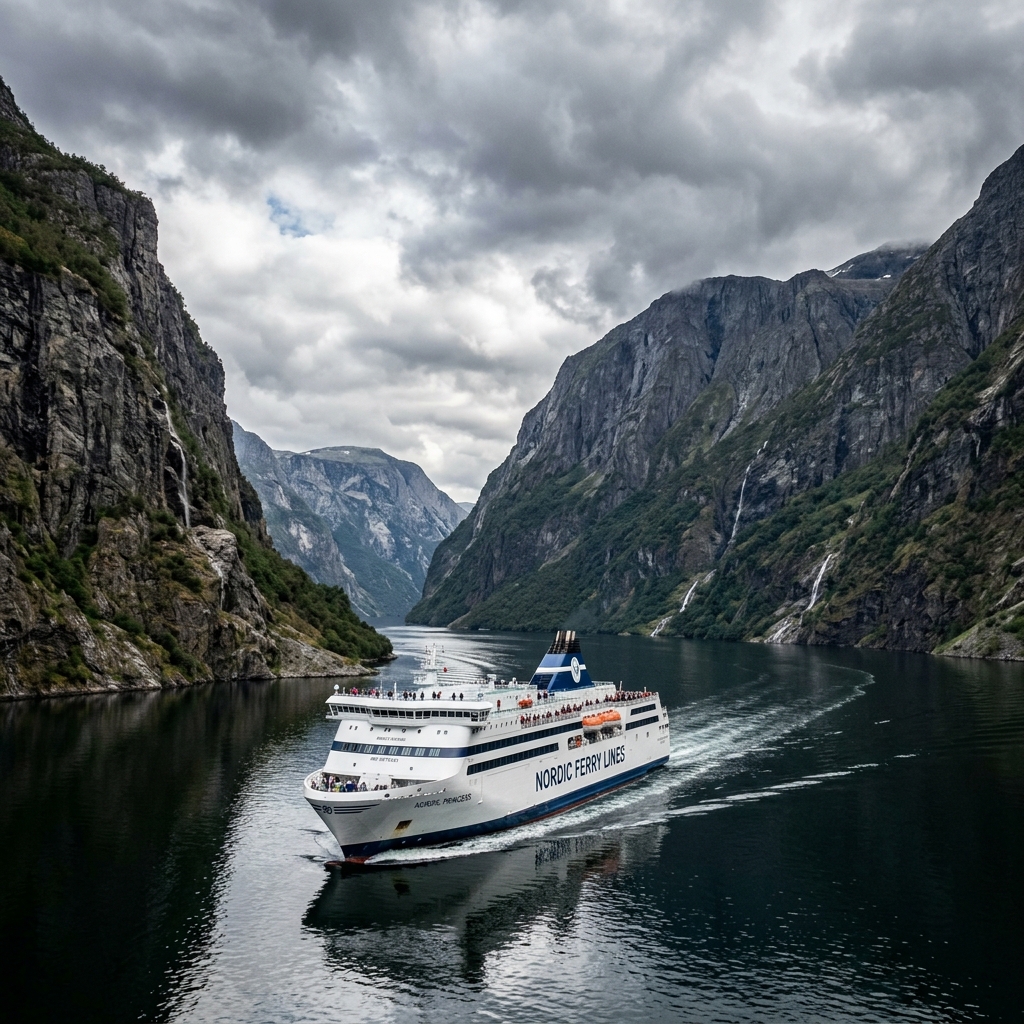
There is a quality of unreality to the Norwegian fjords that hits even people who consider themselves immune to landscape. You are sailing through a crack in the earth’s surface — a crack that happens to be filled with cold, extraordinarily clear, deep-blue water, flanked by walls of rock that rise 1,000 metres on either side, and at the far ends of which villages exist in a state of improbable beauty. The light falls differently here. The scale is different. The silence, when the ferry engine is throttled back and you’re gliding through Nærøyfjord, has a texture you can hear.
Norway’s ferry network is not a tourist amenity. It is the country’s public transport system — ferries replace roads and bridges across a coastline of 25,000 kilometres (including fjords and islands), and the working vessels that carry commuters, freight, and mail between coastal communities have been doing so continuously since the 19th century. The fact that this transport network passes through scenery of surpassing magnificence is, from the Norwegian perspective, simply a feature of the geography.
For the traveller, it is rather more than that.
planning a train journey to Oslo
TL;DR: Norway’s fjord ferries range from free cross-fjord passages (integrated into public transport) to the 11-day Hurtigruten coastal voyage. Norway in a Nutshell (train + mountain railway + ferry + bus) is the classic circuit, bookable independently for €130–€170. Geiranger fjord ferry from Hellesylt takes 1 hour. September is the finest month — autumn colours, reduced crowds, lower prices. The Hurtigruten starts from approximately €1,200 for 11 days full-board.
Why Norway’s Fjords Are Different
The Norwegian fjords are UNESCO World Heritage Sites — specifically, the Geirangerfjord and the Nærøyfjord (in the Sognefjord system) hold this designation. This tells you something about their global significance but nothing about their experiential quality.
The fjords were formed by glaciers — the same glaciers that covered Scandinavia during the last ice age, advancing and retreating over millions of years, carving these extraordinary U-shaped valleys that were subsequently flooded by rising sea levels. The result is water up to 1,308 metres deep (Sognefjord, the world’s deepest fjord) flanked by mountains that were old when the Vikings were young.
What makes the Norwegian fjord experience specifically, irreplaceably itself is the combination of scale and intimacy. The fjords are vast — the Sognefjord runs 205 kilometres inland from the coast — but the ferry passes close enough to the walls to feel the temperature drop from the shade of the rock faces. Waterfalls descend directly from the mountains into the fjord water, some of them year-round, some of them seasonal torrents after snowmelt. The villages at the fjord edges — Flåm, Balestrand, Aurland, Hellesylt — are small enough that their reflection in the water seems to double their entire existence.
The Main Fjord Ferry Routes
Bergen → Flåm: The Sognefjord Express Boat
The most popular ferry journey in western Norway connects Bergen — Norway’s second city and the traditional gateway to the fjords — with Flåm, the village at the end of the Aurlandsfjord branch of the Sognefjord.
The express passenger boat takes approximately 5 hours 30 minutes sailing from Bergen out into the outer fjord, then turning east through the great corridor of the Sognefjord, branching south into the Aurlandsfjord, and pulling into the small wooden quay at Flåm. The scenery intensifies as you proceed inland — the outer fjord has a certain open grandeur, but the inner Aurlandsfjord, with walls rising more than 1,000 metres on both sides, is something else.
This service is operated by Norled and Fjord1, bookable through the Fjord Tours platform (fjordtours.com). In 2025, one-way fares run approximately NOK 700–900 (€60–€80) for adults in standard class. The boat has an indoor lounge with café service and an outdoor observation deck; in good weather, the outdoor deck is the only reasonable place to be.
Stavanger → Lysebotn: The Lysefjord
The Lysefjord east of Stavanger is the fjord beneath Preikestolen — the flat-topped cliff (Pulpit Rock, 604 metres above the water) that appears on more Norwegian tourism photographs than any other single image. The fjord itself is navigable by tour boat from Stavanger to Lysebotn at the fjord’s inner end — a 3-hour journey each way.
Preikestolen is reached by a 4-hour round-trip hike from the car park at Preikestolhytta (served by bus from Stavanger). The combination of fjord boat + Preikestolen hike makes a full day from Stavanger, and the perspective from the water — looking up at the cliff you’ll be standing on later, or that you stood on earlier — has a satisfying narrative coherence.
Stavanger–Lysebotn boat services: operated by Ryfylke and seasonal tour operators, approximately May–September. Book through stavangertours.com or the Ruter regional transit app. Fares: approximately NOK 500–700 (€45–€65) return.
Bergen → Balestrand → Flåm: The Inner Sognefjord
An alternative to the direct Bergen–Flåm boat, this route takes a day to travel inland with a stop at Balestrand — a small village on the Sognefjord north shore with a remarkable collection of Victorian-era wooden architecture (including the English-style St. Olaf’s Church, built by the English wife of a local merchant in 1897) and genuinely excellent walking in the mountains above.
Breaking the Bergen–Flåm journey at Balestrand for one or two nights transforms it from a transit into a destination. The village has a handful of small hotels and guesthouses, restaurants serving local trout and reindeer, and the kind of unhurried pace that the fjords encourage. From Balestrand, a connecting express boat to Flåm takes approximately 2 hours.
Geiranger Ferry: The UNESCO Postcard Fjord
Geiranger is the fjord that appears on most people’s mental image when someone says “Norwegian fjord” — the impossibly dramatic inlet with waterfalls (the Seven Sisters, the Suitor, the Bridal Veil) cascading from the mountain walls into turquoise water below. It is, genuinely, that beautiful.
The ferry route across the Geirangerfjord connects Geiranger and Hellesylt — a 1-hour crossing that passes directly through the UNESCO-listed section of the fjord, under the waterfalls, past the abandoned farm terraces visible high on the cliff walls (people actually farmed these terraces, and hiked down to fetch provisions by boat, until the early 20th century).
- Journey: Geiranger ↔ Hellesylt, 1 hour
- Operator: Fjord1
- Fare: approximately NOK 130 (€12) for foot passengers; car fares around NOK 360 (€34)
- Frequency: multiple daily sailings in summer, reduced in winter
Geiranger village is reachable by Raumabanen train from Åndalsnes (to Åndalsnes), then bus to Geiranger — a combination that works well in summer when the scenic bus route through the Trollstigen mountain pass is operating.
The Hurtigruten: Norway’s Coastal Voyage
What Hurtigruten Actually Is
The Hurtigruten (literally “the fast route”) has been running along the Norwegian coast since 1893, when it was established as a mail and cargo service connecting Bergen with the far north — a postal route that happened to carry passengers because the ports it served had no other connection to the outside world. For the fishing communities, lighthouse keepers, and farmers of coastal Norway, Hurtigruten was the lifeline. It still is, in many of those communities.
This is not a cruise. Hurtigruten carries cars, freight, cargo, and local passengers alongside the tourists; at each port, vehicles drive off, deliveries are made, locals board for the next stop. The ships feel like working vessels with comfortable passenger accommodations — not floating hotels with a Norwegian backdrop.
The classic 11-day round voyage from Bergen north to Kirkenes (600km from the Russian border, at the very top of Norway) and back covers 34 ports in each direction. Many ports are visited twice — going north in daylight, returning in darkness — so different landscapes appear on each pass.
The Route
Bergen → Ålesund → Trondheim → Bodø → Tromsø → Honningsvåg → Kirkenes (6–7 days northbound), then the return southbound journey.
Key stops:
- Ålesund: art nouveau city on a series of islands, entirely rebuilt after an 1904 fire that destroyed the original wooden town
- Trondheim: medieval cathedral city, the historic capital of Norway, with the Nidaros Cathedral — the northernmost medieval cathedral in the world
- Bodø: the gateway to the Lofoten Islands and the crossing of the Arctic Circle
- Tromsø: the Arctic capital, aurora borealis city, accessible in winter for Northern Lights viewing
- Nordkapp: the northernmost accessible point of mainland Europe (excursion from Honningsvåg)
- Kirkenes: the turnaround point, at the Norwegian–Russian border
Booking and Pricing
Hurtigruten fares are full-board, meaning all meals are included. The standard fare for the 7-day one-way Bergen–Kirkenes voyage starts at approximately €900–€1,400 per person in an interior cabin, increasing to €1,400–€2,000 for outside cabins with sea views, and significantly more for premium and suite categories.
Book direct at hurtigruten.com. The price calendar is worth exploring — September–October and February–March are considerably cheaper than the summer peak.
Havila Voyages: The Sustainable Alternative
Havila Voyages (havila-voyages.no) began operating the same Bergen–Kirkenes coastal route in 2021, with ships powered by hybrid battery-electric technology — the largest battery installations on any passenger vessel. The environmental case is genuine; the ships carry enough battery charge to run entirely on zero-emission power through the UNESCO fjord sections of the route.
Havila prices tend to run slightly below equivalent Hurtigruten rates for comparable cabin categories, making it worth comparing both when planning the coastal voyage. The ships are newer and the interior design is more contemporary; the route and port stops are identical.
Norway in a Nutshell: The Classic Circuit Done Properly
The Norway in a Nutshell concept — combining the Bergensbanen railway, the Flåmsbana mountain railway, the Nærøyfjord ferry, and a bus connection — is Norway’s most-sold tourist experience. It is sold as a package by various operators, but it can be booked entirely independently at lower cost and greater flexibility.
The Components
-
Oslo → Myrdal by Bergensbanen (5h 30min): The Oslo–Bergen railway is one of the world’s great railway journeys — 500km across the Hardangervidda plateau, through the highest mountain section of any main railway line in northern Europe, past the extraordinary Finse station (where The Empire Strikes Back exterior scenes were filmed). Myrdal is a mountain junction at 866 metres elevation, serving only as a transfer point. Tickets from NOK 299–599 (€27–€55).
-
Myrdal → Flåm by Flåmsbana (55min): The Flåmsbana descends 863 metres in 20 kilometres — one of the steepest standard gauge railway lines in the world, with gradients of up to 5.5%. The line passes Kjosfossen waterfall (the train stops for 5 minutes for photographs — a concession to tourism that the line has made since tourists began noticing the waterfall in the 1950s). This is not a tourist railway in the heritage sense; it is a working mountain railway that happens to be extraordinary. Tickets: NOK 430–570 (€39–€52) one-way.
-
Flåm → Gudvangen by ferry (2h, Nærøyfjord): The Nærøyfjord section of the Sognefjord is the narrowest fjord in Europe — at its narrowest point, just 250 metres wide, with walls rising 1,700 metres above. It is a UNESCO World Heritage Site and deserves the designation completely. The ferry passes in near-silence beneath walls of rock and water. Two hours: not enough. Tickets: approximately NOK 350 (€32) per person.
-
Gudvangen → Voss by bus (1h): A mountain bus through the Stalheimskleiva — a road with hairpin bends ascending 250 metres, with views back over the fjord. Then onward by train: Voss → Bergen (1h, approximately NOK 175 / €16).
Booking Independently
All components can be booked separately through Norwegian public transport systems:
- Bergensbanen: vy.no (Norwegian railways)
- Flåmsbana: flaamsbana.no or bundled through Fjord Tours
- Nærøyfjord ferry: visitflam.com or fjordtours.com
- Bus and onward rail: vy.no or skyss.no
Total cost, independently booked: approximately €130–€175 per person Oslo to Bergen including all segments. The package operators charge €190–€240 for the same journey — the premium is for convenience rather than quality.
The Off-Season Argument: September in the Fjords
The conventional wisdom on Norwegian fjord travel is: go in summer for guaranteed weather, midnight sun, and full ferry and activity options. This is not wrong. But it omits the case for September, which is, in this writer’s view, the finest month in the fjords.
In September:
- The birch trees turn. The lower mountain slopes go amber, gold, and orange against the dark conifer forests and grey rock. The reflection in the fjord water on a still morning is extraordinary.
- The crowds have gone. Geiranger village in August processes thousands of cruise ship passengers per day. In September it is quiet enough to hear the waterfalls.
- Prices are lower. Accommodation, ferry packages, and Hurtigruten fares all drop meaningfully in September compared to July.
- The light is better for photography. The flat overhead summer sun produces postcard landscapes. The lower autumn light produces art.
- Hiking is easier. Trails are less crowded; temperatures are comfortable rather than warm; mountain visibility is often better in September than in hazy August.
The ferry schedules are still at near-summer frequency in September on all major routes. The Flåmsbana runs regularly. The Nærøyfjord ferry continues until late October. There is no operational reason to prefer August.
Public Transport and Ferry Passes
Norwegian fjord ferries are part of the regional public transport system and can be accessed using regional transit passes:
- Skyss (the Vestland county transport authority, covering Bergen and the western fjord region) integrates some fjord ferry routes into its transit pass system
- Ruter (Oslo and the surrounding region)
- Fram (Møre og Romsdal, including Ålesund and Geiranger access routes)
For most visitors, buying individual tickets for each ferry segment is straightforward and appropriate. For residents or extended-stay travellers in the fjord region, the regional passes offer better value.
The Interrail pass (and Eurail for non-Europeans) covers travel on Norwegian state railways (VY/NSB) but does not cover ferry or bus segments. The Flåmsbana is included in the Interrail pass as a scenic add-on (one journey included, additional journeys at half price).
planning a slow train journey through Europe
Practical Notes
Weather and Expectations
Norwegian fjord weather is variable at any time of year. The fjords are deep, sheltered corridors that create their own microclimates; rain is frequent, and low cloud can obscure the mountain tops in a way that is either atmospheric or disappointing depending on your temperament. The best strategy: build flexibility into your schedule so that if Geiranger is in cloud on your planned ferry day, you can wait a day for the clouds to clear.
Layered clothing is appropriate year-round. Even in July, the open deck of a fjord ferry at speed requires a fleece; the temperature in the shadow of 1,500-metre rock walls is significantly lower than in direct sun.
Getting Around Without a Car
The Norwegian fjords are extremely well-connected by public transport — more so than most European mountain regions. The combination of Vy/NSB train services (Bergensbanen, Dovrebanen, Raumabanen), Nettbuss and regional coaches, and the network of fjord ferries means that car-free travel through the key fjord destinations is entirely feasible.
The constraint is pace: without a car, some of the secondary valleys and villages require extra time to access. The main route — Bergen, Voss, Myrdal, Flåm, Gudvangen, Ålesund, Geiranger — is completely manageable by public transport.
Booking Ferries
For individual fjord routes: fjordtours.com (Norwegian fjord specialist), visitflam.com (Flåm and Aurlandsfjord), fjord1.no (Geiranger and west coast car ferries), norled.no (Stavanger area and some Bergen routes).
The Argument for Going Slowly
The Norway in a Nutshell circuit, done as a single day trip from Oslo, is genuinely impressive and entirely insufficient. You arrive at the fjord in the early afternoon, spend 2 hours on the Nærøyfjord ferry, and leave. You have seen the thing; you have not been there.
The difference between seeing the Nærøyfjord from a ferry in transit and spending three days in Flåm or Balestrand — walking the lakeside trails, sitting on the quay in the evening when the day-trippers have gone and the light on the water is doing something that cameras cannot properly record — is the difference between having visited and having been somewhere. Norway’s fjords are among the places in the world where this distinction matters most.
Stay longer than the itinerary suggests. Take the slow boat. Come back in September.
Related Reading
- Switzerland by Train: Routes, Passes, and the Art of Arriving by Rail — Switzerland has the densest rail network in the world — 5,317km for a country the size of Wales.
- The Adriatic Coast by Train and Ferry: Italy to Croatia Slow — Travel the Adriatic slow: Italy’s coastal rail line from Bologna to Bari, then overnight ferry to Split and…
- Croatia Ferry Guide: Island Hopping the Dalmatian Coast — Croatia ferry guide to island hopping the Dalmatian Coast: Split to Hvar, Vis, Korčula, and beyond.