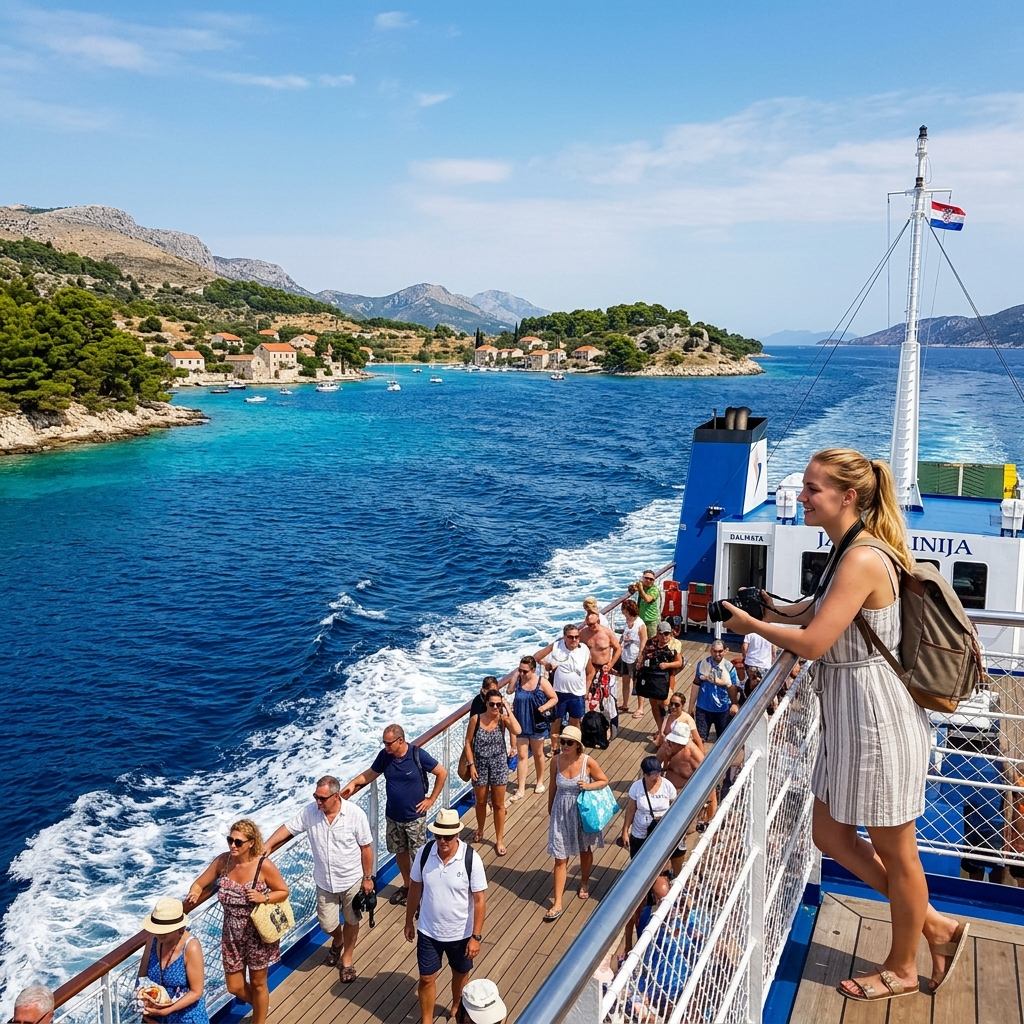
The Adriatic is Europe’s most underused slow travel corridor. On the Italian side, a coastal railway runs from Bologna to Bari — a direct line of nearly 500 kilometres that shadows the sea for much of its length, stopping at towns that most travelers overfly to reach Rome or Florence. On the Croatian side, an island chain stretches from Zadar to Dubrovnik, connected by ferries that run through the summer on schedules that reward patience rather than punish it. Between the two coastlines: a ten-hour overnight crossing from Ancona to Split, a body of water called the Adriatic Sea, and the particular pleasure of waking up in a different country.
This route is not famous. It does not appear on the covers of travel magazines. It does not generate Instagram queues. These are its main qualifications.
full guide to Croatia by ferry
TL;DR: The full route — Bologna to Ancona by train (2h), overnight ferry Ancona to Split (10h, from €50), then island-hop or bus south to Dubrovnik — takes about five to seven days of travel time and costs approximately €150–€250 for all transport. Allow at least two weeks for the full experience. All trains bookable via Trenitalia; Jadrolinija ferries at jadrolinija.hr.
Part One: Italy’s Adriatic Rail Line
The Route: Bologna to Bari
Italy’s east coast is not its famous coast. The west coast — the Ligurian Riviera, Cinque Terre, Rome’s hinterland — absorbs the literary and cinematic attention. The east coast absorbs the Adriatic light and quietly gets on with being interesting.
The Bologna to Rimini to Ancona to Pescara to Bari rail line runs the entire length of Italy’s eastern shore. Intercity trains cover the full route in approximately 5–6 hours; regional trains take longer but stop at every town. This is one of those Italian rail journeys where the regional train, despite its slowness, is the right choice — it stops places worth stopping.
Booking: Trenitalia (trenitalia.com) for all services on this line. Intercity tickets from Bologna to Ancona run €25–€40; the full Bologna to Bari route by Intercity is €35–€55. Regional trains are sold at the station; no advance booking required.
Key Stops on the Italian Adriatic
Rimini: Beyond the Resort
Rimini has been a beach resort since the nineteenth century, and the beaches along its strip — eleven kilometres of them, organized into numbered stabilimenti (beach clubs) with umbrellas and sun loungers — are what most visitors come for. But Rimini has an older identity that most of those visitors never discover.
The Tempio Malatestiano is one of the most important Renaissance buildings in Italy. Sigismondo Pandolfo Malatesta — warlord, Renaissance patron, excommunicated by the Pope — commissioned Leon Battista Alberti to redesign a Gothic church in the 1450s, turning it into a monument to himself and his court. The result, a marble-clad classical building with unfinished ambitions and remarkable bas-reliefs inside, stands in the centre of the old city looking like it was dropped there from another century, which in a sense it was.
The Museo Fellini, opened in 2021 in the Castel Sismondo, is dedicated to Federico Fellini, who was born in Rimini in 1920 and whose films carry the particular weight of a man who grew up somewhere ordinary and made it extraordinary. The museum is serious, well-curated, and worth two hours.
Suggested stop: one night.
Pesaro: Rossini’s Town
Pesaro is a quiet university town with wide beaches, good cycling infrastructure, and one specific reason to stop: it is the birthplace of Gioachino Rossini, composer of The Barber of Seville and a great deal of other music, and it takes this fact with appropriate gravity. The Casa Rossini (Rossini’s birthplace, now a museum) is open in summer; the Rossini Opera Festival each August brings genuinely serious musical performances to the Teatro Rossini.
The beaches at Pesaro are wide, clean, and considerably less crowded than Rimini’s. The centro storico is compact and walkable. There is a reasonable fish market.
Suggested stop: one night, or a few hours between trains.
Ancona: The Port City with Roman Bones
Ancona matters because it is the ferry port for Croatia, but it is worth arriving early enough to see it properly. Most travelers treat Ancona as a transit point — check in, eat near the port, board the evening ferry — and miss the fact that it is a city of considerable character.
The Arco di Traiano stands at the harbour entrance: a triumphal arch erected in 115 AD to honour the Emperor Trajan, still intact after nineteen centuries, looking with appropriate Roman indifference at the container ships and ferries that now dominate its harbour. Walking up from the arch along the harbour wall as the afternoon light fades is one of those Italian urban experiences that cost nothing and are remembered for years.
Ancona Cathedral (Cattedrale di San Ciriaco) sits on the Guasco headland high above the city — you can see it from the departing ferry as the city recedes, which is possibly the best view of it. The mix of Lombard Romanesque and Byzantine elements is unusual and the hilltop position extraordinary.
Ancona’s Mercato delle Erbe (the covered food market, off Via Mazzini) is worth an hour — good cheese, good olives, good fish. Eat before you board.
Suggested stop: one night before the evening ferry.
Lecce: The Florence of the South
At the opposite end of the Adriatic rail line, past Bari and down into the heel of the Italian boot, Lecce is one of the great unsung cities of Italy. It is sometimes called “the Florence of the South” — an epithet that understates its difference from Florence more than it captures its quality.
Lecce is a Baroque city of a particular, almost excessive, exuberance. The local stone (pietra leccese — a soft, golden limestone) can be carved with extraordinary detail, and the Baroque architects of the seventeenth century carved it with apparent delight in their own ability. The facade of the Basilica di Santa Croce alone is worth the journey: a riot of allegorical figures, griffins, cherubs, and foliated decoration that covers an entire building front and somehow coheres into beauty rather than chaos.
The city has good small restaurants, a genuine street life (the Saturday market in Via dei Mocenigo is excellent), and enough to see for three or four days. It is at the end of the line in the most satisfying sense: arriving at Lecce feels like reaching somewhere, not just passing through.
Suggested stop: 2–3 nights. This is a destination in its own right.
Part Two: The Crossing — Ancona to Split
The Overnight Ferry
The standard crossing from Ancona to Split is operated by Jadrolinija, the Croatian national ferry company, and takes approximately 10 hours overnight. The ferry typically departs Ancona around 9pm–10pm and arrives Split around 7am–8am, which is one of the more civilised ways to cross a body of water: you board in the evening, eat, sleep, and wake up in Croatia with the whole day ahead.
Tickets: Passenger fares from €50 in deck/seat class, €80–€110 with a cabin berth. A cabin is worth the upgrade for this crossing — 10 hours in a seat is manageable but a cabin berth with a proper bed makes the arrival in Split substantially more pleasant. Book at jadrolinija.hr or via DirectFerries.
The ferry is large — similar in scale to a Blue Star ferry in the Aegean — with a restaurant, self-service café, bar, and outdoor deck. The Adriatic in summer is generally calmer than the Aegean; the crossing tends to be comfortable.
Ancona to Zadar: The Shorter Option
Jadrolinija also operates Ancona to Zadar, a shorter crossing of approximately 7 hours departing in the afternoon or evening. From €45 in standard class. If your Croatian itinerary starts in the north (Zadar, Šibenik, Plitvice Lakes day trip), the Zadar crossing makes more sense than Split.
Part Three: The Croatian Adriatic
Split: The City Inside a Palace
Split is the second city of Croatia and the transport hub for the entire Dalmatian coast. It is also, uniquely, a city built inside and around a Roman emperor’s retirement palace. Diocletian’s Palace — constructed around 300 AD as a place for the Emperor Diocletian to spend his final years — was never a ruin in the conventional sense. Instead, it was colonised by successive populations who built houses, churches, markets, and streets within the palace walls. The result is a living city whose ground floor is a Roman structure, whose medieval residents turned the mausoleum into a cathedral, and whose alleyways are the old Roman corridors.
Walking the palace after the ferry arrives early morning, before the cruise ship day-trippers appear, is one of the more extraordinary urban experiences in Europe.
Stay in Split two nights minimum. The surrounding mainland (the Kastela riviera, the historic town of Trogir 25 kilometres west) rewards additional time. Trogir — another UNESCO-listed medieval city on a small island connected by bridge — is 30 minutes by bus (€3) and entirely worth a half-day.
Moving South: Zadar, Šibenik, and the Islands
From Split, the coastal route south toward Dubrovnik passes through some of Croatia’s most varied scenery and best islands. There are two approaches:
By bus (fast): FlixBus and local carriers run multiple daily services south from Split. Šibenik is 1 hour 15 minutes (from €8); Zadar is 2 hours 30 minutes (from €10); Dubrovnik is 4 hours 30 minutes (from €15–€25). The coastal highway (Magistrala) is spectacular — clifftops, sea views, island silhouettes.
By island ferry (slow, better): The ferry network from Split reaches Hvar, Brač, Vis, Korčula, and Lastovo — a chain of islands that becomes progressively less visited and more beautiful as you move south.
The Island Chain
Hvar is the most famous and most visited Croatian island: long, warm, lavender-scented in June, with a Renaissance harbour town of considerable elegance. It is genuinely beautiful and in summer genuinely crowded. The key is the interior — the villages of Stari Grad (where the ferry arrives) and the inland lavender fields — rather than Hvar Town’s harbour bar scene.
Vis is further offshore than Hvar and was a closed military zone until 1989, which preserved it from the tourist development that hit the closer islands earlier. It is the island least affected by mass tourism, with two small towns (Vis Town, Komiža), excellent wine (Vugava, a white from an indigenous grape), and the kind of quiet that feels earned rather than managed.
Korčula has a strong claim to being the birthplace of Marco Polo (disputed, but the town makes its case), a medieval walled town similar in character to Dubrovnik’s but smaller and less visited, and good inland wine country (Pošip white wine from the Čara valley).
Ferry from Split to Hvar (Stari Grad): 1h30min, from €6. Split to Vis: 2h15min, from €8. Split to Korčula (Vela Luka): 3h, from €10–€12. All operated by Jadrolinija; buy tickets at the Split ferry terminal or at jadrolinija.hr.
The Full Route, End to End
For those who want the complete picture: Bologna to Dubrovnik, slow.
Day 1–2: Bologna. Arrive by train from anywhere in northern Italy or beyond. Day 2: Train to Rimini (1h15min, from €10). Tempio Malatestiano, Fellini museum. Day 3: Train to Pesaro (30min, regional), then Ancona (45min). Afternoon in Ancona: harbour, arch, market. Evening: board the 9pm Jadrolinija ferry to Split. Day 4: Arrive Split 7am. Diocletian’s Palace. Two nights in Split. Day 5: Day trip to Trogir. Day 6: Ferry to Hvar (1h30min). Two nights. Day 7: Ferry or bus to Korčula. Two nights. Day 8: Ferry to Dubrovnik (approximately 3–4 hours from Korčula, from €15). Three nights.
Total transport cost: approximately €180–€250 for all trains and ferries.
Total trip: 12–14 days, depending on how long you stay at each stop. The minimum is this. The better version takes three weeks.
Italy’s ferry network and routes
A Note on the Route’s Character
The Adriatic corridor is useful in the way that only routes shaped by geography rather than marketing can be. The sea is genuinely central to it — not as a backdrop for photographs but as the medium through which you move, the logic that connects the Italian fishing towns to the Croatian islands. The train along Italy’s east coast is not a scenic train in the promoted sense; it is a working line that passes working towns, and the pleasure of it is precisely that you see the places between the famous places.
This is the slow travel proposition in its simplest form: the journey is not a regrettable interval between destinations. It is the thing itself.
Related Reading
- The Mediterranean Slow Travel Route: 6 Weeks by Train and Ferry — A complete 6-week Mediterranean itinerary by train and ferry: Barcelona to Malta via Valencia, Nice, Cinque Terre,…
- Italy by Train in 3 Weeks: A Slow Travel Itinerary Worth Taking — Three weeks, one country, no rental car.
- Greece Island Hopping by Ferry: The Complete Route Guide — Greece island hopping by ferry is the only real way to do the Cyclades and Dodecanese.