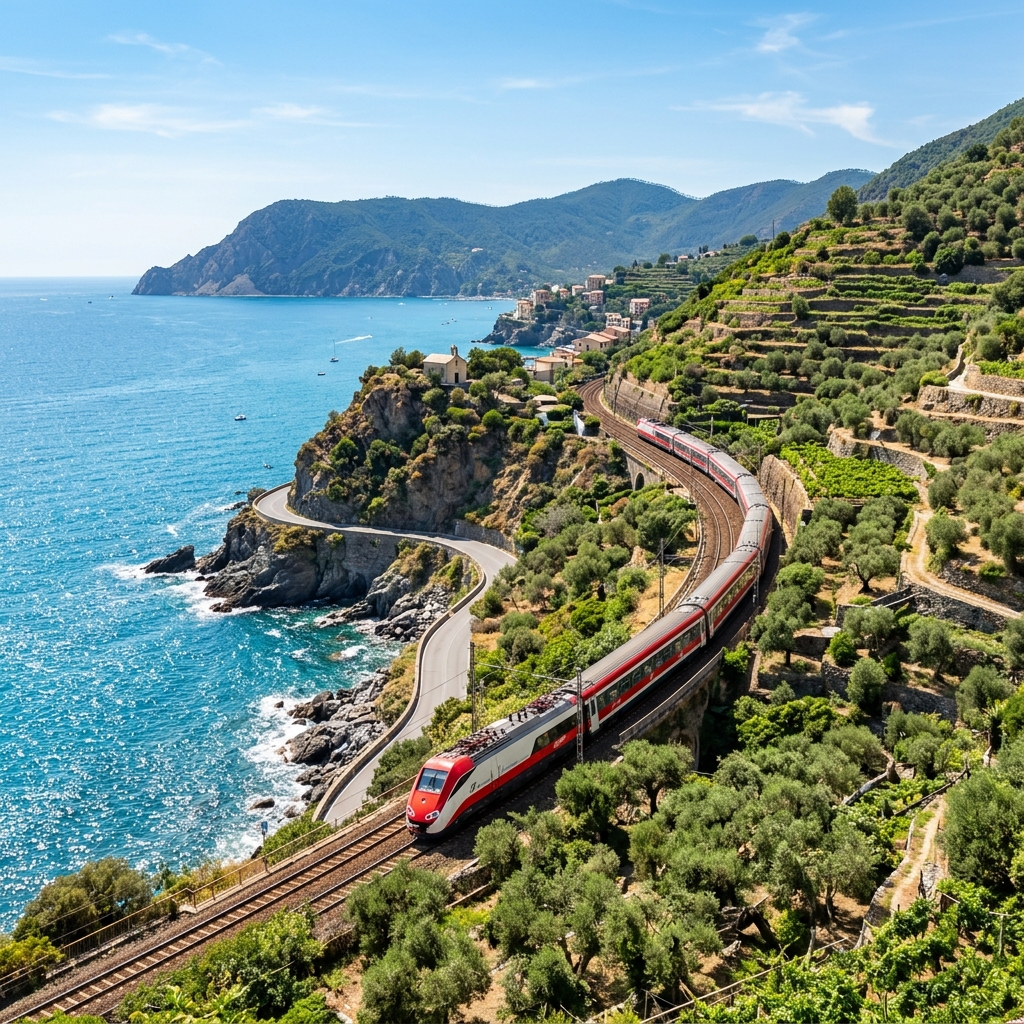
A Grand Tour in the historical sense was a fixed itinerary with a fixed purpose: completing one’s education through contact with the great civilisations of the Mediterranean. Young English aristocrats in the eighteenth century travelled from London to Paris to Rome by carriage, spending months in transit, arriving in Rome as the endpoint and the point.
This route is something different. It is not a tour — not in the sense of a circuit designed to accumulate places visited. It is a route with a logic: the Mediterranean coast, followed by train and ferry from its Atlantic edge in Barcelona to its island heart in Malta, without flying, without days spent changing cities. It is the anti-grand-tour: slower, deeper, directed south and east rather than toward the officially important places.
Six weeks is the right duration. Less and you are rushing — you are back to the two-nights-per-place mistake. More and you need either more money or more flexibility than most people have. Six weeks is long enough to genuinely inhabit each city on the route and still cover remarkable ground.
Paris to Barcelona by train — the first leg
TL;DR: Barcelona→Valencia→Marseille→Nice→Genova→Cinque Terre→Florence→Rome→Naples→Sicily→Malta. All surface — trains and ferries. Total transport: €400–€600 per person booked in advance. Six weeks, approximately twelve stops, no flying. Start by booking Spain and France legs first; Italian legs can be booked closer to travel.
The Principle: Slow, Deep, No Days Spent in Transit
This route breaks one rule of conventional travel itinerary design: it does not try to be efficient. The conventional travel magazine itinerary — see as much as possible in the time available — produces a pattern of cities where you spend more time in transit (airports, stations, immigration queues) than you spend in the places themselves.
The Mediterranean slow route inverts this. The rule is: no day where you change cities. If you are in Rome, you are in Rome for that day — eating, walking, sitting in a piazza, reading on the roof terrace. The train to Naples is for tomorrow, when you have genuinely exhausted today.
The transport legs on this route are mostly short enough to complete in the morning and still have the afternoon in the new city. The exceptions — the overnight ferries (Naples to Palermo, Sicily to Malta) — are designed specifically so that the transit becomes part of the experience rather than an interruption to it.
Week 1: Barcelona (5 Days)
Getting to Barcelona
If you are travelling from Northern Europe by train: the Paris to Barcelona TGV is the most practical entry point. Trains from Paris Gare de Lyon to Barcelona Sants take approximately 6h30m and cost €60–€120 booked in advance. Alternatively, from Madrid to Barcelona by AVE is 2h30m (from €35).
Paris to Barcelona by train — full guide
Barcelona: Five Days
Five days in Barcelona sounds indulgent until you consider what five days gives you: the Sagrada Família without the three-hour queue (book online for a morning slot — €26–€32 entry, essential to pre-book); the Gothic Quarter at 8am before the tour groups arrive; a full day at Park Güell in its quieter northern sections (the ticketed monumental zone: €10, morning); the Picasso Museum (€14, free Thursday evenings); the Boqueria market (excellent for observation, overpriced for eating — eat at the less-famous Mercat de Santa Caterina in the Born district instead).
The Eixample neighbourhood — Gaudí’s grid, the moderniste architecture — rewards slow walking rather than tour-group processing. A single block of the Eixample can hold three significant buildings; the Manzana de la Discordia (Block of Discord) on Passeig de Gràcia puts Casa Batlló (Gaudí), Casa Amatller (Puig i Cadafalch) and Casa Lleó Morera (Domènech i Montaner) within fifty metres of each other.
Eating in Barcelona: the menu del día (three-course lunch with wine, around €13–€16 in a working-district restaurant) is one of the best lunch formats in Europe. The tapas bars of the Barceloneta and El Born neighbourhoods — patatas bravas, jamón, pan con tomate, anchovies from l’Escala — are excellent for evening grazing. Pa amb tomàquet (bread rubbed with tomato, olive oil, salt) is the Catalan table default and the correct accompaniment to everything.
Week 2: Valencia (2 Days) and the French Mediterranean (4 Days)
Barcelona to Valencia: The AVE High-Speed Train
The AVE (Alta Velocidad Española) from Barcelona Sants to Valencia Joaquín Sorolla takes approximately 1h30m and costs €20–€45 booked in advance via Renfe (renfe.com). This is one of the best-value high-speed train journeys in Europe. It is also a useful reminder of how fast Spanish high-speed rail is relative to cost.
Valencia: Two days is a compressed stay in a city that rewards more, but on a six-week route you are making choices. The non-negotiable: the Mercado Central (one of the largest covered markets in Europe, extraordinarily beautiful iron-and-glass architecture from 1928, open Monday to Saturday mornings), a paella lunch in the La Patacona beach district (paella at its origin, not the tourist version), and the Ciudad de las Artes y las Ciencias (Santiago Calatrava’s futuristic science museum complex, which is genuinely remarkable even if you don’t enter — the exteriors are the exhibit).
Valencia to Marseille
Direct train connections require a change at Barcelona or a specific routing via the coast. The practical option: train from Valencia to Barcelona (1h30m), then the French TGV from Barcelona to Marseille Saint-Charles (3h30m from Barcelona, from €35–€60). Total journey: approximately 5 hours with the connection. Alternatively, an overnight service allows you to sleep the Valencia–Barcelona–Marseille section.
Marseille: Two nights. Marseille is not a postcard city — it is noisy, urban, occasionally rough around the edges, and one of the most interesting cities in France. The Vieux-Port (Old Port) is the heart: the morning fish market (Marché du Vieux-Port), the ferries to the Château d’If (€11.50 return) and the Frioul archipelago, the view from Notre-Dame de la Garde basilica on the hill above the city. Bouillabaisse — the Marseille fish stew, properly made with rouille and croutons — at a genuine harbour restaurant (La Boite à Sardine, Le Miramar) is the mandatory meal.
Nice: Two nights from Marseille (TER train, 2h30m, from €22). Nice’s Promenade des Anglais and the old town (Vieux-Nice) with its Italianate streets and morning market in the Cours Saleya are the priorities. Day trip to Eze (the cliff village above Monaco, 30 minutes by bus) or a half-day in Monaco itself (25 minutes by train, €4).
Week 3: The Italian Riviera and Tuscany (7 Days)
Nice to Genova
Regional train from Nice to Genova via the Ligurian coast: approximately 3 hours, from €15–€25 (book via SNCF or Trenitalia). This is the coastline of the Cinque Terre’s wider region — the railway hugs the sea, passing through dozens of small resort towns along a spectacular stretch of coast.
Genova: Half day or one full day. The centro storico of Genova is a UNESCO World Heritage Site — a labyrinth of medieval caruggi (narrow alleys) that form one of the largest medieval urban centres in Europe. The Via Garibaldi (a street of Renaissance palaces, now home to the Strada Nuova Museums — Palazzo Rosso, Palazzo Bianco, and Palazzo Doria Tursi) is genuinely extraordinary. The Mercato Orientale (covered food market in the old city) is where Genova eats.
Cinque Terre: 2 Days
From Genova, the regional train south reaches La Spezia in approximately 1 hour (from €8). From La Spezia, the Cinque Terre Express runs every 30 minutes to all five villages.
Two days is the right allocation for Cinque Terre on a longer route — enough to see all five villages and walk at least one section of the Sentiero Azzurro, not so long that you exhaust it. Stay in Vernazza or Manarola overnight; the morning and evening hours in the village (before 10am, after 6pm) are categorically better than the crowded midday.
Florence: 2 Days
From La Spezia to Florence by regional or IC train: approximately 2 hours (from €15). Florence on a 6-week Mediterranean route is not a full city exploration but a two-day immersion. The Uffizi Gallery (book tickets weeks ahead — €20 entry, the queues without a booking are prohibitive), the Duomo exterior and the climb of Giotto’s campanile (€18 for the bell tower), the Oltrarno neighbourhood across the Arno (artisan workshops, less-visited churches, the Brancacci Chapel with Masaccio’s frescoes — €6), a long lunch somewhere off the San Marco tourist corridor.
Week 4: Rome (5 Days)
Florence to Rome
The Frecciarossa (Italy’s fastest train) from Florence Santa Maria Novella to Roma Termini takes 1h30m and costs €25–€50 booked in advance via trenitalia.com. Multiple departures per hour. This is one of Europe’s most efficient intercity rail connections.
Rome slow travel guide — how to spend 5 days
Rome: Five Days
Five days in Rome is not too many. The first-time visitor spending five days might cover: the Forum and Palatine Hill (€16, book ahead), the Colosseum (same ticket), the Vatican Museums and Sistine Chapel (€20, book weeks ahead), St. Peter’s Basilica (free, no booking), the Pantheon (€5 entry since 2023, no booking needed in the morning), the Borghese Gallery (€15, timed entry — book ahead), Trastevere neighbourhood, the Campo de’ Fiori morning market, and the Appian Way (by bike rental, 3-hour circuit — €15 for the bike, €8 for the Catacombs entry).
The five-day structure allows genuine rest between these things — the trap of Rome is trying to see all of it in two days, which produces exhaustion without comprehension. Rome is not a city to be seen. It is a city to be inhabited, even temporarily.
Eating in Rome: the neighbourhood trattoria model — a fixed menu (not a tourist menu, which is a different thing entirely), paper tablecloths, a carafe of house wine, a bill of €20–€28 per person — is still alive and excellent in the Testaccio and Prati neighbourhoods. The tourist corridor around the Colosseum and Spanish Steps involves premium prices for average food. Go fifteen minutes in any direction.
Week 5: Naples and Sicily (7 Days)
Rome to Naples
Frecciarossa from Roma Termini to Napoli Centrale: 1h10m, from €20–€35 booked ahead. This is one of the world’s great short train journeys — the efficiency of arriving in Naples (loud, dramatic, beautiful, chaotic) from Rome (ancient, measured, museum-city) in just over an hour.
Naples by train — complete guide
Naples: Two Days — more than most visitors allocate, less than the city deserves. The Museo Archeologico Nazionale (the best collection of Pompeii and Herculaneum artefacts in the world, €22) is the most important museum in Italy and entirely worth four hours. The centro storico (UNESCO, one of the highest building densities of any historic city in Europe) rewards walking without a specific agenda: Spaccanapoli (the straight street that cuts the old city in half), the churches, the presepe (nativity scene) workshops in the Via San Gregorio Armeno. Pizza: the Neapolitan pizza (Vera Pizza Napoletana, official appellation) at L’Antica Pizzeria da Michele (queue inevitable, worth it) or Sorbillo is one of the cheapest and best things you can eat in Italy — €6–€9 for a margherita.
Naples to Palermo: Overnight Ferry
The overnight ferry from Naples to Palermo is operated by Grimaldi Lines and GNV (Grandi Navi Veloci), departing in the evening and arriving early morning — approximately 10–11 hours. Deck/seat fares from €40–€60; cabin berths from €80–€110. Book at gnv.it or grimaldi-lines.com.
The alternative is the ferry from Civitavecchia (Rome’s port, 1h30m from Roma Termini by regional train — €5.50) to Palermo, also overnight, operated by Grimaldi and GNV, approximately 13–14 hours. The Civitavecchia option adds a half-day to the route but avoids backtracking from Naples.
Palermo by train — Sicily guide
Sicily: Four Days
Four days in Sicily covers the main points of a first visit; the island deserves two weeks, which is worth knowing for a return visit.
Palermo (2 nights): The Mercato di Ballaro (the largest and oldest street market in Palermo, in the Albergheria neighbourhood — arrive before 11am) is the right introduction. The food: arancina (the Sicilian rice ball, fried in different fillings, available at every bakery), pasta con le sarde (pasta with sardines, fennel, pine nuts, and raisins — a unique and excellent combination), granita (a different beast from the mainland Italian granita — Palermo’s is finer, creamier, eaten for breakfast with a brioscia brioche). The Cattedrale di Palermo and the mosaics at Palazzo dei Normanni (the Palatine Chapel — €12 entry) are the architectural priorities.
Day trip to Monreale: 30 minutes by bus (€1.80) from Palermo to the Norman cathedral of Monreale, which contains the most extensive Byzantine mosaic cycle in the world — 6,340 square metres of gold mosaic covering the entire interior. It is one of the most extraordinary interior spaces in Mediterranean Europe and almost consistently undervisited.
Taormina or Siracusa (2 nights): Choose one. Siracusa (3 hours by train from Palermo, €12–€18) has the better archaeology — the Greek theatre at Neapolis is among the best preserved in the world, the island of Ortigia (the historic city centre, connected to the mainland by bridge) has extraordinary Baroque architecture and a morning fish market that ranks among the best in Italy. Taormina (3.5 hours from Palermo by train) has the Greek theatre with Mount Etna as a backdrop — the view is extraordinary and justifiably famous — and is a more scenic but more tourist-oriented town.
Week 6: Malta (3 Days) and Return
Sicily to Malta
Virtu Ferries operates a high-speed catamaran from Pozzallo (south coast of Sicily, 1h30m from Siracusa by bus or train) to Valletta, Malta: approximately 1h45m, from €45–€70 one way. Book at virtuferies.com. There is also a seasonal service from Catania (check current schedule).
The catamaran is weather-dependent — rough Mediterranean weather causes cancellations. Book the ferry and keep a day of buffer if your return flight from Malta is a fixed date.
Valletta: Three Days
Malta is small enough that three days covers considerable ground. Valletta itself — the smallest capital city in the EU, a Baroque city built by the Knights of St. John in the sixteenth century — requires only a day for the main sights: the Co-Cathedral of St. John (the most lavishly decorated Baroque church in the Mediterranean, containing Caravaggio’s largest painting — €15 entry), the Upper Barrakka Gardens with views of the Grand Harbour, the National Museum of Archaeology (the “Sleeping Lady” figurine and the Ggantija goddess statues — €5).
Beyond Valletta: the Three Cities (Vittoriosa, Senglea, and Cospicua — accessible by water taxi from Valletta’s Grand Harbour, €2.50) are medieval walled towns that predate Valletta and are far less visited; the Ggantija temples on Gozo island (a 25-minute ferry from Ċirkewwa, ferry €4.65 return) are the oldest freestanding structures in the world, predating Stonehenge by a thousand years; Mdina (the old medieval capital, 30 minutes by bus from Valletta) is a silent, car-free walled city that closes to day visitors after a certain hour, giving evenings there a quality of genuine stillness.
Eating in Malta: Maltese cuisine sits between Sicilian and North African, with its own specificities. Pastizzi (flaky pastry parcels filled with ricotta or mushy peas, €0.50–€0.80 each, sold from street kiosks called pastizzerias) are the national snack. Ftira (Maltese flatbread, used for sandwiches of tuna, capers, tomatoes, olives) is excellent for lunch. The fish at harbour restaurants in Marsaxlokk (the fishing village in the south, accessible by bus) is among the freshest in the Mediterranean.
Total Transport Budget
Estimated transport costs for the full route, booked reasonably in advance:
| Leg | Mode | Duration | Cost |
|---|---|---|---|
| Paris/Madrid → Barcelona | TGV/AVE | 2h30m–6h30m | €50–€100 |
| Barcelona → Valencia | AVE | 1h30m | €20–€40 |
| Valencia → Marseille (via Barcelona) | TGV | 4–5h total | €35–€60 |
| Marseille → Nice | TER | 2h30m | €22–€35 |
| Nice → Genova | Regional | 3h | €15–€25 |
| Genova → La Spezia (Cinque Terre) | Regional | 1h | €8–€12 |
| La Spezia → Florence | Regional/IC | 2h | €15–€22 |
| Florence → Rome | Frecciarossa | 1h30m | €25–€50 |
| Rome → Naples | Frecciarossa | 1h10m | €20–€35 |
| Naples → Palermo | Overnight ferry | 10–11h | €40–€110 |
| Palermo → Siracusa | Train | 3h | €12–€18 |
| Siracusa → Pozzallo | Bus | 1h30m | €8–€12 |
| Pozzallo → Malta (Valletta) | Ferry | 1h45m | €45–€70 |
Total range: approximately €315–€589 per person. With accommodation, budget €80–€150 per day for mid-range travel (shared double room plus meals plus local transport plus entry tickets).
The Irreducible Argument
The case for this route over its alternatives — flying between the same cities, or doing it in two weeks rather than six — is not logistical. It is not even primarily about cost, though the cost compares well. It is about what happens when you move through geography at a human speed, by sea and by land, without the discontinuity of air travel.
The distance from Barcelona to Malta — some 2,500 kilometres, measured along the coast rather than as a crow flies — is a real distance. Covered by train and ferry over six weeks, you feel that distance in the way that the Mediterranean coast changes: the Spanish palms, the French lavender, the Ligurian olive terraces, the Campanian volcanic landscape, the Sicilian heat. Each transition is a day on a train or a night on a ferry. You arrive somewhere new having left somewhere else — the geography is continuous rather than punctuated by the airport discontinuity.
There is a particular quality to the morning arrival by overnight ferry in a new country. You have slept. You have crossed water. The light is different. The coffee tastes different. You have, in some small way, earned the place.
Italy’s ferry routes — complete guide
Related Reading
- The Adriatic Coast by Train and Ferry: Italy to Croatia Slow — Travel the Adriatic slow: Italy’s coastal rail line from Bologna to Bari, then overnight ferry to Split and…
- The Two-Week Interrail Itinerary: A Route That Actually Makes Sense — Two weeks is enough time to cross three or four countries by train and arrive somewhere with a genuine sense of…
- Croatia Ferry Guide: Island Hopping the Dalmatian Coast — Croatia ferry guide to island hopping the Dalmatian Coast: Split to Hvar, Vis, Korčula, and beyond.