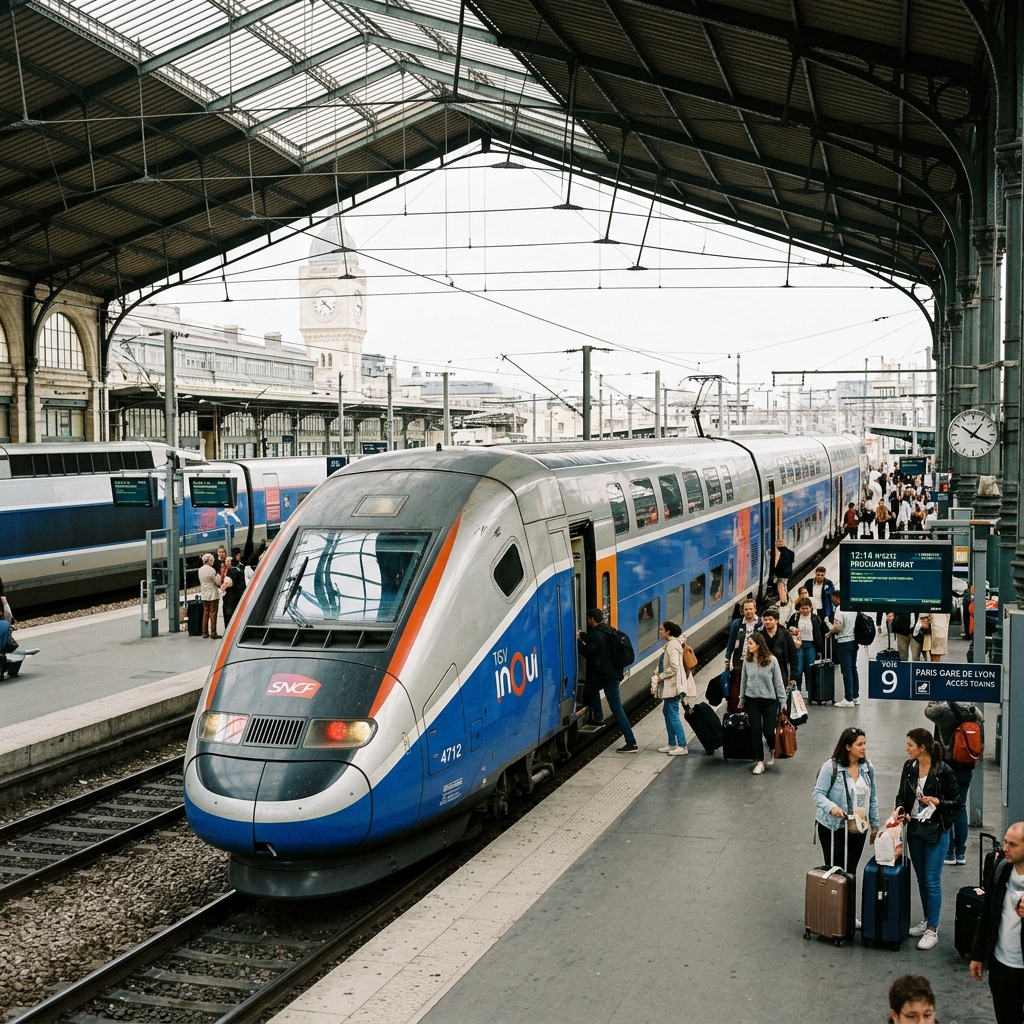
There are routes that exist simply to get you somewhere, and then there are routes that form part of the journey’s meaning. Paris to Barcelona by train is the second kind. You leave one of Europe’s great capitals and arrive, six and a half hours later, in a city that operates by entirely different rules, a different language, a different architecture, a different pace. The train earns that contrast in a way a 90-minute flight simply cannot.
The direct TGV/AVE service covers the 1,033 kilometres between Paris Gare de Lyon and Barcelona Sants in 6 hours 25 minutes, crossing the Pyrenees through a high-speed tunnel before the Mediterranean coast draws you south. It’s a journey with genuine scenery, reasonable prices if you book ahead, and far less friction than flying. This guide tells you everything you need to plan it well.
most scenic train routes in Europe
TL;DR: The Paris to Barcelona train takes 6h 25m on the direct TGV/AVE, operated jointly by SNCF and Renfe. Fares start from €39 on Ouigo (SNCF’s budget brand) and ~€59 on standard TGV, rising to €150+ for flexible tickets. Only 2–3 direct trains run daily, so book early, SNCF opens bookings 180 days out. (SNCF Connect, 2026)
How Long Is the Paris to Barcelona Train?
The direct Paris to Barcelona train takes 6 hours 25 minutes, running from Paris Gare de Lyon to Barcelona Sants without a stop that requires passengers to change trains. That’s the headline number, but it’s worth knowing the context. According to SNCF timetable data, only 2–3 direct services operate daily, which makes this a route where you book the train first and plan around it, rather than treating departures as a frequent bus.
The train operates on high-speed track throughout France and Spain, reaching speeds up to 320 km/h on the French LGV (ligne à grande vitesse) network. The one notable interruption is the Pyrenees crossing, handled via the high-speed tunnel at Figueres-Vilafant on the Spanish side, after which the train continues south through Catalonia to Barcelona.
| Departure (Paris GLY) | Arrival (Barcelona Sants) | Journey Time | Operator |
|---|---|---|---|
| Morning (~7:00–8:00) | Afternoon (~13:30–14:30) | ~6h 25m | Renfe/SNCF |
| Midday (~10:00–11:00) | Evening (~16:30–17:30) | ~6h 25m | SNCF Ouigo |
| Afternoon (~14:00–15:00) | Evening (~20:30–21:30) | ~6h 25m | Renfe/SNCF |
[IMAGE: High-speed TGV train passing through the French countryside, search terms: TGV France high speed train countryside]
How Much Does the Paris to Barcelona Train Cost?
Fares on the Paris to Barcelona route range from €39 to €150+, with price varying sharply by operator, booking lead time, and flexibility. SNCF’s own data shows that the cheapest Ouigo fares, the budget arm of the French national rail operator, start at €39, while standard TGV fares begin around €59 for advance non-flexible tickets. (SNCF Connect, 2026)
Fare overview by operator and class:
| Ticket Type | Operator | Price Range | Flexibility |
|---|---|---|---|
| Ouigo (budget) | SNCF | €39–€79 | Non-refundable, 1 small bag |
| TGV Standard | SNCF/Renfe | €59–€110 | Limited exchange |
| TGV Standard Premier | SNCF/Renfe | €89–€130 | Exchange with fee |
| AVE Turista Plus | Renfe | €79–€120 | Moderate |
| AVE Preferente (1st class) | Renfe | €120–€160+ | More flexible |
| Eurail + reservation | , | Pass + €20–€30 | Depends on pass |
The Ouigo caveat: SNCF’s Ouigo brand runs on the same track, in the same journey time, but with strict baggage rules, one small personal item only (max 36 × 27 × 15 cm) unless you pay extra for a cabin bag. If you’re travelling light, it’s outstanding value. If you have a standard rolling suitcase, you’ll need the full-price TGV or to pay Ouigo’s bag supplement (~€5–€10).
Paris Gare de Lyon: What to Know Before You Board
Gare de Lyon is one of Paris’s busiest mainline stations, handling TGV services to the south of France, Switzerland, and Spain. It’s served by Metro lines 1 and 14 (both fast from central Paris) and the RER A and D, making it well connected from most parts of the city. Allow at least 30 minutes before your train’s departure time if you’re arriving by Metro from the centre; 45 minutes if you’re coming from CDG airport via RER D.
Unlike flying, there’s no passport control at Gare de Lyon before boarding. You show your ticket (digital or printed) at the platform gate, find your seat, and that’s it. French nationals and EU citizens may be asked for ID on cross-border services, carry your passport regardless, as Spanish border rules apply on arrival.
Finding Your Platform
Gare de Lyon has two distinct hall areas: the main hall (Grande Halle) and the Banlieue hall. TGV and international trains depart from the Grande Halle. Platforms are announced on the departure boards approximately 20–30 minutes before departure, not before. Don’t panic when the board shows no platform number an hour out; this is standard French practice. Position yourself near the board and be ready to move when it updates.
Baggage and Luggage Storage
There is no baggage check or security screening for passengers at Gare de Lyon beyond the ticket gate. Large luggage goes in the overhead racks or in the luggage storage areas at the ends of each carriage. Gare de Lyon has left-luggage lockers (consigne automatique) near the main entrance if you want to drop bags before or after your journey, prices start around €6 per item for 24 hours.
What Is the Journey Like?
The Paris to Barcelona train is a genuinely varied journey across two countries, two fields, and, if you’re paying attention, a perceptible shift in the quality of the light as you move south. SNCF route planning data shows the train covers roughly 1,033 km in 6h 25m, averaging around 160 km/h including any low-speed segments. (SNCF, 2026)
Departing Paris Gare de Lyon, the train accelerates quickly onto the LGV Sud-Est, the original French high-speed line opened in 1981, and the Burgundy countryside opens up around you. The first 90 minutes are fast and flat, the train running through wine country you’d otherwise spend a week’s holiday exploring.
The Pyrenees Crossing
South of Nîmes, the field starts to change. The terrain rises, the vegetation shifts from green and grey to ochre and scrub, and somewhere around Perpignan the train enters the high-speed line that runs through the Pyrenees via the Figueres-Vilafant tunnel. Unlike the Eurostar’s Channel Tunnel crossing, there is no passport control stop, the train simply continues through. You don’t need to go to any desk, show a document to an officer on the train, or do anything at all except watch the scenery change from French to Spanish as you emerge from the tunnel.
The Approach to Barcelona
After Figueres, the train descends through the Catalan interior, calling at Girona before the final run into Barcelona. The approach to the city is industrial rather than scenic, you’re arriving into a working European city, not a lagoon or a mountain panorama. But Barcelona Sants is a central, well-connected station, and the city’s famous grid is within easy reach.
[IMAGE: View from a train window of the Catalan countryside approaching Barcelona, search terms: Catalonia field train window Spain]
TGV vs Flying Paris to Barcelona: An Honest Comparison
Door-to-door, flying Paris to Barcelona takes roughly 5–6 hours when you include airport transfers, check-in, security, boarding, and arrival transport. The train takes around 8 hours door-to-door from central Paris to central Barcelona (6h 25m on the train plus roughly 30–45 minutes each end). So the plane is faster, but the margin is narrower than most people assume, and the comparison ignores several important factors. (Eurostat transport data, 2024)
Where the train wins:
- City-centre to city-centre, no airport transfers
- No baggage check or security theatre
- Larger seats and room to move around freely
- Work, eat, read without restriction
- Lower carbon emissions, rail emits roughly 90% less CO₂ per passenger than flying on this route (ADEME, France, 2023)
- One ticket price includes everything; no seat selection fee, no baggage fee (on TGV)
Where the flight wins:
- Faster door-to-door if you’re travelling from near an airport
- More departure times (dozens of flights daily vs 2–3 trains)
- Sometimes cheaper last-minute
The train makes the most sense if you value the journey itself, you’re travelling with standard luggage, or you’re departing from central Paris. The flight makes sense if you’re connecting from another city and have a tight schedule.
How to Book and When to Buy
Booking as early as possible is the single most effective way to reduce the cost of the Paris to Barcelona train. SNCF opens its booking window 180 days in advance, the longest lead time of any major European rail operator. Renfe (the Spanish operator) opens 90 days ahead. Both sell seats on the same trains; SNCF typically has more inventory earlier. (SNCF Connect, 2026)
The cheapest Ouigo fares at €39 are released at the 180-day mark and are finite, once gone, they’re gone. Standard TGV fares follow a similar yield-management pattern: prices rise as the train fills and as departure approaches. In our observation of fare movements on this route, the window between 90 and 60 days out typically offers the best balance of availability and price if you’ve missed the 180-day opening.
Where to Book
- SNCF Connect, official SNCF site; the only place to reliably surface Ouigo fares alongside TGV
- Renfe, Spanish operator’s site; sometimes has slightly different inventory or pricing
- ****, aggregator that covers both operators; useful for comparing and for multi-leg European journeys
- Eurail app, if you hold a Eurail pass; note that a seat reservation (€20–€30) is mandatory and non-negotiable on this route
Eurail pass note: A Eurail Global or France-Spain pass is valid on this route, but the reservation fee is compulsory and not included in the pass cost. At €20–€30 per reservation, a Eurail pass only makes financial sense for this journey if you’re making many other rail trips. For a single return trip, point-to-point tickets are usually cheaper.
Which Barcelona Station Does the Train Arrive At?
The Paris to Barcelona train arrives at Barcelona Sants, not Passeig de Gràcia, not França, not the airport. This is a common point of confusion, partly because Passeig de Gràcia station (more central, on the famous boulevard) sounds like it should be the main international terminus. It isn’t. Sants is Barcelona’s principal intercity station, located in the Eixample district roughly 3 kilometres southwest of the Gothic Quarter. (Renfe, 2026)
Barcelona Sants is large, modern, and well connected. The Metro (lines L3 and L5) connects directly to the city centre from the station, Passeig de Gràcia is 3 stops on L3, and Las Ramblas is 4 stops. Journey time to the Gothic Quarter is around 10–12 minutes by Metro. Taxis are available immediately outside the station; ride-hailing apps (Bolt, Cabify) work well here too.
There is no luggage storage on the train, but Sants has left-luggage facilities inside the station building. The station also has a good food court, a pharmacy, and a tourist information point, useful if you’ve just arrived and are orienting yourself.
Tips and Things to Know
Book the Train Before the Hotel
With only 2–3 direct trains daily, your train time dictates everything else. Lock in your rail booking first, especially for summer travel, Easter week, or Spanish national holidays, and then book accommodation around it. This is the opposite of how most people plan, but it’s the right order for this route.
Seat Selection on TGV
Standard TGV and Renfe AVE tickets include seat selection at the time of booking. Choose a window seat for the Catalan countryside views. If you’re travelling in a group, select seats in the same saloon (open-plan section) rather than a compartment, the open sections are more sociable and have easier access to the café car.
The Café Car
Both SNCF TGV and Renfe AVE trains have an onboard café car (bar-restaurant). Expect sandwiches, hot drinks, pastries, beer, and wine at train station prices, not cheap, but not egregious. On a 6h 25m journey, at least one visit is sensible. Alternatively, Gare de Lyon has a supermarket (Monoprix in the station) where you can stock up on picnic supplies before boarding.
Travel Documents
EU citizens can travel between France and Spain on a national ID card. Non-EU travellers need a passport. There is no border check on the train itself, you won’t be asked for your document mid-journey, but Spanish entry requirements apply on arrival, and you may be asked at Barcelona Sants if there’s a spot check in place.
Carbon Footprint
Flying Paris to Barcelona generates approximately 77 kg of CO₂ per passenger (one way). The equivalent train journey generates roughly 6–8 kg of CO₂ per passenger. (ADEME, 2023) That’s a 90%+ reduction. For travellers who factor environmental cost into their choices, this route is one of the clearest cases in European travel where the train is the obvious answer.
Related Reading
- Amsterdam to Paris by Train: Thalys Guide, Times & Tickets, Amsterdam to Paris by train takes just 3h 17m on Eurostar.
- Paris to Rome by Train: Routes, Times, Tickets and What to Expect, Paris to Rome by train takes 11 hours direct overnight or 6-7 hours with one change.
- Barcelona to Madrid by Train: AVE Times, Tickets and What to Expect, The AVE from Barcelona to Madrid takes 2h 30min and costs from €14 in advance.
Frequently Asked Questions
Is there a night train from Paris to Barcelona?
There is currently no direct overnight train between Paris and Barcelona. The route’s only direct services are daytime TGV/AVE trains taking 6h 25m. The historic “Trenhotel” night service was discontinued by Renfe in 2013. Rail operators including SNCF and Renfe have discussed reinstating a night service as part of Europe’s broader night train revival, but no confirmed launch date exists as of March 2026. (Renfe, 2026)
Do I need a reservation with a Eurail pass?
Yes, a seat reservation is mandatory on the Paris to Barcelona TGV/AVE service, even with a valid Eurail pass. The reservation fee runs €20–€30 depending on the booking platform and class of travel. It cannot be waived. Book your reservation as early as possible through SNCF Connect, Renfe, or a platform like , reservation slots are limited and can sell out independently of ticket availability.
Which is better, Paris to Barcelona by train or plane?
For travellers departing from central Paris and arriving in central Barcelona, the train is competitive door-to-door (around 8 hours total vs 5.5–6 hours for a flight). The train wins on comfort, baggage freedom, city-centre-to-city-centre convenience, and carbon footprint. The flight wins on speed and frequency. Our honest assessment: if you have a morning to spare and value the experience of travelling, rather than just arriving, the train is the better choice on this particular route.
What station in Paris does the train leave from?
All direct Paris to Barcelona trains depart from Paris Gare de Lyon (not Gare du Nord, which serves Eurostar and trains to northern Europe). Gare de Lyon is in the 12th arrondissement, on Metro lines 1 and 14 and RER A and D. It’s roughly 25–35 minutes by Metro from the Marais or Saint-Germain-des-Prés, and around 35–45 minutes from Montmartre.
Can I stop in Lyon or Montpellier on the way?
Yes, you can break your journey at Lyon Part-Dieu or Montpellier Saint-Roch and continue to Barcelona on a later train. You’ll need to book two separate tickets, however; a Paris–Barcelona through-ticket doesn’t allow open-jaw stopovers. Breaking in Lyon makes particular sense: Lyon is one of France’s most rewarding cities for food, and an overnight stop transforms a transit into a mini-trip. Check whether separate tickets work out cheaper than a through-fare, sometimes they do, especially if you mix operators. most scenic train routes in Europe
A Journey Worth Taking Slowly
There’s an argument, and it’s not a sentimental one, that the Paris to Barcelona train is one of the finest long-distance rail journeys in Western Europe. Not for dramatic scenery, which is present but modest, but for the quality of the transition it offers. You leave one world and arrive in another, and you’ve had six and a half hours to feel that change happening gradually, through the window, without interruption.
The train asks something of you: patience with its limited frequency, attention to its booking windows, a willingness to spend a day in transit rather than collapsing the journey to nothing. In return, it gives you a journey with weight and texture, something worth remembering alongside the destination itself.
Book early, travel Ouigo if your bag is small, and be at Gare de Lyon 30 minutes before departure. Barcelona will take care of the rest.
For more on making the most of European rail travel, explore our most scenic train routes in Europe guide or read our honest breakdown of is the Eurail pass worth it? before you commit to a pass.