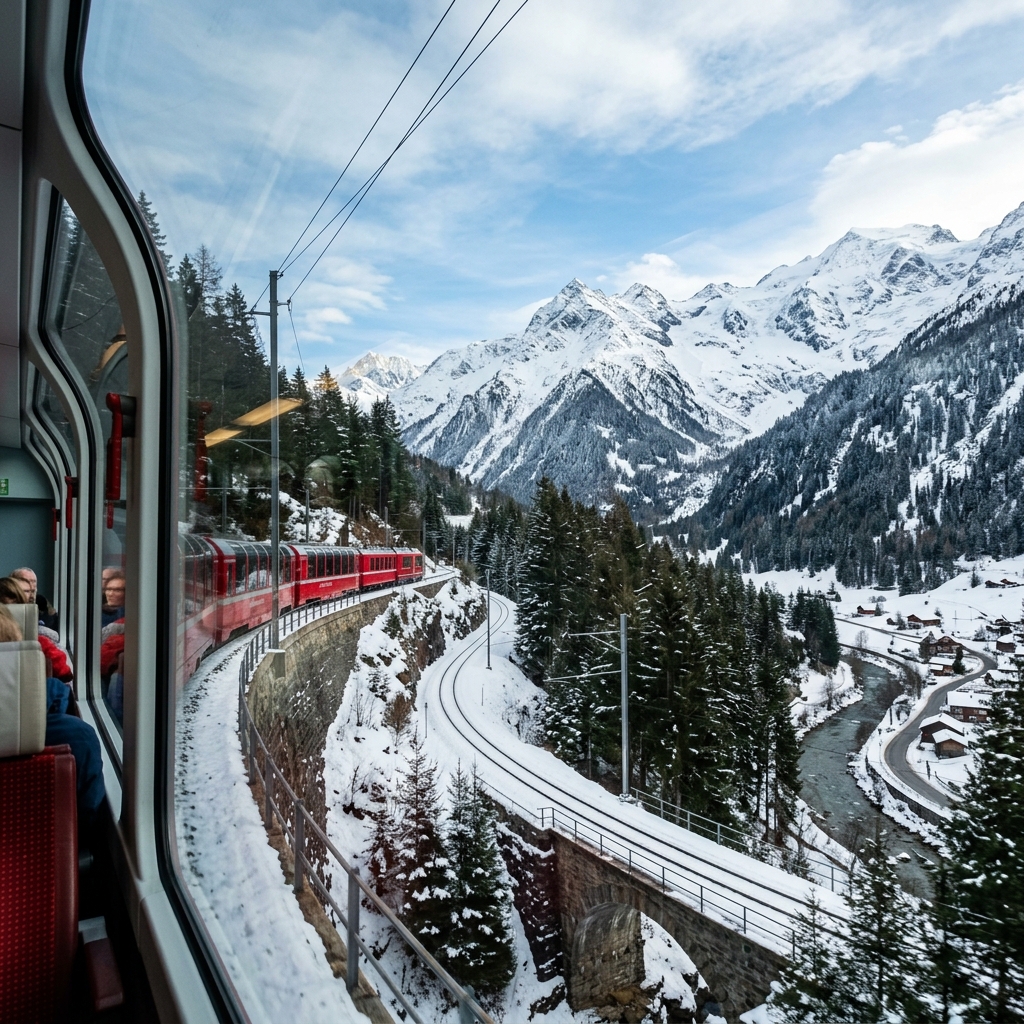
There’s a kind of travel that asks almost nothing of you. You sit down, the field begins to move, and for the next several hours Europe performs, mountains, gorges, coastlines, river valleys, through a window you didn’t have to handle to. Train travel in Europe is the closest thing the continent offers to a moving art gallery, and a handful of routes rise so far above the rest that they’ve become destinations in their own right.
Europe’s rail network carries over 200 million international passengers annually (Eurostat, 2024), but the routes on this list aren’t measured in speed or frequency. They’re measured in what you see from the window. We’ve ranked 12 routes from the continent’s most extraordinary rail journeys, from the UNESCO-listed Swiss Alps to a Scottish overnight that ends at the edge of the Highlands.
understanding slow travel philosophy
TL;DR: Europe’s most scenic train routes range from the 8-hour Glacier Express through the Swiss Alps (from CHF 52) to a 1-hour sprint along the Cinque Terre coast. Two routes, the Bernina Express and Semmering Railway, are UNESCO World Heritage Sites. For multi-route trips, a Eurail pass can reduce costs significantly (Eurail.com, 2026).
How to Use This Guide
Each route below includes journey time, scenery highlights, approximate 2026 prices, and the practical booking details that most lists skip. Routes are ordered by scenic drama, not popularity. Prices are second-class unless noted, and cover point-to-point tickets without a rail pass.
Journey Duration vs. Scenic Intensity: A Quick Overview
Before the routes, a useful orientation. The chart below maps each of the 12 routes by journey duration and scenic intensity, a rough composite score based on UNESCO designation, field variety, and traveler rating data from TripAdvisor and seat61.com.
1. Glacier Express, Switzerland
The Glacier Express is widely regarded as the world’s most scenic slow train. It connects Zermatt to St. Moritz across 291 kilometres of the Swiss Alps, crossing 291 bridges and passing through 91 tunnels in approximately 8 hours (SBB/Rhaetian Railway, 2026). The journey includes the 2,033-metre Oberalp Pass, the highest point on the route, and the spectacular Landwasser Viaduct, one of the most photographed railway structures in Europe.
The train runs year-round. Panoramic carriages with large windows are standard on all services, and the dining car serves proper Swiss meals rather than reheated trays. The landscape shifts from the high-Alpine drama around Zermatt through open Rhine valley farmland and back into mountain wilderness approaching St. Moritz.
Journey time: ~8 hours (Zermatt to St. Moritz) 2026 prices: From CHF 52 (with Eurail/Swiss Pass reservation fee CHF 33–49); full point-to-point fare from CHF 150–220 second class Best season: July–September for snow-free mountain passes; January–March for powder-dusted Alpine drama Booking: SBB or
[IMAGE: Glacier Express panoramic train crossing the Landwasser Viaduct in Switzerland, search: “glacier express switzerland viaduct train”]
2. Bernina Express, Switzerland and Italy (UNESCO)
The Bernina Express is a UNESCO World Heritage railway, one of only two rail routes to hold that designation, shared with the Semmering. The line runs from Chur to Lugano (via St. Moritz), crossing the Bernina Pass at 2,253 metres, the highest non-rack railway crossing in the Alps (UNESCO World Heritage, 2008). The descent from the pass into the Italian-speaking Valtellina and then on to Tirano is one of the great altitude drops in European rail travel, nearly 1,800 metres in under 60 kilometres.
Watch for the Brusio spiral viaduct, a tight 360-degree loop the train uses to lose height without needing a rack system. It’s engineering as spectacle.
Journey time: ~4 hours (St. Moritz to Tirano, the UNESCO segment); full Chur to Lugano takes ~4 hours with connection 2026 prices: From CHF 38 with Swiss Pass (+ CHF 14–16 reservation); point-to-point St. Moritz–Tirano from CHF 32 Booking: Rhaetian Railway, book well ahead in summer; panorama cars sell out
The Bernina and Glacier Express share the same Rhaetian Railway network. If you’re planning both, you can build a loop: Zermatt → St. Moritz (Glacier Express) → Tirano → back into Switzerland via the Bernina, all on the same rail pass. Most itineraries treat them as separate trips. They don’t have to be.
3. Venice Simplon-Orient-Express, London to Venice
The Venice Simplon-Orient-Express full guide is not a train you take for value. It’s a train you take because you want to experience what rail travel was like when it was considered the height of civilisation. The original 1930s carriages, Art Deco marquetry, starched linen, a bar car that never closes, have been meticulously restored by Belmond. The route runs from London Victoria to Venice Santa Lucia, crossing the Channel via Folkestone, traversing France, and threading through the Swiss Alps before descending into northern Italy.
The round-trip starts at around £3,500 per person in a cabin, rising to over £10,000 for the Grand Suites (Belmond, 2026). The journey takes approximately 32 hours in each direction.
Journey time: ~32 hours (London to Venice) 2026 prices: From £3,500 per person (cabin, one-way); Grand Suites from £10,000+ What’s included: All meals, afternoon tea, bar service; not included, Channel Tunnel transfer Booking: Direct via Belmond only; departures from March to November
[IMAGE: Art Deco interior of the Venice Simplon-Orient-Express bar car with warm lighting, search: “orient express train interior art deco”]
4. Flåm Railway, Norway
The Flåm Railway descends 863 metres in just 20 kilometres, making it one of the steepest standard-gauge railways in the world (Flåm Railway/Vy, 2026). The journey from Myrdal (on the Bergen Railway) down to Flåm village runs alongside thundering waterfalls, through mountain tunnels, and past valley farmsteads that look unchanged since the nineteenth century. At one point the train slows near Kjosfossen waterfall so passengers can step onto a platform and stand beneath it.
The full descent takes about 1 hour. Most travelers combine it with the Oslo–Bergen Railway, one of Scandinavia’s great long-distance routes, making the Flåm a dramatic sidetrack rather than a standalone journey.
Journey time: 1 hour each way (Myrdal to Flåm)
2026 prices: From NOK 360 (€32) one-way; Eurail pass holders pay a reservation fee of NOK 60
Booking: Vy/Flåm Railway, book ahead in summer, especially July when the route is packed
5. West Highland Line, Scotland
The West Highland Line runs from Glasgow Queen Street to Mallaig, a journey of roughly 5 hours 20 minutes through some of the most dramatic and least-populated field in Western Europe (ScotRail, 2026). The route crosses the Rannoch Moor, a vast, treeless bog that makes the Highlands feel genuinely elemental, before climbing through mountain passes and descending to the sea at Fort William. The final section, from Fort William to Mallaig, is the one most visitors recognise: it crosses the Glenfinnan Viaduct, the 21-arch structure made globally famous by the Harry Potter films.
The train runs on a diesel locomotive across most of the route (not electrified), which actually suits the field, slower, noisier, more visceral than a high-speed glide.
Journey time: 5 hours 20 minutes (Glasgow to Mallaig) 2026 prices: From £19.50 (advance); BritRail pass holders travel free (reservation recommended) Best season: May–October for clear visibility; winter is dramatic but unpredictable Booking: ScotRail
The Jacobite Steam Train covers the Fort William–Mallaig section on certain summer days, it’s the same route as the ScotRail service but hauled by a vintage steam locomotive. Tickets sell out months in advance. If you want the Harry Potter bridge with a steam engine, book in January for summer travel.
6. Cinque Terre Coast, Italy
The coastal railway between La Spezia and Levanto is barely 45 minutes long, but those 45 minutes pack in five medieval clifftop villages, Mediterranean coast views, and the most Instagram-saturated stretch of Italian railway outside of Venice’s lagoon causeway. The line passes through or near all five Cinque Terre villages: Riomaggiore, Manarola, Corniglia, Vernazza, and Monterosso. Most of the route runs through short tunnels, with brief open-air windows between them that reveal the sea and the coloured houses stacked up the cliffs.
The Cinque Terre Card (€7.50–€16 per day, Cinque Terre National Park, 2026) includes unlimited train travel on this section. It’s exceptional value for a day of village-hopping.
Journey time: ~45 minutes (La Spezia to Levanto) 2026 prices: From €5 point-to-point; Cinque Terre Card from €7.50/day (includes trains) Booking: Regional trains run frequently, no advance booking needed, just turn up
7. Rhine Valley, Germany
The Cologne to Mainz stretch of the Rhine Valley railway runs for about 190 kilometres along the banks of the Rhine, past more castles per kilometre than almost anywhere else in Europe (German Tourism Board, 2024). The UNESCO-listed Middle Rhine Valley section, roughly between Koblenz and Bingen, packs in over 40 castles and fortresses visible from the train window. Steep vineyard terraces rise from the riverbank, and small ferry boats cross between villages that cling to both banks.
The journey takes between 1 hour 45 minutes and 2 hours depending on the stopping service used. Regional trains on this route are cheap and run frequently, this is as much a commuter line as a scenic one, which means no reservation headaches.
Journey time: ~1h 45m–2h (Cologne to Mainz; UNESCO section ~1 hour) 2026 prices: From €15–€25 on a regional day ticket (Rheinland-Pfalz-Ticket or NRW-Ticket) Booking: No advance booking needed for regional services; DB Navigator app
[IMAGE: Rhine Valley castles and vineyard terraces seen from a passing train, search: “rhine valley castles germany train view”]
8. Caledonian Sleeper, London to the Scottish Highlands
The Caledonian Sleeper departs London Euston late in the evening and arrives in the Scottish Highlands, Inverness, Fort William, Aberdeen, the following morning. You lose an evening and gain a morning in the Highlands without a flight or a six-hour daytime train ride. The service operates five nights a week in each direction and carries around 130,000 passengers per year (Caledonian Sleeper/Transport Scotland, 2025).
Accommodation ranges from shared seated coaches to private en-suite cabins with proper beds. The Club class cabins, a small private room with fold-down bed, power, and breakfast included, are the sweet spot for solo travelers who want genuine rest rather than a reclining chair.
Journey time: ~7–8 hours (London Euston to Inverness or Fort William) 2026 prices: Seated from £35; Club cabin from £100–£180 (single occupancy); double cabins also available Booking: Caledonian Sleeper, opens 12 months ahead; popular dates sell out fast
9. Douro Valley, Portugal
The Porto to Pocinho railway follows the Douro River for most of its 175-kilometre length, tracing the curves of a river that carved terraced wine country into near-vertical schist hillsides over millennia. The route passes through the UNESCO-listed Alto Douro Wine Region, the oldest designated wine region in the world, established in 1756 (UNESCO, 2001). Vineyards drop to the water’s edge, quintas (wine estates) appear on every bend, and the light in the late afternoon turns the river a particular shade of amber that explains why so many field painters have attempted this valley.
The full journey to Pocinho takes around 3.5–4 hours on the regional train. Most visitors ride as far as Pinhão (2h 15m), the centre of Port wine production, and return to Porto the same day.
Journey time: 2h 15m (Porto to Pinhão); 3h 30m–4h (Porto to Pocinho) 2026 prices: From €12–€15 (Porto to Pinhão); Eurail pass valid with no reservation fee required on regional services Booking: CP (Comboios de Portugal), book ahead for weekend departures in September during harvest season
10. Semmering Railway, Austria (UNESCO)
The Semmering Railway was the first mountain railway built with a steam locomotive in the world, completed in 1854, and it became the first railway to receive UNESCO World Heritage status in 1998 (UNESCO). The section between Gloggnitz and Mürzzuschlag, which sits within the broader Vienna-to-Graz corridor, climbs 460 metres through dramatic cutting and viaduct country in the Eastern Alps. Fourteen tunnels, sixteen viaducts, and over a hundred stone bridges are packed into 41 kilometres.
The full Vienna to Graz journey takes approximately 2.5 hours on the Railjet service, fast enough to be a practical intercity connection, slow enough through the Semmering section to register the field properly.
Journey time: ~2h 30m (Vienna to Graz, including Semmering section) 2026 prices: From €19 (advance purchase on ÖBB); Eurail pass valid Booking: ÖBB (Austrian Federal Railways)
11. Rhaetian Railway Alpine Gorges, Switzerland
The Rhaetian Railway is best known as the network that operates both the Glacier Express and the Bernina Express, but its less-publicised gorge sections are worth seeking out independently. The line between Chur and Thusis runs through the Viamala Gorge, where limestone walls rise more than 300 metres on either side of the track. The section between Thusis and Samedan passes through the Albula Tunnel and over a series of spiral viaducts that pre-date the Bernina construction by a decade. The entire Albula/Bernina field was inscribed as a UNESCO World Heritage Site in 2008 (UNESCO), but most visitors only ride the headline express services and miss the quiet intermediate sections entirely.
Journey time: ~1h 20m (Chur to Thusis); full Chur to St. Moritz via Albula ~2h 30m 2026 prices: From CHF 18–25 point-to-point; Swiss Travel Pass covers all regional RhB services without reservation Booking: Rhaetian Railway
12. Circumvesuviana, Naples to Sorrento
The Circumvesuviana is not a luxury train. It’s a battered regional railway that has been running on the same rolling stock for decades, packed with commuters, tourists, and school parties. It also happens to provide the most direct view of Mount Vesuvius from any railway in Europe, and it’s the only train that stops at Pompeii Scavi (the archaeological site) before continuing to the clifftop town of Sorrento. The Naples to Sorrento journey takes about 1 hour 10 minutes and costs €4.50 each way (EAV, 2026).
The Circumvesuviana carries approximately 11 million passengers per year, it’s a working railway, not a tourist product, which is exactly what makes it authentic. Hold your bag close, watch the volcano grow larger through the window, and accept that this is what European train travel looks like outside the premium corridors.
Journey time: ~1h 10m (Naples Porta Nolana to Sorrento) 2026 prices: €4.50 each way; Eurail/Interrail passes not valid, buy tickets at the station Booking: No advance booking; trains run every 30–40 minutes
[IMAGE: Mount Vesuvius seen across the Bay of Naples with a local train in the foreground, search: “vesuvius naples train circumvesuviana”]
Price Comparison: What Each Route Costs in 2026
The spread is enormous, from €4.50 for the Circumvesuviana to over £3,500 for the Orient-Express. Most of the 12 routes sit in the €12–CHF 220 range. A Eurail pass changes the maths significantly if you’re combining three or more of the Swiss routes with Portugal and Germany in the same trip.
is a Eurail pass worth it for multi-country routes
How Do You Book These Routes With a Rail Pass?
A Eurail or Interrail Global Pass covers the majority of routes on this list, but “covers” doesn’t always mean “free to board.” Several of the most scenic routes require a paid reservation on top of the pass.
The Glacier Express requires a CHF 33–49 reservation fee even with a valid Swiss Pass or Global Pass. The Bernina Express requires CHF 14–16. The West Highland Line is covered by BritRail but requires a reservation (no additional fee). The Flåm Railway charges a modest NOK 60 supplementary reservation fee. The Circumvesuviana is not covered by any Eurail or Interrail pass at all.
For the full breakdown of when a pass saves money versus point-to-point tickets, complete Eurail pass cost analysis.
Is Slow Train Travel Making a Comeback?
The data says yes. European night train passenger numbers grew by 24% between 2022 and 2024 (European Environment Agency, 2024), driven partly by flight shame, partly by cost, and partly by a genuine cultural shift toward experiencing the journey as the point rather than the obstacle. The routes on this list sit at the intersection of that shift, they’re not shortcuts, they’re the thing itself.
why slow travel is more than just going slowly
If you want to understand what slow travel actually means beyond a buzzword, read our piece on the philosophy of slow travel. And if you’re curious how the American long-distance experience compares to Europe, particularly the scale of the field, the California Zephyr complete guide offers a useful counterpoint.
Citation Capsule
Europe’s scenic rail network encompasses routes on two UNESCO World Heritage lists, the Rhaetian Railway (Albula/Bernina, inscribed 2008) and the Semmering Railway (inscribed 1998), alongside a combined passenger volume of over 200 million international rail journeys annually (Eurostat, 2024). Night train usage across Europe grew 24% between 2022 and 2024 (European Environment Agency, 2024), indicating sustained demand growth for experiential rail travel.
Related Reading
- How to Travel Europe with Carry-On Only (Train Traveler’s Guide), Everything you need to pack for 2+ weeks in Europe with a single carry-on: bag sizes for train overhead racks,…
- The Complete Guide to Traveling Europe by Train, Europe’s 240,000 km rail network connects 400+ cities.
- Luxury Train Travel in Europe: The Best Journeys Worth the Splurge, From the Venice Simplon-Orient-Express to the Glacier Express Excellence Class, these are Europe’s finest train…
Frequently Asked Questions
What is the most scenic train route in Europe?
The Glacier Express (Zermatt to St. Moritz, ~8 hours) is consistently rated Europe’s most scenic slow train. It crosses 291 bridges and the 2,033-metre Oberalp Pass through the Swiss Alps. The Bernina Express is a close second, and unlike the Glacier Express, part of a UNESCO World Heritage Site (UNESCO, 2008).
Glacier Express full booking guide
Do I need to book scenic trains in advance?
For the Glacier Express, Bernina Express, Venice Simplon-Orient-Express, and Caledonian Sleeper, advance booking is essential, popular dates sell out months ahead. The Rhine Valley, Cinque Terre, and Circumvesuviana routes run as regular regional services with no advance booking required. As a general rule, the more famous the route, the earlier you should book.
Are scenic European train routes covered by a Eurail pass?
Most are covered, but several require a paid reservation on top of the pass fee. The Glacier Express charges CHF 33–49, the Bernina Express CHF 14–16, and the Flåm Railway NOK 60 per journey. The Venice Simplon-Orient-Express and the Circumvesuviana are not covered by any rail pass. Full Eurail cost analysis: is the Eurail pass worth it.
What is the best time of year for scenic train travel in Europe?
It depends on the route. The Swiss Alpine routes (Glacier Express, Bernina Express) are striking in both summer and winter, July–September for green valleys, January–March for snowscapes. The Douro Valley peaks in September–October during the grape harvest. The West Highland Line and Caledonian Sleeper are best May–October for clear visibility. The Cinque Terre coast runs year-round with no significant seasonal quality difference.
Can I combine multiple scenic routes in one trip?
Absolutely, and it’s often cheaper than buying separate trips. The Swiss routes share the Rhaetian Railway network, so a Swiss Travel Pass covers the Glacier Express, Bernina Express, and all RhB regional trains in one purchase. For broader European coverage, a Eurail Global Pass handles Germany (Rhine Valley), Austria (Semmering), Portugal (Douro Valley), and Norway (Flåm) in a single pass. Budget 10–14 days for a meaningful multi-route trip.
The Bottom Line
Europe’s greatest train journeys share one quality: they make the act of travelling feel worth more than the act of arriving. That’s not sentiment. It’s a practical argument for choosing the Glacier Express over a flight, the Douro Valley over a hire car, the Caledonian Sleeper over the 7am easyJet.
The twelve routes on this list cover every budget, every season, and every kind of traveler, from the backpacker doing the Rhine Valley on a €15 regional day ticket to the couple marking a significant birthday in an Orient-Express cabin. The only mistake is treating any of them as transport rather than the point.