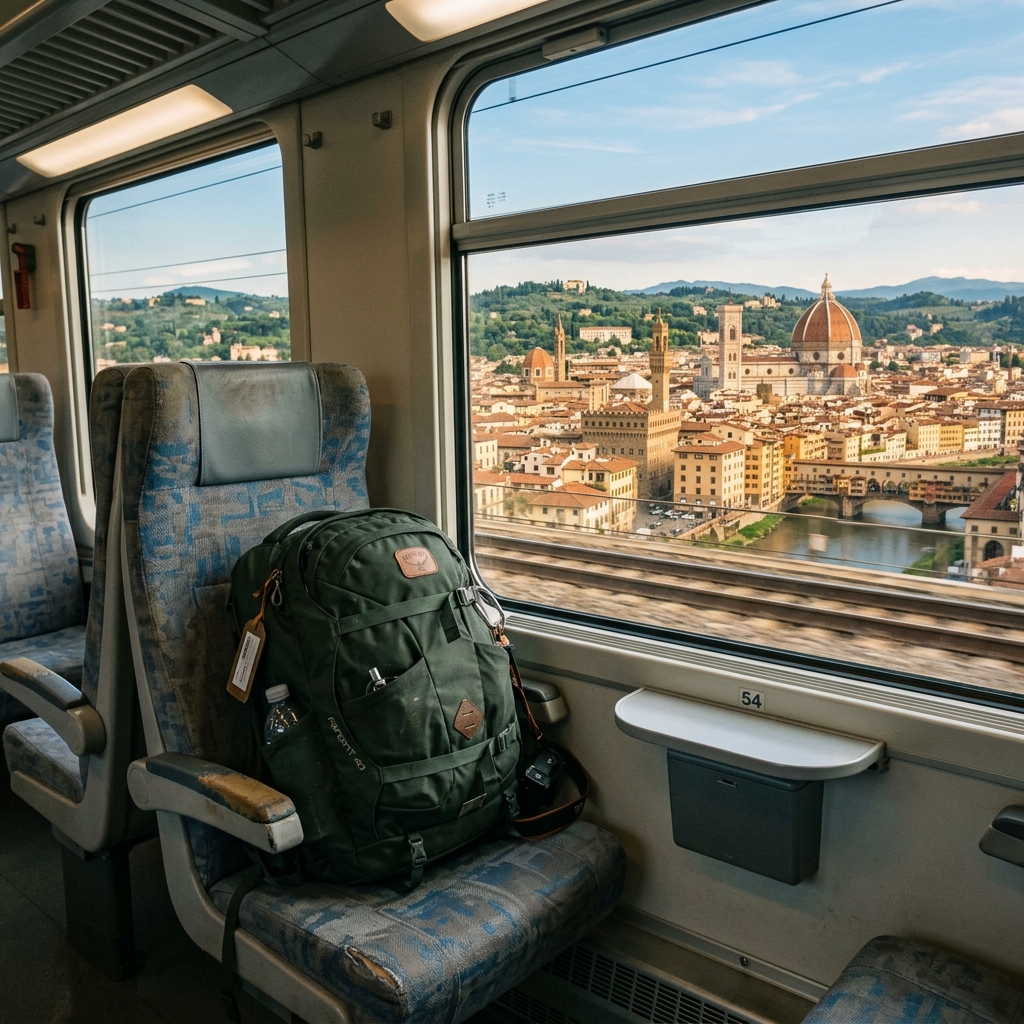
The decision to travel with only a carry-on is less about minimalism as philosophy and more about freedom as practice. The train traveler who arrives at a platform with a single bag can board at the last moment, change trains without choreography, and walk directly from station to hotel without searching for a taxi large enough to fit the luggage. The traveler with two checked bags cannot do any of this.
This guide is specifically calibrated for European train travel — which has its own luggage logic, different from air travel. There are no weight limits, no baggage fees, no carousels. The constraint is simply the overhead rack above your seat and your willingness to carry everything yourself.
Why Carry-On Only Works Better for Train Travel
Train travel in Europe has a significant luggage advantage over flying: you control your bags at all times. You walk onto the train, put your bag in the overhead rack, and that’s it. No check-in, no carousel, no waiting. On a two-week trip involving 6–8 train journeys, this represents a meaningful time saving — and zero risk of the airline losing your bag between Barcelona and Lisbon.
The overhead racks on European trains are generous — most high-speed trains have racks designed for bags up to 55 x 40 x 23 cm, essentially standard carry-on dimensions. Many also have a dedicated luggage bay at the end of each carriage for larger bags. On older regional trains, space is more limited, which is another argument for travelling light: a 35-litre backpack fits anywhere.
The secondary benefit: Europe’s old towns, historic centres, and cobblestoned streets are significantly more navigable with a bag on your back than a rolling case that catches every stone. Venice has 400 bridges. Lisbon is a city built on seven steep hills. Dubrovnik’s old town is a maze of marble steps. A carry-on roller works at airports; a compact backpack works everywhere.
What Size Bag to Choose
The Dimensions That Matter
For European train overhead racks:
- Standard size: 55 x 40 x 20–23 cm (fits all racks)
- Comfortable maximum: 40 litres for a backpack; 21–22” for a roller
| Format | Best for | Fits all train racks? | Good on cobblestones? |
|---|---|---|---|
| 35–40L backpack | Multi-city train travel | Yes | Yes |
| 45L backpack | Longer trips, more gear | Usually (end-of-car area) | Yes |
| 21” roller carry-on | City-to-city, fewer legs | Yes | Difficult |
| Small duffel (30–35L) | Minimal packing, 5–7 days | Yes | Yes |
The honest trade-off: A 40-litre backpack holds more than you think when packed with packing cubes. A 21” roller holds roughly the same volume with easier access, but is substantially worse on stairs, cobblestones, and overnight sleeper trains where you want to stow your bag quickly.
Bag Recommendations
Backpacks:
- Osprey Farpoint 40 — a classic for good reason. Clamshell opening, harness folds away, fits all airline carry-on requirements. ~€160.
- Peak Design Travel Backpack 45L — more expensive (~€300), but the organisation system is exceptional for photographers or anyone with tech gear. Fits European train racks in the end-of-car area.
- Aer Travel Pack 3 — excellent build quality, shoe compartment, laptop sleeve. 35L. ~€250.
Rollers:
- Travelpro Maxlite 5 21” — lightest high-quality roller available. Preferred by many frequent European travelers. ~€170.
- Away Carry-On — durable polycarbonate shell, TSA lock, excellent wheels. ~€275. The magnet latch is genuinely satisfying.
- Horizn Studios M5 — European brand, built for European travel sizes, excellent soft-sided option. ~€230.
The Capsule Wardrobe for Europe: What to Actually Pack
Two weeks in Europe across 2–3 countries typically means navigating warm days, cool evenings, the occasional rain, and at least one dinner where you want to look appropriately put-together. The capsule wardrobe approach — a set of versatile pieces that work in multiple combinations — is the right framework.
The Core Formula: 5 Days’ Worth of Clothes
You will do laundry once during a two-week trip, probably in the middle. With that assumption, the formula works:
Upper body:
- 2 × T-shirts (neutral colours — navy, white, grey)
- 1 × lightweight button-down shirt (linen or technical-fabric, can be smart or casual)
- 1 × mid-layer (merino wool sweater or thin fleece) — essential in spring and autumn
- 1 × lightweight packable rain jacket (doubles as a wind layer on trains with AC)
Lower body:
- 2 × versatile trousers (one that is slightly smarter — chinos or dark jeans; one more casual)
- 1 × shorts (if summer travel) or second trouser option (if autumn/winter)
Shoes:
- 1 × walking shoe with decent support (Allbirds Wool Runners, Adidas Ultraboost in a neutral, or similar) — something you can walk 15,000 steps in and also wear to dinner
- 1 × sandals or lightweight flat (if summer) — Birkenstock Arizonas or similar
The fabric principle: Merino wool is the most practical fabric for travel — it doesn’t wrinkle, resists odour, dries quickly, and works at multiple temperatures. Merino T-shirts and a merino base layer can meaningfully reduce how much clothing you need.
What to Leave at Home
- More than 2 pairs of jeans (jeans are heavy, slow to dry, and one pair does the same job as three in practice)
- Multiple pairs of formal shoes
- A bulky coat (buy a packable down jacket; it compresses to the size of a large orange)
- “Just in case” outfits you will not actually wear
- Full-size anything
Packing Cubes: How to Use Them Properly
Packing cubes don’t create more space — a common misconception. What they do is create organisation that makes a 40-litre bag feel entirely manageable rather than a jumbled archive of crumpled fabric.
The system that works:
- Cube 1 (large): Clothing — trousers, shirts, folded flat
- Cube 2 (medium): Underwear, socks, base layers
- Cube 3 (small/compressible): Worn items that need airing; swimwear if applicable
- Compression sack: Puffy jacket or sweater — compresses to very small, lives in the bottom of the bag
Brands worth using: Eagle Creek Specter Cubes (ultralight, €15–25 per cube), Osprey Packing Cubes (robust, €20–30), Peak Design Packing Cubes (excellent flat packing, works perfectly with their travel bag system). eBags Packing Cubes are a reliable budget option at €15–20 for a set.
Tech Gear for European Train Travel
A two-week Europe trip has specific tech needs — charging across multiple European socket standards, navigating without data gaps, staying connected. Here is the efficient kit:
Essential:
- Universal travel adapter — specifically the EU Type C/F format covers most of continental Europe; a universal adapter that includes UK Type G covers all bases. A single travel adapter, not a bag full of plug adaptors.
- Power bank (10,000–20,000 mAh) — train journeys of 4–8 hours drain devices. Most high-speed trains have power sockets, but regional trains often don’t. A good power bank is the difference between arriving with navigation capability and arriving with a dead phone.
- USB-C cable and adapter — increasingly, one cable charges everything (laptop, phone, headphones). Confirm your devices before packing redundant cables.
- Noise-cancelling headphones — 6-hour train journeys are the ideal use case. Sony WH-1000XM5 or Bose QC45; or if budget-conscious, the 1More ComfoBuds Q for €50.
Navigation:
- Download offline maps for each country before arriving — Google Maps offline or Maps.me (free). Offline maps require storage but mean zero dependence on mobile data.
- Get a local SIM or an eSIM for the trip. Holafly or Airalo eSIMs work across Europe from around €15–25 for 10GB/1 month, which is sufficient for navigation and messaging without roaming charges.
Optional but useful:
- Kindle or e-reader — train journeys require reading material; a tablet is heavier and less focused
- Lightweight laptop or iPad for longer trips where you’re working or writing
Toiletries: The Efficient Kit
The toiletries bag is where most overpacking happens. The rule: anything you genuinely cannot buy at a European pharmacy is worth bringing; everything else can be replaced easily.
Bring:
- Your prescription medications (obviously)
- Sunscreen SPF 50 (European formulations are excellent but may differ in SPF brand you prefer)
- Any specialist skincare products you can’t live without
- Moleskin-style blister prevention stick (European cities are walking cities; blisters are preventable)
Don’t bring in full sizes:
- Shampoo, conditioner, body wash — 100ml travel sizes only; hotels/Airbnbs provide these
- Razor blades — buy locally or use a safety razor with one blade pack
- Hairdryer — nearly all accommodation provides one; 100% leave yours at home
The toiletry kit format: A clear 1-litre zip-lock bag for liquids that must be carried through airport security (if flying any legs). Otherwise, a small soft toiletry bag (10 x 20 cm maximum). The Muji flat toiletry case is lightweight and packs flat when empty.
Doing Laundry in Europe
Accept this early: you will do laundry. Laundromats (self-service) exist in virtually every European city; the app SpinFlow or the website LaundrApp can locate the nearest one. A wash cycle typically costs €4–7, dry €3–5, total time 1.5–2 hours. Doing this once on a two-week trip — on a slow afternoon in a city you want to revisit — is not a hardship.
Alternatively: bring a Scrubba wash bag (€40 — a waterproof bag with an internal washboard). With any hotel sink, you can wash a day’s clothes in 3 minutes, hang them in the bathroom overnight, and they’re dry by morning. Merino T-shirts and synthetic-blend underwear (Exofficio or Meriwool) dry in 2–3 hours. Cotton dries slowly.
The Full Packing List
Clothing
- 2 × T-shirts
- 1 × button-down shirt
- 1 × merino sweater or fleece
- 1 × packable rain jacket
- 2 × trousers (one smart, one casual)
- 5 × underwear (merino or synthetic)
- 5 × socks (2 × smart, 3 × walking)
- 1 × walking shoes
- 1 × lightweight sandals or flats
Tech
- Phone
- Universal EU travel adapter
- Power bank (10,000mAh+)
- USB-C cable
- Headphones (ANC recommended)
- Kindle or tablet (optional)
Documents & Money
- Passport / ID card
- Credit card (no foreign transaction fees — Wise or a travel card)
- Travel insurance documentation
- Any required visas (printed and on phone)
- Rail pass (if using one) — see our Eurail pass guide
Toiletries (travel-size)
- Shampoo & conditioner (100ml each, or solid bars)
- Body wash
- Sunscreen SPF 50
- Deodorant
- Toothbrush + toothpaste
- Floss
- Prescription medications
- Paracetamol/ibuprofen
- Blister stick
- Lip balm SPF
Organisation
- 2–3 × packing cubes
- 1 × compression sack for puffy jacket
- 1 × dry bag or waterproof pouch for documents
- 1 × small day bag or tote (packable, for day trips — a packable daypack from Matador or Osprey, €25–40)
Related Reading
- The Train Travel Packing List: What to Bring (and What to Leave Behind) — Train travel has different demands than air travel.
- Slow Travel for Seniors: Why Train Travel Is the Best Way to See Europe After 60 — Slower itineraries, no rushed airports, no heavy luggage hauling.
- The Best Food Cities in Europe (Ranked by a Slow Traveler) — The 10 best food cities in Europe for travelers who eat seriously: San Sebastián, Bologna, Lyon, Naples, Istanbul,…
Frequently Asked Questions
What size bag fits in European train overhead racks?
Most European train overhead racks comfortably fit bags up to 55 x 40 x 20–23 cm — standard airline carry-on dimensions. Many high-speed trains (Frecciarossa, Eurostar, Thalys/OUIGO) also have dedicated end-of-carriage luggage areas for larger bags. A 40-litre backpack or a standard 21” roller fits all major European train overhead racks.
Can you really travel Europe for 2 weeks with only a carry-on?
Yes — with a capsule wardrobe of 5–7 pieces, packing cubes, and the willingness to do laundry once mid-trip. Two weeks across multiple countries is entirely manageable in 35–40 litres. The discipline of packing light pays compound returns across the trip: faster boarding, no bag fees, no carousel waiting, full mobility in cobblestoned cities.
What is the best carry-on bag for European train travel?
For train-specific travel, a 35–40 litre top-loading backpack (Osprey Farpoint 40, Aer Travel Pack 3) is often preferable to a roller for its ability to fit into smaller overhead racks and navigate stairs and uneven surfaces. If you prefer a roller, the Travelpro Maxlite 5 21” is the gold standard for weight-to-quality ratio.
Do I need to check a bag on European trains?
No — European trains do not check luggage. You bring your bags aboard and store them yourself in overhead racks or end-of-carriage luggage areas. There are no baggage fees and no weight limits. This is one of the significant advantages of rail travel over flying.
What toiletries should I pack for a Europe trip?
Pack travel-size versions of your essential toiletries — 100ml or less for any liquids if you’re flying any legs. European pharmacies (green cross sign) stock everything you’ll need if you run out. Leave full-size products at home; bring only what you genuinely cannot source locally (prescription medications, any specialist skincare).
The Freedom That Fits in One Bag
There is a moment, somewhere around the third train of the trip, when you realise that the decision to travel light was the right one. You board with thirty seconds to spare. You put your bag in the rack above your head. You sit down. You are going somewhere else. Everything you need is within arm’s reach.
This is not minimalism as aesthetic. It is minimalism as the precondition for the specific freedom that train travel across Europe offers — the freedom to change your mind, miss a train without chaos, arrive anywhere.
For the full context of planning a European rail trip, our guide to booking European trains covers operators, passes, and booking strategies. If you’re planning your first Italy by train itinerary, the carry-on-only approach is particularly well-suited to the Italian rail network.