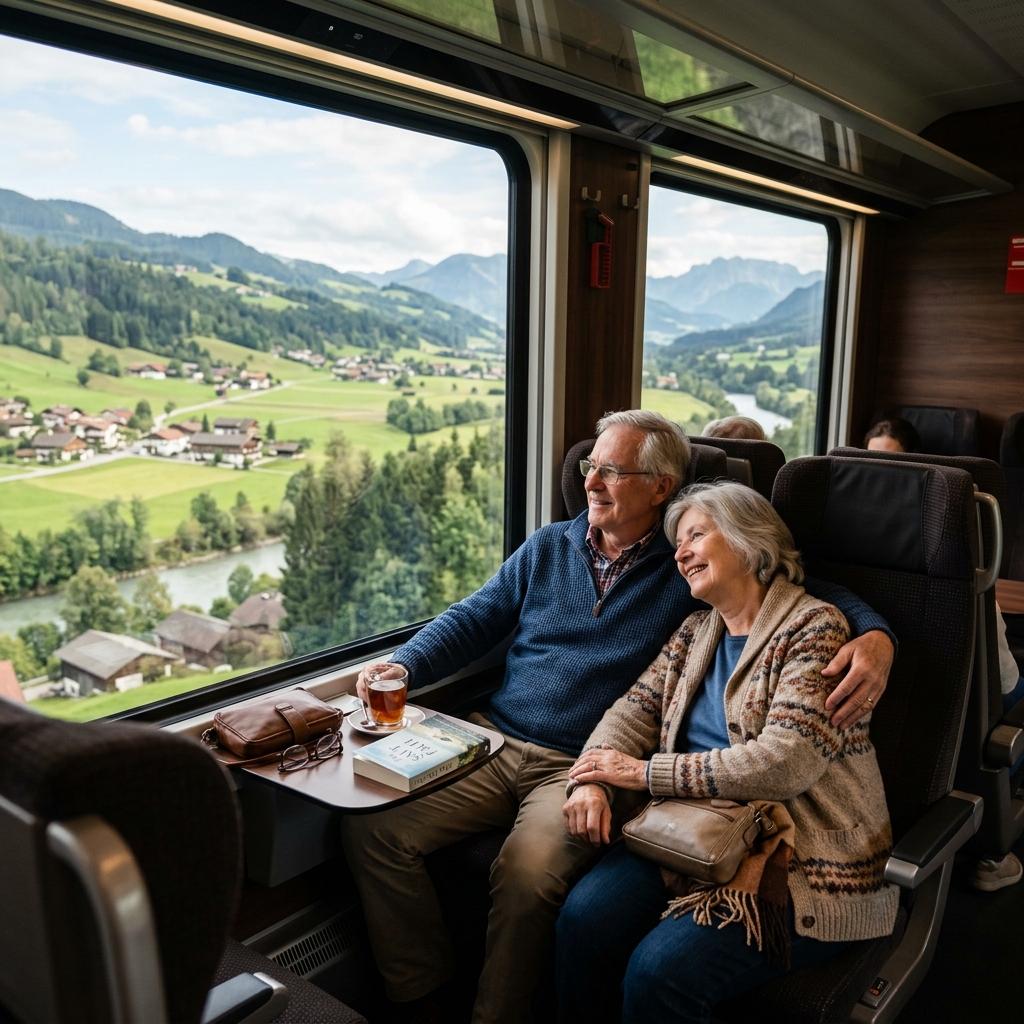
There is a particular kind of exhaustion that airports produce. It has nothing to do with the flight. It’s the queuing at check-in, the performance of security, the twenty-minute walk to gate B47, the search for somewhere tolerable to eat, the shuffling through a cabin with hand luggage that won’t quite fit. By the time you arrive at your destination, you’ve already spent yourself.
Trains don’t do this. You arrive at the station, find your platform, board. The city starts immediately outside the window. The dining car is three carriages along. And if you’ve booked an overnight sleeper, you wake up somewhere entirely different, having lost no evening to transit and gained a hotel night in the bargain.
This isn’t a guide for travellers who are slowing down. It’s a guide for travellers who are choosing to travel better, who have enough experience to know that the itinerary is rarely the point, and enough good sense to stop pretending otherwise.
what slow travel means philosophically
TL;DR: Train travel suits older travellers better than flying for practical reasons: no security theatre, no weight limits on luggage, city-centre arrivals, accessible modern rolling stock, and real senior discounts. Travellers aged 60 and over represent the fastest-growing segment of European leisure travel, accounting for 27% of all overnight trips in the EU (Eurostat, 2024). The train is where they’re going.
Why Do Trains Suit Older Travellers Better Than Planes?
Travellers aged 60 and over make up 27% of all overnight leisure trips in the EU (Eurostat, 2024), and their satisfaction with train travel consistently outperforms air travel in post-trip surveys. The reasons aren’t sentimental. They’re structural. Trains remove most of the friction that makes air travel genuinely tiring.
No security theatre. You don’t remove your shoes, your belt, or your laptop. You don’t stand in a body scanner. You walk to your platform and board. For travellers with joint issues, reduced mobility, or simply a reasonable preference for being treated like an adult, this matters enormously.
Generous luggage allowances. Most European rail operators allow two large bags and a carry-on at no additional charge. There are no weight scales at the door, no fees for a slightly heavy case. You pack what you need. The Frecciarossa, Italy’s premier high-speed service, officially permits luggage up to any reasonable size you can stow yourself, with large overhead racks and underfloor storage on night trains.
City-centre arrivals. This is underrated. Milan Centrale, Paris Gare de Lyon, Vienna Hauptbahnhof, these stations are in or near the heart of the city. You step off a train and you’re already somewhere. Compare that to arriving at Heathrow, CDG, or Malpensa: 45–60 minutes of airport transit before you see anything worth seeing.
Seating that’s actually comfortable. European high-speed trains offer first-class seats that match business-class aircraft legroom at a fraction of the price. Window seats at table configurations give you a surface for reading, a laptop, a meal. You can stand up and walk. The dining car exists. None of this requires a special upgrade.
overview of European train travel
What About Mobility and Accessibility?
Modern European high-speed trains are more accessible than many travellers expect. The Frecciarossa, Eurostar, Thalys, and ICE all offer level-entry boarding at major stations or minimal step boarding (typically one low step). The EU’s Passenger Rights Regulation (EC 1371/2007) requires rail operators to provide free assistance to passengers with reduced mobility, including at the platform, boarding, and arrival.
How to request assistance. For most operators, you book assistance at the same time as your ticket, or contact the operator at least 48 hours before travel. Trenitalia’s assistance service is called Sala Blu (Blue Room) and operates at 14 major Italian stations with staff on the platform. DB (Germany) and SNCF (France) offer equivalent services. Book online or by phone, don’t leave it to the day.
Step-free routes. Not every station is fully step-free, and it’s worth being honest about this. Older stations, some in Switzerland, rural Austria, parts of Spain, have stairs to platforms and no lifts. The itineraries recommended later in this guide are specifically chosen for accessibility at their key interchange stations. If a particular station is a concern, check the operator’s accessibility guide before booking. ÖBB’s website has a particularly good station-by-station accessibility database.
Night trains and mobility. ÖBB Nightjet trains have accessible couchette compartments and dedicated spaces for passengers who need extra room. Major night-train stations (Vienna, Zürich, Amsterdam, Brussels) are fully step-free at the platforms served by these services. Small stations mid-route can be harder, but you’re not getting off there.
Citation capsule: The EU’s Passenger Rights Regulation requires all rail operators in member states to provide free boarding assistance to passengers with disabilities or reduced mobility at staffed stations, with 48 hours’ advance notice (European Commission, 2023). This covers not only wheelchair users but anyone who requests assistance with boarding.
night trains in Europe, routes, booking, accessibility
The Luggage Problem, and Why Night Trains Solve It
Luggage is one of the least-discussed but most significant sources of travel stress. Hauling a large case through an airport, onto an airport bus, into a taxi queue, and then up three flights of stairs to a hotel room is, frankly, unpleasant at any age. After 60, with a dodgy knee or a shoulder that’s been complaining since the spring, it’s worse.
Night trains change this calculation completely. You board in the evening, stow your bags in your compartment, sleep, and arrive the next morning directly at the city centre. You haven’t moved your luggage once. No airport carousel, no taxi boot, no lobby wait. Your bags go where you go, on the same train, and that’s that.
For slow travel specifically, the pack-once principle is worth committing to. One well-chosen wheeled carry-on (55cm x 35cm x 25cm fits the overhead racks on virtually every European train) eliminates the luggage problem entirely. You don’t need to check anything in. You board and go.
If you do have larger bags, most major European stations have left-luggage facilities, staffed cloakrooms or automated lockers, allowing you to check bags in while you explore and collect them later. Prices vary: Rome Termini charges around €6 per bag per day, Zürich HB around CHF 7. Useful if you’re doing a one-night stop and don’t want to haul everything to a hotel.
The honest advice: One wheeled carry-on and a daypack. That’s it. If you can’t fit two weeks of travel into that combination, you’re packing for comfort, not travel, and comfort clothes are available everywhere you’re going.
[IMAGE: A compact wheeled carry-on bag on a European train platform, search terms: wheeled luggage train platform europe]
What Are the Best Slow Travel Itineraries for Travellers Over 60?
The itineraries below are designed around one principle: seven nights minimum per city. Not because you’ll run out of things to do in less, you won’t, but because the first two or three days of any stay are adjustment. The city only starts to become yours from day four onward.
Italy in Two Weeks: Milan to Naples by Frecciarossa
Italy is the natural starting point. The Frecciarossa (Italy’s flagship high-speed train) connects Milan, Bologna, Florence, Rome, and Naples on a single line, with trains every 30 minutes on the busiest corridors. Every city on this route is walkable at its centre. Every city rewards longer stays.
The route: Milan (3 nights) → Bologna (3 nights) → Florence (4 nights) → Rome (4 nights) → Naples (optional 3 nights if time allows).
Bologna is the underrated choice here. It’s the food capital of Italy, it’s compact, it has one of Europe’s oldest universities giving it daily life that has nothing to do with tourism, and almost nobody your friends will have visited. The Frecciarossa from Milan takes 65 minutes. Florence to Rome is 1h 35m. These aren’t journeys that eat your day, they’re short punctuation marks between long stays.
If Naples interests you, add it. The Frecciarossa from Rome to Naples takes 1h 10m. The city is unlike anywhere else in Italy. Stay in Spaccanapoli or the Quartieri Spagnoli and spend your days in the streets rather than the sites.
Switzerland and Austria: Zürich to Vienna Through the Alps
This is the itinerary for travellers who want scenery to be as important as the cities. Switzerland’s rail infrastructure is the finest in the world for its size, trains run on time to the minute, connections are integrated, and the views from the standard IC window are better than most countries’ scenic excursions.
The route: Zürich (3 nights) → Lucerne (3 nights) → Interlaken (3 nights) → Salzburg (4 nights) → Vienna (5 nights).
Interlaken is the gateway to the Bernese Oberland, the Jungfraujoch, the Lauterbrunnen valley, the kind of mountain scenery that stops conversation. It’s also fully accessible by train on every leg. The Interlaken to Salzburg journey goes via Zürich and Innsbruck: scenic, comfortable, about 5.5 hours with one change.
Salzburg to Vienna takes 2h 28m by OBB Railjet, one of Austria’s excellent express trains. Vienna deserves five nights, minimum. It’s one of Europe’s great walking cities, and its cafe culture was specifically invented for spending half a morning over a single coffee with a newspaper.
[IMAGE: The Bernese Alps seen from a Swiss train window near Interlaken, search terms: interlaken train window alps switzerland]
Spain Slow: Madrid to Andalusia by AVE
Spain’s high-speed AVE network is outstanding and underused by international travellers. Madrid to Córdoba takes 1h 45m. Madrid to Seville takes 2h 30m. These are distances that justify long stays at both ends.
The route: Madrid (4 nights) → Córdoba (3 nights) → Seville (5 nights) → Granada (3 nights, by bus from Seville, about 3 hours).
Córdoba is one of the most extraordinary cities in Europe, the Mezquita alone is worth a day, and the old Jewish quarter rewards the kind of aimless walking that only works when you’re not trying to get somewhere. Seville in spring (March–May) is magnificent. Granada requires a bus from Seville since the rail connection is indirect, but it’s worth it for the Alhambra and the Albaicín neighbourhood.
Citation capsule: Spain’s AVE network now covers over 4,000 km of high-speed track, giving it the longest high-speed rail network in Europe and the second-longest in the world after China (Renfe, 2025). Madrid–Seville fares start at around EUR 25 in advance on standard class.
What Senior Rail Discounts Are Available in Europe?
Senior rail discounts across Europe are substantial, and surprisingly underused by travellers who aren’t aware they exist. For EU residents aged 60 and over, the Interrail Senior Pass alone can cut trip costs by a third or more. For non-EU residents, point-to-point booking with senior fares on individual operators achieves similar savings. Used together, these discounts can reduce a two-week rail itinerary by several hundred euros.
Interrail vs Eurail, which pass is right for you
Interrail Senior Pass (60+)
The Interrail Senior Pass is for EU and EEA residents aged 60 and over. It operates identically to the standard Interrail Global Pass but at a significant discount, typically 10–15% below the adult price, on top of which seniors also qualify for the standard advance-booking discounts. The pass covers 33 countries and most high-speed services (with a seat reservation fee, typically EUR 5–15 per journey on high-speed trains). For two weeks of travel across multiple countries, it’s often the most cost-effective option.
SNCF Senior Card (France)
The SNCF Carte Avantage Senior (for travellers 60+) costs EUR 49/year and delivers at least 30% off standard fares across the French rail network, rising to 60% off on some advance bookings. If your itinerary includes Paris, and most European itineraries do, this card pays for itself on a single return journey. Available online at sncf-connect.com.
DB Bahncard 50 (Germany)
The Deutsche Bahn Bahncard 50 gives 50% off all standard DB fares for a year. At EUR 244 for a standard adult subscription, it pays for itself quickly for anyone spending more than a few days travelling through Germany. Seniors get an additional reduction: the Bahncard 50 for over-60s is available at EUR 122 for the second class version. If your itinerary includes Germany, this is worth calculating carefully.
OBB Vorteilscard Senior (Austria)
Austria’s OBB Vorteilscard Senior costs EUR 26.90/year for travellers over 60 and delivers 50% off standard OBB fares throughout Austria, plus discounts on many international connections. Given that Austria sits at the centre of the European night train network, and that Vienna is one of the continent’s best slow-travel destinations, this card is worth picking up before any Central European itinerary.
Senior Railcard (UK)
The Senior Railcard covers travellers aged 60 and over travelling within Great Britain. It costs GBP 30/year (or GBP 70 for three years) and gives one-third off all standard and first-class rail fares. For a trip combining London with Scotland or the English countryside, it saves multiples of its cost on a single journey.
Citation capsule: The UK Senior Railcard, available to all travellers aged 60 and over, reduces standard rail fares by one-third across the national network. At GBP 30/year, it typically pays for itself within two or three journeys (National Rail, 2026). Paired with advance booking, total savings routinely exceed 50% off walk-up fares.
Why Night Trains Are Particularly Good After 60
Here’s a perspective that doesn’t appear in the brochures: sleeping on a train is, for many travellers, easier than sleeping in a hotel the night before an early flight. The gentle motion of the train, the darkness, the knowledge that you don’t have to be anywhere until morning, these are conditions that produce sleep.
The ÖBB Nightjet offers three accommodation tiers worth understanding before you book. A seat is the cheapest option and works fine for journeys under six hours if you can sleep sitting up. A couchette, a reclining berth in a shared six-berth or four-berth compartment, suits most travellers for medium distances and costs EUR 49–99 on most routes. A private sleeper cabin (mini-cabin or deluxe en-suite) gives you a lockable room with a made-up bed, often a small washbasin, and genuine privacy. These are the most comfortable option and cost EUR 100–200+ depending on route and season.
For travellers over 60, the calculation is worth making explicitly: a private sleeper cabin on the Vienna–Rome Nightjet costs roughly EUR 150. A mid-range hotel room in Florence (your morning arrival point) costs EUR 130–180. The night train doesn’t just save you travel time, it saves you a hotel night. And you arrive in the city at 9am, rested, with the whole day ahead.
There is something else, less quantifiable: the particular pleasure of waking up somewhere you weren’t the night before, watching the field announce a different country through the window, with coffee from the attendant and nothing to do for the next half hour but look. This is travel as it used to be, and it’s still available.
complete guide to night trains in Europe
A Note on Travel Insurance
Travel insurance matters more as you get older, not because older travellers are reckless, but because medical costs abroad are significant, and the threshold for needing care rises with age. A single hospitalisation in Italy or Spain without coverage can cost thousands of euros. Repatriation costs, if required, can run to five figures.
The standard advice applies here: check what your policy actually covers. Many annual travel insurance policies cap medical expenses at levels that are inadequate for serious illness. Check specifically for:
- Medical repatriation, what the policy pays if you need to be flown home with medical supervision.
- Pre-existing conditions, disclose everything, even if it feels minor. An undisclosed pre-existing condition is the most common reason insurers deny medical claims.
- Trip cancellation, particularly relevant if you’re booking long itineraries in advance.
Some credit cards offer travel insurance that’s adequate for short trips. Most are not adequate for month-long itineraries or travellers with complex medical histories. An annual specialist policy for over-60s from a reputable provider is worth the cost. Compare policies on an aggregator before booking, not after.
What Are the Practical Tips for Train Travel Over 60?
The structural advantages of train travel are clear. These are the smaller details that make the experience significantly more comfortable.
Book aisle or table seats. Table seats give you a surface for reading, eating, and a laptop. They also give you a reason to get up without bothering anyone. On most European booking platforms, you can select your seat when booking, use this option. On the Frecciarossa, table seats in second class (called Standard or Premium) are excellent value.
Request assistance when booking. If you have any mobility considerations at all, request assistance at booking. This is not an admission of limitation, it’s the sensible use of a service that exists precisely for this. Staff at major European stations are trained and equipped. Using them makes the journey easier.
Bring a neck pillow for night trains. On couchettes, the provided pillow is functional but thin. A compact travel neck pillow means the difference between adequate sleep and good sleep. It takes up almost no space.
Eat in the dining car. This is one of the small pleasures that distinguishes train travel from everything else. Not all trains have a full dining car, but where one exists, use it. The Frecciarossa’s dining carriage serves decent Italian food, real coffee, and wine. It’s also a place to meet people, which is another thing airports have largely eliminated.
Don’t over-schedule. This deserves repetition because it’s the most common error made by travellers who are genuinely excited to be somewhere. Three things per day is enough. Two things per day, done properly, is better. The unplanned hour in a square or a market reveals more than the fourth museum.
how to plan a slow travel trip from scratch
Related Reading
- The Best Food Cities in Europe (Ranked by a Slow Traveler), The 10 best food cities in Europe for travelers who eat seriously: San Sebastián, Bologna, Lyon, Naples, Istanbul,…
- How to Travel Europe with Carry-On Only (Train Traveler’s Guide), Everything you need to pack for 2+ weeks in Europe with a single carry-on: bag sizes for train overhead racks,…
- The Adriatic Coast by Train and Ferry: Italy to Croatia Slow, Travel the Adriatic slow: Italy’s coastal rail line from Bologna to Bari, then overnight ferry to Split and…
Frequently Asked Questions
Do European trains have step-free access for passengers with mobility issues?
Most modern high-speed trains, Frecciarossa, Eurostar, ICE, Thalys, TGV, AVE, have level-entry boarding or one low step at major stations. Accessibility varies by station: major hubs are generally fully step-free, while some regional stations are not. The EU requires operators to provide free boarding assistance with 48 hours’ notice (European Commission, 2023). Check the specific station using the operator’s accessibility page before booking.
European rail accessibility details
Is the Interrail Senior Pass worth buying for a two-week trip?
It depends on your itinerary. The Interrail Senior Pass (EU/EEA residents 60+) offers 10–15% off the standard adult pass price, plus unlimited travel on 33-country networks. For itineraries crossing three or more countries, it typically beats point-to-point tickets. For single-country trips, a national senior card (SNCF, DB Bahncard, OBB Vorteilscard) often saves more. Compare both scenarios before buying. Interrail vs Eurail full comparison
Are night trains comfortable for older travellers?
Private sleeper cabins on ÖBB Nightjet and other operators are genuinely comfortable, lockable rooms with made-up beds, often a washbasin, and attentive service. The motion of the train aids rather than disrupts sleep for most people. Couchettes (shared berths) are adequate for those who sleep easily; private cabins are the right choice for anyone who values privacy or has mobility considerations. The financial case is strong: a private cabin often costs less than a hotel night.
full guide to night trains in Europe
What’s the best European country for senior rail travel?
Austria and Switzerland have the best rail infrastructure for comfort, accessibility, and on-time performance. Italy has the best combination of high-speed services, destinations worth extended stays, and food culture that rewards slowness. Spain offers dramatic scenery and the underrated AVE network. For first-time senior rail travellers, Italy’s Milan–Naples corridor is the most forgiving: frequent trains, easy connections, and cities that are genuinely better explored over multiple days.
What should I pack for a two-week European rail trip?
One wheeled carry-on (55cm x 35cm x 25cm) and a daypack. Pack for layers rather than outfits, a merino wool base layer, a light down jacket, one smart option for dinner. Shoes matter most: comfortable, walkable, and broken in before you travel. Pack prescription medication in your carry-on, not your main bag. A portable phone charger is essential. Everything else is available to buy wherever you’re going.
The Case for Choosing Differently
Travel after 60 is not the same as travel at 30, not because your capabilities are diminished, but because your priorities have changed. You’ve done the hectic itinerary. You’ve ticked the boxes. You know, from experience, that the photograph of the Colosseum doesn’t tell you much about Rome.
What train travel offers is not a compromise with age. It’s a better way to travel, made more valuable by experience. You arrive in the city rather than outside it. You move through the country rather than over it. You have time, on the train, at your destination, in the evenings that aren’t consumed by airport procedures, to actually notice where you are.
The Alain de Botton argument, made in The Art of Travel more than two decades ago, is that we rarely interrogate how we travel, only where. The how matters. The train is a particular kind of how: slower, more located, more present. The journey is not a subtraction from the destination. It is part of it.
Book the train. Book the sleeper. Stay longer than you think you need to. Come back from the trip having actually been there.