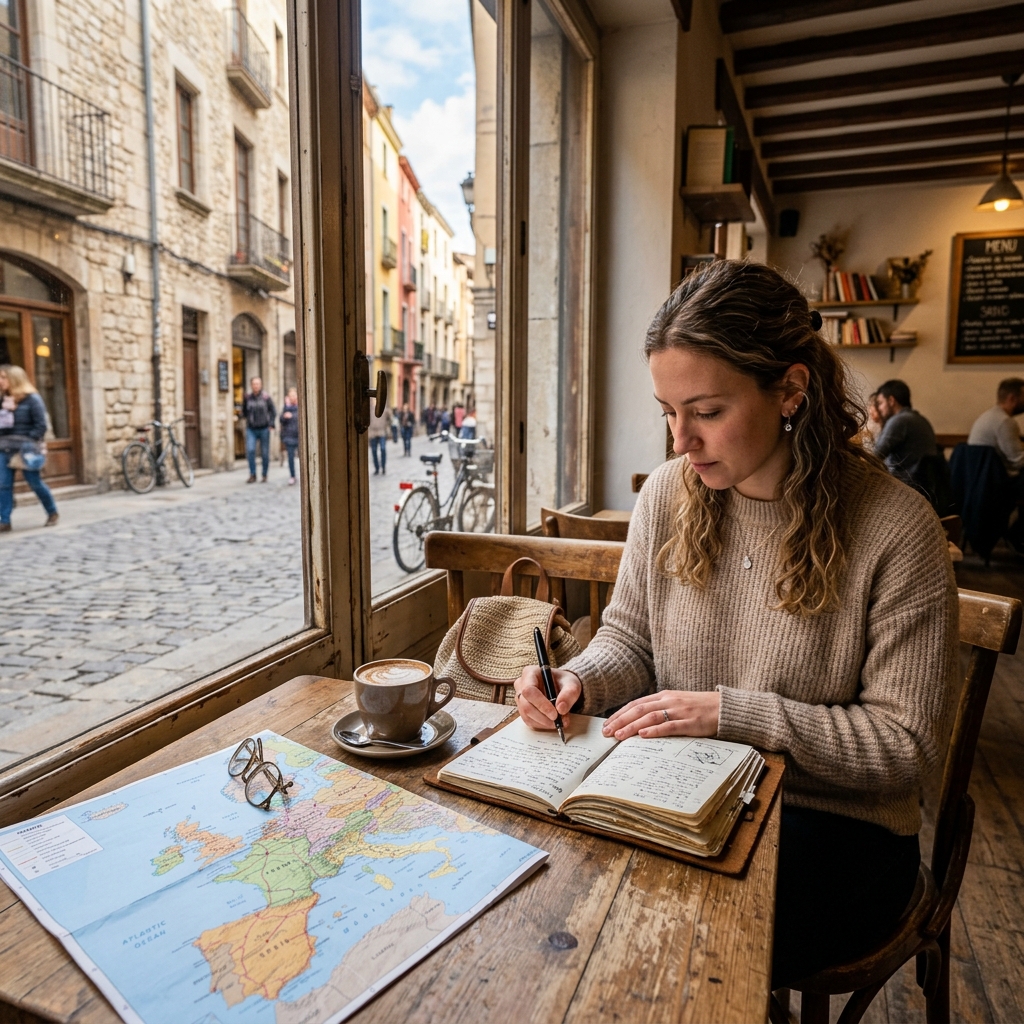
Most travel advice starts with a destination. Slow travel starts with a question: how long is long enough to actually arrive somewhere? The answer, in our experience, is almost always longer than you think. One in four global travellers planned to embrace slow travel in 2025, up significantly from pre-pandemic figures (Hilton Trends Report, 2025). They’ve already done the arithmetic. Depth beats breadth.
This guide is for people who want to travel differently, not necessarily slowly in the sense of torpidly, but slowly enough for a place to become legible. It covers everything: how to choose destinations, how long to stay, what kind of accommodation to book, how to structure your days, what a realistic slow travel budget looks like, and the hardest part, which is saying no.
the philosophy behind slow travel and why it’s growing
TL;DR: Slow travel means a minimum of 5 nights per destination, ideally 7 or more. One in four travellers globally now embrace this approach (Hilton Trends Report, 2025). The practical result is fewer destinations per trip, an apartment rather than a hotel, trains over planes, and itineraries with deliberate blank space built in. It costs less per day and produces measurably better experiences.
The One Rule That Changes Everything
The single most transformative constraint in slow travel planning is a minimum stay of five nights per destination, ideally seven or more. Research on vacation wellbeing shows that psychological detachment from home, the state in which you’ve genuinely stopped thinking about your inbox and your routine, takes several days to establish (Journal of Leisure Research, 2023). You can’t detach on a three-day city break. You barely unpack before you’re repacking.
Five nights is the floor. At five nights you’ve covered the adjustment period and earned two or three days of genuine presence. At seven nights you’ve developed a routine: a café you return to, a walk you’ve done twice, a neighbourhood you no longer handle by map. That’s the qualitative shift slow travel is after.
What actually changes: The difference between three nights and seven in a place isn’t arithmetical, it’s categorical. On day three, you start to relax. On day five, you start to notice things. By day seven, you have a local. Not someone you photographed talking to, but someone who knows your order. That shift, from tourist to temporary inhabitant, is what slow travel is actually after.
89.8% of Americans who practise slow travel say they prefer staying in one destination for the entire trip rather than multi-city hopping (Carl Friedrik / Help, 2025). They’re not being timid. They’ve already discovered what the research confirms: depth beats breadth.
How Do You Choose Where to Go?
The most common slow travel planning mistake is thinking at the wrong scale, booking a flight to “Europe” or “Southeast Asia” and trying to compress a continent into three weeks. Slow travel requires choosing a region, not a continent, and resisting the pull to extend your geographic scope once you’ve booked. Airbnb’s data shows that stays of 28 nights or more accounted for 17% of all gross nights booked in Q1 2024, up nearly 90% from 2019 levels (MDPI, 2025). People are learning to commit.
The selection principle is this: one region, one cultural context, one language area if possible. Northern Italy is a region. “Italy plus France plus Spain” is three trips being compressed into one, and the result is a trip that doesn’t do justice to any of them.
How to choose your region:
- Pick something that rewards depth. Cities with distinct neighbourhoods, food cultures worth investigating, day trips accessible by regional train. Bologna, Lisbon, Kyoto, Oaxaca, all repay extended attention. Theme-park destinations don’t.
- Consider the transport spine. Slow travel works best when your destinations connect by train or ferry, movement that is itself part of the experience. Italy’s Frecciarossa corridor, the French TGV network, the Japanese Shinkansen, the Iberian AVE. If your destinations require separate flights to connect them, you’ve chosen too broadly.
- Choose fewer places than feels comfortable. If your instinct is four cities, plan for two. The discomfort of narrowing your itinerary is productive, it forces you to commit to depth rather than hedge toward breadth.
Italy by train as a model slow travel route
How Long Should You Spend in Each Place?
The right duration depends on the scale of the place. A small market town has a different depth than a capital city, but even a small town rewards more time than most travellers give it. The framework below is a working guide, not a rigid rule. Adjust based on your own pace and what the place demands.
[CHART: Horizontal bar chart showing recommended minimum nights by city type, Small town/village 3-4 nights, Mid-size city 6-7 nights, Major regional city 7-10 nights, Capital city 10-14 nights, source: Art of the Travel planning framework, 2026]
Small Towns and Villages: 3 to 4 Nights
Three nights in a small town feels like a short stay, until you’ve done it and realised how much you saw on days two and three that you’d have missed if you’d moved on. The rhythm of a village is slower and the things worth finding are quieter: the market on Thursday morning, the bakery that opens at 6am, the walk to the viewpoint that isn’t signposted. You need time to discover them.
Mid-Size Cities: 6 to 7 Nights
A mid-size city, somewhere like Bologna, Porto, Seville, or Ghent, has enough to fill a week without feeling like you’re forcing it. These are the slow travel sweet spots: significant enough to repay extended attention but not so overwhelming that a week barely scratches the surface. Six nights gives you two or three deep-dives (a museum, a day trip, a neighbourhood walk) and enough free time around them for the kind of unplanned encounters that make a trip memorable.
Major Regional Cities: 7 to 10 Nights
For cities like Barcelona, Florence, Lisbon, or Kyoto, places with substantial historical depth and multiple neighbourhoods worth inhabiting, a week is a minimum and ten nights is better. Florence at seven nights allows you to move beyond the obvious (the Uffizi, the Duomo) into the city’s residential character: the Oltrarno on a weekday morning, the San Frediano market, the view from Piazzale Michelangelo at dusk rather than noon.
Capital Cities: 10 to 14 Nights
Rome, Paris, Tokyo, Istanbul. These cities don’t yield to a short stay. They’re too large, too layered, too full of things that only reveal themselves after you’ve been there a week. Ten nights is a sensible minimum. Two weeks is better. Paris at a week is a tourist experience. Paris at two weeks starts to become something closer to understanding a city.
Why Do Slow Travellers Prefer Trains Over Planes?
Train travel reduces your journey’s carbon footprint by approximately 86% compared to the equivalent domestic flight (Our World in Data, 2024). That’s the environmental argument, and it’s a good one. But the slow travel case for trains goes further: a flight is a discontinuity, a gap in your experience between departure and arrival. A train is continuous. You pass through the country rather than over it.
The practical advantages compound. No liquids restriction, no baggage fee roulette, no two-hour check-in margin. European city-centre stations are almost always more conveniently located than airports, Paris Gare du Nord to London St Pancras is 2 hours 16 minutes, while the equivalent door-to-door flight adds 90 minutes at minimum when you account for the airports. And the train journey itself is usable time: you can read, write, watch the field change, eat at a dining car, think.
There’s also something harder to quantify. Arriving by train feels different from arriving by plane. You’ve passed through the territory that surrounds a city, the suburbs, the farmland, the rivers, and the city’s presence has been building for the last 20 minutes rather than appearing abruptly through a descending window. You’ve earned the arrival by passing through what precedes it.
the complete guide to travelling Europe by train
European night trains, the slow traveller’s overnight option
Citation Capsule: Train travel generates approximately 14 times fewer carbon emissions per passenger kilometre than domestic flying, and the Eurostar between London and Paris produces 97% fewer emissions than the equivalent flight (Our World in Data, 2024). For slow travellers, the train’s city-centre-to-city-centre routing eliminates airport dead time that typically adds 2 to 3 hours to any short-haul journey.
Apartments or Hotels, Which Works Better for Slow Travel?
For stays of five nights or more, an apartment beats a hotel on almost every dimension that matters to slow travellers. The savings alone make the case. A hotel room at €120 per night runs to €840 for seven nights. A well-chosen apartment in the same city often costs €600 to €700 for the same week, kitchen included, neighbourhood included, the feeling of living somewhere rather than staying somewhere included.
But the financial case is secondary to the experiential one. A hotel, however good, situates you in a parallel version of the city, a version designed for visitors, adjacent to the city rather than inside it. An apartment in a residential neighbourhood puts you into daily life immediately. You use the same bakery, the same corner shop, the same launderette. You start to develop preferences, and preferences are the beginning of understanding.
Why Neighbourhood Choice Matters More Than the Apartment Itself
The neighbourhood question is at least as important as the apartment. Hotel districts exist for tourist convenience, they’re efficient and they feel like nowhere in particular. Booking an apartment a 20-minute walk from the main tourist spine puts you in a different relationship to the city entirely.
In our experience, the best neighbourhood criterion is this: does it have a market within walking distance? A neighbourhood with a functioning local market, not a craft fair, but the place where residents buy their vegetables, is a neighbourhood worth living in for a week. The market tells you more about a city’s daily character than any guidebook.
For longer stays, consider a neighbourhood-first search rather than an apartment-first one. Identify two or three residential areas in your destination city, the ones where people who live there actually live, not the ones that appear on every walking tour map, and then search for apartments within them.
How Do You Structure a Slow Travel Day?
The slow travel day has a different rhythm from the tourist day. Research confirms that the wellbeing benefits of travel are most strongly linked to quality of engagement rather than quantity of activities (Journal of Leisure Research, 2023). It’s not about covering ground. It’s about being present long enough to notice things, and that requires a structure loose enough to allow for unplanned detours without falling apart entirely.
A framework that works:
Morning: routine before exploration. The best slow travel mornings are built around a small ritual: the café you’ve identified on day two, the market you visit every other day, the park you walk through before anywhere else. Routine sounds anti-adventure, but it’s how you start to feel at home in a place. The espresso bar where the barista recognises you by day four is a slow travel achievement.
Afternoon: one destination, not three. The tourist trap is packing three things into an afternoon and experiencing none of them properly. Choose one: the museum, the neighbourhood, the day trip, the hill above the town. Do that one thing without looking at the time.
One “nothing planned” half-day per week. This is the most important structural element in the entire framework. One half-day, a morning or an afternoon, with nothing in the calendar, no destination in mind, and nowhere to be. The best things that happen in slow travel happen in this space. You follow a street that looked interesting. You accept a recommendation from someone at the café. You sit in a square for two hours and watch who passes through it.
Citation Capsule: A 2023 integrative review in the Journal of Leisure Research confirmed five mechanisms through which vacations improve wellbeing: detachment, recovery, autonomy, mastery, and meaning (Journal of Leisure Research, 2023). Slow travel’s longer stays are specifically designed to create the conditions for all five, most rush itineraries only achieve the first two.
Does Slow Travel Actually Cost Less?
Slow travel is almost always cheaper per day than rushed travel, though the total trip cost can be higher because you stay longer. The economics work in your favour in several compounding ways. 57% of Americans planned a longer trip in 2025 than they took in 2024 (IPX1031, 2025). The economics are part of why.
[CHART: Grouped bar chart comparing daily costs for rush travel vs slow travel across three categories, accommodation (rush: €120/night hotel, slow: €65/night apartment on weekly rate), food (rush: €55/day tourist restaurants, slow: €32/day market and local spots), transport (rush: €180 in multiple flights, slow: €45 in advance train tickets), source: Art of the Travel cost framework, 2026]
Accommodation. Weekly and monthly rates are substantially lower than nightly rates. A hotel room at €120 per night becomes a €600 weekly rate on a longer stay, a 30% saving before the week ends. Apartment rentals drop further with extended bookings: a well-located flat in many European cities runs under €65 per night on a weekly rate, kitchen included.
Food. Tourists pay tourist prices. Stay long enough to find the neighbourhood bakery, the market where residents shop, the lunch canteen that doesn’t appear on any app, and your daily food cost drops significantly. The slow travel equation on food is simple: the longer you’re in a place, the less you eat in restaurants designed for people who won’t be there tomorrow.
Transport. Multiple short trips to multiple cities means multiple flight legs, airport transfers, and checked baggage fees. A single train leg into one city and point-to-point tickets for any regional exploration eliminates most of that overhead. Booking European train tickets 8 to 12 weeks ahead typically saves 60 to 75% compared to walk-up prices (Seat61.com, 2026).
The hidden saving that most slow travel budgets don’t account for is the tourist-trap avoidance dividend. When you’re only in a city for two days, you eat at the restaurant near the main square because you don’t have time to find anything else. When you’re there for a week, you find the place two streets back that’s half the price and twice as good. That saving, compounded across every meal and every activity, is substantial.
A Sample 3-Week Slow Travel Itinerary Framework
Three weeks, three cities, seven nights each. Italy’s high-speed corridor connects Florence, Bologna, and Venice at fares from €9 per leg booked in advance (Trenitalia, 2026), making this the most cost-effective slow travel structure in Europe. It’s simple enough to be replicable and spacious enough to actually work. The specific cities below use northern Italy as the template, but the same framework applies to Portugal (Lisbon / Porto / Alentejo), Japan (Tokyo / Kyoto / Hiroshima), or Spain (Madrid / Seville / Granada).
The structure (21 days):
| Week | City | Nights | Character |
|---|---|---|---|
| Week 1 | Florence | 7 | Renaissance depth, food culture, Oltrarno neighbourhood |
| Week 2 | Bologna | 7 | The real Italy, university city, medieval towers, best food in the country |
| Week 3 | Venice | 7 | One of the only cities in Europe that genuinely requires a week to see past the surface |
How the week works in practice:
- Days 1 to 2: Arrival, orientation, finding your café and your market
- Days 3 to 5: The planned things, the major sites, the day trip, the neighbourhood walk you researched
- Day 6: The nothing-planned half-day (morning) + something discovered locally (afternoon)
- Day 7: Slow departure, final market visit, final coffee at your café, afternoon train to the next city
The travel days. Florence to Bologna takes 37 minutes on a Frecciarossa, you barely sit down before you arrive. Bologna to Venice takes 1 hour 40 minutes. These are not journeys to rush. Buy a coffee at the station, take a window seat, watch the Po Valley pass.
Florence to Venice by train, route, fares, and booking guide
What Is the Hardest Part of Planning a Slow Travel Trip?
FOMO is the enemy of slow travel. Yet 89.8% of Americans who already practise slow travel report preferring a single destination over multi-city itineraries, which means the people who’ve actually done it have resolved this tension in favour of fewer places (Carl Friedrik / Help, 2025). The hardest moment is the one where you decide to cut Rome because Florence and Bologna already fill three weeks properly. It’s the moment you close the browser tab with Cinque Terre hotels because you know it would mean two nights there, not seven, and two nights is not how you travel anymore. That moment of closure, of saying no to a place, feels like loss.
It isn’t loss. It’s the decision that makes the rest of the trip possible.
Alain de Botton made this case precisely in The Art of Travel (2002): we rarely think about how we travel, only about where, and this omission costs us most of what travel could offer. The checklist instinct, see as many places as the time budget allows, is a confusion of quantity for quality. It produces trips with a long list of visited places and a thin memory of all of them.
Practical ways to hold the boundary:
Decide on your city count before you start researching. Three weeks: three cities. Two weeks: two cities. Write it down before you open any browser. Then do your research inside that constraint, not before setting it.
Build a “next trip” list. Every place you’re deliberately skipping this time goes on the list for the next trip. This reframes the choice: you’re not saying no to Cinque Terre, you’re deferring it to the trip that gives it proper time.
Commit to the apartment before you feel completely ready to. The moment you have a seven-night booking in a specific neighbourhood, the planning shifts from abstract to concrete, and the temptation to add a city recedes because you now have somewhere specific to be.
Citation Capsule: 89.8% of Americans who practise slow travel say they prefer staying in one destination for an entire trip rather than multi-city hopping (Carl Friedrik / Help, 2025). The preference isn’t timidity, it reflects a deliberate trade of breadth for depth, and the findings suggest that travellers who make this trade consistently report higher satisfaction with their trips.
Related Reading
- The Adriatic Coast by Train and Ferry: Italy to Croatia Slow, Travel the Adriatic slow: Italy’s coastal rail line from Bologna to Bari, then overnight ferry to Split and…
- Amsterdam for Slow Travellers: How to Actually Arrive in the City, Amsterdam rewards people who stay long enough to stop sightseeing.
- The Best Food Cities in Europe (Ranked by a Slow Traveler), The 10 best food cities in Europe for travelers who eat seriously: San Sebastián, Bologna, Lyon, Naples, Istanbul,…
Frequently Asked Questions
How many destinations should a 2-week slow travel trip include?
Two, possibly three if two of them are close together and connected by a short train. The instinct to pack more in is natural, but a 2-week trip with three widely-spaced cities averages less than five nights per city, which falls below the threshold where the qualitative shift in experience occurs. Research on vacation wellbeing consistently shows that psychological detachment, the state where you’ve genuinely stopped thinking about home, takes several days to establish (Journal of Leisure Research, 2023). Two cities, seven nights each, is a better trip.
Is slow travel possible if I only have 10 days?
Yes, but it requires committing to a single city and its surrounding region. Ten days in one place, a city and a few day trips by train or bus, is slow travel. It’s also, in our experience, one of the most productive trip formats available. You have enough time to move past the tourist layer without the logistical overhead of moving between cities. Choose a mid-size city rather than a capital, book an apartment in a residential neighbourhood, and treat the day trips as the variety rather than building them into a multi-city spine.
What’s the best region in Europe for a first slow travel trip?
Northern Italy is the strongest case: excellent train connections, Italy’s high-speed rail corridor explained, world-class food culture in every city, manageable tourist density outside the peak summer months, and enough historical and artistic depth that a week in any single city doesn’t exhaust what it offers. Florence, Bologna, and Venice form a natural three-city triangle connected by trains under two hours. Three weeks in Italy by train, the full itinerary
Should I book every day of my slow travel trip in advance?
No. You should book your accommodation and your major transport legs in advance, the apartment, the train tickets between cities, any single high-demand experience with limited entry (the Last Supper in Milan, the Uffizi, the Alhambra). Everything else is better left open. The daily structure of a slow travel trip gains much of its value from having unscheduled time. Over-planning is the fast travel instinct applied to a slow travel framework. It defeats the purpose.
How do night trains fit into slow travel?
Extremely well. A night train replaces both a hotel night and a daytime journey, you cover distance while you sleep and arrive in a city in the morning, rested and already in motion. ÖBB’s Nightjet network now operates over 60 routes across Europe, with couchette fares from around €49 (ÖBB, 2026). In a slow travel itinerary, a night train between your penultimate and final city is an efficient and atmospheric way to transition, you use the travel day, you don’t waste a night in transit, and you arrive having experienced the journey rather than merely completed it. European night trains, costs, routes, and booking guide
The Argument, Simply
There is a particular kind of exhaustion that comes from travelling quickly, the exhaustion of having covered ground without having understood it. You’ve been in five cities and you remember fragments of all of them. The cathedral in one, the harbour in another, the market you photographed but can’t quite place. The trip happened, and yet it has the quality of something that almost happened.
Slow travel is the argument that this is a planning problem, not an inevitable feature of travel. The corrective is not more time, though more time helps, but a different use of whatever time you have. Fewer places. Longer stays. Movement that is itself meaningful. An itinerary with deliberate space in it.
Carl Honoré argued in 2004 that slowness isn’t about doing everything at a snail’s pace, it’s about doing everything at the right speed. Applied to travel, the right speed is the one at which the place becomes legible. That’s different for every traveller and every city. But the starting condition is always the same: you have to stay long enough to give legibility a chance.
Five nights is the floor. Seven is better. And the day you’re sitting at your regular table in your regular café, and the waiter brings your order without you asking, is the day you’ve actually arrived.
what slow travel means and why it matters
All cost estimates and timetable references reflect March 2026 conditions. Train fares and accommodation rates vary by season and booking window, verify current prices before committing to any specific route or stay.