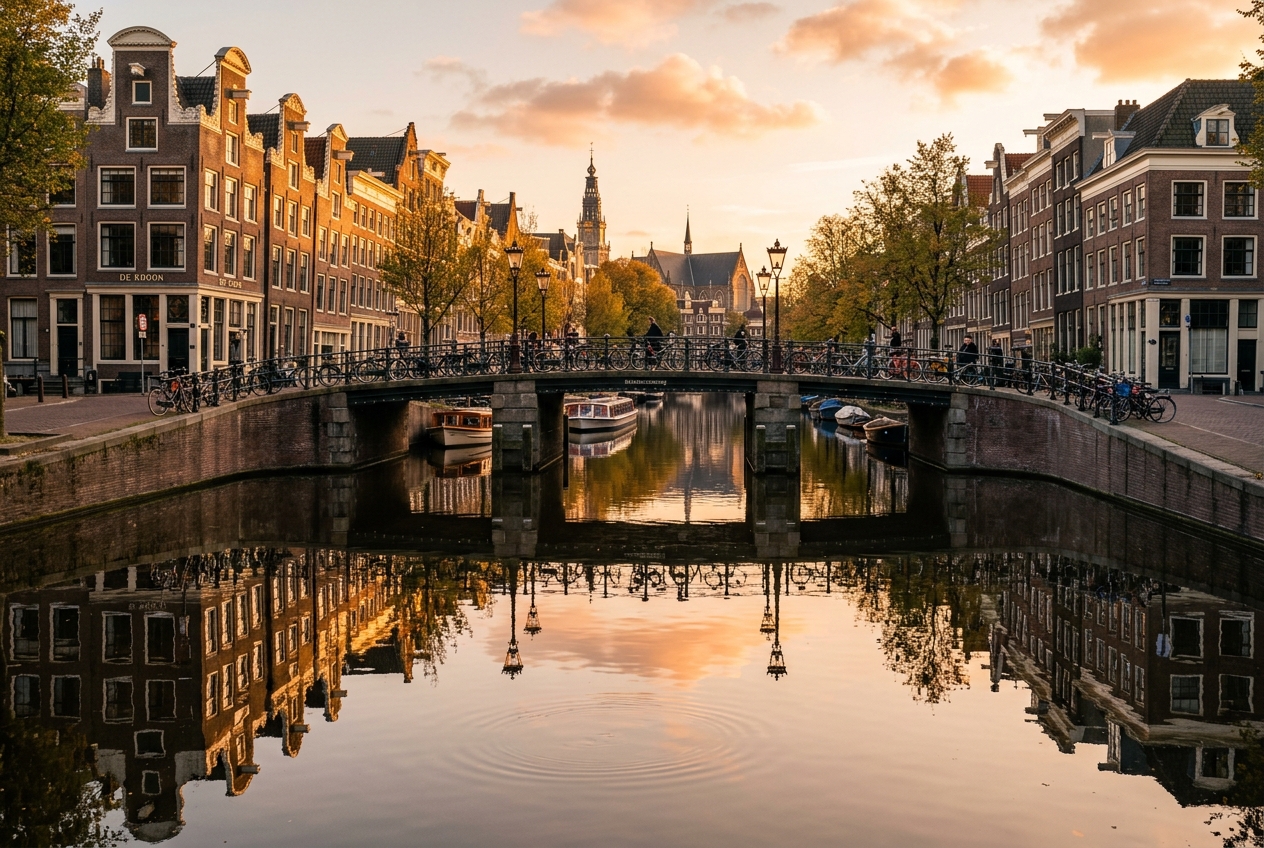
Most people come to Amsterdam for two or three days. They do the Anne Frank House, the Rijksmuseum, a canal boat, a bicycle wobble along the Prinsengracht, and then they leave, photographs secured, box ticked, city filed. That’s a perfectly reasonable way to spend a long weekend. This guide is not for those people.
Amsterdam is one of a small number of European cities that reveal themselves almost entirely in the third, fourth, and fifth day of a stay. The canal ring, a UNESCO World Heritage Site since 2010, is not a set of monuments. It’s a neighbourhood that people cycle through on their way to work, hang their washing above, and argue about planning permissions for. The city has 160 registered nationalities. It is simultaneously one of the world’s most visited cities and one of the most genuinely inhabited. The tourists pass through; the city carries on regardless.
A week here isn’t self-indulgent. It’s the minimum needed to stop sightseeing and start paying attention.
the philosophy behind slow travel and why depth beats breadth
TL;DR: Amsterdam’s 160 nationalities, UNESCO canal ring, and cycling culture make it one of Europe’s best slow travel cities, but only if you stay long enough to stop being a tourist. Seven nights, an apartment in the Jordaan or De Pijp, a rented bicycle, and no itinerary after 2pm is the formula. Amsterdam receives 22 million visitors a year (Amsterdam & Partners, 2025); almost none of them actually arrive.
Why Does Amsterdam Reward Slow Travel?
Amsterdam’s 17th-century canal ring, the Grachtengordel, was inscribed as a UNESCO World Heritage Site in 2010 (UNESCO, 2010), making it one of the most significant planned urban fields in the world. But unlike most heritage sites, it’s still entirely inhabited. People live, work, cycle, and park their boats along the same streets that were laid out in the Dutch Golden Age. That combination of historical density and continued daily life is what makes Amsterdam worth slowing down for.
The city has a geographical quality that rewards walking pace. It’s small, about 30 square kilometres in the historic centre, but extraordinarily layered. Each canal ring adds a different character: the inner Singel, the grander Herengracht, the quieter Keizersgracht, the residential Prinsengracht. The streets connecting them contain, in compact succession, a 17th-century hofje (almshouse garden), a corner shop selling Indonesian spices, a gallery showing contemporary photography, and a café that has had the same brown walls since 1927.
What the tourism numbers don’t tell you: Amsterdam received 22 million visitors in 2024 (Amsterdam & Partners, 2025), nearly 13 times its resident population of 921,000. But the visitors concentrate intensely in a few square kilometres around Centraal station, the Rijksmuseum, and the Leidseplein. Walk 15 minutes south into De Pijp or 10 minutes west into the Jordaan and the crowds thin to almost nothing. The tourist city and the actual city barely overlap. A slow traveller lives in the actual one.
The city’s relationship to the bicycle is also relevant here. Amsterdam has 767,000 bicycles for 921,000 residents (Gemeente Amsterdam, 2024). Cycling is not a tourist activity or a fitness choice, it’s infrastructure, the default mode of movement for everyone who actually lives here. Getting on a bicycle changes your relationship to the city immediately. You stop being a pedestrian threading between sights and start moving at the speed the city was designed for.
Which Neighbourhood Should You Stay In?
Where you sleep in Amsterdam determines most of what your week looks like. The difference between a hotel near Centraal station and an apartment in the Jordaan is not a matter of convenience. It’s a matter of which city you’re in. Amsterdam receives 22 million visitors annually (Amsterdam & Partners, 2025), and most of them concentrate in a small area. Choosing a residential neighbourhood puts you outside that concentration from day one.
[IMAGE: Map-style illustration of Amsterdam’s main neighbourhoods, Jordaan, De Pijp, Oud-West, Centrum, with canal rings visible, search terms: Amsterdam neighbourhood map illustrated]
Jordaan: The Quietest and Most Beautiful
The Jordaan was a working-class district until the 1970s and was progressively gentrified over the following decades. It’s now the most aesthetically complete neighbourhood in the city, a grid of narrow streets and small canals between the Prinsengracht and the Lijnbaansgracht, lined with 17th and 18th-century houses, independent galleries, antique shops, and hofjes (hidden courtyards behind street-level doors). It’s also the most expensive neighbourhood to rent in, because everyone who visits Amsterdam eventually understands that this is where they’d want to live.
A week in the Jordaan means cycling to the Noordermarkt on Saturday morning, spending Sunday at the antique market on the Looiersgracht, finding a brown café (bruine kroeg) by Wednesday that you return to twice before you leave. It’s quiet enough to hear the canal water at night. It’s expensive, budget €900–€1,400 per week for a one-bedroom apartment.
De Pijp: Younger, More Local, Livelier
De Pijp sits south of the historic ring, below the Rijksmuseum. It has a different demographic, younger, more diverse, less touristic, and a different energy. The Albert Cuyp Market, the longest open-air market in the Netherlands, runs through its spine every day but Sunday. This is where Amsterdam residents actually shop: fish, cheese, stroopwafels still warm from the press, Indonesian spices, second-hand clothing. The neighbourhood’s cafés are full of people working on laptops. Prices are lower than the Jordaan by 20 to 30%.
If the Jordaan is where you go to understand Amsterdam’s past, De Pijp is where you go to understand its present. For slow travellers who want daily life rather than preserved atmosphere, it’s often the better choice.
Oud-West: Residential, Excellent Food
Oud-West, between the Vondelpark and the Jordaan, is the neighbourhood most visitors never find. It has a Moroccan and Turkish market character on the Ten Katemarkt, excellent independent restaurants, some of the best bakeries in the city, and a street life that’s entirely local. Accommodation prices sit between the Jordaan and De Pijp. It’s a 12-minute cycle to the Rijksmuseum and a 5-minute walk to the Vondelpark. For slow travellers who want quiet mornings and a neighbourhood that functions without tourists, Oud-West is the strongest recommendation.
Centrum: Where Not to Stay
The Centrum, the area radiating from Centraal station through the Red Light District and along the main tourist spine to the Leidseplein, is efficiently designed for people staying two nights. It concentrates hotels, tourist restaurants, cannabis cafés, and guided walking tours into a tight zone. Nothing in it is wrong. It’s just not the city. Stay elsewhere and visit it by bicycle when you need to.
Citation Capsule: Amsterdam’s historic canal ring, the Grachtengordel, was designated a UNESCO World Heritage Site in 2010 and covers 400 listed monuments and approximately 1,550 buildings constructed between the 17th and early 20th centuries (UNESCO, 2010). Uniquely among major UNESCO urban sites, the entire zone remains fully inhabited and commercially active, making it one of the few living heritage sites in Europe.
How Do You Get Around Amsterdam?
Amsterdam has 767,000 bicycles for a population of 921,000 residents, and the city’s infrastructure was built around cycling over a period of decades of deliberate investment (Gemeente Amsterdam, 2024). You don’t ride a bicycle here as a tourist novelty. You ride one because it’s the fastest, cheapest, and most natural way to move through the city. This is non-negotiable for slow travel in Amsterdam.
Bicycle rental runs €12–€18 per day or €50–€70 per week from reputable shops, avoid the cheapest options near Centraal, which rent out heavy, poorly-maintained machines. MacBike and Black Bikes have reliable weekly rates. If you’re staying seven nights, a weekly rental costs less than a tourist all-day tram pass repeated seven times and gives you a freedom of movement that no tram network can match.
What cycling actually changes: The first 20 minutes on an Amsterdam bicycle are alarming, the traffic patterns, the tram tracks, the confident locals who treat red lights as suggestions. By hour two you’ve stopped thinking about the mechanics. By day two you’re part of the flow, cutting down side streets, locking up outside a bakery without thinking about it. The city stops being a series of destinations and starts being a medium you move through. Nothing else produces that shift as quickly.
For bad weather, and the Netherlands has weather, the GVB tram network is excellent. A 24-hour ticket costs €8; a 48-hour ticket €13.50 (GVB, 2026). Lines 2 and 12 cover most of the slow travel triangle between Centraal, the Jordaan, and the museum quarter. You will not need a taxi. You will definitely not need a car, there’s nowhere to put one.
What Is Worth Doing Properly in Amsterdam?
Does the Rijksmuseum deserve two visits?
Yes, and the two visits should have completely different purposes. The Rijksmuseum holds over 8,000 objects on display from a collection of 1 million, and the building itself, a 19th-century neo-Renaissance structure with an interior renovation completed by architects Cruz y Ortiz in 2013, is as remarkable as the contents (Rijksmuseum, 2026). Going twice isn’t repetition. It’s a different activity.
The first visit should be fast and undirected. Walk through the major galleries without a plan, pause only for what genuinely stops you, not because the label says it’s important, but because something in the image holds your attention. The Vermeers do this for most people. The Night Watch for some, less for others. Note the rooms you want to return to and leave after 90 minutes.
The second visit, two or three days later, is just those rooms. An hour or less, unhurried, without the first-visit anxiety of feeling you’re missing something. The Dutch Golden Age rooms, properly attended to, contain some of the finest light in the history of painting. They deserve stillness.
slow travel principles applied to how we experience culture and art
The Canal Ring at Dawn
The canal ring at 7am on a weekday is a different city from the canal ring at 11am. The tourist boats haven’t started. The bridge cyclists are commuters, not sightseers. The light on the water, Amsterdam’s light, famously particular, flat and diffuse from the proximity to the North Sea, hits the gabled houses at an angle that painters have been returning to for 400 years. Walk from the Jordaan along the Prinsengracht to the Brouwersgracht and back again. Take no photographs for the first 20 minutes. Let the place register.
This walk, an hour, two kilometres, is one of the finest pieces of urban slow travel available anywhere in Northern Europe. It costs nothing and requires only being up before the tour groups.
The Albert Cuyp Market on a Weekday
The Albert Cuyp Market in De Pijp is 260 stalls, 300 metres long, and has operated in the same location since 1905 (Albert Cuyp Markt, 2026). On weekends it fills with visitors; on a Tuesday or Wednesday morning in late spring it’s full of local residents doing their weekly shopping. Go on a weekday. Buy a stroopwafel from the stall that presses them fresh. Eat the herring at the fish stand, hold the fish by the tail, tip your head back, lower it in. This is the correct technique, the Dutch will confirm it, and it’s genuinely one of the better things you can eat standing up in a European city.
On the herring: Raw-cured Dutch herring, Hollandse Nieuwe, is seasonal, available from late May through summer when the fish are freshest. Outside that window you’ll get pickled herring (just as good, different) or maatjes from the previous season. The most reliable stall at the Albert Cuyp is near the junction with Ferdinand Bolstraat, it’s been there in various forms since the 1960s. No signage needed; you’ll know it by the queue of locals.
FOAM Photography Museum
FOAM, on the Keizersgracht, is one of the best small photography museums in Europe, showing four simultaneous exhibitions across historic and contemporary photography in a series of canal-house rooms (FOAM, 2026). Entry runs €17.50. It takes 90 minutes properly and never feels crowded. This is the museum for the afternoon after you’ve done the Rijksmuseum twice and want something smaller, stranger, and more current. The programme rotates regularly, check what’s showing before you go, but it’s rarely disappointing.
Vondelpark on a Weekday
The Vondelpark is where Amsterdam residents actually go when they want to be outside. It has 10 million visitors a year, but most of them come on weekends (Gemeente Amsterdam, 2024). On a Tuesday afternoon in early autumn, it feels like a large, slightly eccentric village green. There are people reading, playing chess, watching dogs, pushing prams, cycling through slowly enough to nod at acquaintances. There’s an open-air theatre in summer. The café in the park, the Vondelpark 3, is excellent and serves lunch to a clientele that is overwhelmingly local. Bring a book. Stay for two hours. This is slow travel.
The Jordaan on a Sunday
Sunday in the Jordaan has two markets worth combining into a single morning loop. The Noordermarkt, in the square fronting the 17th-century Noorderkerk, divides itself: a farmers’ market on one side (organic vegetables, bread, cheese, flowers) and a flea market selling antiques and second-hand clothes on the other. The Looiersgracht antique market, a 10-minute walk south, runs in an indoor space on weekends and specialises in the kind of Dutch domestica, Delft tiles, old maps, pewter, that seems to belong in an Amsterdam house specifically. Neither market is tourist-focused. Both are worth an unhurried morning.
What Should You Eat in Amsterdam?
Amsterdam’s food culture is one of the most underrated in Europe, not because it produced a grand culinary tradition of its own, but because the Dutch colonial history created one of the most interesting immigrant food fields on the continent. Indonesia was a Dutch colony for over 300 years; the culinary consequences are still felt in every city in the Netherlands.
Rijsttafel: Amsterdam’s Greatest Culinary Legacy
The rijsttafel, literally “rice table”, is a Dutch colonial invention: a way of presenting Indonesian food adapted from the elaborate ceremonial meals of the Indonesian royal courts. At an Amsterdam rijsttafel restaurant, you receive a central bowl of rice surrounded by 15 to 25 small dishes: rendang, satay, gado-gado, sambal, tempeh, various curries, pickles, and crackers. It’s not Indonesian food as Indonesian people eat it, it’s a Dutch interpretation with its own 150-year history. It’s also genuinely excellent.
The best rijsttafel restaurants are in the Jordaan and Oud-West: Tempo Doeloe on the Utrechtsestraat has been considered one of the finest for decades; Kantjil & de Tijger near the Spui is slightly more accessible and equally good. Budget €35–€50 per person including wine. Book ahead.
[IMAGE: A rijsttafel spread with 20 small dishes surrounding a central rice bowl at an Amsterdam restaurant, search terms: rijsttafel Amsterdam Indonesian restaurant]
The Dutch Breakfast
The uitsmijter, fried eggs served on thick white bread with ham and cheese, often topped with pickles, is the Dutch working breakfast and one of the more satisfying things to eat at 9am. It appears on virtually every Dutch café menu for €8–€12. Order it with a koffie verkeerd (coffee with hot milk, the Dutch version of a latte) and you have a breakfast that will hold you until 2pm. This is not fusion food or a tourist construct; it’s what Dutch people actually eat.
Beer Worth Drinking
Heineken is made in Amsterdam, the original brewery on the Stadhouderskade is now a tourist experience rather than a working plant. Drink it if you want to; it’s not offensive. But Brouwerij ‘t IJ, brewed in a working windmill in the east of the city, makes beer that’s worth seeking out specifically. Their Natte (double bock), Zatte (tripel), and Columbus (IPA) are available across the city but are best drunk at the taproom in the mill itself, a 15-minute cycle from the Jordaan, and one of the more unusual settings in which to drink craft beer in Europe. The taproom opens at 2pm daily (Brouwerij ‘t IJ, 2026).
Street Food Worth Knowing
Three items, all available from street stalls and market stands:
Stroopwafels pressed fresh over a steam iron, two thin waffles bound with caramel syrup while still warm. The pre-packaged ones in every supermarket are fine. The fresh ones are substantially better. Albert Cuyp Market and the Noordermarkt both have excellent stands.
Herring (haring) from a street cart, raw-cured, eaten with raw onion and pickles. The correct method is by the tail, head tilted back. It sounds more daunting than it is. The flavour is clean and briny, nothing like the aggressively pickled herring of the British experience.
Bitterballen, fried breadcrumbed balls with a molten meat ragù interior. This is the Dutch pub snack, served with mustard at every bruine kroeg (brown café). They’re available everywhere. Eat them slowly: the interior stays hot for longer than seems possible.
Which Day Trips Are Worth Taking by Train?
Amsterdam Centraal connects to most of the Netherlands in under an hour, and the NS network is frequent and reliable. Day trips by train are one of the best arguments for Amsterdam as a slow travel base, the city is simultaneously interesting enough to fill a week and positioned well enough to explore an entire region.
Citation Capsule: The Netherlands has 384 railway stations served by Nederlandse Spoorwegen (NS), with an average of 1.1 million passengers per day on a network covering 3,223 kilometres (NS, 2026). Amsterdam Centraal is the network’s primary hub, with direct Intercity services reaching Haarlem in 17 minutes, Utrecht in 27 minutes, and Leiden in 34 minutes, making same-day return trips effortless and affordable.
Haarlem: 17 Minutes, Entirely Different Character
Haarlem is 17 minutes from Amsterdam Centraal by direct Intercity train and receives a fraction of the tourists. The historic centre is compact and beautiful: the Grote Markt square, the Frans Hals Museum (one of the finest collections of Dutch Golden Age painting outside the Rijksmuseum), the Teylers Museum (the oldest museum in the Netherlands, founded in 1784), and a network of streets that have changed less in the past 200 years than most Dutch cities. It’s quieter than Amsterdam in every register, fewer visitors, slower pace, lower prices. A day here is genuinely restorative. Trains run every 15 minutes; a return costs around €9 (NS, 2026).
Utrecht: 27 Minutes, a University City Worth Half a Day
Utrecht is 27 minutes south, a university city of 350,000 with a remarkable medieval centre built around a canal system that sits lower than street level, the wharfs that line the Oudegracht canal are at water level, creating a two-tier streetscape unique in Europe. The Dom Tower (112 metres, the tallest church tower in the Netherlands) is climbable on a guided tour. The café and restaurant scene around the Vismarkt and Twijnstraat is excellent. Utrecht is a good candidate for a full day if you want a city with a different energy from Amsterdam; Haarlem is better for a half-day.
Leiden: 34 Minutes, Rembrandt’s Birthplace
Leiden is 34 minutes by direct train and is both the birthplace of Rembrandt and the home of the Netherlands’ oldest university, founded in 1575. The city has a canal system almost as beautiful as Amsterdam’s, a fraction of the tourists, and the Rijksmuseum van Oudheden, a national antiquities museum with one of the finest Egyptian collections in Europe. Leiden is also the closest major city to the Keukenhof bulb fields, which makes it the natural base for a spring visit (mid-March to mid-May) when the 32 hectares of tulips, daffodils, and hyacinths are in bloom (Keukenhof, 2026).
Keukenhof: Spring Only, But Worth the Detour
If your visit falls between mid-March and mid-May, the Keukenhof gardens near Lisse are 50 minutes from Amsterdam by bus from Schiphol or by direct shuttle from Leiden station. Seven million bulbs are planted annually across 32 hectares, the largest flower garden in the world (Keukenhof, 2026). It is, unavoidably, a popular attraction. Go on a weekday, arrive at opening (8am), and you’ll have the first hour largely to yourself. By 11am the coaches arrive. The scale is genuinely spectacular in a way that photographs don’t fully capture, fields of colour that extend to the horizon, a smell that has no urban equivalent. Entry is €23.50; book online.
how to travel between Amsterdam and Paris by train, the Eurostar guide
arriving in Amsterdam by Eurostar from London, journey guide and booking tips
What Does a Slow Travel Week in Amsterdam Actually Look Like?
The rhythm of a week in Amsterdam has a natural structure that emerges from the city itself. It doesn’t require an itinerary so much as a framework, a few fixed points around which the days can organise themselves.
Morning: canal walk or market, then coffee. Every neighbourhood has a café worth becoming a regular at. The process of finding it, trying two or three in the first two days, identifying the one with the right light and the right barista and the right newspapers left on the counter, is itself slow travel. By day four, go there first.
Midday: one thing only. The Rijksmuseum, FOAM, a neighbourhood walk, the Vondelpark, a day trip to Haarlem. One destination, properly attended, is more valuable than three visited quickly. Amsterdam’s tourist infrastructure is designed to move you efficiently between sights. Slow travel is the decision not to be moved efficiently.
Afternoon: unplanned. This is the principle that every practised slow traveller eventually discovers and that every first-timer resists. An unscheduled afternoon in a city you’re starting to understand is when the interesting things happen. You follow a street that looked interesting. You see a gallery you hadn’t heard of and go in. You end up at a canal-side bench for an hour because the light was doing something worth watching.
Evening: a bruine kroeg. The bruine kroeg, the brown café, is the Dutch institution that slow travel was apparently designed to culminate in. The name comes from the walls, stained brown by centuries of tobacco smoke. They serve Dutch beer, jenever (Dutch gin, drunk neat in a small glass), and bitterballen. They’re dark and warm and full of regulars. The Jordaan has the highest density: Café ‘t Smalle on the Egelantiersgracht is the most famous; De Reiger on the Nieuwe Leliestraat is the most consistently good. Go at 6pm on a weekday, before the evening crowd arrives, and stay for two hours.
The moment you know you’ve arrived: It happens at different times for different people. For some it’s the bicycle, the day you stop thinking about the traffic and start thinking about where you’re going. For others it’s the café, when the person behind the counter makes your order without you asking. In Amsterdam it’s often the canal at a particular time of day: when the light has gone pink and the houseboats are lit from inside and you’re cycling along the Prinsengracht and the city stops being a place you’re visiting and becomes, temporarily, a place you live. Seven nights gives that enough time to happen.
Related Reading
- Budapest for Slow Travellers: Two Cities, One River, and More Time Than You Planned, Budapest is two cities divided by the Danube and unified by thermal baths, ruin bars, and a food scene that has…
- Edinburgh Slow Travel Guide: One Week in Scotland’s Capital, Edinburgh rewards those who stay long enough to walk Water of Leith, eat in Leith, and take the train to Stirling.
- Lisbon for Slow Travellers: The City That Rewards Staying Longer, Lisbon is one of Europe’s most walkable, affordable, and genuinely liveable cities.
Frequently Asked Questions
How many days do you actually need in Amsterdam?
Seven nights is the slow travel minimum, and the research on vacation wellbeing supports this. Psychological detachment from home, the state at which you stop thinking about your routine and start perceiving your surroundings properly, takes three to four days to establish (Journal of Leisure Research, 2023). A five-day trip gives you one or two days of genuine presence after the adjustment period. Seven gives you four. That’s the week worth having.
Is Amsterdam too crowded for slow travel?
The tourist concentration is intense but geographically narrow. Amsterdam received 22 million visitors in 2024 (Amsterdam & Partners, 2025), and the vast majority moved through a corridor of perhaps 3 square kilometres between Centraal station and the museum quarter. Stay in the Jordaan, De Pijp, or Oud-West, all 10 to 20 minutes from the main sights by bicycle, and you’ll experience a city that is inhabited rather than visited. The crowds and the calm coexist; choosing a neighbourhood is choosing which city you’re in.
What’s the best time of year to visit Amsterdam slowly?
Late September through November offers the strongest combination of light, manageable crowds, and lower accommodation prices. Spring (April to May) has the Keukenhof bulbs and beautiful light but higher visitor numbers. Summer is the peak tourist season and the most expensive. Winter is cold and occasionally grey, but the bruine kroegen are at their warmest and the museums are at their least crowded. Avoid the peak Christmas market weeks and July school holidays if crowd avoidance is a priority.
Is Amsterdam expensive for a slow traveller?
More than Lisbon or Porto, less than Paris or Zurich. A seven-night apartment in the Jordaan runs €900–€1,400. De Pijp and Oud-West average €650–€950 for the same period. Daily costs, coffee, market food, cycling, are moderate. Restaurants are expensive by Dutch standards but reasonable by Northern European ones: €18–€28 for a main course at a good neighbourhood restaurant. The biggest saving a slow traveller makes is avoiding tourist restaurants entirely, which is only possible once you’ve been somewhere long enough to know where else to eat.
Can I reach Amsterdam by train from London or Paris?
Yes, and for slow travellers, it’s the correct way to arrive. The Eurostar runs London St Pancras to Amsterdam Centraal in 3 hours 52 minutes, with fares from £35 booked in advance (Eurostar, 2026). From Paris Gare du Nord, the same Eurostar network reaches Amsterdam in 3 hours 17 minutes, with fares from €29. Arriving by train deposits you at Amsterdam Centraal, the geographic and logistical centre of the city, rather than at Schiphol Airport, 20 minutes south. The train is faster door-to-door and, on the London route, produces 97% fewer carbon emissions than flying (Our World in Data, 2024).
The Argument, Simply
Amsterdam gets reduced, by most travel media, to a shorthand of bicycles, canals, cannabis, and tulips. These things exist. But they’re the surface of a city that has been a centre of European trade, art, philosophy, and immigration for 400 years, a city that produced Rembrandt and Spinoza, that absorbed 160 nationalities without losing its particular character, that built the most beautiful urban canal system in the world and then continued to live inside it as though this were entirely normal.
The two-day version of Amsterdam, the Anne Frank House and the Rijksmuseum and a canal boat and a stroopwafel, is not wrong. It’s just incomplete. It’s the city as postcard rather than as place.
Seven nights is enough to start understanding the difference. Enough to find your café and your canal-side bench and your Wednesday morning at the Albert Cuyp market. Enough for the bicycle to stop being a vehicle you’re operating and become a thing you’re barely thinking about. Enough for Amsterdam to become, for a week, the place you happen to live, and for that to feel, as it always does when slow travel works, like the most natural thing in the world.
how to plan a slow travel trip from scratch, the complete practical guide
what slow travel means and why it matters
All transport times, fares, and opening hours reflect March 2026 conditions. Verify current prices before booking, train fares, entry fees, and accommodation rates vary by season and booking window.