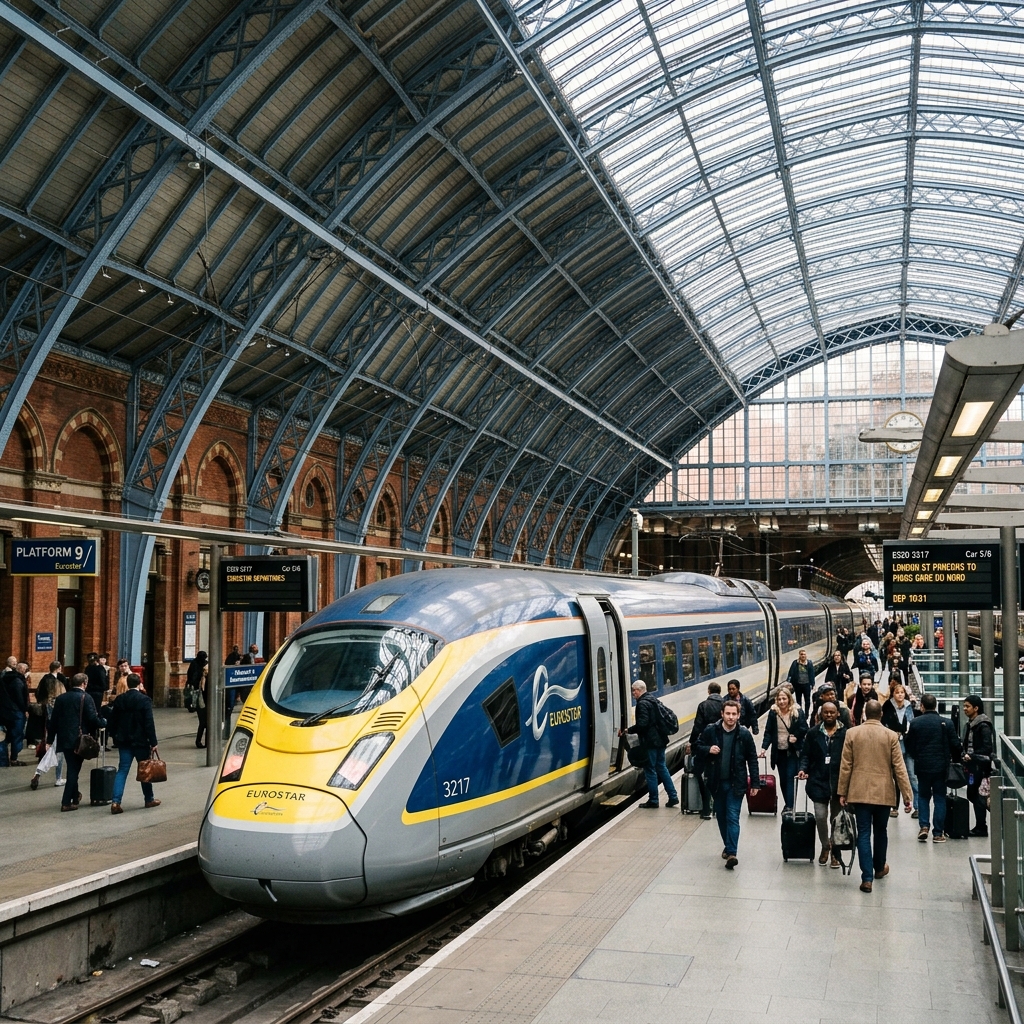
The direct Eurostar from London to Amsterdam takes 3 hours and 52 minutes city centre to city centre, and Standard fares start from £35 booked well in advance (Eurostar.com, 2026). That is the answer most people need upfront. What it doesn’t capture is what the journey actually feels like: St Pancras at dawn, the Kent countryside giving way to the Channel Tunnel, then Belgium flashing past before the Netherlands opens up, flat, wide, extraordinary in its light, and you roll into Amsterdam Centraal having covered 500 kilometres without stepping inside an airport once.
This guide covers everything you need: journey time, ticket prices, booking strategy, border control (which works differently than you’d expect), what to do when you arrive, and whether the train really beats flying door to door.
broader European rail travel context
TL;DR: The Eurostar runs London St Pancras to Amsterdam Centraal in 3h 52min, stopping at Brussels and Rotterdam. Standard tickets start from £35 advance; Standard Premier from £99. You clear both UK exit and Dutch entry border control at St Pancras before boarding, no passport check in the Netherlands. Book 3+ months ahead for the best fares (Eurostar.com, 2026).
How Long Does the London to Amsterdam Train Take?
The direct Eurostar completes the London St Pancras to Amsterdam Centraal journey in 3 hours and 52 minutes (Eurostar.com, 2026). That’s the scheduled time for the direct service, which runs several times daily. The train stops at Brussels-Midi and Rotterdam Centraal en route but passengers don’t need to change, you stay on board from St Pancras to Amsterdam.
Door to door, the comparison with flying is decisive. A London–Amsterdam flight takes roughly 1 hour and 20 minutes in the air. Add 90 minutes to reach Heathrow or City Airport, two hours for check-in and security, 30 minutes on the ground at Schiphol, and another 30–40 minutes on the Schiphol Express into central Amsterdam, and you’re looking at 6 to 7 hours centre to centre. The train takes 4.5 to 5 hours from door to door. It’s not close.
There is one service variation worth knowing. Eurostar also operates a London–Amsterdam route via Brussels without a Rotterdam stop on some timetabled departures, shaving a few minutes. When booking, the standard direct service stopping at Rotterdam is more frequent. Check the Eurostar site’s live timetable to confirm stopping patterns for your specific train.
How Much Does the London to Amsterdam Eurostar Cost?
Standard class fares begin at around £35 one-way on the earliest advance bookings, though £59–£89 is more typical for convenient daytime departures booked four to eight weeks out (Eurostar.com, 2026). Prices rise sharply within three weeks of travel. Standard Premier fares start around £99 and include a wider seat, a light meal, and lounge access. Business Premier starts around £249 and adds a full meal, full flexibility, and priority boarding.
[CHART: Horizontal bar chart, “London to Amsterdam Eurostar: Typical One-Way Fares by Class”, Standard from £35 / Standard typical £69 / Standard Premier from £99 / Business Premier from £249, Source: Eurostar.com, March 2026]
The cheapest fares are released in small batches when the booking window opens at 180 days before departure. Summer Friday departures sell through their cheapest inventory fastest. If your dates are flexible, the Eurostar calendar view shows fare levels across dates, Tuesdays and Wednesdays are reliably 20 to 30% cheaper than Fridays on this route.
How Do You Book, and When Should You Do It?
The booking window opens 180 days before departure (Eurostar.com, 2026). The cheapest Standard fares exist in limited quantities, and on peak-season departures they go within weeks of the window opening. For July and August travel, booking at the 180-day mark is not excessive.
The best place to book is directly at Eurostar.com. Third-party platforms including Trainline and Rail Europe carry Eurostar inventory, but they typically add a booking fee. For a pure London–Amsterdam point-to-point ticket, the Eurostar site has no surcharge and provides the full seat selection interface.
If you hold a Eurail pass, you can travel on the Eurostar with a mandatory passholder reservation fee of €35 per journey on top of your pass cost (Seat61.com, 2026). For most travellers doing a single London–Amsterdam leg, a point-to-point ticket is cheaper. See our full Interrail vs Eurail comparison if you’re weighing up a pass for a longer trip.
Quick booking checklist:
- Book direct at Eurostar.com to avoid third-party fees
- Use the flexible-dates calendar to find the cheapest travel days
- Select your seat at booking, it’s free and worth doing
- Check exchange and refund terms: Standard “Non-Exchangeable” fares are cheapest but inflexible
- Download the Eurostar app before travel, signal in the Channel Tunnel is zero
What Is the Route? London St Pancras to Amsterdam Centraal
The Eurostar departs from London St Pancras International, the ornate Victorian Gothic station in Kings Cross, north central London. You travel southeast through the London suburbs and then onto the High Speed 1 line through Kent, reaching the coast in around 35 minutes.
At Folkestone, the train enters the Channel Tunnel. The 50-kilometre tunnel takes approximately 22 minutes at around 160 km/h (Eurotunnel, 2026). It is dark, quiet, and strangely satisfying. Then you emerge near Coquelles in northern France and the train accelerates onto the French high-speed network.
The route continues through Belgium, passing through or near Lille before stopping at Brussels-Midi, roughly 2 hours into the journey. From Brussels, the Eurostar crosses into the Netherlands, stopping at Rotterdam Centraal before the final 40-minute run north to Amsterdam Centraal. The Dutch landscape in those final miles is something else: below sea level, unnervingly flat, the sky enormous.
[IMAGE: Map showing the Eurostar route from London St Pancras through the Channel Tunnel to Brussels, Rotterdam, and Amsterdam Centraal, search terms: eurostar amsterdam route map europe train]
What Happens at Passport Control?
This is where the London to Amsterdam train surprises most first-time travellers. You clear all border checks at St Pancras before you board, not at the border, not in Brussels, not in Amsterdam.
Because Britain is outside the EU’s Schengen zone, both UK exit control and Dutch entry control happen in London. You queue through UK Border Force first (exit checks for all travellers), then immediately through Dutch Police (entry checks for non-EU nationals, ID checks for EU nationals). Once through both desks, you’re in the international departure zone of St Pancras. When you arrive in Amsterdam, you simply walk off the train and into the city. No passport desk. No queue.
The practical implication: this double border check is where time disappears. A 45-minute pre-departure arrival is the absolute minimum. An hour is comfortable. In summer, the border queues at St Pancras can run 20 to 25 minutes on their own. Check-in closes 30 minutes before departure and the closure is enforced absolutely, miss it and you miss the train.
Passport Requirements
You need a valid passport for this journey regardless of nationality. UK nationals need a passport issued less than 10 years ago that is valid for the full duration of the trip (UK Government, 2026). EU and EEA nationals can use a national ID card. Non-EU international travellers may need a Schengen visa, check your nationality’s requirements before booking.
What Is the Eurostar Actually Like on Board?
Once you’ve cleared the border queues and settled into your seat, the experience is calm and comfortable. The Eurostar e320 trains that serve the Amsterdam route are among the most modern rolling stock in Europe, entering service from 2015 and significantly roomier than the original Eurostar fleet.
Standard class features a 2+2 seating layout, similar to a long-distance UK train. Seats are comfortable for a four-hour journey. Power sockets are available at every seat. Wi-Fi is provided throughout, though signal quality varies, particularly in the tunnel and on stretches through Belgium. There is no overhead X-ray scanner for luggage, no airport security theatre once you’ve cleared border control.
Standard Premier offers a 2+1 layout with wider seats, a light meal served at your seat, and access to the Eurostar lounges at St Pancras and Amsterdam. At £99 on advance booking, it’s worth considering for early-morning departures when the lounge time genuinely adds value.
Business Premier adds a full meal, full ticket flexibility, priority boarding, and a more spacious cabin. It suits business travellers or an occasional treat. The meal service on the Amsterdam route is genuinely good.
The Onboard Cafe Bar
The cafe bar car sells hot food, sandwiches, snacks, hot drinks, beer, and wine throughout the journey. Prices are airport-adjacent but not obscene. For Standard passengers, this is the main food option, worth grabbing something before you board if you want a proper meal. The cafe bar tends to get busy shortly after departure and around the Brussels stop.
Luggage: What Can You Bring?
Eurostar’s luggage policy is considerably more relaxed than airline rules. You’re allowed 2 large bags plus 1 hand luggage item per passenger, at no extra charge (Eurostar.com, 2026). There is no strict weight limit for standard luggage, though items must fit in overhead racks or the dedicated luggage bays at the carriage ends.
There is no baggage scanner for your hold luggage. Your bags go through an X-ray scanner at the St Pancras security point, but this is the same quick process as any international train check, not the remove-your-shoes, laptops-out procedure of airport security.
Large or oversized items, bicycles, pushchairs, sports equipment, need to be booked in advance. Folding bikes in a bag count as standard luggage. Full-size bicycles must be pre-booked on specific bike-friendly services, and space is limited.
Arriving at Amsterdam Centraal: What to Do Next
Amsterdam Centraal is the main railway terminus of the city and one of the most architecturally spectacular stations in Europe, a vast neo-Renaissance building on the waterfront of the IJ harbour, completed in 1889. You arrive directly into the heart of the city.
From Centraal, your onward options are excellent:
- Tram: Lines 2, 11, 12, 13, 17, and 26 depart from directly outside the station front. The network covers the entire city centre and the Jordaan neighbourhood. A single journey costs €3.20 or is covered by an OV-chipkaart transit card (GVB Amsterdam, 2026).
- Metro: Lines 51, 52, 53, 54 run from the underground platforms beneath the station. Line 52 (the North-South line) runs directly to Rokin, De Pijp, and Amsterdam Zuid in under 10 minutes.
- Ferry: Free public ferries depart from behind the station across the IJ to Amsterdam Noord, useful if you’re staying north of the centre.
- Walking: If your hotel is in the canal ring or the Jordaan, you’re 10 to 20 minutes on foot. Amsterdam is an easy city to walk.
Amsterdam Centraal handles around 250,000 passengers per day (NS, 2024), making it the busiest station in the Netherlands. Despite the volume, the station is well-signed in English and rarely feels overwhelming if you follow the main exit toward the waterfront.
Is the Train Better Than Flying London to Amsterdam?
For most travellers, yes, and by a meaningful margin. The door-to-door time comparison favours the train, the carbon footprint difference is stark, and the total cost is often lower once you account for airport transfers.
A London–Amsterdam return flight emits approximately 90–110 kg of CO2 equivalent per passenger compared to roughly 6 kg for the Eurostar, around 15 to 18 times more (European Environment Agency, 2023). That gap has made the Eurostar a meaningful choice for travellers who take their travel emissions seriously, and Eurostar now carries around 2.1 million passengers per year on the London–Amsterdam route alone (Eurostar Group, 2025).
On cost: a “cheap” Easyjet London–Amsterdam fare of £49 typically arrives with £35–£50 in airport transfer costs added (Heathrow Express plus GVB from Schiphol), plus potential hold-luggage fees. A £79 Eurostar Standard fare with no transfer costs and no baggage fee is frequently cheaper in total.
The one scenario where flying has a real benefit: if you’re already connecting through a London airport, or if you’re travelling to a destination outside the city centre that’s closer to Schiphol. For centre-to-centre travel, the train wins on almost every measure.
Is a London to Amsterdam Day Trip Possible?
Technically, yes. The first Eurostar departure from St Pancras arrives in Amsterdam by late morning. The last return service departs Amsterdam in the early evening. You’d have roughly five to six hours in the city.
Whether it’s worth doing is a different question. Amsterdam rewards time. The Rijksmuseum alone takes two to three hours if you take it seriously. The canal ring and the Jordaan neighbourhood need an afternoon to feel rather than just see. Five hours produces a sense of having moved through a beautiful city without quite landing in it.
Two nights is the realistic minimum. Three is better. The city doesn’t perform; it accumulates. You notice things on the second morning that weren’t there on the first.
Your First 24 Hours in Amsterdam
You’ve arrived at Centraal, you’re standing at the waterfront, and the city is in front of you. Here’s what the first day actually calls for.
Morning: The Canal Ring and Jordaan
Walk southwest from Centraal along the Damrak to Dam Square, then turn into the canal ring. The sequence of concentric waterways, Singel, Herengracht, Keizersgracht, Prinsengracht, was laid out in the 17th century during the Dutch Golden Age and remains one of the most coherent pieces of urban planning in Europe. It’s a UNESCO World Heritage Site, designated in 2010 (UNESCO, 2010). Walk the Herengracht southwest and you’ll pass some of the city’s finest canal houses.
The Jordaan neighbourhood sits just west of the canal ring, a grid of narrow streets, independent shops, brown cafes (bruine kroegen), and the Westerkerk’s tower punctuating the skyline. This is the neighbourhood for your first coffee and a slow morning.
Afternoon: The Rijksmuseum
The Rijksmuseum houses the largest collection of Dutch Golden Age paintings in the world, including Rembrandt’s Night Watch and Vermeer’s The Milkmaid. The building reopened after a 10-year renovation in 2013 and now sees over 2.7 million visitors annually (Rijksmuseum, 2024). Book your time slot online before arriving, same-day entry is rarely available.
Allow two to three hours. Don’t try to see everything. The Gallery of Honour on the upper floor, which contains the major Golden Age works, is where most of the meaning lives.
[IMAGE: The Rijksmuseum’s grand facade reflected in the Museumplein pond on a clear afternoon, search terms: rijksmuseum amsterdam exterior reflection]
Evening: Indonesian Food
Amsterdam has one of the finest Indonesian restaurant scenes in Europe, a direct legacy of the Dutch colonial relationship with Indonesia. Rijsttafel, literally “rice table”, is the format to seek out: a spread of 12 to 20 small dishes served alongside rice, designed for sharing. It’s warm, complex, and unlike anything you’ll eat in most of Europe.
The Pijp neighbourhood and the streets around the Leidseplein have the highest concentration of good Indonesian restaurants. Book ahead for dinner, the better places fill quickly.
Citation capsule: The direct Eurostar from London St Pancras to Amsterdam Centraal runs in 3 hours and 52 minutes and serves over 2.1 million passengers per year on this route. Standard tickets start from £35 advance. All UK exit and Dutch entry border checks take place at St Pancras before boarding, no passport control on arrival in Amsterdam (Eurostar.com, 2026).
Related Reading
- Amsterdam to Paris by Train: Thalys Guide, Times & Tickets, Amsterdam to Paris by train takes just 3h 17m on Eurostar.
- Amsterdam for Slow Travellers: How to Actually Arrive in the City, Amsterdam rewards people who stay long enough to stop sightseeing.
- London to Edinburgh by Train: The East Coast Main Line Done Properly, The train from London to Edinburgh takes 4h 20min and costs from £30 in advance.
Frequently Asked Questions
How long does the London to Amsterdam train take?
The direct Eurostar from London St Pancras to Amsterdam Centraal takes 3 hours and 52 minutes, stopping at Brussels-Midi and Rotterdam Centraal en route (Eurostar.com, 2026). Door to door, including travel to St Pancras and from Amsterdam Centraal, the total journey is typically 4.5 to 5 hours, compared to 6 to 7 hours for a flight when airport transfers and processing are included.
Do I need to change trains in Brussels?
No. The Eurostar to Amsterdam is a direct service, you board at London St Pancras and stay on the same train through Brussels-Midi and Rotterdam Centraal to Amsterdam Centraal. The train stops at both intermediate stations for a few minutes but passengers do not need to change (Eurostar.com, 2026).
What is the cheapest Eurostar fare to Amsterdam?
The cheapest Standard fares start from £35 one-way on early advance bookings, with the booking window opening 180 days before departure (Eurostar.com, 2026). The lowest fares are released in limited batches and sell through quickly on peak-season departures. Booking three or more months ahead reliably finds sub-£60 fares. Travelling on a Tuesday or Wednesday typically produces fares 20 to 30% lower than Friday equivalents.
Is there passport control when arriving in Amsterdam?
No. All passport and border checks take place at London St Pancras before boarding, you clear both UK exit control and Dutch entry control in London (UK Government, 2026). On arrival at Amsterdam Centraal, you walk directly off the train and out of the station with no further checks. This is one of the most consistently surprising aspects of the journey for first-time travellers.
Can I take a large suitcase on the Eurostar?
Yes. Eurostar allows 2 large bags plus 1 small personal item per passenger at no extra cost (Eurostar.com, 2026). There is no strict weight limit, though items must fit in overhead racks or the luggage areas at carriage ends. There is no checked-baggage system, you manage your own luggage. There is no overhead scanner for hold luggage, making the check-in process significantly quicker and less stressful than airport security.
The Journey Is Part of the Point
There’s something worth saying about this particular route. The Channel Tunnel alone, 50 kilometres under the sea, that strange hush as the windows go dark, is one of the more quietly remarkable things a person can do on an ordinary Tuesday. The Dutch landscape arriving in the final stretch, flat and luminous and unlike anywhere else in Europe, makes the arrival feel earned.
It takes under four hours. You don’t give up your morning to an airport. You arrive in the centre of one of the world’s great cities with your luggage, your composure, and the knowledge that you’ve produced a fraction of the carbon a flight would have cost.
Book early, take the window seat, and be ready for Amsterdam. The city will do the rest.
For more on travelling the continent this way, our guide to Europe by train covers the big picture, and if Amsterdam opens up an appetite for overnight travel, the night trains in Europe guide covers the ÖBB Nightjet routes that connect Amsterdam to Vienna, Zurich, and beyond.