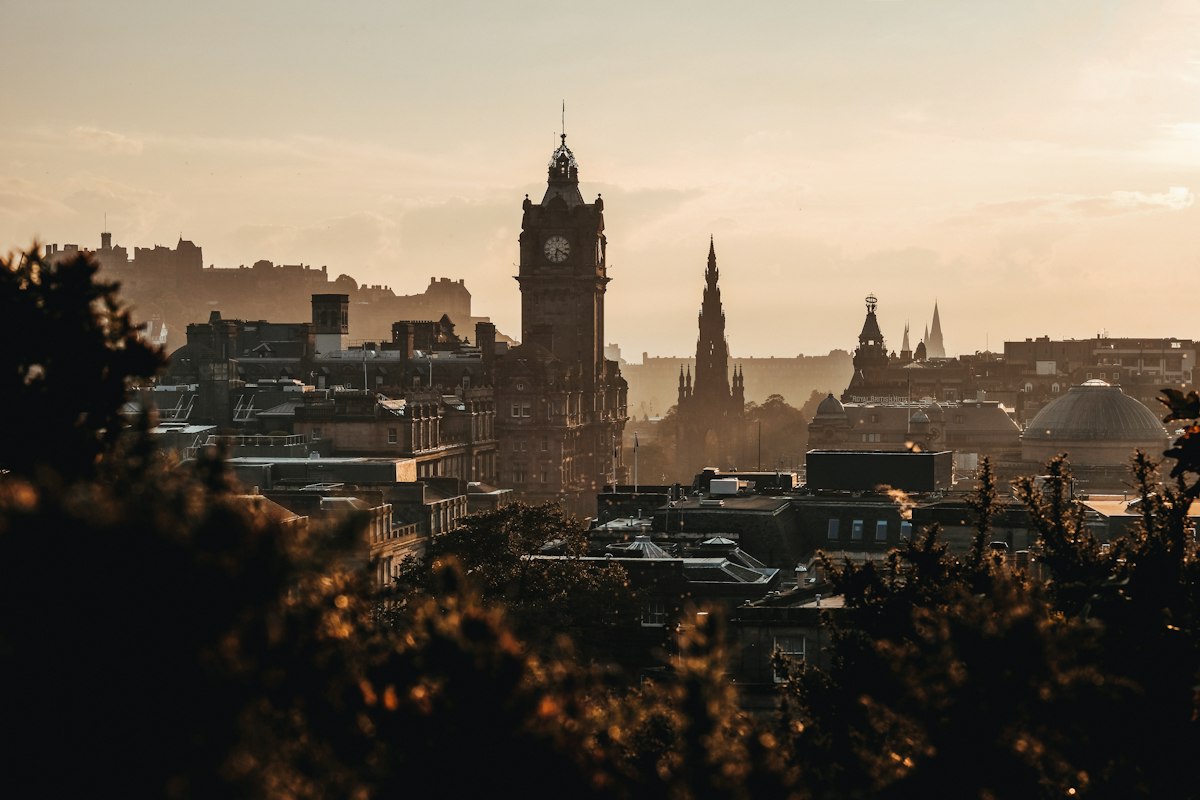
The train from London King’s Cross to Edinburgh Waverley takes 4 hours and 20 minutes on the fastest services, operated by LNER on the East Coast Main Line (LNER, 2026). Advance fares start from £30. That’s the short version. The longer version is that this is one of the great train journeys of Western Europe, Durham Cathedral appearing out of nowhere, the North Sea glittering to the east, and the extraordinary arrival into Waverley station, sitting in a valley below the castle. It beats flying not just on carbon or convenience. It beats it on the experience of actually arriving somewhere.
This guide covers everything: booking, classes, the scenery mile by mile, the honest comparison with flying, and what to do with yourself once you get to Edinburgh. Scotland rewards slow travel more than almost anywhere.
most scenic train routes in Europe
TL;DR: LNER runs London King’s Cross to Edinburgh Waverley in as little as 4h 20min, with services roughly every 30 minutes throughout the day. Advance Standard fares start from £30; walk-up fares can reach £150 or more. Book 12 weeks ahead for the best prices, the booking window opens at 12 weeks on most LNER routes (LNER, 2026). Edinburgh Waverley puts you in the heart of the city. The castle is visible from the platform.
How Long Does the London to Edinburgh Train Take?
The fastest LNER services run the 534 kilometres from King’s Cross to Edinburgh Waverley in 4 hours and 20 minutes (LNER, 2026). Most services take between 4h 20min and 4h 45min depending on the stopping pattern. Trains run roughly every 30 minutes during peak periods, it’s one of the most frequent inter-city services in Britain.
Door-to-door, the comparison with flying deserves an honest look. Edinburgh Airport is 8 miles from the city centre. A tram to Princes Street takes around 35 minutes and costs £8.80 (Edinburgh Trams, 2026). Add 90 minutes at Heathrow or Gatwick for check-in and security, a 1.5-hour flight, and that tram ride, and a London-Edinburgh flight typically takes 4 to 4.5 hours centre to centre on a good day. The train, leaving from central London and arriving in central Edinburgh, takes the same time, without the security theatre.
London–Edinburgh is consistently one of the five busiest domestic air routes in the UK, with around 30 daily return flights across multiple carriers (Civil Aviation Authority, 2024). That number is a legacy of when the East Coast Main Line was slower and less reliable. The modern Azuma trains have quietly undermined the case for flying on this route, but the airlines haven’t gone away. The majority of people still fly, which means the train is often less crowded and far more pleasant.
How Much Does the London to Edinburgh Train Cost?
Advance Standard fares on LNER begin at around £30 one-way, though £45–£75 is more realistic for popular daytime departures booked four to eight weeks out (LNER, 2026). Walk-up Anytime fares, what you pay if you book on the day, are £150 or more. First Class advance fares typically start around £70–£90, which is why upgrading is worth at least checking at booking.
[CHART: Grouped bar chart, “LNER London to Edinburgh: Typical One-Way Fares by Class and Booking Window”, Standard advance (12 weeks): £30-50 / Standard advance (4-8 weeks): £45-75 / Standard walk-up: £150+ / First Class advance (12 weeks): £70-90 / First Class walk-up: £200+, Source: LNER.co.uk, March 2026]
The booking window on most LNER routes opens at 12 weeks (84 days) before departure, shorter than the 180-day window on Eurostar, so there’s less runway for extremely early planning. Set a reminder. The cheapest fares on popular Friday and Sunday services sell out quickly once the window opens.
We’ve found the sweet spot for this route is booking exactly when the window opens for a mid-week departure. Tuesday and Wednesday trains are noticeably cheaper and quieter than Friday or Sunday. If you have any flexibility on travel day, use it.
How Do You Book, and Where?
The two main booking options are LNER.co.uk (the train operator direct) and Trainline (a third-party aggregator). Both show the same fares. LNER charges no booking fee; Trainline charges a small fee on some ticket types but is convenient if you’re combining with other operators or booking multiple legs (Trainline, 2026).
Booking Tips That Actually Matter
Book at the 12-week mark for the best availability on cheapest fares. Download the LNER app or the Trainline app before you travel, mobile tickets are standard now, and printing is unnecessary. Seats must be reserved on most LNER services; this happens automatically at booking.
Choose your seat deliberately. Right-hand side seats (window seats on the right when facing the direction of travel, heading north) give better coastal views through Northumberland, Holy Island appears on that side. The left-hand side has better views of the Yorkshire hills in the earlier part of the journey. Both are worth having; pick based on what you’d rather stare at for four hours.
Railcards reduce fares by a third. The 16-25 Railcard, 26-30 Railcard, Senior Railcard, and Two Together Railcard all apply to Advance tickets on LNER. If you’re travelling regularly, a Railcard pays for itself in one or two long-distance journeys (National Rail, 2026).
Is LNER First Class Worth It on This Route?
First Class on LNER’s Azuma trains is genuinely good, and at advance prices of £70–£90 it’s a credible upgrade option. A meal is included in the ticket price, a two-course set menu served at your seat, with complimentary drinks (LNER, 2026). The seats are wider, in a 2+1 configuration, and the carriage is quieter. Power sockets and Wi-Fi are available in all classes, so those aren’t the differentiator, it’s the space and the meal.
For a four-hour journey, First Class is easier to justify than on a two-hour trip. If you’re working on a laptop, having a wider table and fewer neighbours matters. If you’re travelling for leisure and want to make the journey itself part of the experience, a proper meal, a glass of wine, the Northumberland coast outside the window, the premium is modest at advance prices.
When Standard is clearly the right call: when the gap between Standard and First is more than £40 at the time you’re booking. That happens often on popular trains. At that spread, the Standard class on an Azuma is comfortable and perfectly pleasant for four hours.
What Do You See From the Window?
This is where the London to Edinburgh train separates itself from almost every other UK rail journey. The East Coast Main Line passes through some of the best scenery in England and southern Scotland, and a surprising proportion of it is visible from the right (or left) window at the right moment.
[IMAGE: View from a train window of Durham Cathedral and the River Wear, seen from the East Coast Main Line, search terms: durham cathedral from train east coast main line]
London to Peterborough: Leaving the City
The train pulls out of King’s Cross through a tunnel, emerges into north London’s suburbs, and runs through flat Hertfordshire farmland. This section is unremarkable. Read your book, settle in, get a coffee from the bistro car. Peterborough arrives at around the one-hour mark.
The Fens and the Great Flat North
Between Peterborough and Doncaster, the train crosses the Fens, Britain’s great flat land, reclaimed from marsh over centuries. It looks like the Netherlands. Wide skies, ruler-straight drainage channels, enormous fields. Some people find it boring. Others find it one of the most quietly striking fields in England. It depends on whether you’ve grown up with hills.
Durham: The View That Stops Conversations
At Durham, roughly two hours into the journey, the train crosses a viaduct over the River Wear. Durham Cathedral and Castle appear to the left, perched on a wooded peninsula in a river loop. It’s genuinely one of the great unannounced views in European rail travel. Durham Cathedral is a UNESCO World Heritage Site and one of the finest examples of Norman architecture in the world (UNESCO World Heritage, 2024). You get about 45 seconds of it, framed perfectly. People on phones put them down.
The Durham viaduct view is best from the left-hand side (west-facing window, heading north). If you’ve booked the right-hand side for the coastal views further north, this is the one moment you’ll wish you’d chosen differently. The compromise: book a right-hand window seat and simply stand in the aisle briefly as you cross the viaduct. The conductor won’t mind.
Northumberland: Holy Island and the Coast
North of Newcastle, the line runs along the Northumberland coast. On clear days, and Northumberland gets more clear days than its reputation suggests, you can see Holy Island (Lindisfarne) rising from the tidal flats to the right (Historic England, 2024). Lindisfarne Priory dates to 635 AD and was one of the great centres of early Christian scholarship in Britain. It’s a remarkable thing to spot from a train window.
This coastal section through Northumberland is some of the finest scenery in northern England: wide beaches, dune systems, Bamburgh Castle visible on its headland, the Farne Islands offshore.
Berwick-upon-Tweed: The Border Town
At Berwick-upon-Tweed, the train crosses the Royal Border Bridge, a magnificent 28-arch stone viaduct over the River Tweed, completed in 1850 (Network Rail, 2024). The town of Berwick changed hands between England and Scotland so many times during the medieval period that it exists as a constitutional oddity. You’re now, functionally, in Scotland moments later.
Into Scotland: The Final Stretch
The train runs through the Scottish Borders, the field softening into rolling hills. The final approach to Edinburgh passes through Musselburgh and the Edinburgh suburbs before the train descends into the cutting that leads to Waverley. And then: the station.
Arriving at Edinburgh Waverley
Edinburgh Waverley is one of the great station arrivals in Europe. The station sits in a valley, Princes Street Gardens on the north side, the Royal Mile rising steeply to the south, and the train arrives underground, in a natural trench cut into the city’s bedrock. You walk up a ramp from the platform level and emerge onto Waverley Bridge, with Edinburgh Castle visible directly ahead, the Scott Monument to your left, and Princes Street stretching westward.
Waverley handles around 24 million passengers per year and is the second-busiest station in Scotland (Network Rail, 2024). It’s also one of the few major city-centre stations in Europe where the train literally arrives inside a World Heritage Site, Edinburgh’s Old and New Towns were designated jointly in 1995 (UNESCO, 2024). The castle is not a background detail when you arrive. It’s right there.
Taxis, buses, and the tram to Edinburgh Airport all depart from outside the station. Most of Edinburgh’s central accommodation is within fifteen minutes on foot. You don’t need a transfer.
[IMAGE: The view from Waverley Bridge looking toward Edinburgh Castle, with the station exit visible in the foreground and Arthur’s Seat in the distance, search terms: edinburgh waverley bridge castle view]
Citation Capsule: LNER’s Azuma trains run London King’s Cross to Edinburgh Waverley in a minimum of 4 hours 20 minutes on the East Coast Main Line, with advance fares from £30. Edinburgh Waverley station, at the heart of the city’s UNESCO World Heritage zone, receives approximately 24 million passengers annually (Network Rail, 2024). The station’s valley position makes arriving by train a categorically different experience from arriving by air.
Train vs Flight: London to Edinburgh Honestly Compared
London–Edinburgh is the second-most flown domestic air route in the UK, with over 1.9 million passengers carried by air in 2023 (Civil Aviation Authority, 2024). The dominance of air on this corridor is partly historical, the pre-Azuma East Coast Main Line was slower and less reliable. That picture has changed.
Door-to-Door Time
The realistic door-to-door time comparison looks like this. A flight from central London to central Edinburgh: 45 minutes to Heathrow or City Airport by tube/train, 90 minutes minimum check-in and security, 1h 20min flight, 30 minutes to disstart and exit, 30–40 minutes to city centre by tram or bus. Total: 4 hours 20 minutes to 5 hours on a normal day. Delays, security queues, and late boarding regularly push that past 5.5 hours.
An LNER train from King’s Cross to Waverley: 15 minutes from most central London hotels to King’s Cross, board with 10 minutes to spare, 4h 20min journey, walk out into Edinburgh city centre. Total: just under 5 hours. On a bad flight day, the train wins outright. On a good flight day, it’s a draw.
Carbon Emissions
A return flight on London–Edinburgh emits approximately 149 kg of CO2 equivalent per passenger (BEIS/DESNZ UK Government Greenhouse Gas Conversion Factors, 2023). The equivalent LNER return journey emits approximately 7 kg of CO2, more than 20 times less (Our World in Data, 2023). This is not a marginal difference. It’s a different order of magnitude.
Cost
A budget airline London–Edinburgh return can be booked for £40–£80 in advance. But add two airport transfers (roughly £40 total for trains or buses), and you’re at £80–£120. An LNER Standard return, booked at the 12-week window, runs £60–£100. The train is regularly cheaper overall once you include what the airlines don’t show in the headline fare.
Edinburgh as a Slow Travel Destination
Edinburgh rewards slow travel more than almost any city in Britain. It’s small enough to walk across but deep enough to take weeks to understand. The geological drama of the place, a city built on volcanic rock, with an ancient lava plug at its centre, gives it a physical presence that few European capitals match.
Old Town vs New Town
The Old Town follows the ridge from the castle down to the Palace of Holyroodhouse. This is medieval Edinburgh: the Royal Mile, closes and wynds, tenement buildings that once rose twelve storeys. It’s dense, atmospheric, and slightly chaotic.
The New Town, planned in the 1760s and built over the following century, is Georgian Edinburgh: wide streets, stone terraces, private gardens. Charlotte Square and Heriot Row are among the finest Georgian streetscapes in Europe. The two towns share a valley, Princes Street Gardens, and the contrast between them, visible from almost any high point, is one of Edinburgh’s most striking qualities.
Arthur’s Seat: A Volcano in the City
Arthur’s Seat is an extinct volcano that rises to 251 metres at the edge of the city, about a mile from Waverley station. The summit walk takes around 45 minutes from the base at Holyrood Park. On a clear day, and you should wait for a clear day, the view takes in Edinburgh Castle, the Firth of Forth, the Fife coast, and on exceptional days the Highland peaks.
We’ve climbed Arthur’s Seat in most weather conditions. Cold and clear is the best by some distance. Go early in the morning to beat the crowds, take the Lional’s Haunch approach (starting near the Scottish Parliament), and bring a windproof layer regardless of the forecast.
The Fringe vs Off-Season Edinburgh
The Edinburgh Festival Fringe is the world’s largest arts festival, with over 3,200 shows staged across the city every August (Edinburgh Festival Fringe Society, 2024). It is extraordinary, overwhelming, and expensive. The city’s accommodation prices triple in August. Every bar is loud. Every street is a flyer.
Off-season Edinburgh, October through April, is a different city. The light in October and November is extraordinary: low angle, golden, the castle lit from below after dark. Hotels are half the August price. The restaurants are quieter. It rains more, but Scotland’s weather is rarely as bad as Londoners fear, and the Old Town in light rain, with the stone walls darkening and the closes emptying out, is one of the more atmospheric experiences available in northern Europe.
Food in Edinburgh
Edinburgh has quietly become a serious food city. The essentials: Scotch beef is genuinely world-class and widely available at prices that would embarrass a comparable London restaurant. Haggis, if you haven’t tried it, is better than its reputation. Try it at a good pub as a starter, not a tourist trap. The best food in Edinburgh tends to be in the New Town and Leith (the port district, 20 minutes on foot from the centre).
Whisky requires its own approach. The Scotch Whisky Experience on the Royal Mile is the tourist version. For a more serious introduction, a guided tasting at a specialist bar such as The Bon Vivant or Royal Mile Whiskies will cover far more ground in an hour than any museum exhibit.
Isle of Skye scallops, hand-dived and available at better fishmongers and restaurants, are worth seeking out. Scotland’s seafood supply chain is short, the west coast catches are in Edinburgh restaurants within 24 hours.
Day Trips From Edinburgh by Train
Edinburgh’s position on the Scottish rail network makes it one of the best bases in Britain for day trips. Almost every worthwhile destination in southern Scotland is reachable by train without needing a car.
Rosslyn Chapel: 30 Minutes by Bus
Rosslyn Chapel is 7 miles south of Edinburgh, reached by Lothian Bus 37 from the city centre. The chapel dates from 1446 and is one of the most elaborately carved buildings in Scotland. Its mainstream fame grew after the publication of The Da Vinci Code, but the building itself predates all conspiracy theories by five centuries and is worth visiting on its own extraordinary architectural merits.
Stirling by Train: 45 Minutes
Stirling is Scotland’s most historically important inland city, the gateway to the Highlands, the site of two decisive medieval battles (Stirling Bridge 1297, Bannockburn 1314), and home to a castle that rivals Edinburgh’s in architectural quality. ScotRail runs frequent services; journey time is around 45 minutes (ScotRail, 2026). Stirling Castle, the Wallace Monument, and the Bannockburn Heritage Centre are all within walking distance of each other.
St Andrews by Train: 1.5 Hours
St Andrews sits on the Fife coast, reachable by train to Leuchars (1 hour 5 minutes from Edinburgh Waverley) followed by a 10-minute bus (ScotRail, 2026). The oldest university in Scotland (founded 1413), the cathedral ruins, and, inevitably, the Old Course, golf’s most famous 18 holes. The town is small, beautiful, and entirely walkable. Go in April or October when the students are in residence but the tourists have gone.
Going Further: The Caledonian Sleeper to the Highlands
If Edinburgh is your jumping-off point for the Scottish Highlands, the Caledonian Sleeper is one of the great train experiences in Britain. It runs nightly from Edinburgh (and London) to Inverness, Fort William, Aberdeen, and the far north.
The Caledonian Sleeper is not just a practical connection, it’s a genuine overnight experience. The train leaves Edinburgh Waverley in the late evening, and you wake up in the Highlands. Inverness is the logical base for the far north; Fort William for Ben Nevis and the west coast. A Caledonian Sleeper Comfort berth (private cabin, fold-down bed) from Edinburgh to Inverness costs from around £60 per person (Caledonian Sleeper, 2026). That’s transport and accommodation combined.
This is one of the best-value rail experiences in Britain. The scenery through Drumochter Pass in early morning light is spectacular. You can connect LNER London to Edinburgh with the Caledonian Sleeper Edinburgh to Inverness as a two-leg itinerary, London to the Highlands overnight, no car required.
Related Reading
- London to Paris by Train: The Complete Eurostar Guide, The London to Paris train takes just 2h 16m and costs from £39.
- Edinburgh Slow Travel Guide: One Week in Scotland’s Capital, Edinburgh rewards those who stay long enough to walk Water of Leith, eat in Leith, and take the train to Stirling.
- London to Amsterdam by Train: Eurostar Direct, Times, Tickets and Tips, The direct Eurostar from London to Amsterdam takes 3h 52min and costs from £35.
Frequently Asked Questions
How far in advance should I book LNER London to Edinburgh?
Book as soon as the booking window opens at 12 weeks before departure (LNER, 2026). The cheapest Advance Standard fares, from £30 one-way, are released in limited batches. On popular Friday afternoons and Sunday evenings, cheap fares sell out within days of the window opening. Mid-week departures (Tuesday–Thursday) hold their low prices longer. Walking up on the day means paying the Anytime fare, typically £150 or more each way.
Is it worth taking First Class on the London to Edinburgh train?
At advance prices of £70–£90 one-way, First Class on LNER represents genuine value for a four-hour journey. A two-course meal and drinks are included, seats are wider, and the carriage is quieter (LNER, 2026). When the gap between Standard and First is under £40 at booking, we’d take the upgrade. When it’s £80 or more, a comfortable Standard seat and a bistro car lunch is perfectly pleasant for the journey.
Does the London to Edinburgh train go via York?
Yes. Most LNER services stop at York, approximately 2 hours from King’s Cross. York is one of the most interesting stops on the route, the station itself is a Victorian masterpiece, and the Minster is a five-minute walk. If you’re not in a rush, it’s worth building in a night. LNER’s Anytime Day tickets allow you to break your journey at intermediate stations on the same day (National Rail, 2026).
What is the best side of the train to sit on?
The right-hand side (as you face the direction of travel, heading north) gives the best coastal views through Northumberland, including Holy Island. The left-hand side gives the best view of Durham Cathedral as you cross the viaduct. Both are worth having. If you can only choose one, the Northumberland coast section is longer and more varied, take the right-hand side and stand up briefly for Durham.
Can I bring a bicycle on LNER London to Edinburgh?
Yes. LNER allows unboxed bicycles on most services, but advance reservation is mandatory and spaces are limited to between 2 and 4 bikes per train (LNER, 2026). Bike reservations are free. Book as early as possible, spaces fill faster than standard seats on summer departures. Folding bikes count as standard luggage with no reservation needed.
The Journey Is Part of the Point
There is something that flying cannot replicate about watching England become Scotland through a train window. The light changes. The stone changes colour, from Lincolnshire’s pale limestone to Northumberland’s golden sandstone to Edinburgh’s dark volcanic grey. Durham Cathedral materialises above a river bend. Holy Island sits offshore in the North Sea haze. Then Berwick, the Border Bridge, and a few miles later the field adjusts into something that is unmistakably Scotland, though you’d struggle to say exactly where the shift happened.
This is what slow travel means, in practice. Not slow as in tedious. Slow as in paying attention. The East Coast Main Line gives you four hours and twenty minutes to pay attention to one of Britain’s great geological and historical transects. The castle at the end is worth the journey. But so is the journey.
Book it early, get a window seat, and take the sleeper north when Edinburgh isn’t enough.
most scenic train routes in Europe Europe by train complete guide night trains Europe