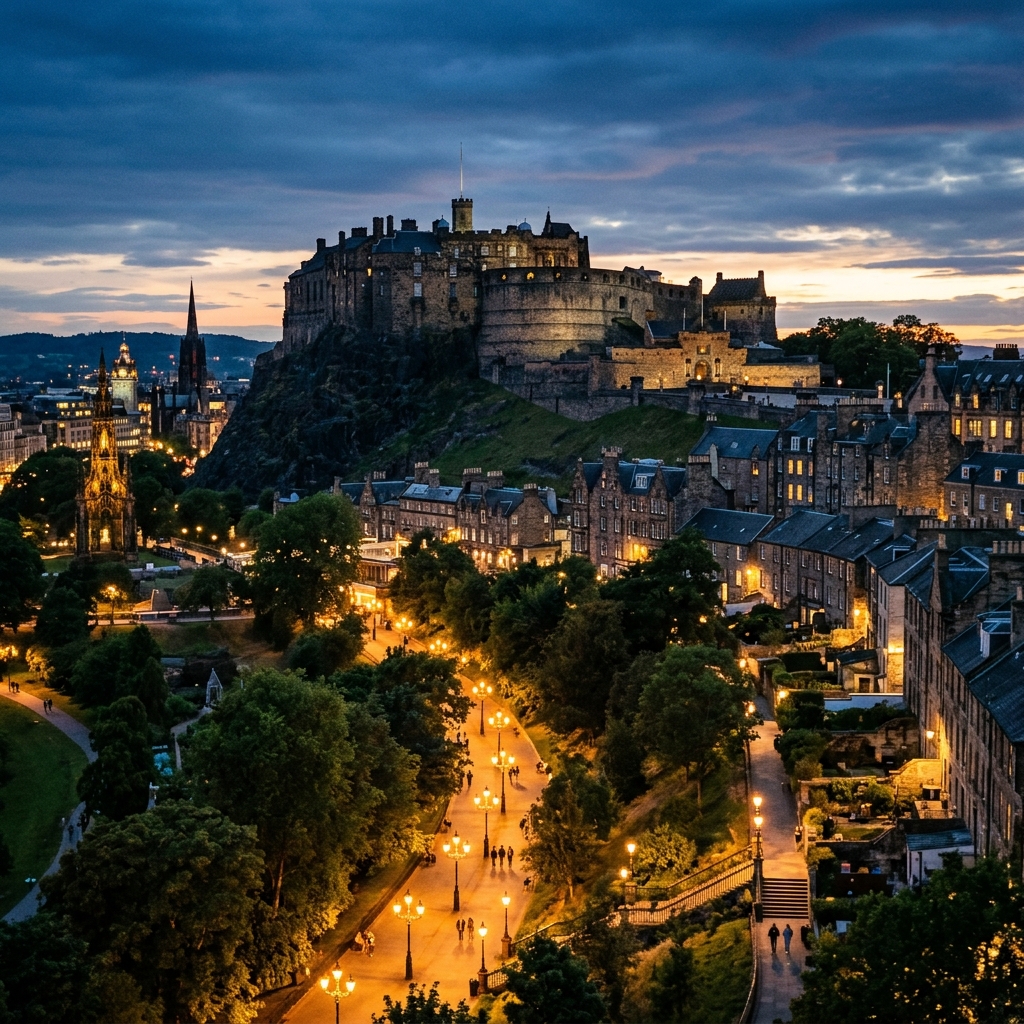
Edinburgh does not give itself up easily. The city that presents itself to the arriving visitor — castle on the volcanic rock, the Royal Mile descending in a long cobbled slope, the Gothic spires of the Old Town against a sky that is never quite certain about its intentions — is a remarkable piece of theatre, and like all theatre, it is not the thing itself. The thing itself requires more time. It requires living in a neighbourhood long enough to develop opinions about which café makes the better flat white, walking the Water of Leith on a Tuesday morning when no one else is there, taking the train to Stirling for the afternoon and returning in time for dinner at a place in Leith that doesn’t take reservations and rewards those who arrive at six.
Most visitors give Edinburgh three days. This is enough time to do the castle and the Palace of Holyroodhouse, to walk the Royal Mile twice, to visit the Scottish National Museum, and to have one dinner in a restaurant with a view. It produces a reasonable account of a remarkable city and absolutely no sense of what Edinburgh is actually like to be in. This guide assumes a week. A week is enough.
the philosophy of slow travel and why staying longer changes the journey
TL;DR: Edinburgh is two cities — the medieval Old Town and the Georgian New Town — connected by a railway cutting that became the Princes Street Gardens. The train from London takes under 4h 30m. Day trips to Stirling, St Andrews, and even Inverness run on ScotRail. The city’s real life is in Stockbridge, Leith, and along the Water of Leith Walkway, none of which appear on the average three-day itinerary. One week is the minimum at which Edinburgh becomes genuinely available to you.
Getting to Edinburgh by Train
The correct way to arrive in Edinburgh is by train — specifically, on an LNER service from London King’s Cross that deposits you at Edinburgh Waverley, a station built into the valley between the Old Town and the New Town, directly beneath the castle. There is no airport transfer. There is no motorway. You step off the train and the city is immediately above you.
LNER runs direct services from London King’s Cross throughout the day, with the fastest trains completing the journey in around 4 hours 20 minutes. Standard advance fares start from approximately £30 booked weeks ahead; flexible walk-up fares can reach £100–150 on peak services. The booking window opens 12 weeks in advance and the cheapest fares are gone within days of release, so booking ahead is more than advisable — it’s financially transformative.
First class on LNER is worth considering for the longer journey: it includes a meal, complimentary drinks, and noticeably more space. The upgrade from standard advance to first class advance can sometimes be as little as £15–30. For a four-and-a-half-hour journey — long enough to read, eat, and arrive somewhere properly — it’s worth the arithmetic.
From Glasgow, Edinburgh is 50 minutes by ScotRail. Trains run every 15 minutes for most of the day on the Queen Street–Waverley corridor. If you’re arriving via Glasgow — on a Caledonian Sleeper from London, for instance, or on a connection from other Scottish cities — the onward journey to Edinburgh is almost an afterthought.
On arriving at Waverley: The station sits in a railway cutting, the Old Town rising to the south and the New Town to the north, with Princes Street Gardens running along the northern wall of the castle rock. Exit toward Princes Street and you emerge into one of the great urban compositions in Europe — the castle above, the Georgian terraces opposite, a city that arranged itself around a geological accident and made it look deliberate. The walk from Waverley to a hotel in the New Town takes ten minutes. In those ten minutes, Edinburgh introduces itself thoroughly.
Two Cities: Old Town and New Town
Edinburgh’s defining architectural fact is that it contains two complete cities, separated by a valley and by a century. The Old Town grew along the ridge of the Royal Mile from the castle to Holyrood, a medieval accumulation of closes and tenements and wynds (narrow alleys) that pile up to eight or nine storeys in places — a vertical city, cramped by the geology of the ridge, dense and dark and magnificent. The New Town was built on the other side of the valley between 1767 and 1850, a Georgian grid of broad streets and formal squares and terraces in sandstone that is, by any measure, one of the most coherent examples of planned urban design in the world.
The two cities look at each other across Princes Street Gardens. The walk between them crosses the Mound or the bridges of the Old Town. Slow travellers should stay in one and explore the other; the contrast between them is the city’s deepest pleasure.
Old Town: Closes, Wynd, and the Royal Mile
The Royal Mile — technically four streets running from the Castle Esplanade to the Palace of Holyroodhouse, but functioning as a single thoroughfare — is where Edinburgh’s history is most densely layered. The closes that open off the Mile are worth exploring individually: Riddle’s Close, Advocates Close, White Horse Close at the foot of the Mile, each containing a different pocket of the city’s story. Mary King’s Close, buried beneath the Royal Mile and now a ticketed underground attraction, offers the most vivid sense of the medieval city’s actual scale.
The Grassmarket, below the castle at the western end of the Old Town, is a handsome square with a complicated history — public executions, a cattle market, covenanting martyrs — that now functions as a neighbourhood of independent pubs and restaurants. It’s less touristy than the Mile itself and a better place to eat dinner on a weeknight.
[IMAGE: The view down Cockburn Street from the Royal Mile, with the Georgian New Town visible in the distance — search terms: Edinburgh Royal Mile Cockburn Street Old Town New Town view]
New Town: Georgian Order and the Sunday Market
The New Town was designed by a 23-year-old architect named James Craig, who won the planning competition in 1766 with a scheme of remarkable restraint — a simple grid of three main streets (Queen, George, and Princes), two large squares (St Andrew and Charlotte), and connecting residential streets. The result, built over the following century by a succession of architects, is a city of Georgian sandstone that is best understood on foot, moving from Charlotte Square (Robert Adam, 1791) through George Street to the scale of Calton Hill on the eastern end.
Stockbridge, fifteen minutes’ walk from the centre of the New Town, is technically a separate village that the city grew around. It has its own character — a Sunday market, independent shops, a high density of good independent restaurants, and immediate access to the Water of Leith Walkway — that makes it the slow traveller’s natural home. A week in Stockbridge and the rest of Edinburgh becomes a place you visit from a base, rather than a place you move through.
Leith: Edinburgh’s Foodie District
Leith is where the city does its serious eating. The port district, 20 minutes’ walk down Leith Walk from the New Town, has shifted in the past two decades from a post-industrial neighbourhood of mixed reputation to one of the most compelling food and drinking quarters in Scotland. The Michelin-starred Tom Kitchin opened The Kitchin here in 2006, largely catalysing what followed. What followed was a proliferation of good restaurants, wine bars, and cafés that have made Leith the reason to stay in Edinburgh rather than use it as a base for touring the Highlands.
The Kitchin on Commercial Quay is the anchor — Tom Kitchin’s cooking is rooted in Scottish produce, technically precise, and worth the advance booking that it requires. The tasting menu changes seasonally and uses ingredients — razor clams, Orkney langoustines, Borders lamb — that justify the price. Book two to three months ahead for dinner.
Ondine on George IV Bridge (technically Old Town, but spiritually Leith in its approach) is the best seafood restaurant in the city for accessible dining — a crustacean bar, excellent Scottish fish, a more relaxed booking situation than The Kitchin, and a quality level that would cost significantly more in London.
The streets around The Shore in Leith — the old harbour front — contain a concentration of wine bars, gastropubs, and neighbourhood restaurants that require no particular recommendation beyond the instruction to walk down and stop at the first place that looks right. The Vintage, The Roseleaf, and a rotating cast of small rooms serve the kind of food that Edinburgh’s food scene is built on: Scottish produce, unfussy presentation, genuine warmth.
The Leith principle: Take the number 16 bus from Princes Street to Leith’s Ocean Terminal. Walk back toward the city along The Shore and Leith Walk, stopping wherever looks promising. This walk takes 45 minutes at pace and three hours at the right pace. Do it on a Saturday afternoon. Arrive somewhere for dinner at 7pm. The neighbourhood will do the rest.
The Hidden Edinburgh
Water of Leith Walkway
The Water of Leith flows for 24 miles from the Pentland Hills to the Firth of Forth, passing through the centre of Edinburgh without most visitors being aware of it exists. The walkway along its banks runs 12 miles through the city, connecting Balerno in the southwest to Leith in the northeast, passing through Dean Village, Stockbridge, and a sequence of woodland stretches that feel entirely disconnected from the urban fabric above.
The section from Dean Village to Stockbridge — perhaps 20 minutes’ walk — is the most beautiful: a deep wooded valley, a Victorian weir, the Dean Bridge overhead, and the Georgian backs of the New Town visible above the trees. Do it early on a weekday morning when the path is empty and the river is audible. This is Edinburgh at its most private — the city’s secret interior that most visitors never find.
Dean Village
Dean Village is a preserved 19th-century milling settlement in the gorge of the Water of Leith, five minutes’ walk from Stockbridge via the walkway. It appears suddenly — a cluster of old mill buildings and converted granaries around a millpond, the Dean Bridge arching overhead, the city apparently absent — and it is one of the most genuinely surprising urban discoveries in Britain. No tourist infrastructure. No entry fee. Just a village that the city forgot to dissolve.
Portobello Beach
Edinburgh’s beach is a 20-minute bus ride from the city centre: a Victorian promenade called Portobello, with a proper sandy beach, painted Victorian villas, a Georgian street of independent shops and cafés, and an outdoor swimming pool — the Portobello Outdoor Pool, a restored lido — that reopens each spring. On a clear day in early spring, with the Fife coast visible across the Firth of Forth, Portobello offers a version of Edinburgh almost nobody finds on a three-day visit.
Take the number 26 bus from North Bridge. Walk the promenade in either direction. Get an ice cream from Luca’s, which has been serving Edinburgh’s seafront since 1908.
Summerhall
Summerhall is a former Royal (Dick) School of Veterinary Studies, a large Victorian institutional building south of the Meadows that was converted after 2011 into an arts venue, micro-distillery, bar, and events space. The Summerhall Distillery operates on-site, producing gin and other spirits using the building’s original equipment. The bar serves one of the most thoughtfully curated whisky lists in the city, weighted toward independent bottlings and smaller distilleries.
It has almost no tourist visibility. During the Edinburgh Festival it becomes the city’s best fringe venue; the rest of the year it’s a working arts space that happens to have an exceptional bar. Find it on Summerhall Place, a short walk from the Pleasance.
Day Trips by Train from Edinburgh
Edinburgh’s position in Scotland’s rail network makes it the natural base for exploring the central belt and beyond. All of the following depart from Edinburgh Waverley on ScotRail services.
Stirling: 50 Minutes
Stirling is the most important small city in Scottish history — the gateway to the Highlands, the site of the battles of Stirling Bridge (1297) and Bannockburn (1314), and home to a castle that rivals Edinburgh’s in strategic and architectural significance. The castle itself, perched on a volcanic crag similar to Edinburgh’s, contains the Royal Palace of James V and the Great Hall — both extensively restored and genuinely spectacular.
The Wallace Monument, on Abbey Craig outside the town, commemorates William Wallace’s victory at the Battle of Stirling Bridge. The climb to the top is 246 stairs and the view over the Forth Valley on a clear day takes in Ben Lomond, the Ochil Hills, and the whole geography of Scotland’s central belt.
Stirling is a half-day trip. Leave Edinburgh at 9am, arrive at 9:50am, spend three hours in the castle and the town, lunch at a pub on the High Street, return mid-afternoon. Or make it a full day and walk to the Wallace Monument as well. The ScotRail return fare is typically £10–15 booked in advance.
St Andrews: 1 Hour 15 Minutes
The route to St Andrews requires a change at Leuchars Junction, where a regular bus connection completes the 10-minute journey into town. The total journey from Edinburgh Waverley runs approximately 1 hour 15 minutes to 1 hour 30 minutes depending on connections. St Andrews is worth the arithmetic.
The town is simultaneously three things: the home of golf (the Old Course and the Royal and Ancient Golf Club), a medieval university city (Scotland’s oldest, founded 1413), and a seaside town of considerable beauty with two beaches — West Sands and East Sands — and a ruined cathedral that was, before the Reformation, the largest church in Scotland. The cathedral ruins on a blustery morning in January are among the more atmospherically melancholy experiences available in Scotland.
Walk the West Sands in the morning (the Chariots of Fire beach), lunch in the town, visit the cathedral ruins in the afternoon, take the 4pm bus to Leuchars. This is a full day done well.
Inverness: 3 Hours 15 Minutes
The Inverness train from Edinburgh Waverley is one of the great railway journeys in Britain. The route runs via Perth and through Perthshire — the broad strath of the Tay, the approach to the Cairngorms, the Highland line at Drumochter Pass at 452 metres above sea level — before descending into Inverness and the Moray Firth.
Three hours fifteen minutes is a long day trip but a practical one: leave Edinburgh at 8am, arrive Inverness 11:15am, spend the afternoon in the city and around Loch Ness or Culloden battlefield (both accessible by local bus), return on the 5pm train, arrive Edinburgh 8:15pm. Or — the better option for slow travellers — spend a night in Inverness and return the following morning. The Highland capital is a pleasant base in its own right, and Loch Ness by boat is a different experience from Loch Ness by coach tour.
solo train travel in Europe — booking strategies and what to expect
The Practical Edinburgh
Getting Around
Edinburgh is a walking city. The distance from Edinburgh Waverley to the top of the Royal Mile is 12 minutes on foot; from Waverley to Stockbridge is 20 minutes; from the New Town to Leith is 30 minutes. The city’s geography — two ridges and a valley — means that walking is often faster than waiting for a bus, and always more interesting.
The Lothian Buses network is excellent and covers areas that walking can’t efficiently reach: Portobello (buses 26, 45), Leith (bus 16, 22, 35), the south side (bus 41, 42). A contactless card works on all buses; there’s no need for a dedicated travel card unless you’re using buses very heavily, in which case a Ridacard (weekly pass) costs around £19.
The ScotRail app is the cleanest way to book day trips: it shows live departures, allows seat reservations on longer services, and holds your tickets digitally. Download it before you arrive.
Edinburgh Castle vs. The Free Alternatives
Edinburgh Castle is £19.50 per adult (2026 pricing) and worth doing once — the Crown Jewels of Scotland (the Stone of Destiny, the Honours of Scotland), the Great Hall, the views from the ramparts across the city and the Firth of Forth. Book online in advance, particularly in summer; queues for walk-up tickets can be substantial.
The free alternatives are not consolations but genuine attractions. The National Museum of Scotland on Chambers Street is one of the best national museums in Europe — an exhaustive and beautifully presented journey through Scottish history from the Mesolithic to the present, housed in a Victorian building with a dramatic atrium. Allow a full morning. The Scottish National Gallery on the Mound holds a collection strong in Dutch and Flemish masters, French Impressionists, and Scottish painting — particularly the Scottish Colourists — and is free throughout. The Scottish National Portrait Gallery in the New Town is the most beautiful building of the three and the most undervisited.
The Palace of Holyroodhouse (£18.50, seasonal) is where the monarch stays when in Edinburgh. The State Apartments and the ruins of Holyrood Abbey in the palace grounds are worth the ticket on a good day; the audio guide is excellent.
The Whisky Question
Edinburgh has more whisky bars per capita than any other city. The serious ones — those worth visiting for the whisky rather than the experience of being in a whisky bar — include the Scotch Whisky Experience on the Royal Mile (more educational than atmospheric, but the collection is extraordinary), the Bow Bar on Victoria Street (a working pub with a serious whisky list and no pretension), and Summerhall (as noted above).
A dram in Edinburgh costs £4–12 depending on the distillery and the age. Ordering “a Speyside” or “an Islay” is a reasonable shorthand for style preference if you’re finding the list bewildering. The bartender at the Bow Bar will not judge you for asking what the difference is.
The Slow Traveller’s Rhythm for a Week
Day 1–2: Arrive, settle in, do the Royal Mile on foot at your own pace. Walk from the castle to Holyrood, taking as many closes as look interesting. The Scotch Whisky Experience or the Castle one afternoon. Dinner in the Grassmarket.
Day 3: New Town morning — Charlotte Square, George Street, a coffee in Stockbridge. Water of Leith Walkway from Stockbridge to Dean Village and back. Afternoon free. Leith for dinner: walk down Leith Walk, pick a restaurant on The Shore, don’t plan too far ahead.
Day 4: Day trip to Stirling. Leave at 9am, return mid-afternoon. Debrief at the Bow Bar. This is the day Edinburgh reveals that it’s the gateway to a country rather than a city in isolation.
Day 5: South side exploration — the Meadows, the Summerhall bar, a slow loop through Marchmont and Morningside (which is exactly what you imagine it is: Presbyterian sandstone, good charity shops, excellent coffee). Free museums in the afternoon.
Day 6: Day trip to St Andrews or Inverness, depending on appetite. The Inverness train requires commitment; St Andrews is a more relaxed day.
Day 7: Portobello in the morning. The walk from Portobello promenade back toward Arthur’s Seat, which you may not have climbed yet. Climb it. The view from the summit of an extinct volcano in the middle of the capital city is Edinburgh’s most honest self-portrait. Come down slowly. Dinner in Stockbridge. Leave the next day with something still left to do.
how to book European and British train journeys in advance
Related Reading
- Amsterdam for Slow Travellers: How to Actually Arrive in the City — Amsterdam rewards people who stay long enough to stop sightseeing.
- Budapest for Slow Travellers: Two Cities, One River, and More Time Than You Planned — Budapest is two cities divided by the Danube and unified by thermal baths, ruin bars, and a food scene that has…
- Lisbon for Slow Travellers: The City That Rewards Staying Longer — Lisbon is one of Europe’s most walkable, affordable, and genuinely liveable cities.
Frequently Asked Questions
How long does the train from London to Edinburgh take?
The LNER train from London King’s Cross to Edinburgh Waverley takes approximately 4 hours 20 minutes to 4 hours 45 minutes depending on the service. Advance tickets booked 12 weeks ahead start from around £30 for a standard seat. The full walk-up fare can reach £100–150. The train deposits you at Edinburgh Waverley, directly below the Old Town — there is no airport transfer, no motorway. You step off the train inside the city.
What is the best neighbourhood to stay in Edinburgh for a week?
For a slow travel stay of a week, Stockbridge — a residential village within the city, with its own Sunday market and immediate access to the Water of Leith Walkway — offers the best balance of quietude, food options, and access to the rest of the city. The Old Town (Royal Mile, Grassmarket) is the most atmospheric but also the most tourist-facing and noisy for an extended stay. The New Town is comfortable and central. Stockbridge is where you feel closest to living in Edinburgh rather than visiting it.
Is Edinburgh expensive for slow travel?
Edinburgh is one of the more expensive British cities outside London but remains substantially cheaper than the capital. A pint of Scottish ale costs £4.50–6; a two-course lunch at a neighbourhood bistro runs £15–22; weekly apartment rentals in Stockbridge or the New Town start around £600–800. The city’s free museums — the National Museum of Scotland, the Scottish National Gallery, the Portrait Gallery — reduce cultural spend considerably. Budget roughly £80–120 per day all-in.
What day trips can I do from Edinburgh by train?
Three stand out: Stirling (50 minutes, ScotRail, £10–15 return) for the castle and Wallace Monument; St Andrews (1h 15m via Leuchars then bus, £15–20 return) for the medieval university town, cathedral ruins, and West Sands beach; Inverness (3h 15m, ScotRail, £25–45 return) for the Highland capital and access to Loch Ness and Culloden — also one of the great railway journeys in Britain. All depart from Edinburgh Waverley; book via the ScotRail app for the best fares.
What are Edinburgh’s hidden gems that most tourists miss?
The Water of Leith Walkway — a 12-mile riverside path through the city that most visitors never find. Dean Village — a preserved 19th-century milling settlement five minutes from Stockbridge, appearing suddenly in the gorge of the Water of Leith. Portobello Beach — Edinburgh’s Victorian seaside promenade, 20 minutes by bus, with a lido and ice cream from a shop that has been there since 1908. Summerhall — a former veterinary college turned distillery and arts venue with one of the best whisky lists in the city, almost entirely unknown to tourists.
A City That Asks for More Time
Edinburgh is one of those cities that is easy to visit and difficult to know. The theatre of the Old Town — the castle on the rock, the closes descending from the Mile, the silhouette against the Lothian sky — is so complete and so immediately affecting that it can seem sufficient. It is not sufficient. It is an introduction to a city that keeps a good deal of itself in reserve, distributed across neighbourhoods that most visitors never reach, along a river path that most visitors never find, in a port district that became one of the most interesting places to eat in Scotland without making a particular announcement about it.
A week is not a long time. But a week spent slowly — with a base in Stockbridge, a day trip to Stirling, an evening in Leith, a morning on the Water of Leith before the rest of the city wakes — is enough to understand Edinburgh as something more than a backdrop for photographs of a castle. It is enough to know, on the last morning, that you haven’t finished. That is the correct feeling with which to leave a city worth returning to.
slow travel philosophy and why it produces better journeys
solo train travel in Britain and Europe — what to know before you go
the complete guide to the London to Edinburgh train
All transport times, fares, and price ranges reflect January 2026 conditions. LNER and ScotRail advance fares vary significantly by booking window and date of travel — the figures quoted represent typical advance pricing rather than guaranteed prices. Verify current fares before booking.