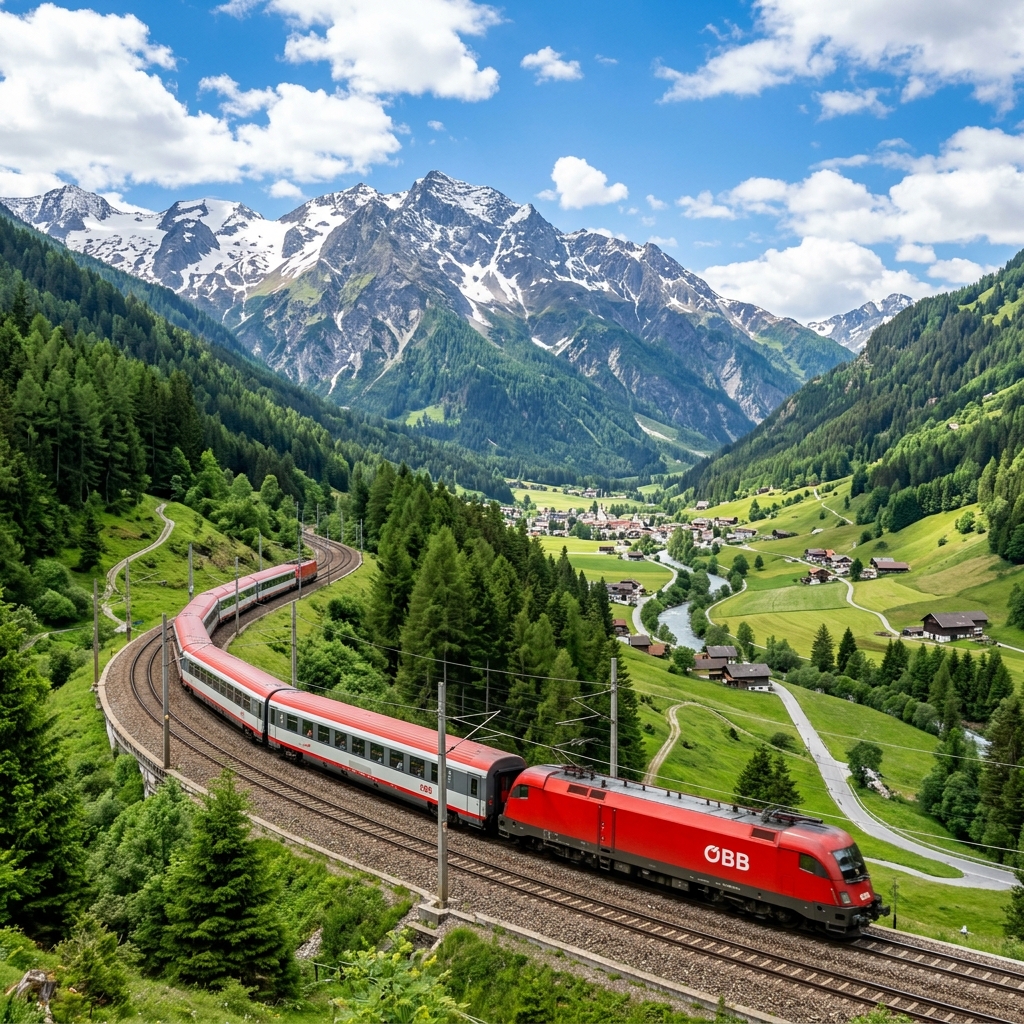
Treat Europe by train as a catalog of operators and booking windows, not a ranked list of “best” journeys. This desk maps pass versus tickets, then sends the Channel Tunnel product to London to Paris by Train, the northbound Eurostar to Paris to Amsterdam by Train, the Spanish AVE corridor to Barcelona to Madrid by Train, and the Italian duopoly to Italy by Train. Checkout screens live on How to Book European Train Tickets. Live hubs: the journal and tools. This desk does not sell passes or tickets; see how we make money.
There is no continent on earth that rewards train travel the way Europe does. Nowhere else can you step off a high-speed service in Paris, board a night train to Vienna, continue to Budapest by morning, and never once pass through an airport. Nowhere else has invested so consistently, across so many countries, languages, and political systems, in a rail network built on the assumption that the journey itself has value.
Europe has 240,000 kilometres of railway (UIC, International Union of Railways, 2024). That figure alone doesn’t communicate what it means in practice: trains that connect city centres to city centres, depart every 30 minutes on major corridors, and can travel at 300 km/h through countryside that would take twice as long by road. High-speed rail emits roughly 90% less CO₂ per passenger than flying on equivalent routes (European Environment Agency, 2023).
Desk listing check: booking windows and reservation rules change by operator. Confirm the current window on Eurostar (research snapshot of 180 days), Trenitalia (120), SNCF (90), and Renfe (60) on those operator pages — aggregators often hide the cheapest batch that still exists on the railway site. Euro figures below are research ranges, not a live checkout.
Desk note: this desk does not run a private continent-rail lab and did not ride every corridor as a field test. Pass prices, reservation fees, and fare bands below are research ranges from published Eurail, UIC, Eurostar, Trenitalia, Renfe, and Seat61 pages — not a live quote. Confirm current prices before you buy.
TL;DR: Europe’s rail network spans 240,000 km across 30+ countries, connecting most major cities within 3 hours or less. A Eurail Global Pass sits in a research range around €185 for 4 flex days, but advance point-to-point tickets beat the pass for fixed itineraries under 5 segments (UIC, 2024; Eurail, 2026). Book the national operator first. Skip Global continuous if you have rest days. Skip the pass on a locked Italy-or-Spain circuit booked 6+ weeks ahead. Skip flying on any corridor under about four hours door-to-door.
Before you book — the checklist the continent page skips
Work this list before you open Eurail.com or an aggregator. The first multi-country result is not the trip cost.
- Name the operator for the first long hop. Eurostar, TGV, AVE, Frecciarossa, ICE. Book that site first.
- Count long-distance boardings, not countries. One flex day per calendar day you take a long train. Most two-to-three week trips need 5–8 days, not a continuous month.
- Look up reservation fees on the flagship legs. Eurostar, Frecciarossa, TGV, AVE. A 7-day pass used on seven flagships can add a research illustration of €70–€245 in fees.
- Name the exclusions. Italo is out. Domestic UK trains are not this pass. Glacier Express and Bernina need supplements.
- Decide skip versus buy. Skip Global continuous if you will sit still. Skip a One Country Italy pass when Trenitalia and Italo advance fares are already cheap — see Italy by train. Skip the aggregator when the operator still shows the cheap inventory. Slow-travel framing: what is slow travel.
[IMAGE: High-speed Eurostar train pulling into St. Pancras International station in London, search: “eurostar st pancras london train station”]
Why Travel Europe by Train?
Europe’s rail network offers something no other mode of transport can: city-centre arrivals, lower emissions, and more usable travel time. The Eurostar carries 11 million passengers per year between London and Paris (Eurostar Group, 2024), a route where the train already beats the plane on total journey time when you factor in airports and check-in. Train travel is not a compromise, on dozens of European corridors, it’s the fastest practical option available.
The city-centre advantage is decisive. Paris Gare du Nord to London St. Pancras is a 2 hours 16 minutes journey. Add the time to travel to Charles de Gaulle, check in, clear security, board, land, and reach central London from Heathrow, and the train saves at least 90 minutes, usually more. The same logic applies on London–Brussels, Paris–Amsterdam, Milan–Florence, and Madrid–Barcelona.
Then there’s the matter of what you can do on the train. A flight asks you to sit motionless, screen-staring, in a pressurised tube. A train window gives you the Alps, the Loire Valley, the Rhine gorge, the Venetian lagoon. You can walk to a dining car, spread work across a table, watch a field shift from urban sprawl to farmland to mountain in an hour. The journey becomes part of the trip rather than a preamble to it.
First-time European train travelers often report the same surprise: they arrived less tired than they expected, having actually seen the country they were travelling through. That’s not nostalgia, it’s just physics and a decent seat.
How Does the European Rail Network Work?
Europe’s railways operate on a patchwork of national operators, high-speed corridors, and regional networks, and understanding the layers helps you book smarter. The EU’s high-speed rail network now covers 8,556 km (Eurostat, 2023), up 47% since 2013, with new lines opening in France, Italy, and Spain every few years. Regional and intercity trains fill the gaps between the high-speed spine.
High-Speed Trains
High-speed services are the headline act: France’s TGV, Italy’s Frecciarossa, Germany’s ICE, Spain’s AVE, and Belgium/Netherlands’ Thalys (now part of Eurostar). These trains operate on dedicated high-speed tracks, often separate from the regional network, and travel at 250–350 km/h. They link major cities with frequent departures, Paris to Lyon runs roughly every 30 minutes at peak times.
Most high-speed trains require advance seat reservations, whether you hold a rail pass or a point-to-point ticket. This is the most important structural fact about European high-speed travel. The reservation is not your ticket, it’s your allocated seat on a specific departure.
Regional and Intercity Trains
Regional trains fill the network around and between the high-speed corridors. They’re slower, cheaper, and generally reservation-free. In Germany, Austria, and Switzerland, regional trains are particularly useful for scenic routes, the Rhine Valley, the Alpine passes, the Bavarian countryside, and a Eurail or Interrail pass lets you board most without any additional booking.
InterCity and EuroCity (IC/EC) trains sit between the two: faster than regional, slower than high-speed, often crossing international borders. The Vienna–Venice EuroCity, for instance, is a classic IC-style service, comfortable, scenic, borderless.
Night Trains
Night trains are in the middle of a genuine European revival. Österreichische Bundesbahnen (ÖBB) operates the flagship Nightjet network, which now runs over 30 overnight routes connecting Vienna, Zurich, Brussels, Berlin, Rome, and beyond. European night train passenger numbers grew 24% between 2022 and 2024 (European Environment Agency, 2024). More on this in the dedicated section below.
the complete guide to European night trains
Rail Passes vs. Point-to-Point Tickets, Which Is Right for You?
This is the most consequential decision in European train planning. The short answer: a Eurail Global Pass sits in a research range around €185 for 4 travel days in one month (Eurail.com, 2026), but advance point-to-point tickets are usually cheaper if you’re booking fixed routes more than 6 weeks ahead.
The pass makes sense when:
- You’re crossing 3+ countries on a flexible itinerary
- You’re making 5 or more long-distance journeys
- You’re travelling spontaneously (walk-up fares are punishingly expensive)
- You’re under 28, youth pricing reduces pass costs by 25–35%
Point-to-point tickets win when:
- Your dates are fixed and known at least 6–8 weeks ahead
- You’re travelling primarily in one or two countries
- You’re visiting Italy specifically, Trenitalia and Italo advance pricing undercuts the One Country Pass almost every time
- You’re making fewer than 4 or 5 train journeys total
The reservation fee problem catches most first-time pass buyers off guard. A Eurail pass covers the base fare, not the mandatory seat reservation on high-speed trains. Add €5.50 per ICE journey in Germany, €13 per Frecciarossa leg in Italy, €10–20 per TGV in France, and €35 per Eurostar leg, and the pass economics shift significantly. Budget these fees before committing to a pass purchase.
[IMAGE: Interior of a high-speed TGV or ICE train showing wide seats, tables, and large windows with countryside passing, search: “high speed train interior europe seats window”]
What Are the Best Train Routes in Europe?
Europe’s best train routes aren’t just the fastest, they’re the ones where the journey adds something to the trip. The London–Paris Eurostar is the continent’s most-used international rail link, with a single tunnel crossing that still feels quietly miraculous. Paris to Barcelona takes 6 hours 25 minutes on a direct TGV, past the Pyrenees, arriving in a city no airport can prepare you for.
Italy’s high-speed corridor, Rome to Florence to Venice, is among the most complete rail experiences in Europe: you can connect all three cities in a single day if you start early, every leg under 2 hours 30 minutes on a Frecciarossa. For the most atmospheric approach to any city in Europe, the lagoon causeway into Venice Santa Lucia remains unmatched.
For something beyond practical transport, the scenic routes set Europe apart from every other continent: the Glacier Express through the Swiss Alps, the Flåm Railway in Norway, the Douro Valley in Portugal. And at the extreme end of the experiential spectrum, the Venice Simplon-Orient-Express, from London to Venice in Art Deco carriages, is not transport at all. It’s an event with a train underneath it.
the 12 most scenic train routes in Europe
How Do You Book European Train Tickets?
Booking early is the single most impactful action in European rail planning. Trenitalia releases tickets 120 days ahead; SNCF opens 90 days out; Eurostar opens 180 days ahead (Seat61.com, 2026). On each of these operators, the cheapest fare tier is available from day one of the booking window, and it sells out fast on popular routes.
The process itself is straightforward. Always check the national operator directly first, then compare with an aggregator. Most operators open bookings 90 to 120 days in advance, and the cheapest fares are released at the earliest booking date.
Step 1: Know your route. Is it within one country, or crossing borders? Single-country trips are easiest to book directly. Multi-country trips benefit from an aggregator that shows multiple operators simultaneously.
Step 2: Choose your platform.
- National operators (best for lowest prices within their country): Trenitalia (Italy), SNCF/Oui.sncf (France), Renfe (Spain), Deutsche Bahn (Germany), SBB (Switzerland)
- Aggregators (best for multi-country and comparison shopping): Trainline or Rail Europe search across operators with one checkout — still confirm the cheapest batch on the national operator
- Eurail app, for pass holders booking mandatory reservations
Step 3: Book early. Advance fares are non-refundable but dramatically cheaper, often 60–75% less than flexible tickets bought close to departure. If you’re travelling in July or August, or over Easter, book the moment the 90–120 day window opens.
Step 4: Download your ticket. Most operators now issue mobile tickets. Keep a PDF backup, some older ticket barriers on regional services still struggle with low-brightness screens.
[IMAGE: A Nightjet night train sleeper cabin with fold-down beds and warm lighting at dusk, search: “night train sleeper cabin europe obb nightjet”]
Night Trains in Europe, Sleeping Your Way Across the Continent
Night trains are the most efficient form of European travel: you cover distance while you sleep, arrive in a new city in the morning, and skip both a flight and a hotel night. ÖBB’s Nightjet network is the current flagship, it runs from Vienna, Zurich, and Brussels to destinations including Rome, Berlin, Prague, Paris, and Amsterdam, with new routes launching in 2025 and 2026.
the complete guide to European night trains
A Nightjet couchette (shared 6-berth compartment) starts from around €29–€49 per person, depending on the route and booking window. A private sleeper cabin, your own lockable room with beds, linen, and often breakfast included, runs €100–€250 per person. Both beat the equivalent hotel plus a daytime train in both cost and convenience.
The night train revival has real infrastructure behind it now, not just sentiment. The EU committed €100 million specifically to night train development in its 2023 rail infrastructure package (European Commission, 2023). By 2030, planned new Nightjet routes will connect cities as far apart as Barcelona and Stockholm on a single overnight service, a journey that currently requires two flights and a layover.
Key night train routes operating in 2026:
- Vienna → Paris (Nightjet, ~14 hours)
- Zurich → Berlin (Nightjet, ~9 hours)
- Brussels → Vienna (Nightjet, ~13 hours)
- Vienna → Rome (Nightjet, ~11 hours)
- Amsterdam → Zurich (Nightjet, ~10 hours)
- London → Inverness / Fort William (Caledonian Sleeper, ~8 hours)
A Eurail Global Pass covers most Nightjet routes; book the berth on the operator site, not as an afterthought. See night trains in Europe.
What to Expect on European Trains
European trains carry over 9 billion passenger-journeys per year across the continent (Eurostat, 2023), a figure that reflects not just commuters but a vast range of trip types, train classes, and onboard experiences. The standard is high. A high-speed ICE, TGV, or Frecciarossa in standard class is comfortably ahead of economy flying on any metric that matters to a traveler: space, usable time, and arrival location.
The experience varies considerably by country, operator, and train class. A Frecciarossa Executive cabin in Italy is a different world from a Romanian regional service, both are valid European train experiences, and neither should surprise you if you know what you booked.
Classes and Seating
Most European high-speed trains offer two main classes: Standard (second class) and First (sometimes called Business, Executive, or Prima). Standard class on the Frecciarossa, ICE, and TGV is genuinely comfortable, wide seats, tables, power sockets, Wi-Fi. First class adds extra legroom, quieter carriages, and often at-seat service.
Regional trains typically offer one class only. Seats are assigned on high-speed trains (reservation required); regional trains are usually open seating.
Food and Dining
High-speed trains carry a catering car or trolley service. Italy’s Frecciarossa café is the one travellers mention most often: proper espresso, pastries, and a decent selection of cold food. France’s TGV bar car is functional. Germany’s ICE dining car sells hot meals. Regional trains carry nothing, bring your own.
Luggage
There are no luggage size or weight restrictions on European trains. Large bags go in the overhead racks or in dedicated luggage areas at the ends of each carriage. Some night trains have a dedicated luggage car. There’s no check-in process, you carry your bag on and off.
Wi-Fi
Wi-Fi is offered on most high-speed services but quality varies substantially. Italy, Germany, and France all provide on-train Wi-Fi as standard; Switzerland’s SBB trains have reliably fast coverage. Regional trains often lack Wi-Fi entirely. Don’t rely on train Wi-Fi for video calls on a deadline.
European Train Travel by Country
Five countries dominate European rail travel, together they account for roughly 70% of all EU high-speed rail traffic (UIC, 2024). Italy, France, Spain, Germany, and Switzerland each have distinct network structures, pricing models, and booking quirks. Understanding them individually saves both money and confusion when you’re planning a multi-country itinerary.
Italy
Italy’s high-speed network is operated by two competing operators: Trenitalia (Frecciarossa) and Italo (a private company). Competition keeps prices low, advance tickets on the Rome–Florence–Milan–Venice corridor frequently start at €15–€25. Both operators use the same tracks and stop at the same major stations. Italo is not covered by Eurail passes; Trenitalia is.
The key Italian routes: Rome–Florence (1h 30m), Florence–Venice (2h 05m), Milan–Venice (2h 30m), Rome–Naples (1h 10m). All served hourly or better by high-speed services.
France
SNCF’s TGV network is one of the oldest and most extensive in Europe. The Paris hub connects to Lyon, Marseille, Bordeaux, Lille, Strasbourg, and international services to London, Brussels, Amsterdam, and Barcelona. TGV trains require a reservation; advance fares (called “TGV Max” for subscribers or regular advance fares) can be extremely cheap. Ouigo, SNCF’s budget arm, operates on selected routes at low cost.
Spain
Spain has the longest high-speed network outside China and Japan, the AVE (Alta Velocidad Española) connects Madrid to Barcelona, Seville, Valencia, Málaga, and beyond. Madrid–Barcelona (2h 30m) was the route that largely killed the domestic air market on that corridor. Spain’s advance fares are competitive; a Madrid–Barcelona ticket can be under €14 booked early.
Germany
Deutsche Bahn’s ICE network connects Berlin, Munich, Frankfurt, Hamburg, Cologne, and Stuttgart at speeds up to 300 km/h. Germany is notable for the quality and density of its regional network, the Deutschlandticket (€49/month at introduction, now adjusted) unlocked regional travel for millions. DB advance fares (Supersparpreis) start from €17.90. ICE reservation fees for Eurail pass holders are Europe’s lowest at €5.50 per journey.
Switzerland
Switzerland isn’t the fastest rail country in Europe, but it might be the most precise. SBB runs trains to the minute, with connections timed to the second. The Swiss Travel Pass covers almost every train, tram, and bus in the country without reservation fees (except the Glacier Express and Bernina Express). Switzerland is expensive by European standards, budget CHF 30–80 for most intercity journeys point-to-point, but the network’s comprehensiveness is unmatched.
How Much Does It Cost to Travel Europe by Train?
Budget European rail travel is genuinely achievable, but only with advance planning. A 3-week western Europe circuit (London–Paris–Amsterdam–Cologne–Zurich–Milan–Florence–Rome, 8 long-distance trains) sits in a research range of €280–€400 in advance fares vs. a research range of €800–€1,100 at walk-up prices (Seat61.com, 2026). The spread between advance and walk-up is the single most important variable in rail budgeting.
Here’s a rough per-day budget framework for European rail travel:
- Budget traveler (hostels, regional trains, advance booking): €40–€65/day including accommodation
- Mid-range traveler (B&Bs, mix of high-speed and regional, advance fares): €100–€150/day
- Comfort traveler (hotels, high-speed throughout, some first class): €200–€350/day
- Luxury (Venice Simplon-Orient-Express, Grand Suites, premier hotels): €500+/day
The biggest variables are accommodation and how far in advance you book train tickets. Rail costs themselves are highly controllable, more so than airfares, which are increasingly unpredictable at short notice.
Tips for First-Time European Train Travelers
First-time European rail travelers make the same avoidable mistakes, and the most expensive one is booking too late. Advance tickets on the Paris–London Eurostar can be 75% cheaper than same-week walk-up fares (Eurostar Group, 2024). The practical tips below close the gap between a trip that costs €200 in train fares and one that costs €800.
Getting the most from European rail travel is mostly about preparation. Here are the practical things that separate smooth trips from frustrating ones.
Book as early as the system allows. Most operators open 90–120 days ahead. Set a calendar reminder for your target travel dates and book the morning the window opens. This applies especially to popular summer routes (London–Paris, Rome–Florence) and scenic trains (Glacier Express, Bernina Express).
Arrive early, not just on time. European trains board from open platforms, there’s no UK-style gate system on most European networks. Platforms are announced on departure boards typically 15–20 minutes before departure in Italy, France, and Spain. Arrive at the station 20–30 minutes before your train to find the platform and locate your carriage.
Know your station. Major European cities often have multiple stations. Paris has six major termini (Gare du Nord, Gare de Lyon, Gare de l’Est, Gare Montparnasse, Gare Saint-Lazare, Gare d’Austerlitz), and your train departs from a specific one based on direction of travel, not just city. Check this carefully when booking.
Validate regional tickets. In France, Spain, and Italy, regional and intercity tickets sometimes require validation (punching in a yellow machine on the platform or at the station entrance) before boarding. Failure to validate can result in an on-the-spot fine even if you have a valid ticket. High-speed and international tickets are usually electronic and don’t require validation.
Download offline maps and timetables. Station Wi-Fi and mobile data can be unreliable in some regions. Keep your tickets downloaded offline, and download the Deutsche Bahn or Trainline app for live departure information that works across multiple countries.
Related Reading
- London to Paris by Train: The Complete Eurostar Guide, 2h 16m under the Channel, border control at St Pancras.
- Paris to Amsterdam by Train: The Complete Eurostar Guide, 3h 20m northbound Eurostar, Brussels as transit.
- Barcelona to Madrid by Train: AVE Times, Tickets and What to Expect, Renfe Promo window and the 15-minute refund.
- Italy by Train: The Essential Guide to Italian Rail Travel, Two operators, one spine, yellow stamps on regionals.
- European Rail Passes: The Complete Buyer’s Guide (Eurail, Interrail, Point-to-Point), Eurail or Interrail?
- The Two-Week Interrail Itinerary: A Route That Actually Makes Sense, Two weeks is enough time to cross three or four countries by train and arrive somewhere with a genuine sense of…
- Interrail vs Eurail: What’s the Difference and Which Should You Buy?, Interrail and Eurail are the same pass, different eligibility.
FAQ
Is it cheaper to travel Europe by train or by plane?
For advance-booked routes, trains often match or beat budget airlines once you add baggage fees, airport transfers, and check-in time. A 2025 Greenpeace study of 142 European routes found trains were already cheaper than flights on 70% of domestic routes when total journey costs were compared (Greenpeace, 2025). On short routes like Paris–London or Milan–Florence, the train is almost always the better value option.
Do I need to speak the local language to use trains in Europe?
No. Major European train stations have English-language displays and ticketing systems. The Trainline app and Eurail platform operate entirely in English. On-board announcements on high-speed trains are typically made in the local language and English. Regional trains in rural areas may have local-language-only announcements, but the stops are displayed on screens inside the train.
How far in advance should I book European train tickets?
For high-season travel (June–August, Easter, Christmas), book the moment the booking window opens, typically 90 to 120 days ahead. For shoulder season (March–May, September–November) with fixed dates, 4–8 weeks ahead is usually sufficient for good fares. For flexible travel without fixed dates, a Eurail or Interrail pass removes the advance booking requirement, though high-speed reservations should still be made as early as possible.
Can I take a bicycle on European trains?
Most European trains accept bicycles, but the rules vary by operator and train type. High-speed trains in France (TGV) and Italy (Frecciarossa) generally require a bike to be disassembled and bagged. German ICE trains accept bikes with a reservation on most services. Regional trains across Germany, the Netherlands, and Switzerland are the most bike-friendly, bikes travel at a small additional cost without disassembly. Always check the specific operator’s bike policy before travelling.
What’s the best app for planning European train journeys?
Trainline covers most European operators in one search and is the most convenient for multi-country trips. For Germany specifically, the Deutsche Bahn Navigator app is excellent. For Italy, Trenitalia’s own app gives access to all fares. The Eurail app is essential if you’re travelling on a pass, it handles seat reservations and stores your pass digitally. Rome2Rio is useful for initial route research across countries, though it doesn’t handle booking directly.
Conclusion: Why Europe by Train Remains the Definitive Way to Travel the Continent
Europe was built around its railways. The cities that grew around station districts, the brasseries of the Gare de Lyon, the coffee houses of Vienna Westbahnhof, the canal bars of Amsterdam Centraal, are still there. The infrastructure hasn’t aged so much as it has deepened, with high-speed lines laid on top of 19th-century foundations, night trains reimagined for the 21st century, and a network that now touches nearly every corner of a continent in a day’s travel.
High-speed rail emits 90% less CO₂ than flying (EEA, 2023). It arrives city-centre to city-centre. It lets you move through fields rather than above them. It connects you to places airports don’t serve. These aren’t minor advantages, they’re structural reasons why European rail is not just the most pleasurable way to travel the continent but, increasingly, the most practical.
The key takeaways from this guide:
- Book advance point-to-point tickets for fixed itineraries (6+ weeks ahead)
- Consider a Eurail pass for multi-country, flexible travel with 5+ journeys
- Use night trains to cover long distances and save on accommodation
- Know your station, European cities have multiple termini
- Arrive 20–30 minutes early and validate regional tickets where required
Start planning with the route guides above, or use Art of the Travel’s journey finder tool to build a custom European rail itinerary around your interests and budget.
Ready to book? Compare passes on European rail passes.
Citation Capsule: Europe’s rail network spans 240,000 km across more than 30 countries, operated by a combination of national carriers and private high-speed operators (UIC, International Union of Railways, 2024). High-speed rail generates approximately 90% fewer carbon emissions per passenger than equivalent flights (European Environment Agency, 2023). European night train passenger numbers grew 24% between 2022 and 2024 (EEA, 2024), reflecting sustained growth in demand for surface travel across the continent.
All prices and timetables reflect March 2026 conditions. Train schedules and fares change seasonally, always verify current prices on the relevant national operator’s website before booking.