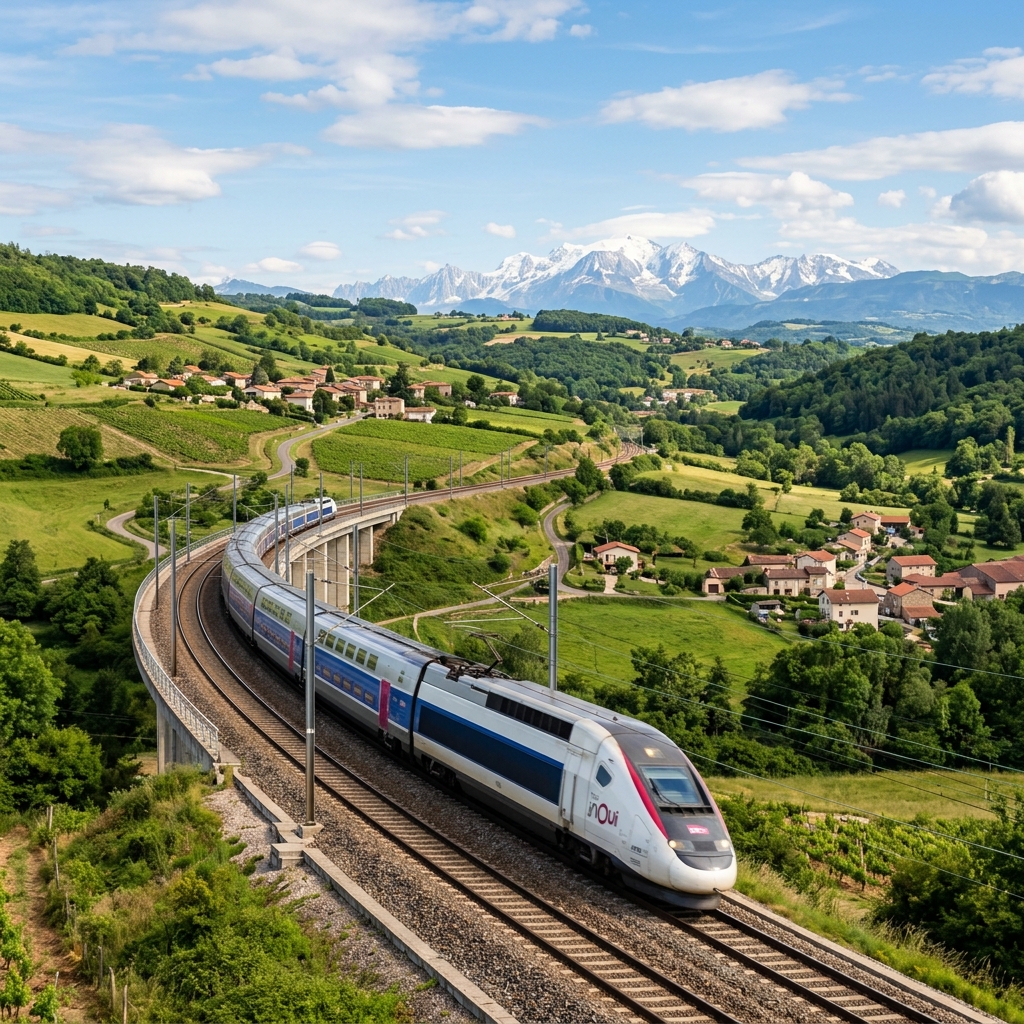
Paris to Rome is 1,420 kilometres. By air, including the commute to and from city-centre airports, it takes the better part of a day. By train, it takes roughly 6 to 7 hours with one connection, or you can sleep your way there on a night service and wake up in Italy. Neither option is perfect. Both are better than most people expect.
The direct overnight Thello train that once ran Paris–Rome was suspended in 2021 and has not returned. The practical route in 2026 is a daytime combination: TGV Lyria from Paris Gare de Lyon to Turin or Milan, then a Frecciarossa or Italo from Milan to Rome. Combined journey time with a reasonable connection: around 6 hours 30 minutes to 7 hours. Total cost booked ahead: from around €45.
There is also an overnight option via ÖBB Nightjet, but it runs Paris–Venice, not Paris–Rome, so it works only if your Italian plans include Venice first. All of that is covered below.
planning a longer Italian rail trip
TL;DR: There is no direct Paris–Rome train in 2026. The fastest daytime route is Paris Gare de Lyon → Milan Centrale (TGV Lyria, ~3h 45m) + Milan → Roma Termini (Frecciarossa, ~3h), totalling around 7 hours with a connection. Combined fares start from roughly €45 booked in advance. ÖBB Nightjet operates a Paris–Venice overnight if you want to sleep rather than connect. (TGV Lyria, Trenitalia, 2026)
Is There a Direct Train from Paris to Rome?
No direct daytime train runs between Paris and Rome in 2026. The Thello overnight service, which once made the journey while passengers slept, was suspended in April 2021 when its Franco-Italian operating consortium wound down, and the route has not been reinstated. That leaves two realistic options: a daytime journey with one change in either Turin or Milan, or an overnight Nightjet service that reaches Venice (requiring an onward connection to Rome). For most travellers, the daytime route via Milan is the practical choice, and it’s faster than many people expect.
[IMAGE: TGV Lyria high-speed train at Paris Gare de Lyon, search Unsplash: “TGV train Paris station platform”]
How Long Does the Paris to Rome Train Take?
The fastest realistic Paris to Rome journey takes around 6 hours 30 minutes to 7 hours, depending on connection time in Milan. According to TGV Lyria’s 2026 timetable, the Paris–Milan leg takes 3 hours 40 minutes to 4 hours depending on the service. Frecciarossa then covers Milan–Rome in approximately 2 hours 55 minutes to 3 hours 10 minutes. Factor in a 40-to-60-minute connection window in Milan, and the total door-to-door time from Paris Gare de Lyon to Roma Termini is around 6 hours 45 minutes on a well-timed combination.
| Leg | From | To | Time |
|---|---|---|---|
| TGV Lyria | Paris Gare de Lyon | Milan Centrale | 3h 40m–4h |
| Connection | Milan Centrale | Milan Centrale | 40–60 min |
| Frecciarossa | Milan Centrale | Roma Termini | 2h 55m–3h 10m |
| Total | ~6h 30m–7h |
Via Turin Porta Susa instead of Milan, the Paris–Turin TGV takes around 3 hours 5 minutes. Turin–Rome by Frecciarossa is approximately 4 hours 30 minutes. Total: similar to the Milan route, often slightly longer, with fewer onward services from Turin.
Why Milan beats Turin as a changeover: Milan Centrale has 20+ daily Frecciarossa departures to Rome across the full day. Turin Porta Susa has far fewer, typically 6 to 8. A missed or delayed TGV into Milan still leaves you multiple options within the hour. In Turin, a delay can mean a 2-hour wait for the next Rome service. Unless you specifically want to spend time in Turin, Milan is the smarter connection.
How Much Does the Paris to Rome Train Cost?
The Paris to Rome combination is two separately booked tickets, and that’s where the savings are. TGV Lyria fares from Paris to Milan start at €29 in second class when booked ahead, according to TGV Lyria’s published pricing for 2026. Frecciarossa fares from Milan to Rome start at €9 for Super Economy. In practice, the cheapest realistic combination on the same day runs to around €45–€65 booked several weeks out. Leave it to the last moment and you’ll pay €130 or more for both legs combined.
Why book each leg separately? Booking Paris–Milan on TGV Lyria and Milan–Rome on Trenitalia directly (or via a comparison site) keeps costs lower than any single “through” booking, because each operator’s cheapest fares are available independently. There is no Paris-to-Rome combined ticket that beats buying the two legs individually.
The Daytime Route: Paris to Milan on the TGV Lyria
The TGV Lyria is SNCF and SBB’s joint high-speed service connecting Paris Gare de Lyon with Switzerland and northern Italy. On the Paris–Milan route, the train runs via the Mont Cenis tunnel and through the Maurienne Valley in the French Alps before crossing into Italy at Modane and descending into Turin. TGV Lyria operates 3 to 5 daily Paris–Milan services, with most stopping at Turin Porta Susa before continuing to Milan Centrale.
The Alpine crossing is the visual highlight of the whole Paris–Rome journey. The section from Chambery through the Maurienne Valley, and the descent into Piedmont after the tunnel, passes through one of the genuinely dramatic rail fields in Europe. Sit on the right-hand side (when travelling south) for the best mountain views. This stretch alone makes the daytime route worth choosing over a flight.
On choosing your departure time: The 07:05 from Paris Gare de Lyon arrives Milan Centrale around 11:15, which leaves you a 40-minute connection to a midday Frecciarossa into Rome, arriving around 15:00. That’s a full afternoon in the city. The 10:05 departure works well too. Avoid the 17:00+ Paris–Milan services unless you’re happy arriving Rome after midnight with limited options for the final leg.
Gare de Lyon, what to know: Paris Gare de Lyon is one of the larger Paris terminals, and TGV platforms are located in the Hall 2 departure area. Self-service ticket machines and manned counters are both available. The famous Train Bleu restaurant on the upper level, opened in 1901, all gilt and painted ceilings, is worth 20 minutes even if you only have a coffee before your train. It’s genuinely one of the most extraordinary station restaurants in the world.
comparing Europe’s best rail journeys
The Connection: Milan Centrale
Milan Centrale is one of the grandest railway stations in Europe, a 1931 Fascist-era monument in marble and steel, with a booking hall tall enough to feel like a cathedral. It’s also extremely functional. Frecciarossa services to Rome depart roughly every 30 minutes during peak hours, so even a tight connection can be recovered if your TGV runs slightly late.
The two things to know about the connection:
First, TGV Lyria arrives at Milan Centrale’s upper-level international platforms. Frecciarossa departs from the lower ground-level platforms numbered 1 through 24. The walk between levels takes 7 to 10 minutes, not tight, but don’t assume you can stop for a coffee if your connection is under 40 minutes.
Second, book your Frecciarossa ticket separately before you travel, not at the station. Super Economy fares (from €9) sell out well in advance. Walking up to the Trenitalia window at Milan Centrale and buying a same-day Rome ticket will cost you significantly more, typically €40–€60 for a standard Economy fare.
Citation capsule: Frecciarossa high-speed trains cover the 576km Milan–Rome route in approximately 2 hours 55 minutes at top speeds of 300 km/h, making it one of the fastest intercity rail connections in Europe relative to distance. Trenitalia operates 20+ direct Milan–Rome services daily. Super Economy fares start from €9; flexible Business class from €50. (Trenitalia, 2026)
the full Italy by train guide covers all the major corridors
Is There a Night Train from Paris to Rome?
No direct night train connects Paris to Rome in 2026. The closest option is the ÖBB Nightjet Paris–Venice service, which launched in December 2021 and runs several times weekly. It departs Paris Austerlitz in the late evening and arrives Venice Santa Lucia the following morning, a journey of roughly 13 hours. From Venice, you’d take a separate Frecciarossa to Rome (3 hours 45 minutes), making the total overnight journey around 17 hours end-to-end.
That’s a long way to travel. But the Nightjet has a real case for certain travellers: you save a hotel night in Venice, you arrive rested (relatively), and the carbon footprint is dramatically lower than flying. ÖBB Nightjet couchette fares on the Paris–Venice route start from around €49 in a shared 6-berth couchette, rising to around €129–€169 for a private sleeper compartment. (ÖBB Nightjet, 2026)
| Option | Departs | Arrives | Duration | From |
|---|---|---|---|---|
| Nightjet Paris–Venice + Frecciarossa to Rome | Paris Austerlitz ~19:00 | Roma Termini ~13:00 next day | ~18h total | ~€49 + €19 |
| Daytime TGV + Frecciarossa | Paris Gare de Lyon ~07:00 | Roma Termini ~15:00 same day | ~8h | ~€45 |
For most travellers doing Paris to Rome directly, the daytime connection is more practical. The Nightjet Paris–Venice makes more sense if you actually want to spend time in Venice first, which, to be honest, is not a bad idea at all.
the complete guide to European night trains
Paris to Rome by Train vs. Flying, What’s Actually Faster?
The honest comparison favours the train more than most people expect. Ryanair and easyJet fly Paris CDG or Orly to Rome Fiumicino or Ciampino regularly, with base fares that often appear cheaper than train tickets. But the full door-to-door picture changes things considerably.
Flying Paris to Rome typically means: 60–75 minutes from central Paris to CDG or Orly by RER or taxi, 90 minutes recommended check-in window, 2-hour flight, 45 minutes baggage claim and terminal exit, 45–60 minutes from Fiumicino to central Rome by Leonardo Express. Total door-to-door: 6 to 7 hours on a smooth day. On a delayed day, longer.
The daytime train is Paris Gare de Lyon to Roma Termini, both stations are central. Total time: 6 hours 30 minutes to 7 hours. With no security queues, no liquid restrictions, no bag fees, and no airport transit at either end.
The hidden cost of flying. A “€30 Ryanair flight” from Paris Orly to Rome Ciampino frequently becomes €70–€90 once you add a cabin bag fee (€20–€25), an allocated seat (€10–€15), and the €6 Ciampino–Rome bus. The train at €45 combined, booked at the same point, is genuinely competitive on price, not just convenience. European comparison studies consistently find rail within 20% of flying costs on routes under 1,000km when all costs are included. (International Transport Forum, 2024)
Eurail and Interrail Passes: What You Need to Know
Pass holders can use both legs of this journey, but mandatory seat reservations on both trains add meaningful cost. On TGV Lyria, an Interrail/Eurail reservation costs €20–€30 for the Paris–Milan leg, depending on class, because TGV services into Switzerland and Italy attract higher reservation fees than domestic French TGV. On Frecciarossa, the seat reservation for pass holders is approximately €10 in second class.
That adds €30–€40 in reservation fees on top of the pass. If you’re buying a Global Pass specifically for this journey, the math rarely works out in your favour versus booking individual tickets. The pass makes sense on this route if it’s part of a 2-to-3-week multi-country itinerary covering other legs as well.
Italo is not valid with Eurail or Interrail, this matters on the Milan–Rome leg. If you’re travelling on a pass, book Frecciarossa (Trenitalia), not Italo, for the Italian segment.
is an Interrail or Eurail pass actually worth it for your trip
Related Reading
- Amsterdam to Paris by Train: Thalys Guide, Times & Tickets, Amsterdam to Paris by train takes just 3h 17m on Eurostar.
- Paris to Barcelona by Train: TGV Guide, Prices & Tips, Paris to Barcelona by train takes 6h 25m on the direct TGV/AVE.
- Paris for Slow Travellers: Why a Week Is Barely a Start, Paris doesn’t reveal itself quickly.
Frequently Asked Questions
How do I book Paris to Rome by train?
Book each leg separately. Use TGV Lyria or SNCF Connect for the Paris–Milan segment, and Trenitalia or Italo for Milan–Rome. A comparison site like lets you see both legs and prices on one screen, which is useful for finding the best connection. There is no single combined Paris–Rome ticket, so always book the two legs independently.
What is the cheapest way to get from Paris to Rome by train?
Book both legs as far in advance as possible, ideally 6 to 8 weeks out for summer travel. TGV Lyria fares from Paris to Milan start at €29; Frecciarossa fares from Milan to Rome start at €9. A combined fare of €40–€50 is achievable with good timing. (TGV Lyria, Trenitalia, 2026). Avoid booking on the day, same-day fares on both legs combined regularly exceed €130.
Do I need to validate my train tickets in France and Italy?
TGV Lyria e-tickets (app or PDF) do not need validation, the booking is registered digitally. On the Italian side, Frecciarossa and Italo e-tickets also require no validation. Physical paper regional tickets in Italy must be validated in the yellow stamping machines on the platform before boarding, but this doesn’t apply to any of the tickets you’ll use on this route. Have your ticket ready on your phone or printed; both French and Italian inspectors check during the journey.
Can I stop in Turin or Milan en route?
Yes, and it’s straightforward. Buy Paris–Turin (or Paris–Milan) as your first ticket, spend as many days as you like, then book a separate Turin–Rome or Milan–Rome Frecciarossa when you’re ready to continue. This is actually a very good way to structure a longer trip, both cities reward a day or two, and the rail connections mean you’re not losing travel time. The Italy by train guide covers the full north-to-south sequence in detail.
Is the Paris–Rome Nightjet running?
No direct Paris–Rome Nightjet operates in 2026. ÖBB Nightjet runs a Paris–Venice overnight service (departing Paris Austerlitz, arriving Venice Santa Lucia) with fares from around €49 in a couchette. From Venice you’d need a separate Frecciarossa to Rome (3h 45m, from €19). This works well if Venice is already in your itinerary, it’s a slower but genuinely comfortable way to enter Italy. (ÖBB Nightjet, 2026). See the European night trains guide for full booking details.
What to Do in Your First 24 Hours in Rome
You’ll arrive at Roma Termini, Rome’s central station, directly connected to Metro lines A and B. Most hotels in the historic centre are 15 to 30 minutes by metro or taxi. If your hotel is near the Colosseum, take Metro B to Colosseo. For the Trastevere or Vatican area, Metro A to Ottaviano or a taxi are the practical options.
The first evening belongs to the neighbourhood. Don’t try to see the Colosseum on your first night. Instead, walk. Rome’s historic centre is compact enough that an hour’s walk from Termini will take you through Piazza della Repubblica, past the Baths of Diocletian, and into the streets of the centro storico. Find a trattoria, not the ones with photos on the menus outside, and eat something simple. Cacio e pepe. Supplì. A litre of house white. This is Rome’s first lesson: unhurried is correct.
First morning: The Colosseum and Roman Forum open at 9 a.m. Book tickets in advance at coopculture.it, the walk-up queue is long and the combined ticket is worth it. Allow three hours minimum. The Forum is larger than most first-time visitors expect, and the Palatine Hill (included in the ticket) gives views over the whole site that are better than anything at ground level.
First lunch: Testaccio, the neighbourhood directly south of the Aventine Hill, is Rome’s genuine food neighbourhood. The indoor Testaccio Market has stalls selling supplì, offal sandwiches, and pizza al taglio at prices untouched by the tourist economy. It’s a 20-minute walk or 10-minute taxi from the Forum.
First afternoon: Trastevere or the Janiculum Hill. Trastevere is touristy now, less so than it was ten years ago, but still excellent. The streets around Piazza di Santa Maria in Trastevere reward wandering. The Janiculum above it has the best panoramic view in Rome, better than any paid viewpoint.
continuing south to more of Italy or planning a loop north to Florence
The Journey in Full
Paris Gare de Lyon at seven in the morning is a particular atmosphere, the light through the tall glass canopies, the smell of coffee from the station brasseries, the specific quality of purposefulness that characterises a major rail terminus before the city has fully woken up. You board a TGV Lyria. It pulls south out of the city.
For the first two hours, the field is French countryside, rolling, agricultural, familiar. Then the hills steepen. The train enters the Rhone Valley and you’re in a different geography: tighter, higher, the sky framed by ridge lines. Past Chambery the Alps assert themselves properly, and for perhaps 40 minutes before the Modane tunnel you’re moving through mountain scenery that is, quietly, some of the most beautiful rail field in Europe.
Then Italy. The descent through Piedmont is fast, Susa valley, the Fiat-dominated sprawl of Turin visible far below, then Turin Porta Susa station if your train stops there, then the flat agricultural plain of the Po Valley stretching east toward Milan. The light in Italy is already different: softer, more yellow, the kind of light that made the Renaissance painters reach for ochre.
Milan Centrale. Forty minutes in a station that looks like a set from a 1930s film about the future. A Frecciarossa south. Emilia-Romagna flat and industrial, then the Apennines, then a long descent into Lazio, and then the outer suburbs of Rome assembling themselves outside the window: umbrella pines, ochre and terracotta apartment blocks, the occasional dome punctuating the roofline. Roma Termini.
Seven hours from Paris. One change. The eternal city.