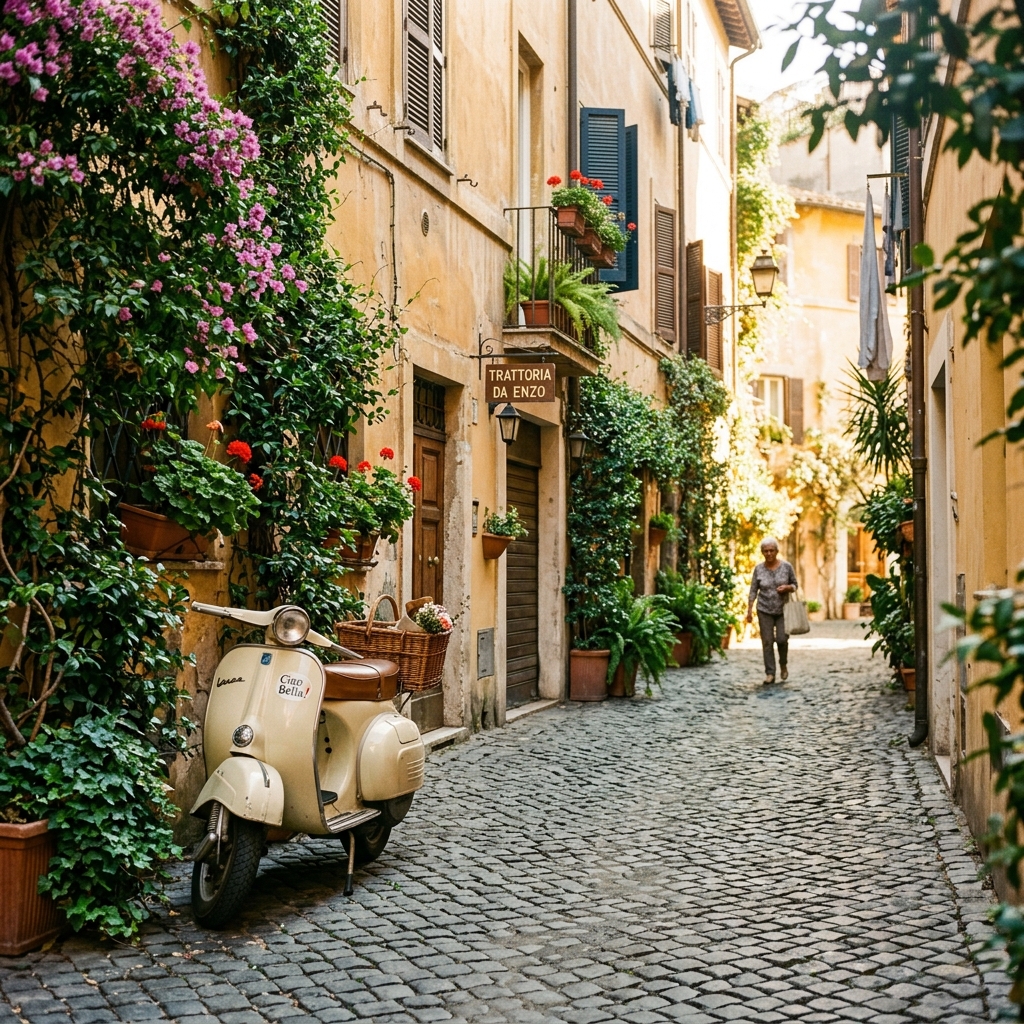
The Rome problem is one of scale and time. The Pantheon, still standing, still in daily use as a church, was completed in 125 AD. The Forum, which predates it by several centuries, was the civic centre of a republic that had already been functioning for four hundred years when Augustus turned it into an empire. The Baths of Caracalla, the Aurelian Wall, the catacombs that run under the southern suburbs: each represents a different era of a city that spent roughly a millennium as the most powerful place on earth. Rome has been living with the consequences of that concentration ever since.
Most visitors spend three to five days here. That is enough time to visit the Colosseum, walk through the Forum, queue for the Vatican Museums, throw a coin in the Trevi Fountain, and photograph the Pantheon. It is not enough time to understand any of them. Rome does not reveal itself to visitors in transit. It opens, slowly and on its own terms, to people who stay.
the philosophy behind slow travel and why depth beats coverage
TL;DR: Rome has a metropolitan population of 4.3 million and over 900 churches, with archaeological layers spanning 28 centuries (ISTAT, 2025). Seven nights is the minimum for any honest engagement with the city. This guide is for slow travellers, people who want to find a neighbourhood bar, learn the market schedule, and encounter a Rome that has nothing to do with the tourist route.
Why Does Rome Require More Time Than Any Other European City?
Rome’s metropolitan area holds 4.3 million people and the city proper 2.8 million (ISTAT, 2025). It contains more than 900 churches, a number so large it functions less as a statistic than as a spatial condition. The Vatican Museums alone contain 54 galleries. The Forum covers 2 hectares of ruins that took five centuries to build and another fifteen to fall into. No European city concentrates this much history into this little space.
Most visitors, despite the scale of what’s available, spend 80% of their time within a 2-kilometre radius of the Colosseum. That radius contains the Forum, the Palatine Hill, the Imperial Fora, the Capitoline Hill, and the Circus Maximus. It’s impressive. It’s also, by rough estimate, 5% of what Rome actually is.
On Rome’s geological layering: Each neighbourhood in Rome carries the fingerprint of a different historical era, and the eras don’t overlap neatly. Trastevere is medieval, narrow lanes, the old Jewish ghetto immediately adjacent, a street grid that predates the car by fourteen centuries. The centro storico around the Piazza Navona is Baroque: the fountains, the churches, the palazzo facades all express the confident Counter-Reformation Rome of the 17th century. EUR, the suburb Mussolini built for a world fair that never happened, is Fascist rationalism in travertine marble, grand and uncomfortable. Pigneto is 20th-century working class, the Rome of the borgate and the early Pasolini films. These aren’t districts of the same city wearing different clothes. They’re different cities, layered chronologically on top of one another and each requiring a different kind of attention.
The implication for slow travel is direct. A week spent moving between the Colosseum, the Vatican, and the major piazzas is a week spent inside one thin layer of Rome’s 28 centuries. What lies beneath and alongside that layer, the medieval, the Baroque, the Fascist, the working-class 20th century, requires time, lateral movement, and the willingness to walk away from the monument circuit.
Which Neighbourhood Should You Stay In?
Where you sleep in Rome determines almost everything about the quality of daily life you’ll experience. The most important accommodation decision is not price or aesthetic, it’s the ratio of residents to tourists within walking distance of your door. Get that wrong and the neighbourhood that frames your mornings is a tourist neighbourhood, which is a different thing from a neighbourhood.
[IMAGE: An illustrated map of Rome’s central neighbourhoods, Trastevere, Testaccio, Pigneto, Prati, Ostiense, and the centro storico marked clearly, search terms: Rome neighbourhood map illustrated]
Testaccio: The Most Roman Neighbourhood
Testaccio grew up around the Mattatoio, the old municipal slaughterhouse that operated from 1891 to 1975 and now houses a contemporary art museum and a portion of the MACRO contemporary art collection (Soprintendenza Speciale di Roma, 2025). The neighbourhood’s food culture is a direct inheritance of that history: the quinto quarto (fifth quarter, offal, tripe, oxtail) tradition that defines Roman cooking originated here, in a neighbourhood that fed itself on the parts of the animal the wealthy didn’t want. The food is exceptional, the prices are honest, and the clientele is Roman.
The Mercato di Testaccio, Tuesday through Saturday, 7am–2pm, is the best food market in Rome. Not the Campo de’ Fiori, which is beautiful and aimed squarely at visitors, but Testaccio, where the cheese stalls have been in the same family for two generations and the supplì (fried rice balls, Rome’s street food standard) come from a counter that opens at 9am and sells out by noon. The walk to the Aventine Hill is fifteen minutes. The Metro B stop (Piramide) is five minutes away. Testaccio is the right neighbourhood for most slow travellers coming to Rome for the first time.
Trastevere: Beautiful but Careful
Trastevere is medieval in structure, the lanes are genuinely narrow, the piazzas genuinely old, the church of Santa Maria in Trastevere genuinely 12th century in its current form. It’s also the neighbourhood that Rome’s tourist industry has most successfully colonised on weekends. Friday and Saturday evenings bring crowds that transform the Piazza di Santa Maria in Trastevere into something closer to an open-air bar district than a neighbourhood piazza.
During weekday mornings, before 11am, Trastevere is its best self: quiet, local, the bars occupied by Romans eating a standing breakfast. It’s worth visiting many times. It’s a slightly more complicated choice as a base for a longer stay, because the weekend noise is significant.
Pigneto: Working-Class Rome, Slowly Changing
Pigneto is where Rome keeps its 20th-century self. The neighbourhood grew up between the wars as housing for the working class, and Pasolini filmed here in the 1950s, it appeared in Accattone (1961) as the field of a Rome that was poor, peripheral, and entirely unconcerned with tourism. It’s still relatively cheap, still residentially dense, and still operating as a neighbourhood rather than a destination.
On staying in Pigneto: Pigneto is a 25-minute tram ride from the centre, which is precisely the right psychological distance for a slow travel stay. Close enough to reach the Forum before the crowds, far enough that returning to the neighbourhood in the evening feels like arriving somewhere real. The Via del Pigneto at 7pm, the aperitivo hour, the tables outside the bars, the noise that is specifically neighbourhood noise rather than tourist noise, is one of the more reliable pleasures a week in Rome can produce. Rents for weekly apartment stays run €500–€900, which is below the Trastevere or centro storico rate for equivalent space.
Prati: Calm, Connected, Underrated
Prati sits across the Tiber from the Vatican, residential and grid-planned, the neighbourhood was built in the late 19th century to house the professionals and officials who arrived with the unified Italian state. It’s calm in the way that residential neighbourhoods are calm: bakeries, butchers, bars where the espresso is for regulars. The Vatican Museums are a 15-minute walk. The Castel Sant’Angelo is closer still. For families or travellers who want easy Vatican access without the tourist-infrastructure surroundings, Prati is the sensible choice.
Ostiense: Industrial Edge, Quiet Culture
Ostiense is where the city’s industrial past has been quietly converted into cultural infrastructure. The Centrale Montemartini, an early 20th-century thermoelectric plant that now houses ancient Roman sculptures, stands in Ostiense and is one of the most formally interesting museums in the city: white marble gods and athletes displayed against boilers and turbines in a combination that should be absurd and instead works perfectly. The neighbourhood is less touristed, cheaper, and has the slightly provisional feeling of a place that is still deciding what it wants to be.
Where Not to Stay
Anywhere within 500 metres of the Trevi Fountain, for a stay longer than two nights. The tourist density in that area, the Via Veneto, the immediate surroundings of the Spanish Steps, creates a neighbourhood life made entirely for and of visitors. There is no morning coffee bar where locals stand. There is no evening where the street noise is the noise of people who live there. There are hotels, restaurants with laminated menus, and very large crowds. These are not the conditions for slow travel.
Citation Capsule: Rome’s metropolitan area has a population of 4.3 million, with 2.8 million in the city proper (ISTAT, 2025). The city contains over 900 churches and more than 280 fountains. The Roman archaeological zone, the area covered by the Forum, the Palatine, the Colosseum, and the Imperial Fora, is managed by the Parco Archeologico del Colosseo, which recorded approximately 12 million visitors in 2024 (Parco Archeologico del Colosseo, 2025). That figure represents a tourist concentration that a slow traveller’s best strategy is to handle around, not through.
What Is the Food Argument for Staying Longer?
Roman cooking is hyperlocal in a way that most Italian regional cooking isn’t. It’s not regional in the broad sense, it’s neighbourhood-specific, historically rooted, and directly connected to the slaughterhouse economy that fed the working-class city for a century. Carbonara, cacio e pepe, amatriciana, coda alla vaccinara: these are not dishes that emerged from grand culinary tradition. They emerged from the Testaccio mattatoio and the economic logic of eating cheaply and well from ingredients that others discarded.
Italy’s agri-food sector, which includes the trattoria tradition, contributes approximately €580 billion annually to the national economy (Coldiretti, 2025). The economic weight of that figure obscures what it means at the scale of a single lunch. In Testaccio, a pasta with carbonara, a glass of house wine, and a coffee costs €15–€20 at a neighbourhood trattoria. The same dish in a tourist-facing restaurant two kilometres north costs €30–€40 and is usually worse.
how to eat well in Italy and what to order in each region
The lunch-versus-dinner dynamic in Rome is worth understanding. Romans take lunch seriously, it is the main meal of the day for much of the working population, eaten between 1pm and 3pm, often with wine. Dinner is frequently lighter: a plate of cured meat, a glass of something local, a conversation that goes on longer than the food. A slow traveller who adjusts to this rhythm, real lunch, light dinner, an aperitivo between the two, will spend less and eat better than one who follows the Northern European pattern of a skipped lunch and a large restaurant dinner.
The Mercato di Testaccio
The Mercato di Testaccio runs Tuesday through Saturday, 7am to 2pm, in a purpose-built covered market that replaced the old open-air market in 2012. It is not a tourist market. It does not sell souvenirs or artisanal olive oil in gift packaging. It sells vegetables from the same stalls that have occupied the market for decades, cheese from producers in Lazio and the south, meat from the local supply chain, and supplì from a counter that operates out of a converted shipping container and produces the definitive version of Rome’s essential street food.
On the supplì question: The debate about where Rome’s best supplì comes from is genuinely contested, which is itself a sign of a food culture in reasonable health. The Mercato di Testaccio counter, Supplì Roma on the Via di San Francesco a Ripa in Trastevere, and the takeaway window at Da Remo in Testaccio are the standard reference points. The Testaccio market version costs €2–€2.50 and is eaten standing at a counter. This is the correct price and the correct posture. Eating a supplì at a table in a restaurant near the Trevi Fountain costs €7–€9 and produces an inferior experience by every available measure.
The Enoteca as Infrastructure
The wine bar, the enoteca, operates in Rome as a slow travel institution in the same way the bistro zinc counter does in Paris. You sit at the bar, order a glass of the house white (in Rome, almost always a Frascati or a Marino from the Castelli Romani hills), eat a plate of affettati (cured meats) or a modest dish from whatever the kitchen has that day, and stay as long as the conversation or the newspaper permits. The price is €8–€15 total. You are under no obligation to leave.
Aperitivo in Pigneto and Ostiense
The aperitivo hour in Pigneto runs from roughly 7pm to 9pm, earlier and more democratic in character than the Milanese apericena tradition. A glass of wine or a Negroni at a Pigneto bar costs €5–€7 and often comes with a small plate of something: olives, crisps, occasionally a more substantial snack. The social function is identical to the Spanish vermú hour or the French apéritif: a transitional ritual between work and dinner, conducted at low cost with high social density. For a slow traveller staying in Pigneto or Ostiense, the aperitivo replaces the evening monument as the day’s final event. It is a more honest exchange.
What Is Worth Doing Slowly in Rome?
The Capitoline Museums Before the Vatican
The Capitoline Museums were founded in 1471, making them the oldest public museums in the world, predating the Louvre by more than three centuries (Musei Capitolini, 2025). They hold the bronze equestrian statue of Marcus Aurelius (the original; the figure in the piazza below is a replica), the Capitoline Venus, and the Dying Gaul, the Hellenistic sculpture of a fallen warrior that Goethe considered one of the finest things he’d ever seen.
The terrace of the Palazzo dei Senatori, accessible from within the museums, offers the most useful view of the Forum available anywhere in Rome: improved, unobstructed, and framed in a way that makes the spatial logic of the ancient city comprehensible. Visitors who go straight to the Forum from the street level see ruins. Visitors who see the Forum first from the Capitoline terrace understand what the ruins were. Entry costs €15 (Musei Capitolini, 2026). Book online. Go on a Tuesday morning before 10am.
The Protestant Cemetery on a Wednesday Morning
The Cimitero Acattolico, the Protestant Cemetery, though it accepts the non-Catholic dead of all nationalities, occupies 1.5 hectares in Testaccio behind the Pyramid of Cestius, a 12 BC Roman tomb that the medieval city absorbed into its walls and which now forms one of the more extraordinary pieces of Roman street furniture. The cemetery contains Keats (died 1821, of tuberculosis, aged 25) and Shelley (drowned 1822), Antonio Gramsci, and several thousand others from the 18th century onwards.
It’s one of the most beautiful enclosed spaces in Rome: mature trees, old stone, the sound of the neighbourhood on the other side of the wall. Open 9am to 5pm, closed Sundays, free entry with a donation suggested. On a Wednesday morning in October or November it’s almost entirely empty. Allow an hour. Bring nothing in particular. The pyramid is visible from the cemetery wall and costs nothing to observe from outside.
The Baths of Caracalla
Completed in 216 AD under Emperor Caracalla, the Thermae Antoninianae were designed to accommodate 1,600 bathers simultaneously, an engineering and logistical achievement that required an aqueduct branch, a hypocaust heating system running under the floors, and a staff of several hundred to operate (Soprintendenza Speciale di Roma, 2025). The surviving structure covers 11 hectares. The walls, in places, still stand 30 metres high.
The Baths of Caracalla are consistently and inexplicably undercrowded for a Roman monument of this scale. On most mornings outside July and August, you can walk through the frigidarium and caldarium in relative solitude. Entry is €8 (Coopculture, 2026). In summer evenings the site hosts open-air opera, which is worth attending for the spatial experience of sitting in a 2nd-century ruin under a warm Roman sky, regardless of your feelings about Verdi.
The Aventine Hill at 7am
The Aventine Hill sits directly above Testaccio, a 15-minute walk from the market, and in the early morning before the city’s tourist hour begins it’s as quiet as Rome gets. The Giardino degli Aranci, the Orange Garden, is a small formal park on the hill’s western edge with a terrace view of the Tiber, Trastevere, and the dome of St Peter’s in a single sight line. It’s free, open from dawn, and uncrowded before 9am.
The keyhole of the Priorato di Malta, the Knights of Malta headquarters on the southern side of the Aventine, is one of those Rome experiences that sounds improbable and delivers completely: a decorative keyhole in a large green door, through which the dome of St Peter’s is perfectly framed at the end of a long garden avenue. Thirty seconds. Worth it. The Basilica di Santa Sabina next door dates from the 5th century, is one of the earliest intact Christian basilicas in the world, and has wooden doors carved around 430 AD that still contain their original panels. It receives approximately 0.1% of the visitors that St Peter’s does and is categorically more interesting as a piece of early Christian architecture.
[IMAGE: The view of St Peter’s dome from the Orange Garden on the Aventine Hill in Rome at dawn, with the terracotta rooftops of Trastevere in the foreground, search terms: Rome Aventine Hill view St Peters dome morning]
How Do You Get to Rome by Train?
All long-distance trains arrive at Roma Termini, Rome’s main station. It’s central, connected to Metro lines A and B, and serves as a node for the city’s bus and tram network. Arriving at Termini and being in Testaccio or Prati within 20 minutes is straightforward: the Metro B Piramide stop for Testaccio, Metro A Lepanto for Prati.
the complete guide to booking Italian trains, operators, prices, and strategy
The Frecciarossa high-speed service is operated by Trenitalia and connects Rome to the rest of the country at speeds up to 300 km/h. From Milan, the journey takes 3 hours with advance fares from €19 (Trenitalia, 2026). From Florence, the Frecciarossa takes 1 hour 30 minutes with advance fares from €10, one of the best-value rail journeys in Europe for the distance covered.
full guide to the Rome to Florence train, times, prices, and booking
From Naples, the Frecciarossa reaches Termini in 1 hour 10 minutes, with advance fares from €9 (Trenitalia, 2026). Naples as a day trip from Rome, or Rome as a day trip from Naples, is feasible on this timetable, though a day trip to either city from a slow travel base in the other is probably the wrong approach to both.
From Venice, the journey takes 3 hours 45 minutes on the Frecciarossa direct service. The route passes through Florence, giving you the option of a stop in both directions.
Rome to Venice by train, the direct Frecciarossa and what to expect
There is no direct train from Paris to Rome. The overnight Thello service that once ran the route was discontinued in 2021. The current option is a Paris-to-Milan TGV (approximately 7 hours), followed by a Frecciarossa to Rome (3 hours). Total journey: around 12 hours, possible in a single day with an early departure from Paris.
Getting around Rome itself is best done on foot for the central areas, supplemented by tram and bus rather than Metro. The Metro network is limited, only two lines, A and B, covering a relatively small part of the city, because excavating underground in Rome means stopping every hundred metres to deal with whatever antiquity the diggers have just uncovered. The No. 3 tram runs through Testaccio, Trastevere, and up to the Villa Borghese. Walking from Trastevere to the Colosseum takes 45 minutes and passes through the Jewish Ghetto, across the Tiber island, and up the Via Sacra. Do it at least once.
Citation Capsule: Frecciarossa high-speed services operated by Trenitalia connect Rome (Roma Termini) to Florence in 1 hour 30 minutes, with advance fares from €10 (Trenitalia, 2026). The Rome-Florence corridor carries over 30 daily Frecciarossa departures. Milan is reachable in 3 hours from €19; Naples in 1 hour 10 minutes from €9. All services arrive at Roma Termini, connected to the city’s Metro network by lines A and B.
What Does the Slow Traveller’s Rhythm for a Week in Rome Look Like?
This isn’t an itinerary. Itineraries for Rome are how people end up exhausted by Wednesday. This is a rhythm, a daily architecture that lets the city arrive at you rather than requiring you to assault it.
Morning starts with an espresso standing at a bar. Sitting down at a bar in Rome costs two to three times as much as standing, this is not an informal arrangement, it’s a formally priced distinction at almost every bar in the city. Stand at the counter. The coffee costs €1–€1.50. You’re done in four minutes and have exchanged brief pleasantries with the barista, which by the third morning approaches something like recognition. Then one monument, early, before 9am if possible. The Baths of Caracalla at 8:30am with almost no one else present. The Protestant Cemetery the same. The Capitoline Museums at opening. Rome’s tourist density concentrates between 10am and 5pm; either side of those hours the city belongs to different people.
Midday belongs to lunch. The Mercato di Testaccio between 11am and 1pm for a market lunch: supplì from the counter, a coffee, done for €5–€7. Or a neighbourhood trattoria between 1pm and 3pm, the pasta course and a glass of house wine, the unhurried eating that is lunch in Rome rather than an interruption to it.
Afternoon, from roughly 2pm to 5pm in the summer months, from April through October, belongs to rest. This is not a concession to laziness. It’s an acknowledgement that the heat and light of a Roman afternoon are not conducive to museum-going or walking, and that the city’s rhythm pauses here for a reason. Read. Sleep. Sit somewhere with a drink. The city reconstitutes at 5pm when the light changes and the temperature drops.
Evening opens with aperitivo at 7pm, the neighbourhood bar, the glass of wine, the salted almonds. Dinner doesn’t start before 8:30pm in a Roman restaurant that functions for Romans. Walk after dark, when the Pantheon and the fountains are lit and the tourist groups have mostly dispersed. Rome after 10pm in the warm months is quieter, more navigable, and frankly more beautiful than at any point in the daylit hours. The city at night is one of its most dependable pleasures.
On the cost of slowing down: A slow travel week in Rome, structured along these lines, apartment in Testaccio or Pigneto, market lunches, neighbourhood trattorias, standing espressos, costs roughly €80–€120 per person per day including accommodation. The same week in Rome at tourist pace, central hotel, restaurant dinners near the major monuments, taxis rather than trams, costs €200–€300 per day and produces a more exhausting and less interesting experience. The slower version is not a budget compromise. It’s a different and superior product.
Related Reading
- The Best Food Tours in Rome (And What They Actually Cover), The best food tours in Rome, from Testaccio Market to the Jewish Ghetto, what you’ll eat, what to skip, and how to…
- Milan to Rome by Train: Timetables, Fares, and What to Expect on Board, The Milan to Rome train takes 2h 55min on the Frecciarossa, Italy’s fastest intercity service.
- Amsterdam for Slow Travellers: How to Actually Arrive in the City, Amsterdam rewards people who stay long enough to stop sightseeing.
Frequently Asked Questions
How Long Should You Spend in Rome for Slow Travel?
Seven nights is the minimum at which Rome begins to feel inhabited rather than processed. Research on the psychology of vacation engagement suggests that genuine perceptual detachment from daily life, the state in which you begin noticing where you are rather than thinking about where you’re not, takes three to four days to establish (Journal of Leisure Research, 2023). A five-night trip to Rome gives you one, perhaps two, days of that quality of attention. Seven gives you three or four. Ten to fourteen nights allows the city to open in a different way entirely: the lesser-known churches start to accumulate, a pattern emerges in the market schedule, the evening walks develop their own logic. Many people who commit to two weeks in Rome report that it’s the first time the city has made sense to them. This is not coincidence.
Which Neighbourhood Should I Stay In for Slow Travel in Rome?
Testaccio is the right first answer for most slow travellers, the most genuinely Roman neighbourhood that remains accessible, with the best food market in the city, straightforward Metro access, and a residential density that means daily life happens on the streets around you. Pigneto is the right answer for a longer stay (ten nights or more) or for travellers who want cheaper rent and a neighbourhood still operating largely without reference to tourism. Prati works well for families or anyone prioritising Vatican access from a calm residential base. Trastevere is worth visiting repeatedly but becomes complicated as a longer-term base due to weekend tourist density. The advice on what to avoid is simpler: don’t stay anywhere within 500 metres of the Trevi Fountain or the Via Veneto. The tourist infrastructure in those areas has replaced neighbourhood life so completely that there’s nothing left to slow down into.
Is Rome Expensive for Slow Travel?
Less expensive than its tourist reputation suggests, provided you eat where Romans eat. A trattoria lunch with pasta, wine, and coffee in Testaccio runs €15–€20. A standing espresso costs €1–€1.50. A glass of house wine at a neighbourhood bar is €3–€5. Weekly apartment rentals in Pigneto or Ostiense run €500–€900 ([typical market rate, Rome short-stay platforms, 2026]). The expensive Rome is a geographically specific phenomenon: the tourist-menu restaurants within sight of the major monuments, where pasta carbonara costs €35 and is made with cream. This version of Rome is avoidable. It requires only the willingness to walk ten minutes in any direction from the Colosseum and look for a menu that has a daily special written in marker on a board rather than laminated in a plastic sleeve.
slow travel on a budget, how to structure a European trip that costs less and delivers more
What Is Worth Doing in Rome That Most Visitors Miss?
The Capitoline Museums are arguably a better introduction to Rome than the Vatican Museums, smaller, better curated, with the original Marcus Aurelius bronze and a terrace view of the Forum that makes the spatial logic of the ancient city legible in a way the Forum itself, seen from street level, doesn’t. The Baths of Caracalla are vast, ancient, and reliably undercrowded. The Protestant Cemetery in Testaccio is one of the most beautiful enclosed spaces in Rome and receives a fraction of the attention it deserves. The Centrale Montemartini in Ostiense, ancient sculptures in a converted power station, is formally extraordinary and almost unknown outside the city. The Aventine Hill at 7am, the Knights of Malta keyhole, the Basilica di Santa Sabina: these are 30 minutes of the finest free things in Rome, all in walking distance of each other, and almost never crowded.
How Do You Get to Rome by Train?
All long-distance rail services arrive at Roma Termini. From Milan, the Frecciarossa takes 3 hours with advance fares from €19 (Trenitalia, 2026). From Florence, it’s 1 hour 30 minutes from €10, one of Europe’s most compelling short-haul rail bargains. From Naples, 1 hour 10 minutes from €9. From Venice, 3 hours 45 minutes direct. There is no direct service from Paris, the former overnight train no longer runs, but a Paris-to-Milan TGV followed by Frecciarossa to Rome is feasible in a single day with an early start. Book all Frecciarossa and Italo services in advance at Trenitalia or Italo directly. The price difference between an advance booking and a same-day ticket on this corridor can be €40 or more.
The Argument, Simply
Rome defeats speed. This is not a poetic statement, it’s a practical observation about the relationship between the city’s density and any visitor’s available attention. The Colosseum can be visited in two hours. The Forum in another two. The Vatican in a morning if you’re efficient and ruthless about what you skip. At the end of that day you have seen three of Rome’s most significant monuments and understood approximately nothing about any of them, because understanding requires context, and context requires time.
The slow travel argument for Rome is different from the slow travel argument for Paris or Lisbon or Amsterdam. In those cities, the case is partly philosophical, slow down, stop rushing, find the neighbourhood life running quietly beside the tourist circuit. In Rome, the case is more urgent. The city contains 28 centuries of continuous habitation, more than 900 churches, a ruined empire’s worth of archaeology, and a food culture that is hyperlocal in ways that take days to decode. Three days doesn’t scratch the surface. Seven begins to. Two weeks lets the city open in the way it opens for people who live there.
What you’re aiming for, as a slow traveller in Rome, is the moment when the city stops being a list of monuments and starts being a place. The moment when the barista at the bar around the corner from your apartment starts your espresso when he sees you come through the door. When you know which stall at the Testaccio market has the better pecorino. When the evening walk has a preferred route and the aperitivo bar has a preferred stool. These things take time. In Rome, they’re worth every day it takes to arrive at them.
what slow travel means and why it changes how you experience a city
Italy by train, the complete guide to the Frecciarossa network and what to book
Rome to Venice by train, direct Frecciarossa, times, and booking
All transport times, fares, museum prices, and market hours reflect February 2026 conditions. Verify current prices before booking, train fares, entry fees, and accommodation rates vary by season and booking window.