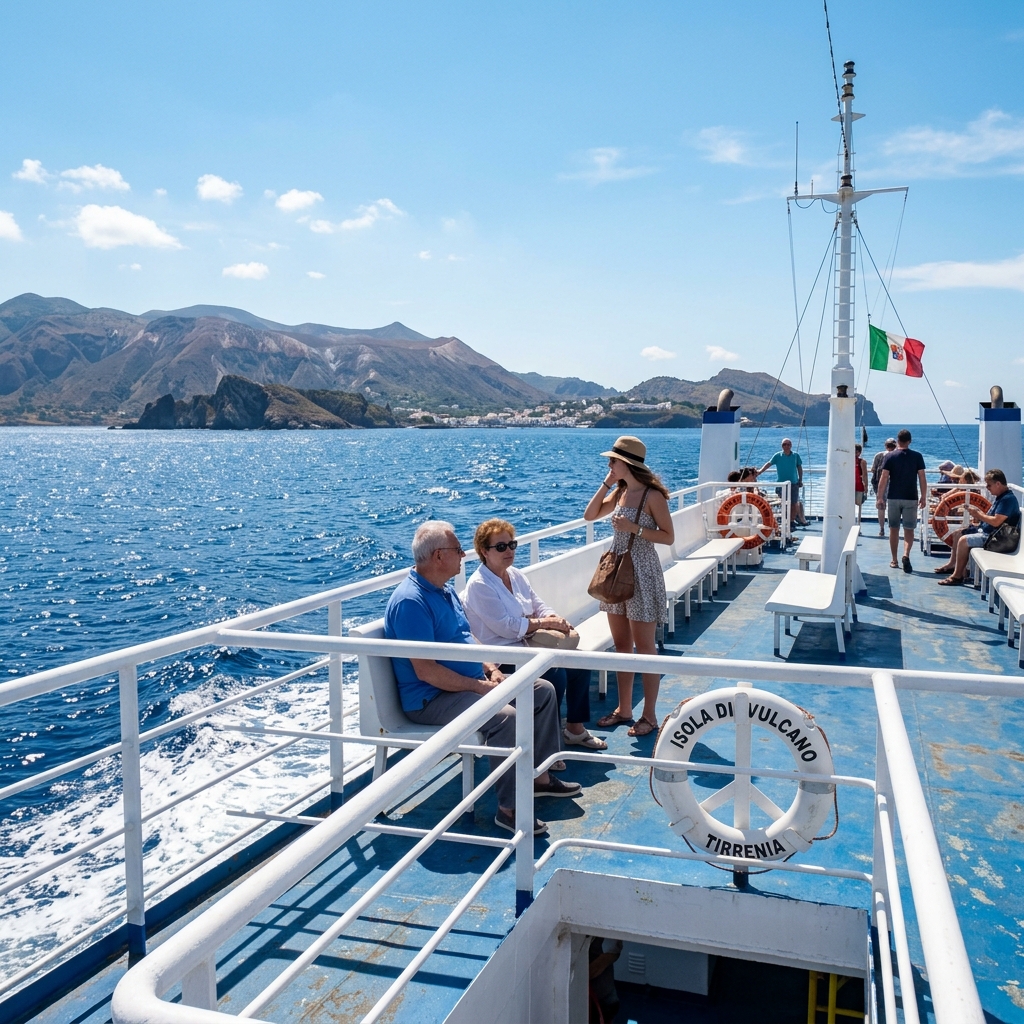
Italy is a country that reaches into the sea from three sides and scatters itself across twenty-odd islands before it is done. Getting between those islands — and between the peninsula and the larger ones — requires ferries, and Italy has built one of the Mediterranean’s most comprehensive ferry networks to do exactly that. Whether you are crossing to Sicily on an overnight ship out of Naples, island-hopping the Aeolians by hydrofoil, or boarding the ferry to Greece from Bari, Italy’s ports are gateways to an entirely different kind of slow travel: one measured in sea miles and the slow change of light on open water.
The Major Operators
Italy’s ferry market is served by several large operators, each with their own routes and character.
Grimaldi Lines is the workhorse of the Italian ferry network — large car-ferry ships on the major routes to Sicily and Sardinia, reliable, and among the better value overnight options. Their Civitavecchia→Palermo and Genova→Sardinia services are used as much by Italian families moving furniture as by tourists.
GNV (Grandi Navi Veloci) runs similar large ferries on Sicily and Sardinia routes, with slightly more modern ships on some routes. Competitive pricing and often the best option when Grimaldi is sold out.
Tirrenia is the historic state-linked operator, now privatised, with broad coverage including Sardinia and Sicily routes. Service is workmanlike.
SNAV specialises in fast ferries and hydrofoils, with routes from Naples to the Aeolian Islands in summer and Palermo overnight.
Caronte & Tourist runs the short Strait of Messina crossings (Villa San Giovanni→Messina) as a local transport service — essentially a bus route on water, departing every 20 minutes.
Ustica Lines / Liberty Lines dominate the Aeolian Islands and Sicilian island hydrofoil network out of Milazzo and Palermo.
For international routes, Superfast Ferries and ANEK Lines run Italy→Greece, while Jadrolinija and Venezia Lines serve the Adriatic crossings to Croatia.
Sicily: Getting to the Island
The Overnight Ferry from Rome or Naples
The classic approach: board an overnight ferry from the mainland and arrive in Palermo or Catania at dawn.
From Civitavecchia (Rome’s port, reached by train from Roma Termini in 1h10m):
- Civitavecchia→Palermo: 13 hours overnight, departing around 8–9pm, arriving 8–9am. Grimaldi Lines and GNV. Deck class from €30–45, cabin from €80–120 per person. Book at grimaldi-lines.com or gnv.it.
From Naples (Napoli Porta di Mare terminal or Stazione Marittima):
- Napoli→Palermo: 10 hours overnight, Grimaldi and SNAV. From €25 deck class. A quicker option for travellers already in the south.
- Napoli→Catania: Grimaldi runs this in summer — 11 hours, useful for eastern Sicily.
Booking advice: For July and August, book 4–6 weeks ahead. For May, June, September and October, 1–2 weeks is usually fine. Deck class (a reclining seat in a communal lounge) is perfectly adequate for an overnight crossing if you travel light and can sleep sitting up. A 4-berth inside cabin adds €40–60 per person and guarantees a proper night’s sleep.
The Train-on-a-Ferry at Villa San Giovanni
One of Europe’s last great rail curiosities: your train from Rome, Milan, or Naples does not terminate at the toe of Italy’s boot. Instead, it rolls at walking pace into the belly of a ferry at Villa San Giovanni, crosses the Strait of Messina in 20 minutes, and emerges onto the tracks of Sicily at Messina.
Passengers can stay in their seats or — as most do — walk up to the ferry deck and watch the Italian mainland recede and Sicily approach. It takes less time than boarding a budget airline but feels like a scene from another era of travel.
If you are not taking the train, Caronte & Tourist runs car and foot-passenger ferries from Villa San Giovanni to Messina every 20 minutes throughout the day (€2.50 foot passenger, crossing time 25 minutes). Messina is then a short connection by train to Palermo, Catania, Taormina, or Siracusa.
Sardinia: Italy’s Largest Island
Main Routes
Sardinia receives most of its visitors by air, which means the ferries are less crowded and more affordable than you might expect — even in summer.
From Livorno (Tuscany, reached from Florence in 1h20m by train):
- Livorno→Olbia: 8 hours overnight. Moby Lines and Grimaldi. From €30–50 deck class. This is the most popular route for northern Italian travellers — you can board in the evening and wake up in Sardinia.
From Civitavecchia (Rome’s port):
- Civitavecchia→Cagliari: 16 hours, Grimaldi and Tirrenia. From €35.
- Civitavecchia→Olbia: 8 hours, GNV. From €30.
From Genova:
- Genova→Cagliari: 20 hours. GNV and Tirrenia. A long crossing but you sleep through most of it.
- Genova→Porto Torres: 12 hours. Tirrenia. Useful for the north of the island.
From Naples:
- Napoli→Cagliari: Tirrenia runs this in summer. About 16 hours.
Which Part of Sardinia?
Olbia (northeast) is the gateway to the Costa Smeralda — luxury beach territory, not the slow travel version of the island.
Cagliari (south) is the capital and by far the most rewarding arrival point for slow travellers — a proper city with excellent food, a historic Castello district, and beaches close enough to walk to. The lagoon behind the city is home to flamingos year-round.
Porto Torres (northwest) is a port town used mainly for passing through to Alghero (30min by bus), a genuinely lovely Catalan-speaking walled city.
The Aeolian Islands
Seven volcanic islands north of Sicily, each with a distinct character, connected by a web of hydrofoils and slow ferries. The slow travel case for the Aeolians: you cannot fly here, you cannot rush here, and the islands themselves enforce a pace that the mainland has largely forgotten.
Getting There
From Milazzo (the main gateway): Milazzo is on the northeast coast of Sicily, reached from Messina by train in 30 minutes or from Palermo in 2h30m.
From Milazzo, Ustica Lines and Liberty Lines run hydrofoils to:
- Lipari: 55 minutes, €22–28 return. The hub — largest island, most facilities.
- Vulcano: 30 minutes, €17. The sulphurous one — volcanic crater hike, mud baths.
- Salina: 1h30m. The green island — capers, Malvasia wine, fewer tourists.
- Stromboli: 2h30m. The active volcano — nightly lava shows from the crater.
- Filicudi and Alicudi: 3+ hours. The remote ones — barely touched by tourism.
From Naples in summer: SNAV runs a direct hydrofoil service to the Aeolians (5–6 hours), cutting out the Milazzo connection entirely.
Island-hopping: Once on the islands, the same Ustica Lines hydrofoils connect them to each other. A typical circuit: Milazzo→Lipari (base for 2–3 nights)→Vulcano (day trip)→Salina (2 nights)→Stromboli (night hike, stay 1 night)→back to Milazzo via Lipari. Allow 7–10 days minimum.
The Aeolian Pace
July and August are crowded and expensive — Stromboli in particular fills up with day-trippers who leave on the last hydrofoil. The best months are May, June, and September: warm enough to swim, quiet enough to actually see the islands. October is stunning if you can handle the occasional ferry cancellation due to rough seas.
Each island has one or two villages, no cars allowed on Stromboli, and restaurants that close at 10pm because everyone wakes up at 7. Bring cash — ATMs are limited. And book accommodation well ahead for summer; there are no large hotels, only small pensions and B&Bs.
International Ferries from Italy
Italy to Greece
The main routes are operated out of Bari and Ancona.
From Bari (southeastern Italy, reached from Rome in 4h by train):
- Bari→Igoumenitsa: 9 hours. Superfast Ferries. From €40 deck class.
- Bari→Patras: 16 hours overnight. Superfast Ferries and ANEK. From €50 deck class, cabin from €100.
From Ancona (Adriatic coast, reached from Bologna in 2h by train):
- Ancona→Igoumenitsa: 15 hours. ANEK Lines. From €50.
- Ancona→Patras: 21 hours. ANEK Lines. Full overnight with cabin optional.
From Venice:
- Venezia→Igoumenitsa: Summer service, Minoan Lines. About 30 hours — the scenic choice, but very slow.
Patras is connected by bus to Athens (3 hours) or you can continue by train via Corinth. Igoumenitsa is a port town — most travellers continue immediately to Ioannina (bus, 1.5 hours) or take the ferry to Corfu (1.5 hours).
Italy to Croatia and Montenegro
From Ancona:
- Ancona→Split: 10 hours overnight. Jadrolinija. From €50 deck class. One of the best value overnight crossings in the Adriatic.
- Ancona→Zadar: 7 hours. Jadrolinija. From €40.
From Venice:
- Venezia→Poreč / Rovinj / Pula: 3h30m–5h. Venezia Lines and Commodore Cruises. Seasonal (April–October). From €45–70 foot passenger.
From Bari:
- Bari→Bar (Montenegro): 9 hours overnight. Montenegro Lines. From €50. An unusual and worthwhile crossing — Bar is connected by the extraordinary Beograd–Bar railway (11 hours) into Serbia.
Planning Your Ferry Journey
Booking: Most Italian ferry operators sell online directly, but aggregators like directferries.com or ferryscanner.com let you compare all operators on a single route. For Sardinia routes in summer, book 3–4 weeks ahead. For the Aeolians, a week ahead is usually enough outside August.
Arriving at port: Italian ferry terminals (Civitavecchia, Napoli Stazione Marittima, Bari) are generally well-signed and connected to the city centre by shuttle or taxi. Allow 45–60 minutes before departure for check-in. Foot passengers can usually queue later than car passengers.
What to bring: For overnight deck crossings, a light sleeping bag or blanket is useful — air conditioning can make lounges cold. Earplugs for cabins. Onboard restaurants exist but are overpriced — bring provisions. A power bank if you want to work or entertain yourself.
Rough seas: The Strait of Messina is calm. The Tyrrhenian Sea (Rome→Sardinia/Sicily) can be choppy in autumn and winter. The Adriatic is generally calm but can produce short sharp swells. If you suffer from motion sickness, take medication before boarding rather than after.
The Slow Travel Case for Ferries
Ferries impose a pace that trains encourage and planes destroy. An overnight crossing from Genova to Sardinia is not a necessary inconvenience — it is eight hours on the water, a dinner you did not cook, a sunrise over the island as it comes into focus through the mist. The journey itself is part of arriving. That is the only thing that matters.
Ferry schedules and prices change seasonally. Verify current routes and book at directferries.com, grimaldi-lines.com, gnv.it, or the operator’s own site.
Related Reading
- The Mediterranean Slow Travel Route: 6 Weeks by Train and Ferry — A complete 6-week Mediterranean itinerary by train and ferry: Barcelona to Malta via Valencia, Nice, Cinque Terre,…
- The Adriatic Coast by Train and Ferry: Italy to Croatia Slow — Travel the Adriatic slow: Italy’s coastal rail line from Bologna to Bari, then overnight ferry to Split and…
- Palermo by Train: Arriving in Sicily and Exploring by Rail — How to reach Palermo by train — including the famous ferry crossing — plus the best Sicilian rail routes for day…