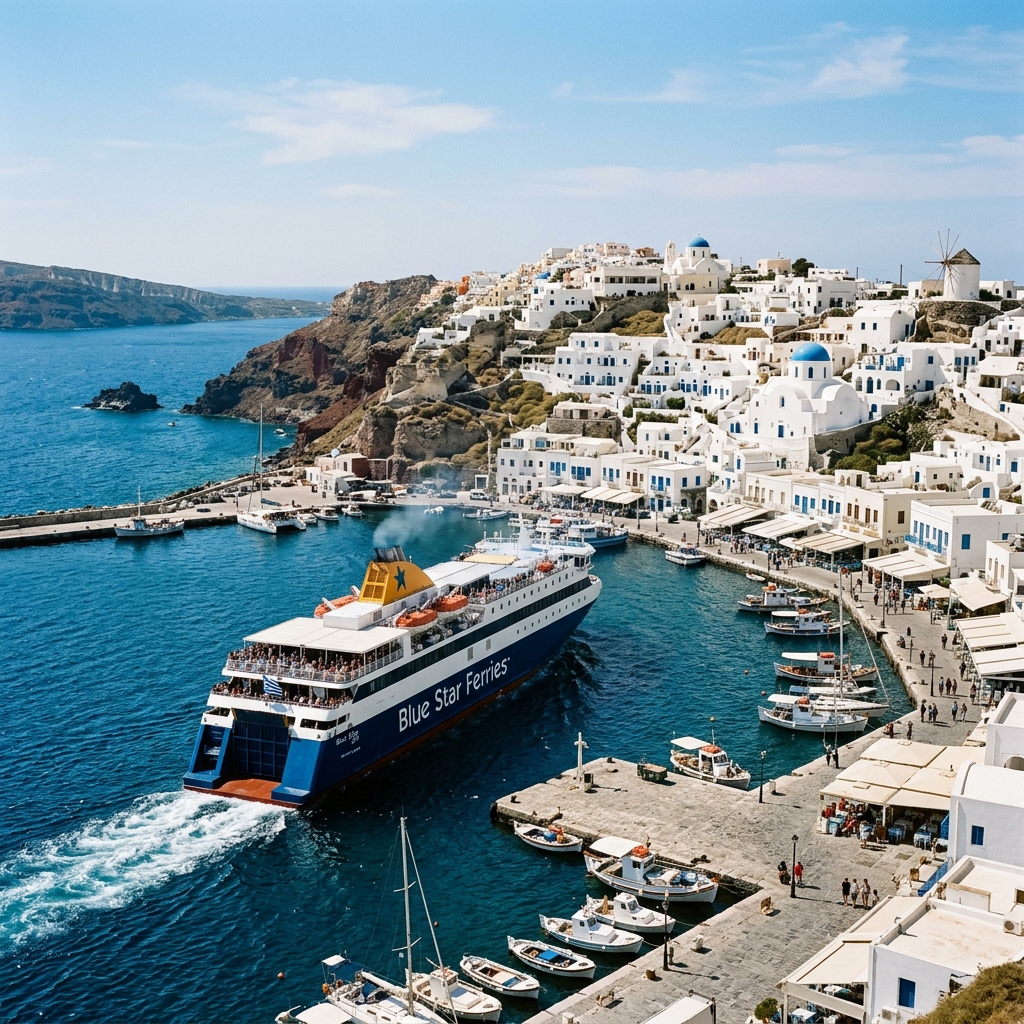
There are no bridges to the Greek islands. This is not an oversight of infrastructure but a fact of geography that shapes everything about how the Aegean is experienced. The islands are islands — genuinely, irreversibly separate from the mainland, separated by water that the ancient Greeks understood as a medium of connection rather than a barrier. The sea was how you got there. The sea was how you got anywhere. And arriving by ferry, even now, has a quality that arriving by air cannot replicate: you approach from the water, you see the island as sailors have seen it for millennia, and you understand that you have crossed something to get there.
This is the foundational argument for island hopping by ferry. The practical argument is almost as compelling: the islands have no airports between them, flying from Athens to each island and back is expensive and environmentally ruinous, and the ferries — particularly the overnight Blue Star services — are far more comfortable than their price suggests.
planning a slow travel trip through Europe
TL;DR: Piraeus port (Metro Line 1 from Athens, 20 min, €1.40) is the hub for all Cyclades and Dodecanese ferries. Blue Star Ferries run the most comfortable conventional services. SeaJets run fast catamarans at a premium. Key routes: Piraeus→Santorini (8h, from €40), Piraeus→Mykonos (5h, from €35), Mykonos→Santorini (2h30m, from €40). Book 2–3 weeks ahead for July/August. Minimum 3–4 nights per island if you’re travelling slowly.
The Operators: Who Runs the Ferries
Blue Star Ferries: The Backbone of the Aegean
Blue Star Ferries is the dominant operator on the main Cyclades and Dodecanese routes, and for most island-hopping itineraries it should be your default choice. Blue Star operates large, modern ro-ro passenger ferries — the Blue Star Delos, Blue Star Paros, Blue Star Naxos and their siblings — which are substantially more spacious and comfortable than their prices suggest. A deck ticket from Piraeus to Santorini costs around €40–€55; a cabin berth costs €80–€120 depending on berth number and season.
The ships have proper restaurants (functional rather than exceptional, but hot food at reasonable prices), self-service cafés, outdoor sun decks, and comfortable airline-style seating throughout. On overnight routes, the cabins — typically four-berth with bunk beds — are clean and adequately quiet. If you’re making multiple overnight crossings, the Blue Star cabin experience is genuinely comfortable.
Book direct at bluestarferries.com or via aggregators. The official site occasionally has slightly lower prices, but the aggregators are faster for comparing routes.
SeaJets: Fast, Expensive, Efficient
SeaJets operates high-speed catamarans across the Cyclades — faster than Blue Star by 30–50%, but at a significantly higher price point. The Piraeus–Santorini route in just over 4 hours costs €70–€90 for a standard seat; Piraeus–Mykonos in 2h30min costs €60–€80. The catamarans are more susceptible to rough weather cancellations than the large conventional ferries, and in choppy Aegean conditions, the fast boats are considerably less comfortable.
SeaJets is worth it when time is genuinely short. If you have a week and want to cover the classic Cyclades circuit, the speed advantage is real. If you have two weeks and are travelling slowly, the extra time on a Blue Star ferry is not a sacrifice — it is part of the experience.
Hellenic Seaways and Golden Star Ferries
Hellenic Seaways operates some catamaran routes, particularly in the Cyclades and to the Sporades islands northeast of Athens. Golden Star Ferries has expanded its Cyclades coverage in recent years with a fleet of newer high-speed vessels, and is a good alternative to SeaJets on several routes. Check both on Ferryhopper when comparing times and prices.
ANEK Lines: The Crete Specialist
ANEK Lines specialises in routes to Crete — from Piraeus to Heraklion (the capital) and Chania (the western city). ANEK runs large overnight ferries with cabins, restaurants, and vehicle decks. The Piraeus–Heraklion crossing takes approximately 9 hours overnight; a deck ticket costs €35–€50, a cabin berth €70–€100. ANEK is the operator to use if Crete is part of your itinerary; their ships are well-maintained and the overnight experience is well-organised.
The Piraeus Hub: Getting to the Port
Piraeus (Πειραιάς) is Athens’ main port — one of the busiest passenger ports in Europe, handling over 10 million passengers annually. Getting there from central Athens is straightforward.
By Metro: The Standard Approach
Take Metro Line 1 (Green) south to the Piraeus terminal. The journey from Monastiraki (the most central interchange) takes approximately 20 minutes and costs €1.40 — the same single-journey fare that covers all Athens Metro, bus, and tram services within Zone 1.
From Syntagma (the main central square): take Line 3 west one stop to Monastiraki, then Line 1 south to Piraeus. Total journey time around 25 minutes.
The Piraeus Metro station deposits you directly at the port’s Gate E1 area. The main Blue Star and ANEK terminal gates (E2, E3, E4, E5, E6, E7, E8, E9) are strung along the quayside — in summer, numbered shuttle buses and on-foot signposting indicate which gate corresponds to which destination. Allow 30–45 minutes from Metro arrival to ferry boarding.
Practical Port Logistics
- Arrive at the port 30–45 minutes before departure. This is not a suggestion. Greek ferries board efficiently when full and close gangways on schedule.
- Print or download your boarding pass. While staff occasionally check tickets manually in quieter periods, the standard process is a barcode scan at the gangway.
- Car passengers queue separately in designated vehicle lanes; foot passengers use the pedestrian entrance.
- Luggage: There are no formal luggage restrictions on conventional ferries. Trolley bags and large backpacks are routine. The challenge is deck passengers with vast amounts of luggage — the ferries handle it, but overhead storage is limited; most passengers leave bags in corridors or the designated luggage areas at carriage ends.
Key Routes: Times, Costs, and What to Expect
Piraeus → Santorini (Thira)
The headline route of Aegean island hopping. Santorini is 130 nautical miles from Piraeus — a serious crossing.
- Blue Star conventional ferry: approximately 8 hours, departing Piraeus in the evening and arriving Santorini (Athinios port, below the caldera) in the early morning. Fares: €40–€55 deck/seat, €80–€120 cabin berth (2026 prices, high season).
- SeaJets/Golden Star fast catamaran: approximately 4h30min–5h, multiple morning departures. Fares: €70–€90 standard seat.
Santorini’s main port is Athinios, a narrow landing cut into the cliff base — not the famous Oia caldera, which is accessible only by cable car (€6) from Fira, the island capital. From Athinios, buses run to Fira (€1.80, 20 minutes) and all major villages.
Piraeus → Mykonos
- Blue Star conventional ferry: approximately 5 hours. Fares: €35–€50 deck/seat, €70–€100 cabin.
- SeaJets fast catamaran: approximately 2h30min. Fares: €60–€75 standard seat.
Mykonos New Port (Tourlos) is the main arrival point for conventional ferries; some catamarans use the Old Port closer to Mykonos Town. Check which port your ferry uses — the bus route differs.
Mykonos → Santorini
One of the classic inter-island hops, and the route that makes a Cyclades circuit possible without returning to Piraeus.
- SeaJets/Golden Star catamaran: approximately 2h30min–3h. Fares: €40–€60 standard seat (2026 prices).
- No direct conventional Blue Star service on this inter-island route; you’d need to change at Piraeus or route via Paros or Naxos.
Santorini → Crete (Heraklion)
A useful extension southward if you want to combine the Cyclades with Crete.
- Fast catamaran (SeaJets or Minoan Lines): approximately 2h–3h. Fares: €35–€55.
- ANEK conventional overnight from Piraeus stops at Santorini before continuing to Heraklion — total Santorini–Heraklion segment approximately 3 hours.
Rhodes → Kos (Dodecanese)
The Dodecanese routes are longer and less frequently served than the Cyclades, but the ferry connections between islands are good in summer.
- Blue Star or Dodekanisos Seaways: Rhodes to Kos in approximately 2h30min. Fares: €25–€40 deck.
- Dodekanisos Seaways operates a catamaran service that covers multiple Dodecanese islands in a single day — Kos, Kalymnos, Leros, Patmos — which is efficient for those with limited time.
The Cyclades Circuit: Classic Two-Week Route
The Cyclades are the islands most first-time visitors picture when they think of Greece: white cubic houses, blue domes, terraced hillsides above turquoise water. The standard circuit visits the most accessible and photogenic islands while allowing enough time on each to get beyond the port and the tourist strip.
The Route
Piraeus → Paros → Naxos → Ios → Santorini → Piraeus
This circuit can be done in ten days minimum (staying 2–3 nights per island) or more comfortably in two weeks (3–4 nights each). All legs are Blue Star or catamaran, with no need to return to Athens between islands.
- Piraeus → Paros: 4h 30min (Blue Star conventional), from €32
- Paros → Naxos: 45min (frequent local ferries and catamarans), from €8–€12
- Naxos → Ios: 1h 30min (catamaran), from €15–€25
- Ios → Santorini: 1h (catamaran), from €18–€30
- Santorini → Piraeus: 8h overnight (Blue Star), from €40
Island Character Notes
Paros is the slow traveller’s island of choice in the Cyclades — large enough to have a functioning local life beyond tourism, small enough to explore by bicycle. The inland village of Lefkes is one of the finest examples of Cycladic architecture untouched by commercialisation. Stay in Naoussa rather than Parikia (the port) if possible.
Naxos is the largest of the Cyclades and the most self-sufficient — it has mountains, farms, olive groves, and beaches, and produces its own cheese, wine, and citrus fruits. The chora (old town) above the port is a genuine medieval Venetian settlement. Naxos rewards five or six nights rather than three.
Ios has a reputation as a party island — justified, if you are near the main village. The beaches are genuinely beautiful, and away from the village, the island is quiet and largely undiscovered.
Santorini is the most-photographed and most-visited island in the Cyclades. The caldera views from Oia are extraordinary. The crowds in July and August are extraordinary in the same way. Go in May or October if you can. Stay in Firostefani or Imerovigli rather than Oia itself.
The Dodecanese Circuit: A Longer Journey East
The Dodecanese — the southeastern island chain stretching toward Turkey — is less visited than the Cyclades and significantly more interesting for slow travellers. The main circuit follows Blue Star Ferries on the Piraeus–Rhodes run, with island stops along the way.
The Route
Athens (Piraeus) → Rhodes → Kos → Patmos → Athens
- Piraeus → Rhodes: overnight (Blue Star), approximately 15–18 hours, from €45 deck, €90–€120 cabin
- Rhodes → Kos: 2h30min, from €25
- Kos → Patmos: approximately 3h (via Kalymnos and Leros on Blue Star or Dodekanisos Seaways), from €20–€35
- Patmos → Piraeus: overnight return (Blue Star), approximately 8–10 hours depending on stops, from €35
Rhodes warrants three or four nights minimum — the medieval walled city (a UNESCO World Heritage Site) is the finest surviving crusader city in the Mediterranean, and the southern beaches and villages are barely touched by mass tourism.
Kos is pleasant but more resort-oriented than Rhodes. The Roman agora, Byzantine ruins, and the Asklepion (ancient medical school) are genuine historical sites worth half a day each.
Patmos is the island where St. John is said to have written the Book of Revelation — and the pilgrimage atmosphere is palpable. The monastery of St. John crowns the hill above Chora. The island is quieter, more austere, and spiritually different in tone from the hedonistic Cyclades. It is the right place to end a long journey.
Slow Travel and the Greek Islands
The great temptation of island hopping is to hop too much. The itineraries published in travel magazines — seven islands in ten days, with a ferry every other morning — treat the Greek islands as a series of photographs rather than places. This is exactly backwards.
The Greek islands reward staying. Three nights on Naxos is enough to find the baker on the back street who makes spanakopita at 7am. Four nights on Paros gets you to the evening market in Naoussa. Five nights on Rhodes puts you in a taverna where the owner’s father’s photographs are on the wall and the dolmades are from a recipe that predates the internet by several decades.
The minimum for slow travel is three to four nights per island. The ideal is five to seven nights on the islands you like best, with a deliberate willingness to adjust when you arrive somewhere unexpected that turns out to be worth twice the time you’d allocated.
Naxos and Paros are, in this writer’s view, the two Cyclades islands best suited to slow travel: large enough for genuine exploration, traditional enough to have a local life that tourism hasn’t entirely replaced, and — critically — served by multiple daily ferry connections that make extending your stay by two nights a logistical non-event.
There is an afternoon on Naxos — on almost any afternoon in June — when the light on the white walls of the chora turns the colour of warm stone, the cafes empty for the mid-afternoon rest, and the town goes quiet in the way that only places with a genuine working life go quiet. You could stay a week and not run out of reasons to be there. The ferry back to Piraeus leaves when you decide it does.
Overnight Ferries: Deck Class vs. Cabin
Deck Class
Deck class is the cheapest fare and, on a calm night, entirely comfortable. It means access to the ferry’s outdoor deck and interior lounge areas — you are not assigned a cabin berth, but you have a reserved seat (a specific airline-style seat in a lounge, indicated on your ticket). On Blue Star ferries, the deck lounge seats are wide and recline reasonably well; bring a travel pillow and an eye mask.
For overnight crossings (Piraeus–Rhodes, Piraeus–Crete), deck class passengers often stake out spots in lounges, on deck chairs, or in the interior passageways with sleeping bags. This is normal Greek ferry behaviour. Bring: sleeping bag or blanket (ferries are heavily air-conditioned), ear plugs, eye mask, snacks (onboard food is adequate but overpriced), and a power bank for devices.
Cabin Class
A cabin berth on Blue Star or ANEK adds €30–€70 to your ticket price, depending on the route and berth position. The cabins are typically four-berth with bunk beds, clean sheets, a reading light, and a small bathroom. For crossings longer than 6 hours, a cabin berth transforms the experience considerably: you sleep properly, arrive refreshed, and start the day without the slightly depleted feeling that an overnight airport-lounge sleep produces.
Two-berth cabins are available at a premium and worth booking if you’re travelling as a couple — privacy on an overnight crossing matters.
Seasickness
The Aegean can be rough, particularly in the meltemi season (July–August winds from the north). Fast catamarans are considerably more susceptible to rough conditions than the large conventional ferries. If you are susceptible to seasickness:
- Take Dramamine or Stugeron (cinnarizine) 30–60 minutes before boarding
- Choose conventional ferries over catamarans in summer
- Sit or lie in the middle of the ship, on a lower deck, close to the water line — this is the most stable position
- Fresh air on deck helps; the interior lounges can become uncomfortable when the ship is rolling
Booking: How and When
Booking Platforms
- Ferryscanner (ferryscanner.com) — the most comprehensive aggregator for Greek routes; shows all operators, all times, price comparison across ticket classes
- DirectFerries (directferries.com) — good for comparative pricing and international routes connecting from Greece
- Ferryhopper (ferryhopper.com) — cleaner interface, popular with travellers who know their specific routes; particularly good for multi-leg itineraries
- Direct with Blue Star (bluestarferries.com) — sometimes marginally cheaper for Blue Star-operated routes; always available as a fallback
When to Book
- July and August: Book 2–3 weeks ahead at minimum, especially for cabin berths. Popular routes (Piraeus–Santorini, Piraeus–Mykonos) sell deck space too.
- June and September: Book 3–7 days ahead for peace of mind; same-day booking usually possible for deck class.
- May and October: Book a few days ahead or at the port; many routes have reduced frequency so check timetables before assuming daily service.
- November–April: Significantly reduced winter schedules. Some inter-island routes drop to two or three sailings per week. Major routes (Piraeus–Crete, Piraeus–Rhodes) continue year-round with reduced frequency.
Practical Guide: What to Know Before You Board
Getting from Athens Airport to Piraeus
Two practical options:
-
Metro + Metro: Take the Proastiakos suburban rail from the airport to Neratziotissa (approximately 30 minutes, €10), then Metro Line 1 south to Piraeus (approximately 25 minutes, €1.40). Total: 55 minutes, €11.40. Or take the X96 express bus directly from the airport to Piraeus port (approximately 1 hour in normal traffic, €6.40).
-
Taxi: €35–€45 from the airport to Piraeus port, 45–75 minutes depending on traffic. Convenient if you have heavy luggage; avoid during rush hours (7–9am, 5–8pm).
Port Arrival and Boarding
- Arrive at Piraeus 45 minutes before departure for conventional ferries, 30 minutes for catamarans
- The port is large — confirm your gate number (E2–E9) from your ticket or the Blue Star app before arrival; gates are spread along a 2km quayside
- Foot passengers enter at pedestrian gates adjacent to vehicle ramps
- Boarding announcement is by gate number on the port PA system; ferry departure times are generally reliable
Foot Passenger vs. Car
Bringing a car to the Greek islands significantly complicates logistics: not all islands have the same road quality, island-to-island car transport costs €100–€160 per leg, and most island centres are pedestrian-only. The better option for most visitors is to travel as a foot passenger and rent a quad, scooter, or small car on each island as needed. Rental is readily available on all major islands and costs €15–€40 per day for a quad or scooter, €35–€65 for a small car.
planning a slow travel trip to Athens
The Irreducible Case
The writer Nikos Kazantzakis, in Zorba the Greek, describes the sea as the great teacher of indifference to time. He may have been right. On the upper deck of the overnight Blue Star ferry from Piraeus to Rhodes, watching the lights of the Attic coast recede and the open Aegean open ahead, it is difficult to feel that arriving tomorrow instead of today is any great loss. The stars are clearer at sea. The pace adjusts. The island will be there in the morning, as it has been for three thousand years.
Book the cabin. Take the slow ferry. Stay longer than you planned.
Related Reading
- Greek Islands for Slow Travelers: Which Island and How Long to Stay — Greek islands slow travel done right: island character guides for Naxos, Paros, Folegandros, Hydra, Samos, and…
- Greek Ferries: Everything You Need to Know Before You Go — Greek ferries practical guide: booking platforms, ticket types, operators ranked honestly, port logistics, what to…
- The Adriatic Coast by Train and Ferry: Italy to Croatia Slow — Travel the Adriatic slow: Italy’s coastal rail line from Bologna to Bari, then overnight ferry to Split and…