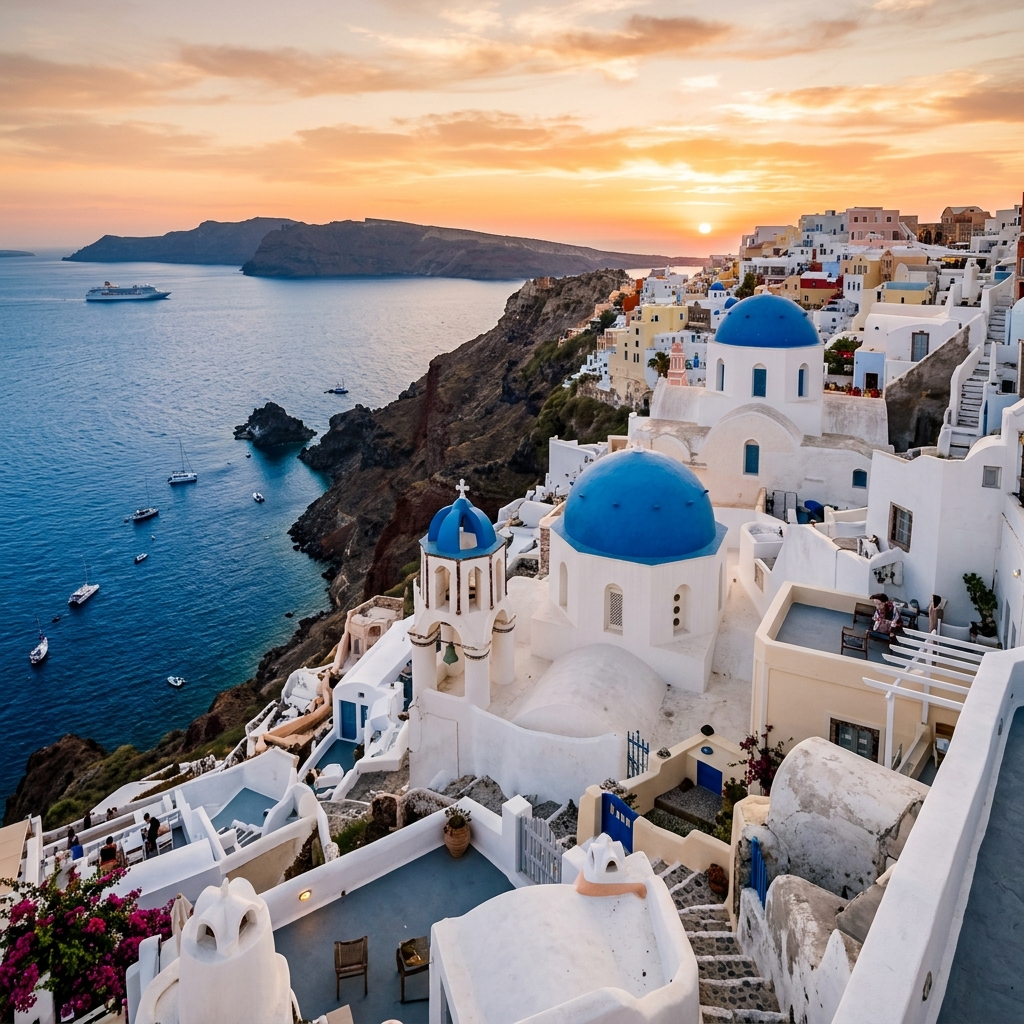
There is a way to do the Greek islands that is, by any honest reckoning, a mistake: five islands in ten days, two nights per island, ferry at 7am, check into the next hotel by noon, photograph the view, move on. The magazine editors and the Instagram algorithm have much to answer for. This is not travel to the Greek islands. It is a delivery service in which you are the package.
The Greek islands are among the most beautiful places on earth — and among the most easily ruined by the manner of their visiting. What they require, and generously reward, is time. Not endless time. Just enough to move past the port and the tourist strip and into the actual island: the morning market, the village priest, the taverna that doesn’t have an English menu because it doesn’t need one. This happens on the fourth day, usually. Not the second.
how to plan a slow travel trip
TL;DR: Stay minimum 5 nights per island. September beats August on every measure. Ferry from Piraeus (Athens) is the starting point for all Cyclades routes. Best slow travel islands: Naxos (7–10 days), Paros (5–7 days), Folegandros (4–5 days), Hydra (3–4 days), Samos (5–7 days). Rhodes Old Town warrants 4–5 nights; ignore the resort coast entirely.
The Anti-Guide: Why Two Nights on Five Islands Fails
The logic of the five-island sprint feels compelling on paper. You see more. You cover more ground. You collect more photographs. What it actually produces is a continuous state of arrival — the mildly disorienting first twenty-four hours on any new island, repeated five times without ever reaching the other side of it.
The first day on a Greek island is almost always the same: you find the hotel, you eat somewhere obvious, you walk the main waterfront. The second day is better — you start to find your bearings, you walk a bit further. The third day is when the island actually begins to reveal itself: the side streets, the lunch spot the hotel owner mentioned, the beach that requires a twenty-minute walk rather than a five-minute bus ride. The fourth day is when you are not a tourist anymore but a temporary resident.
The two-night island-hopper never reaches day three. They are always in their first twenty-four hours somewhere, permanently disoriented, permanently in the most expensive restaurant nearest the port.
This guide is for people who want to actually be somewhere.
Six Islands, Honestly Assessed
Naxos: The Most Livable Island in the Cyclades
Naxos is the largest island in the Cyclades and, for slow travel, the best. This is not a close call.
The argument for Naxos begins with self-sufficiency. Most Cycladic islands import nearly everything they eat; Naxos produces its own food. The island has mountains (Mount Zas, the highest peak in the Cyclades at 1,001m), enough rainfall to support proper agriculture, and a tradition of production that predates tourism by centuries. Naxian graviera cheese — a hard, slightly sweet mountain cheese — is sold throughout Greece. Naxos supplies much of the potato crop for Athens. The citrus groves in the valley villages produce oranges and lemons that actually taste of something.
The Chora (Naxos Town) is a proper working port town with a Venetian kastro on the hill, a labyrinthine old town inside its walls, good bookshops, a hardware store, a fish market. It has not been entirely transformed into a tourist facility, though it would like more visitors to notice it exists. Naoussa on Paros gets more attention; Naxos gets the better island.
The beaches are long, sandy, and sufficiently numerous that they empty as you walk further from the main bus route. Agios Prokopios and Agia Anna are the closest and most crowded; Saint George (the town beach) is perfectly adequate; Plaka, four kilometres further south, is long, slightly wild, and rarely packed. In September, you can have long stretches of it to yourself.
In the interior: the village of Halki is a twenty-minute bus ride from the port and contains a Venetian tower, three churches, a distillery producing Kitron (a citrus liqueur unique to Naxos), and an excellent restaurant. The villages of Apeiranthos and Filoti — higher in the mountains — have a different culture entirely, more Cretan than Cycladic in character, with older stone buildings and an independence that comes from geography.
Staying on Naxos: 7–10 days is the right range. Less than five nights and you will not see the interior.
Ferry from Piraeus: approximately 5 hours on Blue Star Ferries, from €32 deck class. Departs Piraeus in the evening; arrives Naxos in early evening, stopping first at Paros (4h30min).
Paros: The Elegant Hub
Paros occupies the centre of the Cyclades geographically and the centre of many good itineraries by merit. It is a ferry hub — services to almost every other Cycladic island pass through or start from Parikia, the port — and a genuinely beautiful island in its own right.
The town of Naoussa, on the north coast, is the reason to come. A Venetian port with a small ruined castle at the harbour mouth, fishing boats, good tavernas on the waterfront, and a village behind the waterfront that retains its character despite considerable summer popularity. In September, Naoussa is very close to perfect.
Paros is also a windsurfing island — the bay of Chryssi Akti on the east coast hosts international competitions and is consistently rated among the best windsurfing sites in Europe. If windsurfing is part of your travel, Paros organises itself around it. If it isn’t, the east coast beaches are quieter and longer than the west.
Staying on Paros: 5–7 days. Stay in Naoussa rather than Parikia; the port is practical but the village is the point.
Ferry from Piraeus: approximately 4h30min on Blue Star Ferries, from €30 deck class.
Folegandros: The Island That Stayed Small
Folegandros receives perhaps 50,000 visitors a year. Santorini receives roughly 3 million. The arithmetic explains everything about the experience of being on Folegandros.
It is a small island — seventeen kilometres long, five kilometres wide — with a population of around 750 people. There is no party scene, no beach club, no strip of hotel-restaurants aimed at package tourists. What there is: a clifftop Chora that is widely considered one of the most beautiful villages in the entire Aegean, a handful of excellent restaurants, clear water, and a quality of quiet that is genuinely unusual in the summer Cyclades.
The Chora is the centerpiece: a medieval settlement on a 200-metre cliff above the sea, its buildings interconnected in the traditional way, with a church at the highest point (Panagia church, reached by a long path of steps) that has views across the entire southern Aegean. In the evening, the Chora’s three small squares fill with people eating and talking; it is the least performative social atmosphere in the islands.
Folegandros has no airport. Getting there requires a ferry, and the ferry schedules are less frequent than the main Cycladic islands — this filters the visitor population usefully.
Staying on Folegandros: 4–5 days. The island is not large, but it is better in three days than Santorini in a week.
Ferry from Piraeus: approximately 5–6 hours on Blue Star or Zante Ferries, from €30–€40 deck class. Also reachable via ferry from Naxos (approximately 2h30min on catamaran, from €25).
Hydra: The Island Without Engines
The rule on Hydra is strict and, once you understand it, essential to the island’s character: no cars, no motorcycles, no electric scooters. Transport is by foot, by donkey, or by water taxi. The ban has been in place for decades. It has produced an island that is measurably quieter, slower, and more beautiful than any other in Greece of comparable accessibility.
Hydra is only a 90-minute hydrofoil from Piraeus — which makes it technically a day trip from Athens, and yes, some people do this. Ignore them. The day-trippers leave on the last hydrofoil; what remains in the evening is an island that belongs to the people staying there, with the main harbour transformed from a photo backdrop into a living space.
The port town is a single continuous bay of elegant stone houses, neoclassical mansions, and a harbour alive with caïques and water taxis. The wealthier Athenians have been summering on Hydra since the 1950s (Leonard Cohen lived here for years; the artists and writers came before and after him). The aesthetic consequence is that the town is unusually well-preserved and unusually attractive in a way that goes beyond the typical Cycladic white-and-blue.
Walking is how you explore Hydra. The island has good trails inland and along the coast — to the monastery of Profitis Ilias, to the hamlet of Kamini, to the quieter coves that the day-trippers never reach. Bring comfortable shoes.
Staying on Hydra: 3–4 days. Small enough that longer risks running out of new things to see; large enough that three days goes by before you’re ready.
Getting there: Hellenic Seaways and Aegean Flying Dolphins run hydrofoils from Piraeus (Gate E8/E9) to Hydra in approximately 90 minutes, from €28 one way. No advance booking usually necessary outside July and August.
Samos: The Green Island Near Turkey
Samos is an anomaly in the Greek island hierarchy: large, mountainous, forested, agricultural, and less visited than its quality warrants. It lies very close to the Turkish coast — the Strait of Mycale, at its narrowest point, is less than two kilometres wide — and this geographical accident has given it a slightly different history and atmosphere from the Cyclades.
The case for Samos begins with its wine. The Muscat wine produced in the north of the island — exported since antiquity — is legitimately excellent; Byron drank it, and there are worse recommendations. The cooperative wineries in Samos Town and Karlovassi offer tastings and direct sales.
Pythagoreion — named for Pythagoras, the mathematician born on the island — is a well-preserved ancient capital on the south coast, with a Heraion temple, a Roman aqueduct tunnel (the Eupalinos Tunnel, one of the engineering wonders of the ancient world), and a harbour with good fish restaurants that benefit from the island’s relative obscurity.
Kokkari, on the north coast, is a former fishing village that has become a pleasant resort without losing its original architecture. Good beaches, good seafood, windsurfing in season. The mountains above it — covered in pine and cypress — give Samos a lushness entirely absent from the Cyclades.
Staying on Samos: 5–7 days. The island is large enough that each part of it — north coast, south coast, interior mountains — rewards its own exploration.
Ferry from Piraeus: overnight Blue Star service, approximately 11–13 hours (the ferry stops at several islands en route), from €35–€50 deck class, €80–€100 for a cabin berth. There is also a direct seasonal ferry from Piraeus (approximately 10 hours); check BlueStarFerries.com for the current summer schedule.
Rhodes: Ignore the Resort Strip, Stay in the Old Town
Rhodes is the largest and most visited of the Dodecanese, and it suffers from the consequences of this in the resort towns along the north and west coasts — Faliraki, Ialyssos, Kremasti — which are oriented entirely toward package tourism and have approximately nothing to offer the independent traveler.
The exception is Rhodes Old Town, which is a UNESCO World Heritage Site and one of the finest surviving medieval walled cities in the Mediterranean. The crusader Knights of St. John built it in the fourteenth century; the Venetians, Ottomans, and Italians all left marks; what remains is a labyrinthine fortified city of cobblestoned lanes, Gothic archways, Ottoman mosques converted from Byzantine churches, and a streetscape that operates on a human scale unchanged since the fifteenth century.
Stay inside the walls. The accommodation within the Old Town ranges from simple pension rooms to small boutique hotels in restored medieval buildings. Eating inside the walls in September — at a small restaurant in the Jewish Quarter or the Turkish Quarter — is a pleasure that has nothing to do with the resorts forty minutes away.
Day trip to Lindos: The village of Lindos, forty-five minutes south by bus (€4, regular service), occupies a position of extraordinary drama: a Byzantine acropolis above a whitewashed village above a perfect curved bay. Go early in the morning before the day-trippers arrive from the resort hotels. Walk up to the acropolis at 8am and you will have it nearly to yourself.
Staying on Rhodes: 4–5 nights, all of them in the Old Town.
Ferry from Piraeus: Blue Star overnight service, approximately 15–18 hours (with stops at Patmos, Kos, and other Dodecanese islands), from €45 deck class, €90–€120 for a cabin berth. For Rhodes, the cabin is worth the upgrade — it is a long crossing, and arriving refreshed matters.
When to Go: The September Case
Every month of the Greek island summer has its character, and September wins by a meaningful margin for slow travelers.
July and August are the peak months by every metric: visitor numbers, accommodation prices, temperature (38°C on some Cycladic islands in August), and crowds. The ferries are full, the popular beaches are genuinely unpleasant by midday, and the atmosphere on islands like Mykonos and Santorini tilts from travel to event management. This does not mean July and August are without pleasure — the evenings are long and warm, the nightlife is alive, and the islands have real energy — but the kind of travel described in this article is difficult in peak summer.
September reconfigures everything. The sea is at its warmest — the Aegean holds summer heat into October and the water temperature in September is typically 26–28°C, warmer than most British and Irish summers at their peak. The crowds thin noticeably after the August bank holiday weekend and retreat further through the month. Accommodation prices drop 20–40% from August peaks. The restaurants, freed from the conveyor-belt pressure of August, slow down; the owners have time to talk. The light is softer in September, the evenings are earlier, and the figs are ripe.
Late May and June are the other strong choice: the flowers are still in bloom, the hills are green before the summer heat burns them, and the crowds are the thinnest they will be until October. The sea is cooler than September (22–24°C) but perfectly swimmable.
October is beautiful but some ferry routes reduce to three or four sailings per week, accommodation starts closing for winter, and the evenings carry a chill after dark. Still worthwhile for those who prefer solitude over guaranteed sunshine.
Getting to the Islands: Ferry Facts
All Cyclades routes originate at Piraeus, Athens’ main port, easily reached by Metro Line 1 (Piraeus station) from central Athens in about 20 minutes (€1.40). Dodecanese routes also start at Piraeus. Arrive at the port 45 minutes before departure; the gates are spread along a 2km quayside (gates E2–E9), so confirm your gate from your ticket.
Key journey times from Piraeus (conventional Blue Star ferry):
- Paros: 4h30min, from €30
- Naxos: 5h, from €32
- Folegandros: 5–6h, from €30
- Samos: 11–13h overnight, from €38
- Rhodes: 15–18h overnight, from €45
Hydra is reached by hydrofoil from Piraeus Gate E8/E9, 90 minutes, from €28.
Book via: Ferryscanner (ferryscanner.com), Ferryhopper (ferryhopper.com), or directly at bluestarferries.com. In July and August, book cabin berths 2–3 weeks ahead. In September, a few days ahead is usually sufficient.
island hopping routes and operators
The Practical Minimum
The practical minimum for a Greek island slow travel trip: two islands, twelve days. Choose two islands whose characters complement each other — Naxos and Folegandros, or Paros and Samos — and spend six days on each. You will leave knowing the islands in a way that a five-island sprint could not produce in twice the time.
The impulse to see more is understandable. It is also, in the Greek islands, almost always wrong.
The Aegean does not reward maximalism. It rewards the kind of attention that can only be sustained by staying still long enough to actually see what is in front of you: the particular shade of blue that the Cycladic sea reaches in September, the smell of oregano on a hillside above a village that has been there for three thousand years, the sound of a cat on old stone in the early morning before anyone else is awake.
Stay longer. Move less. The ferry home will wait.
Related Reading
- The Adriatic Coast by Train and Ferry: Italy to Croatia Slow — Travel the Adriatic slow: Italy’s coastal rail line from Bologna to Bari, then overnight ferry to Split and…
- The Mediterranean Slow Travel Route: 6 Weeks by Train and Ferry — A complete 6-week Mediterranean itinerary by train and ferry: Barcelona to Malta via Valencia, Nice, Cinque Terre,…
- Croatia Ferry Guide: Island Hopping the Dalmatian Coast — Croatia ferry guide to island hopping the Dalmatian Coast: Split to Hvar, Vis, Korčula, and beyond.