The Balkans by train is the most honest form of travel the region has to offer. Western Europe’s high-speed rail has compressed its geography until cities feel logistically close even when culturally distant — Frankfurt to Cologne in an hour, Madrid to Barcelona in two and a half. The Balkans hasn’t done this. The trains are slower, the track older, the timetables more approximate, and the result is that you understand the distances: how far Ljubljana is from Belgrade, how the landscape changes between the Adriatic coast and the Serbian highlands, how many hours it takes to cross Bosnia.
This is not a complaint. It is the character of the region translated into transit.
The Belgrade–Bar overnight — 11 hours from the Serbian capital to the Montenegrin coast, crossing 254 bridges and 254 tunnels through the Morača Canyon — is one of the most dramatic train journeys in the world that most travellers have never heard of. The Zagreb–Split service crosses the Dinara Alps via Knin in views that match anything on the Glacier Express. The Ljubljana–Zagreb run is two hours of efficient Slovenian–Croatian cooperation that deposits you in Zagreb before lunch. Everywhere there are cheap tickets, genuinely spectacular landscape, and the particular kind of encounter — with fellow passengers, with history, with the actual scale of the region — that slow overland travel produces.
This guide covers the key routes, the country-by-country rail reality, and a practical 3-week itinerary.
the detailed guide to the Budapest–Belgrade train — booking, border crossing, and what to expect
TL;DR: Balkans rail is slower than Western Europe but scenic, cheap, and entirely navigable. Key routes: Budapest→Belgrade (7h 30m, from €15), Belgrade→Bar (11h overnight, from €12), Zagreb→Split (5h 30m, from €15), Ljubljana→Zagreb (2h 15m, from €10). Supplement trains with buses across Bosnia and coastal Croatia south of Split. A 3-week circuit from Budapest to Vienna via the Adriatic covers six countries at a realistic pace.
The State of Balkans Rail
What’s Working Well
Slovenia has the best rail infrastructure in the region — inherited from its Austro-Hungarian and Yugoslav periods and consistently maintained since independence. The Ljubljana–Zagreb corridor is efficient (2h 15m, from €10). The Ljubljana–Venice route, though infrequent, is beautiful.
Croatia covers the Zagreb–Split corridor creditably (5h 30m by the fastest services) and runs a functioning network of regional connections. The Dalmatian Coast south of Split has no rail service at all — buses cover it entirely.
Serbia is improving meaningfully. The Belgrade–Novi Sad section of the Budapest–Belgrade high-speed corridor has opened and represents a significant upgrade to northern Serbia. The existing network reaches all major cities, albeit slowly by Western European standards.
Montenegro has the Belgrade–Bar line as its only rail corridor of consequence — one track, spectacular, operated by Žljeznice Crne Gore. Local services are minimal. Arrive by train from Belgrade; use buses for mobility within the country.
Where Trains Don’t Go
Bosnia and Herzegovina’s network is thin and cross-border connections are poor. The Sarajevo–Mostar rail section exists and is beautiful (though slow, with an infrequent timetable); for most Bosnian travel, buses are the practical choice. Book the Federation Railways network at zfbh.ba when rail applies.
North Macedonia, Albania, and Kosovo have minimal or non-functional passenger rail. Travel by bus.
Dubrovnik and the Dalmatian Coast south of Split have no rail. The coastline is too steep and narrow for track. FlixBus, RegioJet, and local operators cover the coast comprehensively.
Key Routes: Times, Costs, and What to Expect
Budapest → Belgrade (7h 30m, from €15)
The gateway to the Balkans from Central Europe. The Pannonian Plain journey crosses the Hungary–Serbia border near Subotica — border processing on the train, 20–40 minutes — and delivers you to Belgrade Glavna or the newer Prokop station depending on the service. The landscape is flat and wide and agricultural, with a specific eastern European character that grows on you over a long afternoon.
For detailed booking and border crossing guidance: see the Budapest to Belgrade train guide.
Belgrade → Bar, Montenegro (11h, from €12)
This is the one.
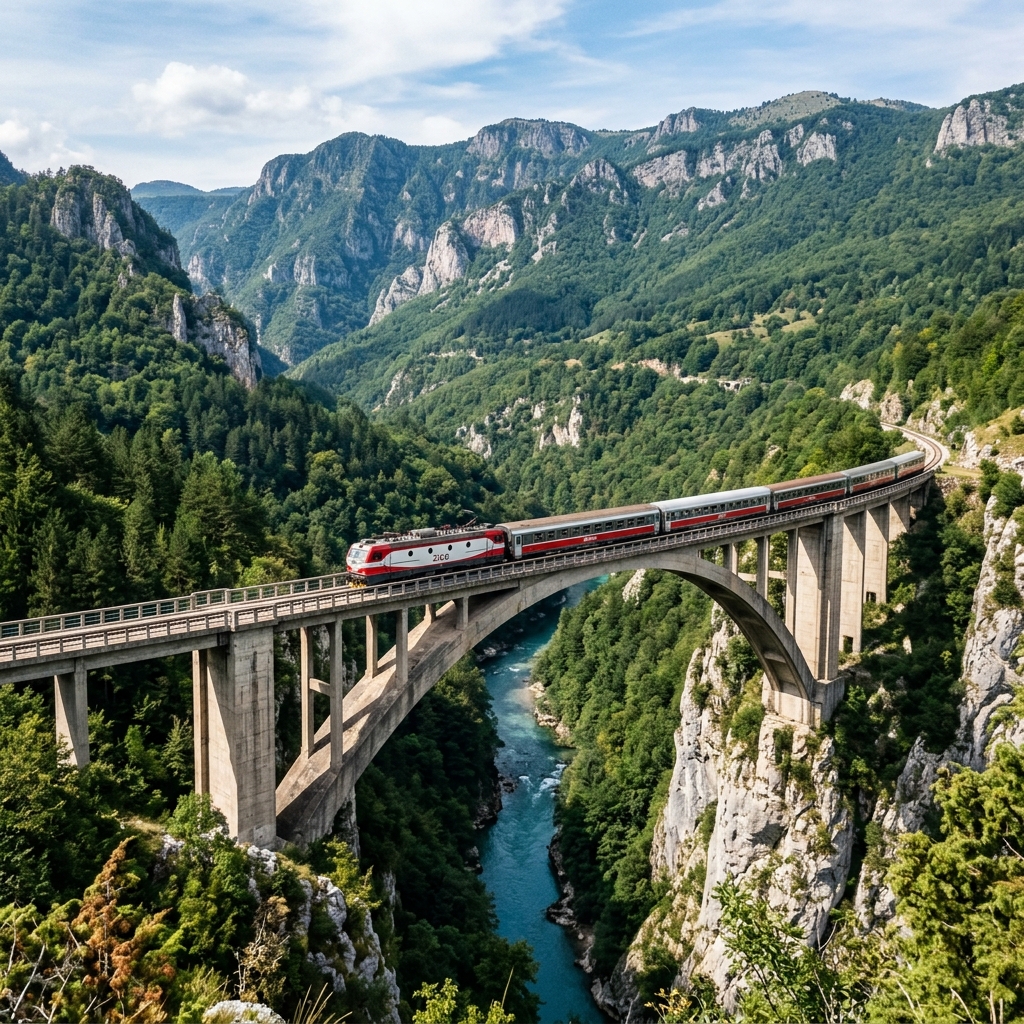
The Belgrade–Bar railway — 476km from the Serbian capital to the Adriatic coast of Montenegro — is widely considered one of the great engineering achievements of the 20th century and one of the world’s most dramatic train journeys. The line climbs from near sea level on the Pannonian Plain to over 1,000 metres in Montenegro, then descends through the Morača Canyon — a 104km limestone gorge where the river runs far below and the canyon walls rise hundreds of metres on each side.
The engineering statistics: 254 bridges, 254 tunnels, the Mala Rijeka viaduct at 198 metres — the tallest railway bridge in the world when it opened in 1973. Construction employed tens of thousands of workers over 17 years (1959–1976), at enormous cost to Yugoslavia’s GDP. The country that built it dissolved in 1991. The railway is still there.
The Morača Canyon section begins approximately 3 hours before Bar: the train enters the gorge and spends the next few hours alternating between tunnels and high viaducts, the river visible far below, the canyon walls closing in and then opening, the vegetation shifting from alpine to Mediterranean as altitude drops. This section justifies the journey by itself.
Service options:
| Service | Departs Belgrade | Arrives Bar | Notes |
|---|---|---|---|
| Day train | ~07:15 | ~18:30 | Full canyon views in daylight |
| Overnight sleeper | ~21:00 | ~08:00 | Couchette; wake on the Montenegrin coast |
The day train is better for scenery; the overnight is better for efficiency and eliminates a hotel night. The overnight has couchette sleepers — basic but functional. Book through srbvoz.rs (Srbija Voz). Fares from approximately €12–€25 depending on class and seat/couchette. The website works in English with an international card.
Belgrade → Sarajevo (approximately 8–9h, from €15)
The Sarajevo rail connection from Belgrade is operationally complicated. A direct train exists but runs infrequently — check current timetables carefully at srbvoz.rs and zfbh.ba, as schedules have changed. Journey times run 8–9 hours with a change at Šamac on the Bosnia–Serbia border; the approach through the Bosnian valleys is spectacular in places but slow.
Most independent travellers take a bus from Belgrade to Sarajevo directly: FlixBus and RegioJet cover the route in 6–7 hours, from approximately €15–€20, with reliable schedules. This is a practical concession to the rail gap rather than a compromise — the bus covers the same landscape and the price difference is negligible.
The Sarajevo–Mostar section by train — once one of Yugoslavia’s scenic showpieces — remains operational, running approximately 2h 30m through the valley of the Neretva. Infrequent, but worth taking if schedules align. Check at zfbh.ba.
Zagreb → Split (5h 30m, from €15)
Croatia’s finest train journey runs from the capital to the Dalmatian coast, crossing the Dinaric Alps via the Lika route — through the Knin canyon, past the medieval fortress at Knin, and down through the limestone karst highlands toward the coast. From Knin southward the scenery is genuinely spectacular: open karst landscape, forested ridges, the occasional distant peak.
Approximately 4–5 services daily; best trains run 5h 30m. Advance fares booked at hzpp.hr (Croatian Railways). The train arrives at Split Predgrađe station, approximately 2km from Diocletian’s Palace — a short bus or taxi ride.
Ljubljana → Zagreb (2h 15m, from €10)
The most efficient cross-border connection in the Balkans: Slovenian and Croatian trains share the corridor smoothly. Multiple daily services; Slovenian track is modern, the Croatian transition imperceptible in comfort. Fares from approximately €10 advance. Book via potniski.sz.si (Slovenian Railways) or hzpp.hr.
Sofia → Istanbul (11h overnight, from €20)
Worth noting for travellers extending east from the Balkans. The overnight service between Sofia and Istanbul Halkali covers 550km in approximately 11 hours — an overnight sleeper through Bulgarian and Turkish Thrace. Book via bdz.bg (Bulgarian State Railways) and TCDD (Turkish Railways). The service is the last remaining direct rail link between the EU and Turkey, and carries a certain historical weight for that reason.
The Belgrade–Bar Line in Full
The line deserves more than a route entry.
History
The line was conceived in the early 1950s as a way to connect landlocked Serbia with a Yugoslav Adriatic port — reducing dependence on Croatian ports (Split, Rijeka) that belonged to a different republic within the federation. The project was one of the most ambitious infrastructure undertakings in postwar European history: 476km of track through terrain ranging from flat agricultural plain to precipitous mountain gorge, requiring 254 bridges and 254 tunnels in a single line.
The Mala Rijeka viaduct stands 198 metres above the river — it was the tallest railway bridge in the world when it opened in 1973. The highest point of the line reaches 1,032 metres above sea level on the Kolašin section in Montenegro. Construction cost Yugoslavia an enormous proportion of its GDP and lives that were not recorded with the precision of Western infrastructure projects.
The federation it was designed to bind together dissolved in 1991. The railway is still there, carrying the same mix of commuters, backpackers, and occasional travellers who understand what it is.
What You See
Belgrade to Vranje (approximately hours 1–3): The Pannonian Plain gives way to the rolling hills of the Serbian Šumadija. Agricultural land, small stations, gradual elevation gain. Not the dramatic part — let it settle over you.
Vranje to the Montenegrin border (hours 3–5): Higher hills, denser forest, limestone formations characteristic of the Balkan interior. The Serbian–Montenegrin border crossing occurs in the Komovi mountain range.
The Morača Canyon (approximately hours 8–11, the final stretch before Bar): The train enters the gorge of the Morača River and begins the descent that makes the journey famous. For three hours, tunnels alternate with high viaducts every few minutes — the river far below, the walls rising hundreds of metres, the vegetation shifting from alpine to coastal Mediterranean as altitude drops. The scale is not photographable in the conventional sense: a wide-angle lens catches the gorge walls but loses the relationship between train and canyon that makes it comprehensible as a human achievement. Watch it from the window. Put the camera down.
Bar station itself is unremarkable. Walk to the waterfront (10 minutes) or take a bus to Budva (40 min), Kotor (1h), or Herceg Novi (1h 30m) for the Montenegrin coast resorts.
[IMAGE: Belgrade-Bar railway crossing the Mala Rijeka viaduct in Montenegro, the tallest railway bridge in the world when built — search terms: Mala Rijeka viaduct Belgrade Bar railway Montenegro]
Country by Country: Rail Reality
Slovenia — Excellent
Small network, well-maintained, punctual by regional standards. Ljubljana to Bled: 65 minutes, from €5 (bus covers the final stretch to Bled village from Lesce-Bled station). Ljubljana to Venice via Trieste: infrequent but beautiful. Book at potniski.sz.si.
Croatia — Good for Main Routes
The Zagreb–Split corridor is the backbone; Zagreb–Rijeka functional. The Dalmatian coast south of Split has no rail — buses are the only option. Istria has minimal rail service. Book at hzpp.hr.
Serbia — Improving
The Belgrade–Novi Sad HSR section is the most significant recent upgrade; the full Budapest–Belgrade line will continue improving. Existing network reaches all cities, slowly. Belgrade–Bar remains the signature journey. Book at srbvoz.rs.
Bosnia and Herzegovina — Slow but Occasionally Spectacular
Split between Federation Railways (ŽFBH, zfbh.ba) and Republic of Srpska Railways (ZRS) with limited coordination. Buses are the practical mode for most routes. Sarajevo–Mostar by rail is worth taking when schedules allow. Book ŽFBH network online; ZRS often requires station windows.
Montenegro — Minimal but Magnificent
Rail is essentially one line: Belgrade to Bar. Local services are minimal; buses handle all practical within-country movement. The train is worth taking for the journey itself. Leave Montenegro by bus toward Croatia or Albania.
Bulgaria — Underrated
Bulgaria’s rail network is more functional than its reputation suggests. Sofia to Plovdiv (2h 15m, NOK ~€8) and Sofia to Varna overnight are useful routes. Sofia to Istanbul overnight is the key international connection. Book at bdz.bg.
A 3-Week Balkans by Train Itinerary
This runs north to south and can be reversed. It uses trains where they are the best option and buses where they are not — the only realistic approach to the Balkans.
Days 1–2: Budapest (arrival) Buda Castle, the thermal baths at Széchenyi or Gellért, the Great Synagogue, ruin bars in the Jewish Quarter on Kazinczy utca in the evening.
the slow travel guide to Budapest — neighbourhoods, food, and the Danube
Days 3–5: Belgrade (7h 30m train from Budapest Keleti, from €15) Kalemegdan Fortress above the confluence of the Sava and Danube, Skadarlija’s cobblestone kafanas, the Zemun waterfront, a Friday evening on a splav (floating river bar). Belgrade is louder and more energetic than its reputation and deserves three nights at minimum.
Day 6: Novi Sad day trip (1h 30m from Belgrade, ~€5 return) Petrovaradin Fortress across the Danube, the compact old town, lunch. Return to Belgrade, or stay one night in Novi Sad and take the morning train south.
Days 7–9: Sarajevo (bus from Belgrade, 6–7h, ~€15–20 via FlixBus or RegioJet) Baščaršija bazaar, the Gazi Husrev-beg Mosque, the Yellow Bastion for city views, the War Childhood Museum (one of the most affecting small museums in Europe), ćevapi at Ćevabdžinica Petica. Sarajevo is a city still processing a recent and complicated history, and it does so with a dignity and warmth that makes it one of the most rewarding urban stops in the Balkans.
Days 10–11: Mostar (bus from Sarajevo, 2h, ~€8) The Stari Most (rebuilt after its destruction in 1993), the old bazaar, the Koski Mehmed Pasha Mosque for rooftop views over the bridge. Two nights is exactly right for Mostar — one day feels rushed; three is slow even by slow travel standards.
Days 12–13: Dubrovnik (bus from Mostar, 3h, ~€12) The old city walls, Stradun, the cable car to Srđ mountain, the Lokrum island ferry. Dubrovnik is expensive by regional standards — mid-range accommodation runs €80–120/night; book early and accept the cost or stay outside the walls in Gruž.
Days 14–16: Split (bus from Dubrovnik, 4–5h, ~€15) Diocletian’s Palace — people live inside a Roman emperor’s 4th-century retirement complex, which is a more extraordinary fact on the ground than it sounds. The Meštrović Gallery, the Marjan Hill park, a day trip to Hvar by ferry (50 min, ~€7). Split is genuinely worth three nights.
how to plan a multi-country European rail itinerary
Days 17–18: Zagreb (train from Split, 5h 30m, from €15 advance) Gornji Grad (upper town), the Museum of Broken Relationships (genuinely excellent — the concept sounds gimmicky; the execution is affecting), the Dolac market on a Saturday morning, trams. Zagreb is undersold as a destination and benefits from people arriving with no particular expectations.
Days 19–20: Ljubljana (train from Zagreb, 2h 15m, from €10) Compact, walkable, beautiful: the Triple Bridge, the Ljubljana Castle funicular, the Tivoli Park, Metelkova (alternative arts district in a former Yugoslav military barracks). Ljubljana is the kind of city where two nights feels exactly right — not too much, not a rushed afternoon.
Day 21: Vienna or onward (train from Ljubljana, ~6h via Villach, from €20) Or extend toward Venice (Ljubljana to Venice, ~3h 30m) if Italy is next. The trans-European rail network connects here in all directions.
the slow travel guide to Vienna — the city by foot and the Ringstrasse by tram
Total transport budget (all rail and bus legs): approximately €80–120 per person with advance booking. Accommodation across the circuit runs €25–60/night at mid-range — dramatically cheaper than an equivalent Western European circuit.
Train vs Bus in the Balkans: The Decision Framework
The Balkans requires accepting that trains and buses are complementary, not alternatives with a clear winner. The practical rule:
Take the train when:
- The train is direct and the bus requires changes (Zagreb–Split, Ljubljana–Zagreb)
- The journey itself is the point (Belgrade–Bar)
- The train saves a hotel night (overnight sleepers to Bar, Sofia–Istanbul)
- You have time and want the experience of the crossing (Budapest–Belgrade)
Take the bus when:
- No useful direct train exists (Belgrade–Sarajevo for most travellers)
- The bus is significantly faster or more frequent (Sarajevo–Mostar, all of coastal Croatia south of Split)
- Cross-country routes with no rail alternative (Bosnia generally, Montenegro internally)
Key operators:
- FlixBus — covers major Balkans cities including Sarajevo, Belgrade, Zagreb, Split, Dubrovnik, Skopje
- RegioJet — Czech operator running Balkans routes; comfortable, air-conditioned, often cheaper than FlixBus and with better on-board service
- Arriva — covers some Croatian and Slovenian regional routes
- Local bus (autobusna stanica) — every Balkans city has a main bus station; for shorter regional routes, local services are more frequent than any European operator and a fraction of the price
Practical: Visas, Currencies, and Booking
Visas: EU and Schengen-area citizens travel freely throughout the region. US, UK, Canadian, and Australian passport holders enter all Western Balkans countries without a visa for stays under 90 days. Check your specific nationality’s requirements for Serbia, Bosnia, and Kosovo — the rules have changed in recent years and the situation for some nationalities differs from the standard.
Currencies: Euro in Slovenia and Montenegro (and Croatia since January 2023, when the kuna was replaced). Serbian dinar (RSD) in Serbia. Bosnian convertible mark (KM/BAM) in Bosnia — pegged to the euro at approximately 1.96 KM = €1. Bulgarian lev (BGN) in Bulgaria — pegged to the euro at 1.96 BGN = €1. Card payments widely accepted in Slovenia and Croatia; cash more important in Serbia and Bosnia, particularly outside cities.
Booking platforms: Book national rail on each country’s operator website (srbvoz.rs, hzpp.hr, potniski.sz.si). Omio aggregates cross-border routes. For overnight trains with sleeping accommodation, book as early as practical — couchette places on the Belgrade–Bar overnight sell out in summer.
Related Reading
- Zagreb by Train: The Underrated Heart of the Balkans — Zagreb is Croatia’s most liveable city — affordable, unhurried, with a covered market, a great coffee culture, and…
- The Adriatic Coast by Train and Ferry: Italy to Croatia Slow — Travel the Adriatic slow: Italy’s coastal rail line from Bologna to Bari, then overnight ferry to Split and…
- Croatia Ferry Guide: Island Hopping the Dalmatian Coast — Croatia ferry guide to island hopping the Dalmatian Coast: Split to Hvar, Vis, Korčula, and beyond.
Frequently Asked Questions
Is Balkans train travel practical for independent travellers?
Yes, with calibrated expectations. Major routes — Budapest→Belgrade, Belgrade→Bar, Zagreb→Split, Ljubljana→Zagreb — are navigable and rewarding by train. Bosnia, coastal Croatia south of Split, and most of Montenegro require buses. Treat trains and buses as a combined toolkit rather than expecting rail to do everything; the regional bus network is extensive and cheap.
night trains in Europe — routes, booking, and what to expect on an overnight service
What is the Belgrade-Bar train and why is it worth taking?
The Belgrade–Bar railway is an 11-hour journey from the Serbian capital to the Montenegrin Adriatic coast, crossing 254 bridges and 254 tunnels. The route climbs to over 1,000 metres and descends through the spectacular Morača Canyon. It is one of the most dramatic train journeys in Europe. The day train offers full canyon views; the overnight sleeper from approximately €12 in a couchette is the efficient option. Book at srbvoz.rs.
Do I need an Interrail or Eurail pass for the Balkans?
Usually not the most economical choice for a standalone Balkans trip. Point-to-point fares are low (€10–25 for most journeys) and Bosnia is not covered by either pass regardless. The pass makes more sense as part of a broader European itinerary combining Balkans travel with significant Western European mileage. Calculate your specific routes before buying.
Eurail and Interrail passes — when they save money and when they don’t
What is the best 3-week Balkans train itinerary?
The recommended circuit: Budapest → Belgrade (train, 7h 30m) → Novi Sad (day trip) → Sarajevo (bus, 6–7h) → Mostar (bus, 2h) → Dubrovnik (bus, 3h) → Split (bus, 4–5h) → Zagreb (train, 5h 30m) → Ljubljana (train, 2h 15m) → Vienna (train, 6h) or home. Six countries, trains where they excel, buses where they don’t, a logical geographic arc.
How do I book trains in the Balkans?
National railway websites: mavcsoport.hu (Hungary), srbvoz.rs (Serbia), hzpp.hr (Croatia), potniski.sz.si (Slovenia). Bosnia’s Federation Railways at zfbh.ba. Omio aggregates cross-border routes. Many shorter regional trains can be bought at the station window without advance booking — still reasonable in the Balkans where demand rarely overwhelms capacity outside peak summer.
Why the Balkans Rewards the Slow Traveller
The Balkans’ slowness is not a problem to be solved. It is the mechanism by which the region reveals itself. A 7h 30min train across the Pannonian Plain gives you time to understand the scale of the flat; the 11-hour Belgrade–Bar gives you time to understand what it took to build a railway through the Morača Canyon at the human cost it required. You don’t understand either of those things from a bus window doing 80 km/h on an adjacent road, and you certainly don’t understand them from 35,000 feet.
There is also the economic dimension. A slow traveller who spends three nights in Belgrade rather than one afternoon in transit finds a city the transit tourist never sees: the kafanas on Skadarlija on a Friday night, the Zemun waterfront restaurants on a Sunday afternoon, the Ada Ciganlija beach in July. A traveller who lingers two nights in Novi Sad understands why people call it the most pleasant city in Serbia. The Balkans is configured for depth rather than efficiency, and its rail network — however imperfect by Western European standards — is exactly the right tool for that kind of travel.
Plan carefully, book overnight trains and peak-season ferries in advance, and leave the rest to the station windows. The trains come.
the Budapest to Belgrade train — detailed booking guide and what to expect
slow travel — the philosophy and practice of going more slowly
Citation Capsule — Budapest to Belgrade: MÁV-START (Hungary) and Srbija Voz (Serbia) operate services between Budapest Keleti and Belgrade. Journey time approximately 7 hours 30 minutes including border processing at Subotica. Fares from approximately €15–20 advance. Book via mavcsoport.hu or omio.com (2025).
Citation Capsule — Belgrade–Bar Railway: Žljeznice Crne Gore (Montenegro) and Srbija Voz (Serbia) operate the 476km Belgrade–Bar line, crossing 254 bridges and 254 tunnels. Journey time approximately 11 hours. The Mala Rijeka viaduct (198m) was the world’s tallest railway bridge when completed in 1973. Fares from approximately €12–25. Book via srbvoz.rs (2025).
Citation Capsule — Zagreb to Split: HŽ (Croatian Railways) operates multiple daily services between Zagreb Glavni Kolodvor and Split, journey time approximately 5 hours 30 minutes via the Lika route through Knin. Advance fares from approximately €15. Book via hzpp.hr (2025).
All transport times, fares, and entry prices reflect November 2025 conditions. Prices in local currencies are approximate euro equivalents at prevailing exchange rates. Verify current fares before booking — timetables across the Balkans change seasonally and some cross-border services are subject to periodic schedule revisions.