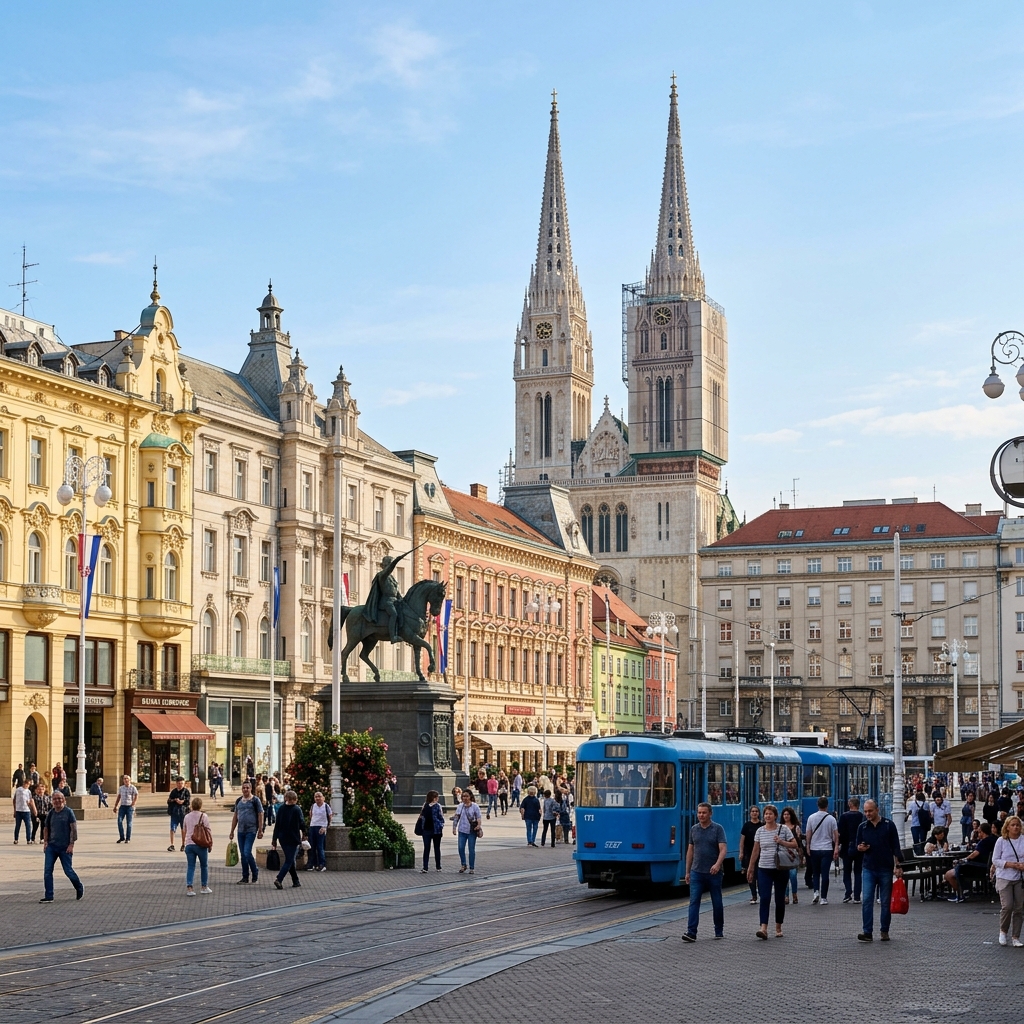
Zagreb doesn’t have a shorthand. There is no single image — no Eiffel Tower, no Colosseum, no ruin bar in a bombed-out factory — that encapsulates the city for the audience that has never been. This is simultaneously Zagreb’s disadvantage and its appeal. The people who arrive expecting something specific are in the wrong city. The people who arrive expecting to find a city going about its life at its own pace, with excellent coffee and a covered market and a very good reason to still be there on Thursday, are exactly where they should be.
Croatia’s tourism infrastructure is, by now, largely built around the coast — Split, Dubrovnik, Hvar, the islands. These are genuine places with genuine pleasures, and the summer crowds are a function of their genuine quality. Zagreb absorbs none of those crowds. The city of 800,000 that functions as Croatia’s capital, its academic centre, and its cultural hub receives a fraction of the tourist attention that Dubrovnik receives and a corresponding fraction of the tourist pricing. This asymmetry is the slow traveller’s opportunity.
the complete guide to European train travel — routes, connections, and booking
TL;DR: Zagreb is the most underrated capital city in the Balkans — affordable (€40–60/day), walkable, with a working daily rhythm of markets and coffee culture that rewards a slow week. Fast trains connect it to Vienna (6h), Budapest (2h 30m), and Ljubljana (2h 15m). The Split-to-Zagreb train via Knin is one of the most beautiful daytime rail journeys in Southeast Europe. There are no Game of Thrones crowds. There is a Museum of Broken Relationships, a magnificent cemetery, and a Baroque day-trip city an hour away.
Getting to Zagreb by Train
Zagreb Glavni kolodvor — the Main Station — is a yellow Historicist building from 1892, sitting at the south end of a sequence of Lenuzzi Horseshoe parks (the “Green Horseshoe”) that form Zagreb’s most elegant public space. Arriving by train, you walk out into a square with a horseshoe of parks and gardens ahead of you and the city starting immediately in the streets beyond. It is a very good way to arrive.
From Vienna: 6 Hours
The direct Railjet service from Wien Hauptbahnhof to Zagreb Glavni kolodvor runs approximately 6 hours, with multiple departures throughout the day. Advance fares start from around €30. The journey passes through Slovenia — Maribor, Ljubljana — and offers the gradual shift from Alpine to Balkan landscape that is one of the pleasures of this corridor. If you’re combining Vienna and Zagreb on a longer slow travel trip, the direct connection makes the pairing logical.
From Ljubljana, the train stops before reaching Zagreb for those who want a night in Slovenia’s compact and beautiful capital en route.
From Budapest: 2 Hours 30 Minutes
The Budapest Keleti to Zagreb Glavni kolodvor EC service takes approximately 2 hours 30 minutes, making it one of the faster and cheaper cross-border connections in Central Europe. Advance fares run €15–40 depending on booking window and service. This is perhaps the most natural pairing in the region: Budapest and Zagreb share a certain Central European quality — the Habsburg architecture, the coffee culture, the thermal bath tradition (Zagreb has the Stubičke Toplice spa complex 45 minutes by bus) — that makes moving between them feel continuous rather than jarring.
From Ljubljana: 2 Hours 15 Minutes
The Ljubljana to Zagreb train takes approximately 2 hours 15 minutes and is among the best-value cross-border connections on the Balkans route. Fares start from as little as €10–25 advance. If you’re on a Zagreb–Ljubljana–Vienna or Zagreb–Ljubljana–Trieste corridor, this connection makes both cities accessible in sequence without a budget airline or a rental car.
From Split: 5 Hours 30 Minutes via Knin
The Split to Zagreb service, running inland via the Dalmatian hinterland and the Knin gorge, takes approximately 5 hours 30 minutes and is one of the most scenically remarkable daytime rail journeys in Southeast Europe. The line climbs from the Dalmatian coast through the Dinaric Alps — limestone karst, river gorges, the Krka canyon from above — before descending into the Sava plain and Zagreb. It is long. It is unhurried. It is exactly the kind of journey that justifies train travel as a mode of seeing rather than simply a mode of arriving.
Fares are modest by European standards — typically €20–35 regardless of booking window. Reserve a seat facing the direction of travel and a window seat on the right side heading north toward Zagreb.
From Prague: 9 Hours
The Prague–Zagreb connection requires changes and runs approximately 9 hours. It’s feasible as an overnight option with a night train to Vienna and a connection south, or as a long day journey for those with a high tolerance for train time. Not the most natural connection, but navigable.
The Two Parts of Zagreb
Zagreb’s geography is simple: an Upper Town (Gornji Grad) on the hill, and a Lower Town (Donji Grad) on the plain below. The two are connected by a funicular that has been running since 1890 — 66 metres of track, technically the world’s shortest public funicular, a ticket costing €0.66 — and by staircases and sloped streets. The character of the two towns is entirely different.
Gornji Grad: The Upper Town
The Upper Town is the medieval core: cobbled streets, a cathedral, St Mark’s Church with its famous tiled roof bearing the coats of arms of Croatia, Dalmatia, Slavonia, and Zagreb in brilliantly coloured majolica tiles. The Lotrščak Tower, a 13th-century fortification at the top of the funicular, fires a cannon every day at noon — a tradition dating to 1877, and one of those minor urban rituals that becomes, over a week, a surprisingly reliable pleasure. Climb the tower for the best view over the city and the Sava plain beyond.
[IMAGE: St Mark’s Church in Zagreb’s Upper Town with its distinctive tiled roof showing the Croatian coat of arms — search terms: Zagreb St Mark’s Church tiled roof Gornji Grad]
The streets around the Cathedral and through Kaptol to the north of Gornji Grad are the oldest part of the city. The Archbishop’s Palace, the Cathedral of the Assumption (damaged in the 2020 earthquake and under restoration, but still open for visits), the Dolac market below — this quarter repays walking slowly, turning into any alley that looks promising, returning a different way.
Donji Grad: The Lower Town and Tkalčićeva Street
The Lower Town is 19th-century and Austro-Hungarian in character — the broad boulevards, the neoclassical public buildings, the sequence of parks that Herman Bollé designed as the Green Horseshoe in the 1880s. Ban Jelačić Square (Trg bana Josipa Jelačića) is the central hub: a large open square with a mounted statue of the ban (governor) Jelačić that was removed during the communist era and reinstated in 1990. Trams cross it continuously; the city’s entire tram network originates here.
Tkalčićeva Street, running north from the square toward the Upper Town, is the social artery of Zagreb: a pedestrianised street lined with cafés and bars, operating at outdoor seating density even in winter, the site of the city’s coffee culture in its most concentrated form. The Croatian coffee ritual — kavica, a small, strong espresso, consumed slowly, ideally with someone, ideally for longer than seems efficient — happens here at all hours of the day. Participating in it is the first act of slow travel in Zagreb.
On the kavica: There is a particular Zagreb quality to sitting on Tkalčićeva with a small espresso at 10am on a Tuesday with nowhere specific to be. The street faces south; if it is March and the sun is at the right angle, you are warm. The coffee costs €1.20. The conversation at the table next to you is in Croatian. Nobody is looking at their phone in a way that suggests urgency. This is a city that has not yet confused busyness with productivity, and the coffee ritual is its most honest expression.
What to Do Properly
Dolac Market
The Dolac covered market, occupying a raised terrace just above Ban Jelačić Square, has been the centre of Zagreb’s food supply since 1930. The open-air flower and vegetable section operates daily; the covered meat and dairy hall below runs Tuesday through Saturday. Saturday morning is the full expression: flower stalls, local farmers with early spring vegetables, stalls of Paški sir (Pag island cheese), kulen (Slavonian paprika sausage), fresh bread, ajvar (roasted pepper relish) in jars, honey from the Zagorje region.
Buy cheese and cured meat from the covered hall, bread from the bakers around the market’s edges, and sit on the market terrace with a coffee from one of the small bars. This is breakfast done correctly in Zagreb.
Museum of Broken Relationships
The Museum of Broken Relationships, on Ćirilometodska Street in the Upper Town, is one of the most original and affecting museums in Europe. It was conceived in 2006 by Zagreb artists Olinka Vištica and Dražen Grubišić, who decided to collect the objects that remained after a relationship ended — the photographs, the letters, the prosthetic leg, the garden gnome stolen as an act of small revenge — together with short essays by the donors about what the relationship and its ending meant. The collection has since expanded to include donations from around the world, and the museum occupies a permanent space in the Upper Town.
The effect is not sad, exactly, but it is genuinely moving in a way that formal art collections rarely are. The essays are short, often funny, sometimes devastating. Allow 90 minutes. It is £7–9 entry and consistently produces the sense of having spent time in exactly the right place.
Mirogoj Cemetery
Mirogoj cemetery, designed by Hermann Bollé and opened in 1876, is a 20-minute tram ride north of the city centre. The approach through the long arcade of neo-Renaissance arcades, domed towers, and covered walkways is one of the great architectural approaches in any Croatian city — the proportions are Venetian in quality, the material local stone, the effect both solemn and humane.
The cemetery is mixed-faith — Catholic, Orthodox, Jewish, Muslim sections coexist without apparent hierarchy — which reflects something important about Zagreb’s self-understanding. The sculpture throughout is worth more time than most visitors give it: 19th and early 20th-century funerary monuments at a quality level that would be museum-worthy in most cities.
Take tram 106 from the city centre; the journey takes around 20 minutes. Go on a weekday morning when the cemetery is quiet. Allow two hours.
The Funicular and the Lotrščak Tower
The Zagreb funicular is 66 metres long, operates on a 52-degree incline, and has been running continuously since 1890. The ticket costs €0.66 (one of the more pleasingly logical pricing decisions in European public transport). It runs every 10 minutes from 6:30am to 10pm. Take it up; walk down via the Upper Town streets. Repeat as needed.
The Lotrščak Tower adjacent to the funicular’s upper station fires a cannon (a small, actual cannon) every day at noon. The tradition commemorates a medieval warning system used to signal the city’s gates. It is now one of those minor civic rituals that becomes unexpectedly charming when you are there for it — particularly if you have forgotten it is coming.
Where to Eat
Konoba Didov San
Konoba Didov San, tucked into the Upper Town on Mletačka Street, is the restaurant that most consistently represents Croatian cooking as it should be: fresh ingredients from the Dalmatian hinterland and the Adriatic, simple preparation, no pretension. The peka (slow-cooked meat or fish under a bell-shaped lid covered in embers) is ordered 24 hours in advance and is the reason to go. The wine list is Croatian-focused. The room is small and warm. Book ahead for dinner.
Mundoaka Street Food
Mundoaka, on Petrinjska Street in the Lower Town, is the city’s best casual eating — a small, busy space serving bowls influenced by Asian and Levantine cooking, using Croatian produce. It opened in 2012 and has maintained a consistent standard that makes it the answer to the question of where to have lunch on any given weekday. No reservations; arrive at noon or after 1:30pm to avoid the queue.
The Craft Beer Scene
Zagreb’s craft beer scene has expanded considerably since 2018. Zmajska Pivovara (Dragon Brewery), in a converted space on Ilica Street, was one of the first and remains one of the best — 12 taps, rotating seasonal releases, a relaxed atmosphere that is neither tourist bar nor exclusively local in a way that excludes the curious visitor. Garden Brewery’s taproom in the east of the city is the larger destination operation. Both are worth an evening.
Budget Eating: Ćevapi and the Burek Question
For €3–5, Zagreb offers the two canonical fast foods of the former Yugoslav republics. Ćevapi — small grilled minced meat rolls in a flatbread, served with raw onion and the yoghurt sauce called kajmak — are available at dozens of small stands across the city. The burek question (whether burek refers only to the meat-filled version or can include cheese and spinach variants) is technically a Balkan culture war, and Zagreb residents will have opinions. Order the cheese version (sir burek) and wait.
Getting Around Zagreb
Zagreb’s tram network, operated by ZET, covers the Lower Town comprehensively. The central hub is Ban Jelačić Square; from there, trams run west along Ilica (the longest street in Croatia), east toward Heinzelova and the new city, and south toward the train and bus stations. A single 30-minute tram ticket costs €0.53 via the ZET app or €0.66 from the driver. A 24-hour day pass costs €1.99 via the app — one of the most affordable public transport day tickets in Europe.
The Zagreb Card (24-hour €13.27, 72-hour €18.58) includes unlimited tram travel plus free or discounted entry to the city’s museums. For a first or second day — when you’re visiting several museums — it pays for itself; for subsequent days, the €1.99 day pass is sufficient.
The Upper Town is not served by trams. Reach it by funicular (€0.66, 66 metres), by the free Agram electric shuttle that runs through the Upper Town streets, or on foot via the staircases from Tkalčićeva or the Dolac market.
Day Trips by Train
Varaždin: 1 Hour North
Varaždin is the outstanding day trip from Zagreb: a Baroque city of 46,000 people in the Zagorje region, 1 hour north by HŽ (Croatian Railways) train, with a beautifully preserved historic centre of a kind that suggests an Austrian provincial capital that somehow ended up south of the border.
The centrepiece is the Stari Grad (Old Town Castle), a Renaissance fortification with a working drawbridge and a moat, housing the Varaždin City Museum. The historic centre surrounding it — pedestrianised streets of Baroque palaces, the Cathedral of the Assumption, the Church of the Ursulines — is compact, walkable, and almost completely free of international tourism. A Saturday in Varaždin, when the town market is running and the streets are busy with locals rather than visitors, is one of the more pleasant day trips available in this part of Europe.
Trains depart Zagreb Glavni kolodvor roughly every hour; the return fare is typically €6–10. Leave Zagreb at 9am; return at 5pm. This is enough.
Sisak: 1 Hour South
Sisak is a quieter option: a small Posavina town at the confluence of the Sava and Kupa rivers, 1 hour south of Zagreb by train, with a triangular Renaissance fortress (the Stari Grad of Sisak, 1544) and a pleasant town centre that has essentially no tourist infrastructure. For slow travellers who want a half-day outside Zagreb without the mild formality of Varaždin’s well-preserved centre, Sisak offers something more unmediated: a Croatian town going about its daily life without particular reference to visitors.
Zagreb as a Base for Croatia
The slow travel case for Zagreb is strongest when the city functions as a base rather than an endpoint. From Zagreb, the whole of Croatia becomes navigable by train, bus, and occasional ferry: the Dalmatian coast by the scenic Split train, Plitvice Lakes by bus (2 hours), Istria by bus (3 hours to Pula), Slavonia (Osijek, 3.5 hours by train) for a completely different face of the country — flat, agricultural, influenced by Hungarian and Ottoman rather than Venetian history.
A week in Zagreb with day trips to Varaždin, a day at Plitvice, and a three-night extension to Split (or the reverse — Split first, then the train journey north to Zagreb) constitutes one of the most complete Croatian itineraries available, using almost no internal flights and almost no rental cars.
Budapest slow travel guide — thermal baths, ruin bars, and the two-bank city
Practical Information
Currency: Euro (since 1 January 2023). Cash is widely accepted; card payments work at most restaurants and shops.
Language: Croatian. English is widely spoken among anyone under 45, less reliably among older residents. A few words of Croatian — hvala (thank you), molim (please/you’re welcome), dobar dan (good day) — are received with disproportionate warmth.
Budget: Zagreb costs approximately €40–60 per day for a slow traveller — accommodation in a mid-range apartment or guesthouse, three meals, coffee, trams, and occasional museum entries. This is roughly half the equivalent spend in Vienna or Ljubljana. Weekly apartment rentals run €300–500 in the centre.
Safety: Zagreb is safe by any standard — low street crime, well-lit at night, comfortable for solo travellers. The 2020 earthquake caused significant damage to some Upper Town buildings and the Cathedral, several of which remain under restoration. The Cathedral is open for visits during restoration.
When to go: April to June and September to October are the best months — mild temperatures, lower visitor numbers than the summer peak, outdoor café life in full effect. July and August are warm and busy; January and February are cold but atmospheric, with the Christmas market running into early January and genuine winter quiet thereafter.
Related Reading
- The Balkans by Train: A Complete Rail Route Guide — Balkans by train: key routes, times, and prices — Budapest to Belgrade, the legendary Belgrade-Bar overnight, Zagreb…
- Budapest to Belgrade by Train: The Balkans Express — Budapest to Belgrade by train takes 7h 30min and costs from €15 advance.
- The Adriatic Coast by Train and Ferry: Italy to Croatia Slow — Travel the Adriatic slow: Italy’s coastal rail line from Bologna to Bari, then overnight ferry to Split and…
Frequently Asked Questions
How do I get to Zagreb by train?
From Vienna: direct Railjet in approximately 6 hours, advance fares from €30. From Budapest: direct EC train in around 2 hours 30 minutes, fares from €15–40. From Ljubljana: direct train in approximately 2 hours 15 minutes, fares from €10–25. From Split: the scenic inland route via Knin takes around 5 hours 30 minutes — one of the most beautiful railway journeys in the Balkans. All services arrive at Zagreb Glavni kolodvor, a 15-minute walk from the Upper Town.
Is Zagreb worth visiting as a slow travel destination?
Zagreb is one of the best-value and most underappreciated slow travel destinations in Europe. The city has a genuine daily rhythm — the morning Dolac market, the afternoon kavica on Tkalčićeva, the evening promenade — that rewards participation rather than observation. Costs are €40–60 per day. There are no Game of Thrones crowds (that’s Split), no cruise ship infrastructure, and no particular expectation of what a tourist should do. Zagreb is simply a very good city to be in for a week.
What currency does Croatia use now?
Croatia adopted the euro on 1 January 2023, replacing the kuna. All transactions in Zagreb are in euros. Prices have risen somewhat since adoption, but Zagreb remains significantly cheaper than Vienna, Ljubljana, or Budapest. A coffee costs €1–1.50; a tram ticket is €0.53; a good dinner for two with wine runs €35–55.
What are the best things to do in Zagreb?
The Dolac market on Saturday morning is the essential experience — the whole social life of the city in miniature. The Museum of Broken Relationships is one of the most original museums in Europe. Mirogoj cemetery is the most beautiful cemetery in the Balkans, designed by Hermann Bollé in 1876. The Upper Town (Gornji Grad) contains St Mark’s Church with its famous tiled roof, the Lotrščak Tower, and the world’s shortest public funicular (66 metres, €0.66). Tkalčićeva Street is where the coffee culture operates in its most concentrated form.
What day trips can I take from Zagreb by train?
Varaždin (1 hour north, €6–10 return) is the outstanding option: a Baroque city with a Renaissance castle, a working drawbridge, and a beautifully preserved historic centre that is virtually free of international tourism. Sisak (1 hour south) is a quieter alternative. For Plitvice Lakes — the most spectacular natural site within day-trip range — the connection is by bus (2 hours) rather than train, but well worth including if you have a day available.
The Case for Zagreb
There is a type of European city that rewards the traveller who arrives without a specific expectation and punishes the one who arrives with a list. Zagreb is this type of city. It does not have a single iconic image. Its pleasures are distributed across a covered market, a peculiar museum, a very good espresso, a cemetery, a tram, a Baroque town an hour north, a cannon fired at noon.
What it has, in a quantity that cities with more famous names do not always have, is a sense of its own life continuing around you in a way that is inviting rather than indifferent. The market stallholder on Saturday morning is selling cheese to the same people she sold cheese to last week. The bar on Tkalčićeva has a Tuesday regulars problem because Tuesday is when the regulars come. The city is not performing itself for your benefit. It is simply operating, and it is inviting you to operate within it for as long as you choose to stay.
A week is the right amount of time. Enough for the Dolac market to become routine, for the tram routes to become second nature, for the day trip to Varaždin and the night in the craft beer bar and the afternoon at Mirogoj. Enough for Zagreb to stop being a city you are visiting and start being a city you temporarily inhabit.
It costs €40–60 a day to inhabit it. That is, by any measure, a reasonable price for a city that rewards you this generously.
the complete guide to European train travel — routes, booking, and what to expect
Budapest slow travel guide — thermal baths, ruin bars, and the two-bank city
Vienna slow travel guide — coffeehouses, the Ringstrasse, and Central Europe by rail
All transport times, fares, and price ranges reflect January 2026 conditions. Croatian Railways (HŽ) and international EC/Railjet fares vary by booking window and travel date — figures quoted represent typical advance pricing. Exchange rate: all prices in euros (Croatia adopted the euro 1 January 2023).