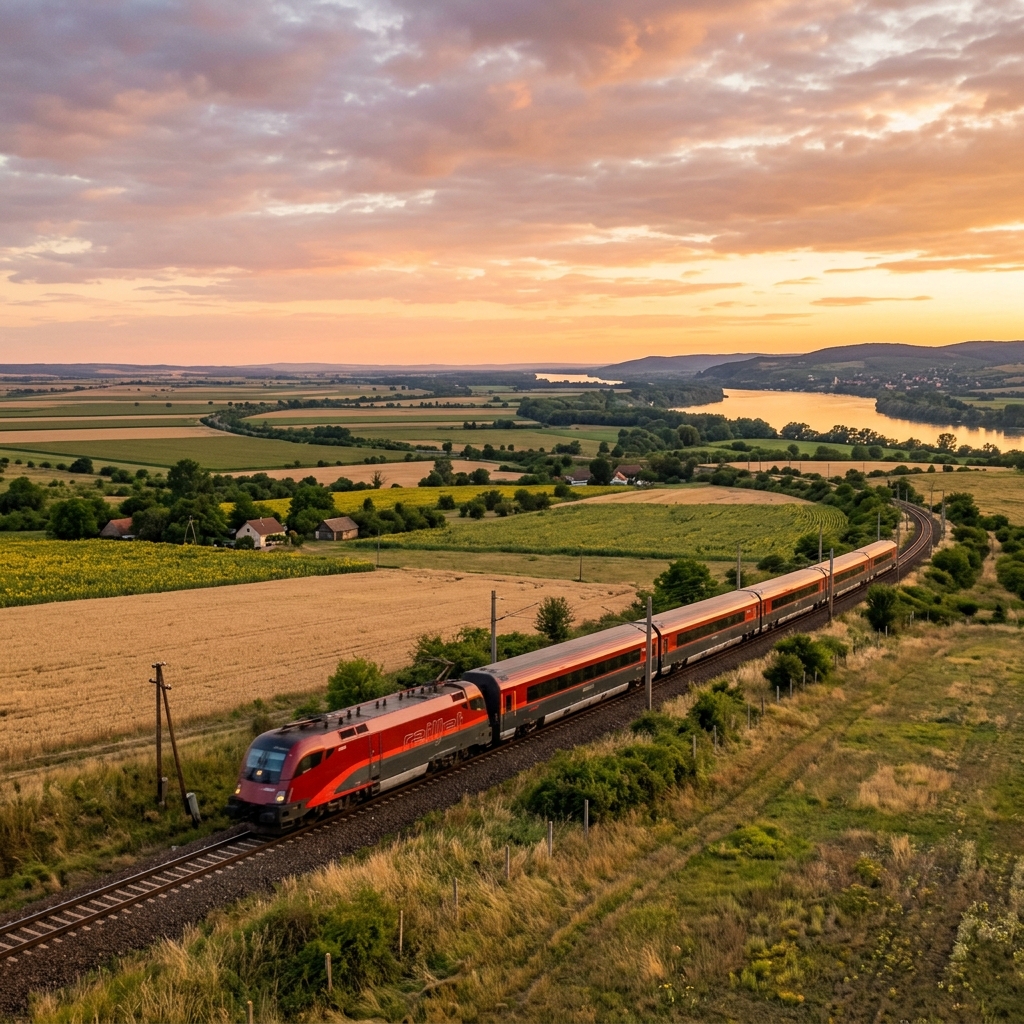
The train from Budapest to Belgrade is not trying to be efficient. It takes 7 hours 30 minutes to cover approximately 370 kilometres — a pace that would be considered slow on any Western European corridor. The track is old, the stations are crumbling in parts, and the border crossing adds 30–40 minutes of on-train passport processing somewhere in the middle of the Pannonian Plain.
All of this is precisely the point. The Budapest–Belgrade corridor is the gateway to the Balkans by rail, and the Balkans have never been primarily about efficiency. They are about depth: layered histories in modest spaces, remarkable food at implausible prices, a pace of life that hasn’t yet been rationalised into productivity. The 7h 30m train from Budapest Keleti to Beograd Centar gives you time to understand the transition from Central to South-Eastern Europe as it happens, kilometre by kilometre.
The journey is also, at least in name, temporary. A Hungarian–Chinese joint venture is building high-speed rail on this corridor. When it opens — projected for 2026–2027, though Balkans infrastructure timelines tend to slip — the journey will compress to approximately 3 hours. Take the slow train while you still can.
TL;DR: Budapest to Belgrade currently takes 7h 30min by direct train. Advance second-class fares from approximately €15–20. Border crossing on the train at Kelebia/Subotica adds 20–40 min. Serbia is visa-free for most Western passports; currency is Serbian dinar (not euro). Belgrade is one of Europe’s most affordable capitals at €30–40/day.
The Journey: Budapest Keleti to Beograd Centar
Budapest Keleti: The Departure
Budapest Keleti is the city’s main international railway terminal — a 19th-century station in the Erzsébetváros district, with a handsome neoclassical facade and the controlled chaos of a station that serves as the junction for much of Eastern Europe’s rail network. Trains to Vienna, Bratislava, Prague, Bucharest, Zagreb, and Belgrade all depart from Keleti.
The station is served by Metro lines M2 (Keleti pályaudvar) and M4 (Keleti pályaudvar), making it one of Budapest’s most accessible major transit points. Allow 20 minutes from central Pest, 30 minutes from the Buda side.
The international ticket windows are at the far left of the main concourse. Queue times can be long in summer; the MÁV-START app or website allows advance booking and avoids the queue. Seat reservations are strongly recommended on the Budapest–Belgrade service and often mandatory for the cheapest advance fares.
Operators: MÁV and Srbija Voz
The Budapest–Belgrade service is operated jointly by MÁV (Magyar Államvasutak) — Hungarian State Railways — and Srbija Voz — the Serbian national rail operator. You board a single train at Keleti; the locomotive typically changes at the border or in Belgrade. The carriage quality varies: some are reasonably modern, others are older stock. Second-class (2nd class) compartments are the standard; first-class carriages are available and worth the small premium on a 7h 30m journey for the extra space and usually quieter environment.
[IMAGE: Budapest Keleti station interior, arched hall with natural light — search terms: Budapest Keleti station interior trains hall]
Booking the Budapest to Belgrade Train
MÁV-START (mavcsoport.hu) is the primary booking site and app — available in English, accepting international credit cards. The booking window typically opens 60 days in advance for international services. Advance fares in second class start from approximately €15–20; first class approximately €25–35.
Omio aggregates MÁV and Srbija Voz inventory and is useful for checking what’s available without navigating an unfamiliar booking interface. Omio adds a booking fee (typically €2–5) but the convenience is genuine.
At the station: International ticket windows at Budapest Keleti sell same-day and advance tickets; a small queue is likely but they’re accustomed to English speakers. At Belgrade, the Srbija Voz ticket windows at Beograd Centar handle returns and onward Serbian connections.
Interrail/Eurail passholders: Both MÁV and Srbija Voz are covered by Interrail/Eurail, but seat reservations are mandatory and must be booked separately. Hungarian reservations run approximately €3–5; Serbian reservations approximately €2–3. (Interrail, 2025)
The Border Crossing: What to Expect
The Hungary–Serbia border is crossed somewhere in the flat agricultural landscape south of Budapest, near the village of Kelebia on the Hungarian side and Subotica on the Serbian side. You do not leave the train.
The sequence:
- The train slows and stops on Hungarian territory (near Kelebia)
- Hungarian border police board the train and walk through each carriage checking documents
- Hungarian exit stamps are applied (for non-EU travellers)
- The train moves forward across the border
- Serbian border police board and check passports
- Serbian entry stamps are applied (for non-EU travellers)
Total time: 20–40 minutes depending on volume. The train waits; it does not leave without the border process completing.
Documents:
- EU citizens: EU ID card or passport valid for the journey
- Non-EU citizens (US, UK, Canada, Australia, NZ, etc.): Passport required; Serbia grants 90-day visa-free stays for most Western nationalities. Check the Serbian MFA’s current list for your specific country
- Note: Serbia is not in the EU and its border controls are not Schengen. If you are travelling on a Schengen visa, your exit from the Schengen Area occurs at the Hungarian border; your Serbian entry is separate
Keep your passport easily accessible from boarding — the border police work efficiently but expect everyone to have documents ready.
Novi Sad: The Essential Stopover
Novi Sad is 1h 30m from Belgrade by train and sits in the direct line between Budapest and Belgrade — making it a natural one or two night stop on this journey. It is, in the honest assessment, one of the most underrated cities on the Central European rail circuit.
The Petrovaradin Fortress
The fortress on the cliff above the Danube is Novi Sad’s defining landmark — a massive 18th-century Habsburg military construction that took 88 years to build and is sometimes called the “Gibraltar of the Danube.” The views from the upper terrace over the Danube and the Novi Sad skyline are among the best in the region.
The fortress is also, every July, the site of the EXIT Festival — one of Europe’s major electronic and alternative music festivals, with an attendance of around 200,000 over four days. If your timing aligns (and it’s worth engineering your itinerary to make it do so), EXIT is one of the best festival experiences in Europe: excellent lineups, remarkable venue, reasonable prices by Western European standards, and a full-city atmosphere that smaller, more sanitised festivals rarely achieve.
The Old Town and Eating Well
Novi Sad’s Stari Grad (old town) is a compact, walkable Austro-Hungarian district centred on Trg Slobode (Freedom Square) and the neoclassical Novi Sad City Hall. The streets around the square are full of kafanas (traditional Serbian taverns), bakeries selling burek (filo pastry with cheese or meat), and the kind of unpretentious restaurant scene that appears when a city is not overwhelmed by tourism.
Eat: Kafana Donat for traditional Serbian food in a genuine kafana atmosphere. Order ćevapi (grilled minced meat) and roasted peppers; drink local wine or rakija (fruit brandy). Budget €10–15 per person for a full dinner.
Belgrade: Why It Rewards Slow Travellers
Beograd Centar: The Arrival
The new Beograd Centar station opened in 2018 in the Savamala district, part of the broader Belgrade Waterfront (Beograd na vodi) development along the Sava river. It’s a modern, functional station with good Metro and tram connections into the city centre. The older station — Beograd Glavna — is being phased out of service as Beograd Centar takes over all intercity routes.
From Beograd Centar, tram line 13 or a 20-minute walk reaches Terazije, the city’s main square. A taxi or Bolt runs approximately €3–5.
Kafana Culture
The kafana is Serbia’s foundational social institution — a traditional tavern that functions simultaneously as a restaurant, café, bar, and community gathering place. Belgrade has hundreds of them, ranging from grand 19th-century establishments to neighbourhood holes-in-the-wall where the television shows football and the rakija is house-made.
The kafana is the right place to understand Belgrade. Order domaća kuhinja (home cooking): prebranac (slow-cooked beans with onions and paprika), pasulj (bean soup), roasted pork or lamb. Bring no agenda. The evening in a good kafana in Skadarlija (Belgrade’s bohemian cobbled quarter) — where the kafanas have been established since the 19th century, when artists and bohemians colonised the street — lasts as long as it needs to.
Recommended: Tri Šešira or Zlatni Bokal in Skadarlija for a classic introduction; Kafana ? (Café “Question Mark,” open since 1823) in the old Dorćol district for the most historically layered option.
The Belgrade Nightlife Reputation
Belgrade’s nightlife is genuinely exceptional — not by tourist-brochure logic but by the measurable fact that people fly from Western European cities specifically to experience it. The city’s river barges (splavovi) — floating clubs along the Sava and Danube — operate from around midnight to dawn and host serious electronic music programmes. The central club scene around Savamala is younger and more mixed in music style.
This is not obligatory. Mentioning it because the slow traveller who arrives in Belgrade intending only kafanas and history and church-hopping sometimes discovers around midnight that the city is doing something different, and that it’s worth investigating.
Zemun
Zemun is a village that was absorbed into Belgrade’s urban fabric — technically part of the city, physically and atmospherically a different place. It sits on the Danube upstream from Belgrade proper, its streets narrower and more Austro-Hungarian in character (Zemun was part of the Habsburg Empire while Belgrade was Ottoman, and the distinction is still architecturally visible). The waterfront fish restaurants along the Zemun key are excellent; order fresh Danube fish (carp, catfish, pike) prepared in the Serbian manner.
Reach Zemun by bus from central Belgrade (around 20 minutes, roughly 50 RSD) or by taxi/Bolt (approximately €5).
Ada Ciganlija: The River Beach
Ada Ciganlija is a river island connected to the Belgrade bank, forming a lake on the city side that serves as Belgrade’s main swimming and recreation area. In summer it operates as a beach — sand, sunbathers, outdoor bars, water sports — that is entirely informal and almost entirely local. Entry is free. The 4km walking/cycling path around the lake is pleasant year-round.
It is one of those city amenities that reveals something important about a place: that Belgrade, for all its historical turbulence, prioritises a version of public pleasure that feels genuinely civilised.
[IMAGE: Belgrade Kalemegdan Fortress at sunset, view over the Sava and Danube rivers — search terms: Belgrade Kalemegdan fortress Sava Danube confluence sunset]
Practical: Serbia on a Budget
Serbia is not in the EU and does not use the euro. The currency is the Serbian dinar (RSD). Exchange rates (approximate as of 2025): €1 ≈ 117 RSD; $1 ≈ 108 RSD.
Use ATMs for the best exchange rates; avoid exchanging at hotels or airport windows. Most restaurants and shops in Belgrade accept cards, but having some dinar for smaller kafanas, markets, and transport is practical.
Daily budget estimates (Belgrade, 2025):
| Category | Budget | Mid-range |
|---|---|---|
| Accommodation | €25–40 | €50–80 |
| Food (3 meals) | €12–18 | €20–30 |
| Transport | €2–4 | €5–10 |
| Sights/activities | €3–8 | €10–20 |
| Total | €42–70 | €85–140 |
Belgrade is one of the most affordable European capitals for Western visitors. A good mid-range hotel in the city centre costs less than a budget hostel in Amsterdam.
Visa: Serbia grants visa-free entry for 90 days to citizens of EU countries, USA, UK, Canada, Australia, New Zealand, Japan, and most other Western nations. Check the current Serbian MFA list for your passport. (Serbian Ministry of Foreign Affairs, 2025)
The High-Speed Line: What’s Coming
The Budapest–Belgrade high-speed rail project is a joint venture between Hungary, Serbia, and China (the construction is led by a Chinese state-owned enterprise, CCCC, funded partly by Chinese loans). The line will reduce the 7h 30m journey to approximately 3 hours at design speeds up to 200 km/h.
The Hungarian section (Budapest–Kelebia) is further along and partially open for freight testing. The Serbian section (Subotica–Novi Sad–Belgrade) is under construction with Novi Sad–Belgrade expected first. The full line opening date has shifted repeatedly — current projections suggest 2026–2027 for the Serbian section, with the complete Budapest–Belgrade corridor potentially operational by late 2027.
When it opens, the Budapest–Belgrade corridor will change character entirely: it will become a functional day-trip connection, integrating Belgrade more fully into the Central European orbit. The long, contemplative journey across the plain will be replaced by something faster and more contemporary. Take it now while it still has the character of a genuinely transcontinental passage.
Budapest and what to do there wider European rail context
Related Reading
- Budapest by Train: How to Get There, What to Eat, and Why It’s Worth the Journey — Budapest is one of Europe’s great train destinations — connected to Vienna in 2h 40min, Prague in 7h, and a city…
- Zagreb by Train: The Underrated Heart of the Balkans — Zagreb is Croatia’s most liveable city — affordable, unhurried, with a covered market, a great coffee culture, and…
- The Bernina Express: Switzerland’s Most Scenic Train Journey — The Bernina Express crosses the Alps from Chur to Tirano in 4 hours — UNESCO-listed, panoramic windows, and views…
Frequently Asked Questions
How long does the Budapest to Belgrade train take?
Currently approximately 7 hours 30 minutes on the direct service from Budapest Keleti to Beograd Centar. The journey includes a 20–40 minute border crossing near Kelebia/Subotica. A high-speed line currently under construction between Hungary and Serbia will reduce the journey to approximately 3 hours when complete; projected opening is 2026–2027, with Balkans infrastructure timelines historically subject to delays.
How do I book Budapest to Belgrade train tickets?
Book via the MÁV-START app or website (mavcsoport.hu) — available in English, accepting international cards. Omio also aggregates this route. The booking window is typically 60 days for international tickets. Second-class advance fares start from approximately €15–20. Seat reservations are strongly recommended and often included in the advance fare; book early on weekends.
What happens at the Hungary–Serbia border crossing?
The border crossing occurs on the train — you do not disembark. Hungarian border police board and check passports on the Hungarian side; Serbian border police board on the Serbian side. The combined process takes approximately 20–40 minutes. EU citizens need their EU passport or ID card; most non-EU Western nationals (USA, UK, Canada, etc.) enter Serbia visa-free for 90 days with a valid passport. Serbia is not Schengen — this is a full international border crossing with stamps.
Is Novi Sad worth a stopover?
Strongly recommended. Novi Sad is directly on the Budapest–Belgrade corridor (1h 30m from Belgrade by train) and offers the Petrovaradin Fortress, a pleasant Austro-Hungarian old town, and an excellent food and café scene at Serbian prices. The EXIT Festival in July makes the timing particularly compelling. One to two nights adds meaningful depth to the Budapest–Belgrade journey at minimal extra cost.
How expensive is Belgrade?
Belgrade is one of the most affordable European capitals. Mid-range daily budget runs €50–80 including accommodation, meals at good kafanas, transport, and sights. The Serbian dinar (not euro) is the currency; use ATMs for the best rates. A good hotel in the city centre runs €50–70 per night. A full dinner with wine at a traditional kafana costs €10–15 per person.
The Train You Should Take Before It Changes
The Budapest–Belgrade overnight journey will eventually be a three-hour sprint. For now it is something older and more interesting: a slow crossing of the continental border between Central and South-Eastern Europe, a border crossing conducted in the small hours of the afternoon by police with stamps, and an arrival into a capital city that has been too busy living to worry overmuch about whether tourists find it convenient.
Take the morning train from Keleti. Pack something to eat. Change €50 into dinars when you cross the border. Look up from your book for the approach into Novi Sad, where the Danube flashes through the fortress walls. Belgrade will be there when you arrive, and it will feed you, keep you up too late, and give back more than you came expecting.
For planning the full Balkans rail circuit, read the Balkans by train guide. For context on Budapest itself before you leave, the Budapest slow travel guide covers the city in full depth.