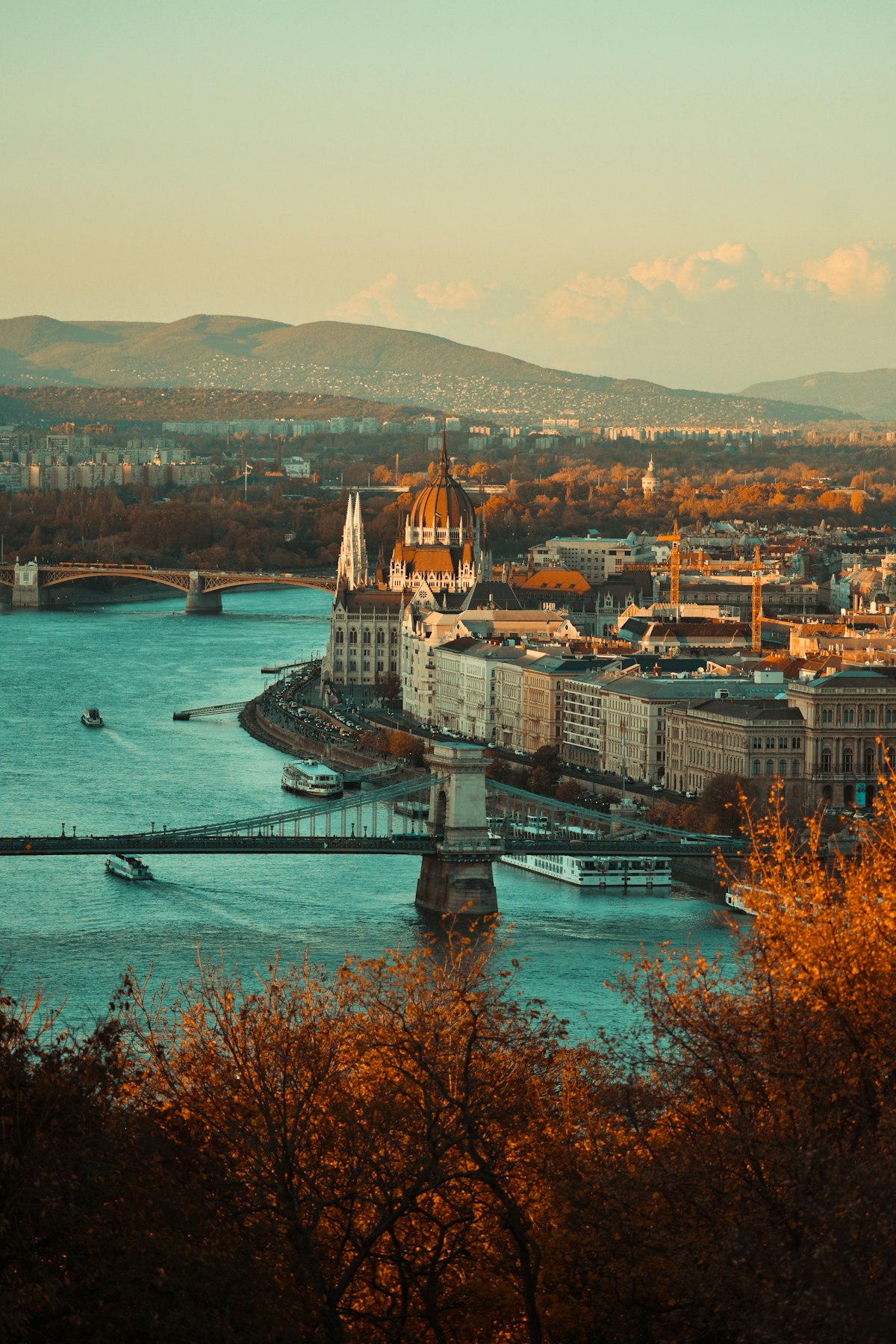
Budapest is an argument for slow travel made in architecture, thermal water, and paprika. The city sits at the geographic and cultural crossroads of Central Europe, and it’s one of the continent’s most naturally railway-oriented destinations. Every major route from Western Europe funnels through Vienna and directly into the Hungarian capital. You don’t arrive at Budapest by train as a compromise. You arrive as the only sensible choice.
Hungary’s rail connections to Austria alone carry millions of passengers annually, and the ÖBB Railjet has made the Vienna–Budapest corridor one of the most pleasant short-haul train journeys in Europe. Yet Budapest remains, somehow, less overrun than Prague or Krakow. It’s sophisticated without being performatively expensive. Genuinely beautiful without knowing it. Difficult to leave after four days.
TL;DR: Budapest is reachable from Vienna in 2h 40min by Railjet from around €19, from Prague in roughly 7 hours, and from Bratislava in just 1 hour. Keleti station puts you 5 minutes from the city by metro. Plan for a minimum of 4 nights, ideally 7. Budapest is one of Europe’s most affordable capitals: a thermal bath entry runs around €20–€30, a bowl of goulash costs €6–€10, and the city consistently ranks as one of the cheapest major destinations in the EU (Numbeo Cost of Living Index, 2026).
Why Is Budapest One of Europe’s Best Train Destinations?
Budapest’s position on the European rail map is almost absurdly convenient. The Vienna–Budapest Railjet covers 250 km in 2 hours 40 minutes, with fares from around €19 booked in advance through ÖBB (ÖBB timetables, 2026). That’s a faster city-to-city connection than many domestic bus routes. The train doesn’t ask you to choose between convenience and experience. It offers both at once.
But the practical case is almost secondary. Trains suit Budapest temperamentally. The city moves at a pace that rewards patience. A morning in a thermal bath, a long lunch in the Great Market Hall, an evening walk along the Danube embankment, this is not an itinerary that benefits from rushing. You arrive at Keleti station with your bags, step onto the metro, and twenty minutes later you’re settled in a neighbourhood café learning the difference between an espresso and a black coffee in Hungarian. That’s how Budapest should begin.
The Vienna–Budapest corridor is one of the few routes in Europe where the train is both faster and cheaper than flying. When you add airport transfer times and security at both ends, a Budapest-bound flight from Vienna doesn’t make practical sense. The train wins on every metric.
train vs flying comparison context
How Do You Get to Budapest by Train?
Vienna to Budapest: The Best Route
The Railjet service from Vienna Hauptbahnhof to Budapest-Keleti takes 2 hours 40 minutes and runs roughly every 2 hours throughout the day. This is the headline route, fast, comfortable, frequent, and cheap if you book ahead. ÖBB’s advance fares start at €19 in second class; standard walk-up fares run around €35–€55 (ÖBB, 2026). Business class is available from around €49 and gives you a noticeably quieter carriage.
The Railjet is ÖBB’s premium intercity product, air-conditioned, with power sockets, a restaurant car, and luggage space that actually fits a proper bag. The journey follows the Danube corridor through the Austrian flatlands before crossing into Hungary at Hegyeshalom. There’s a passport check at the border, Hungary is Schengen but Hungary is not in the eurozone, so border formalities do apply for some passengers. Have your documents accessible.
ÖBB and European train booking tips
Prague to Budapest: The 7-Hour Option
The direct EC (EuroCity) service from Prague to Budapest takes approximately 7 hours and operates once or twice daily depending on the season, running via Brno and Bratislava (Czech Railways CD, 2026). It’s a long day’s journey, but a thoroughly pleasant one. The field through Moravia and western Slovakia is genuinely beautiful, and the train is comfortable enough to read, sleep, and eat your way through the crossing.
Alternatively, you can change in Vienna or Bratislava with a shorter wait. Both options are worth knowing. The Bratislava connection is especially clean, you can break the journey for a few hours and still arrive in Budapest by evening.
Bratislava to Budapest: The 1-Hour Hop
Bratislava to Budapest is one hour by direct train, and this almost absurd proximity makes it one of Europe’s great day-trip combinations. You can be in two capital cities in a single day without exerting any real effort. Regular IC and EC trains connect Bratislava Hlavna Stanica with Budapest-Keleti throughout the day. Fares are minimal.
If you’re building a multi-city Central European itinerary, Vienna, Bratislava, Budapest, the train makes the whole triangle logical rather than laborious.
Night Trains from Berlin and Amsterdam
Budapest is also reachable overnight from Germany and the Netherlands via ÖBB Nightjet connections. The practical routing involves an evening Nightjet from Berlin or Amsterdam toward Munich or Vienna, with a connection the following morning on the Vienna–Budapest Railjet. It’s not a single-seat overnight journey to Budapest itself, but it’s a very reasonable two-segment approach that means you don’t lose a full day to transit.
Direct overnight services from Berlin to Budapest via the Budapest-Keleti corridor have operated historically and may return, check the ÖBB Nightjet network for the latest schedule before you book.
What Is Keleti Station Like?
Budapest-Keleti is one of the great railway stations of Central Europe. Built in 1884, it was designed by Gyula Rochlitz in the historicist style, a grand iron-and-glass facade topped with allegorical figures representing railway engineering. Step outside the main entrance and you’re immediately in the city’s 8th district, one of the most architecturally dense neighbourhoods in Budapest, five minutes from the city centre by metro.
Keleti (the name simply means “eastern”) sits on the M2 metro line. Two stops brings you to Deák Ferenc tér, the central hub where all three metro lines converge. The station has ATMs, luggage storage, a handful of cafes, and taxi ranks outside, though the metro is almost always the right choice for reaching accommodation.
The building itself is worth ten minutes of your time before you leave. Stand in the main hall, look up, and consider that this structure was built the same decade as the Eiffel Tower. European railway architecture in this period was treated as civic statement. Keleti makes that statement without apology.
[IMAGE: The grand neoclassical facade of Budapest Keleti railway station in daytime with passengers outside, search terms: Budapest Keleti station exterior facade]
What Should You Do in Budapest as a Slow Traveller?
The Thermal Baths: Morning Ritual, Not Tourist Trap
Budapest has 118 thermal springs within city limits, more than any other capital in the world, and the bath culture they’ve produced is genuinely embedded in daily life (Budapest Tourism, 2025). This is not a tourist gimmick. Working Budapestians go to the baths before work, after work, on Sunday mornings, in all weather. The baths are cheap, medically serious, and socially central.
Széchenyi in City Park is the most famous, a vast yellow Baroque complex opened in 1913, with outdoor pools you can use year-round. In winter, steam rises off the 38-degree water and chess players sit at boards bolted to the pool edge. It’s surreal and perfect. Arrive early (before 9am on weekdays) to avoid the afternoon crowds. Entry runs around €20–€30 depending on the day and whether you want a cabin (Széchenyi Baths, 2026).
Gellért Baths, on the Buda side of the Danube, is architecturally the more spectacular of the two, a 1918 Art Nouveau complex attached to the Gellért Hotel, with original mosaic tiles, vaulted ceilings, and a formality that Széchenyi lacks. It tends to attract a slightly older, quieter crowd. Entry is roughly comparable to Széchenyi. Go on a weekday.
A practical note from experience: don’t bring valuables to the baths. A locker and a towel (rentable on-site for a few hundred forints) is all you need. Budget around half a day, 3 hours is ideal. Going in the morning before sightseeing, rather than after, means you arrive at the afternoon attractions fresher and less likely to fall asleep.
[IMAGE: The outdoor thermal pool at Széchenyi Baths in winter with steam rising from the water and the yellow Baroque building in the background, search terms: Széchenyi baths outdoor pool steam winter Budapest]
The Jewish Quarter and Ruin Bars
Budapest’s 7th district, the old Jewish Quarter, is one of the most interesting neighbourhoods in Central Europe. The Great Synagogue on Dohány Street is the largest synagogue in Europe, built between 1854 and 1859, and the second largest in the world. The interior, restored in the 1990s with funding from a foundation co-established by Tony Curtis (who was of Hungarian-Jewish descent), holds 3,000 people and is architecturally arresting in a way photographs don’t quite capture (Great Synagogue Budapest, 2026). Budget 90 minutes including the attached museum.
A few streets away, Szimpla Kert sits in a half-collapsed 19th-century building, and has done so since it opened in 2002. It’s the original Budapest ruin bar: a labyrinthine space of salvaged furniture, mismatched art, fairy lights, and graffiti spread across multiple floors and courtyards. On Sunday mornings it doubles as a farmers’ market, which is actually one of the better times to visit if you want to see it without the weekend night crowds.
Ruin bars as a concept originated in Budapest and have since been exported and diluted everywhere. The 7th district originals remain the reference point.
The Food: What to Eat and Where
Hungarian food is the most underrated cuisine in Central Europe. It’s hearty, deeply spiced with paprika, built around slow-cooked meats and sharp fermented dairy, a cuisine that reflects centuries at the intersection of Ottoman, Austro-Hungarian, and Central European influence.
Goulash (gulyás) is the most famous dish, but order it as a soup rather than a stew, the Hungarian version is broth-based, not the thick Central European export most people know. A proper gulyás costs €6–€10 in a sit-down restaurant away from the tourist core.
Lángos is the street food answer to everything: deep-fried flatbread topped with sour cream and grated cheese, optionally with garlic or ham. You’ll find it at market stalls and street corners throughout the city for around €2–€4. Eat it immediately. It deteriorates fast.
Kürtőskalács (chimney cake) is the other unmissable street food, a spiral of sweet dough cooked on a rotating spit, caramelised on the outside, soft inside, often dusted with cinnamon or walnut. Ignore the shops selling it filled with Nutella or ice cream; find one that serves it plain and hot.
For wine: Hungary produces some of Europe’s most interesting bottles and almost none of them make it to international shelves. Tokaj (Tokay) is the most famous, a golden dessert wine produced northeast of Budapest from Furmint grapes, with a history traceable to the 17th century. But the Eger region produces serious dry reds under the Egri Bikavér (“Bull’s Blood”) label that are worth seeking out. You’ll find both in wine bars throughout the city from around €4–€8 a glass.
food travel and culinary experiences
The Great Market Hall
The Central Market Hall (Központi Vásárcsarnok) opened in 1897 and remains the finest food market in Hungary, a three-storey iron-and-glass structure near the Liberty Bridge, stocked with paprika, sausages, pickles, fresh produce, embroidered linen, and a first-floor food court where you can eat goulash soup for under €5. It’s touristy in the sense that tourists have discovered it; but the ground floor is still where Budapestians actually shop, particularly on weekend mornings.
Arrive between 8am and 10am on a Saturday for the least performative version of the experience. Go hungry.
Buda vs Pest: Cross the River
Most visitors base themselves in Pest, the flat, dense, commercial eastern bank, and make day excursions to Buda, the hilly western side. This is sensible, but worth questioning. Buda has a different character entirely: quieter, more residential, with the Castle District on a limestone plateau above the river, medieval lanes, and views of the Danube and Pest that no postcard fully represents.
The Castle District (Várnegyed) contains Matthias Church, the Fisherman’s Bastion, and Buda Castle itself, all genuinely worth time, though the area directly around Fisherman’s Bastion is the most photographed and therefore the most crowded. Go early or return in the evening when tour groups have cleared. Take the funicular up from Chain Bridge rather than the steep walk; it costs a few hundred forints and is a small piece of 19th-century engineering worth using.
On the Buda hillsides south of the castle, the Gellért Hill district offers solitude, parks, and the best free panoramic view in the city from the Liberation Monument at the summit.
[IMAGE: View from the Fisherman’s Bastion in Buda looking across the Chain Bridge and the Danube toward Pest with the Parliament Building visible in the distance, search terms: Budapest Fisherman’s Bastion view Danube Parliament]
Should You Take a Day Trip from Budapest?
Eger: Wine Country and Ottoman History
Eger is 2 hours from Budapest by direct train and is probably the most rewarding day trip from the capital (MÁV Hungarian Railways, 2026). It’s a Baroque market town in the northern wine region, dominated by an Ottoman-era castle that resisted a Turkish siege in 1552, an event that entered Hungarian national legend. The castle is walkable, the town is beautiful, and the wine cellars (most concentrated in the “Valley of Beautiful Women” just outside town) serve Egri Bikavér direct from the barrel.
Don’t rush Eger into a half-day. Take the morning train, have lunch in town, explore the castle, spend the afternoon in the wine cellars, and take an evening train back. That’s a complete day.
How Long Should You Stay in Budapest?
Four nights is the honest minimum, enough to cover the baths, the Jewish Quarter, both sides of the river, one or two museum visits, and a proper meal at a neighbourhood restaurant rather than a tourist-facing place. But Budapest is a city that reveals itself slowly. A week gives you Eger, a second bath visit, the kind of unhurried wandering that leads you somewhere genuinely unexpected, and the particular satisfaction of finding a favourite bakery before you leave.
Budapest is one of Europe’s most affordable capitals. As of 2026, it consistently ranks in the bottom quartile of EU capital cities for cost of living, accommodation, food, and transport are all substantially cheaper than Vienna, Prague, or Warsaw (Numbeo, 2026). A mid-range hotel runs around €60–€100 per night; a full dinner with wine at a good neighbourhood restaurant, €20–€35 per person. The maths favour staying longer rather than shorter.
how to travel slowly and cheaply
Related Reading
- Budapest to Belgrade by Train: The Balkans Express, Budapest to Belgrade by train takes 7h 30min and costs from €15 advance.
- Budapest for Slow Travellers: Two Cities, One River, and More Time Than You Planned, Budapest is two cities divided by the Danube and unified by thermal baths, ruin bars, and a food scene that has…
- The Adriatic Coast by Train and Ferry: Italy to Croatia Slow, Travel the Adriatic slow: Italy’s coastal rail line from Bologna to Bari, then overnight ferry to Split and…
Frequently Asked Questions
How do I book Vienna to Budapest train tickets?
Book directly through ÖBB up to 180 days in advance, or through Trainline for a single booking interface. Advance fares start around €19 in second class. Tickets are available as mobile passes, no printing required. Reserve a seat (seat reservations are mandatory on some Railjet services) when booking.
booking European trains explained
Do I need a reservation on the Budapest train?
On most international trains into Budapest, including ÖBB Railjet services from Vienna, a seat reservation is compulsory and included in the ticket price when you book through ÖBB or Trainline. If you’re using an Interrail or Eurail pass, a separate reservation fee (typically €3–€5) applies on top of your pass (Interrail, 2026).
how Interrail and Eurail passes work
Is Budapest safe for solo travellers?
Budapest is broadly safe and well-visited by solo travellers, including solo women. The main risk is petty theft in crowded tourist areas and on certain tram routes, keep bags close in the Great Market Hall and on the 4/6 tram, which runs at high capacity. Use licensed taxis (Bolt is the most reliable app-based option in the city) rather than unmarked cars outside Keleti station.
What is the currency in Budapest?
Hungary uses the Hungarian Forint (HUF), not the euro. As of early 2026, approximately 380–400 HUF equals €1, though rates fluctuate. ATMs are widely available throughout the city. Avoid airport and hotel exchange counters, rates are significantly worse. Credit cards are accepted at most restaurants and shops, though smaller market stalls and bath lockers may require cash.
What is the best time of year to visit Budapest?
Late spring (May–June) and early autumn (September–October) offer the best combination of mild weather, manageable crowds, and full city life. Summer (July–August) is hot and increasingly busy; December has a well-regarded Christmas market but gets cold quickly. The thermal baths run year-round and are, if anything, better in winter when the contrast between cold air and warm water is most dramatic.
Getting the Most Out of Budapest
Budapest rewards the traveller who doesn’t try to do everything. It’s a city with enough depth to fill a week without touching the highlights a second time, and the kind of place where the things you discover without trying (a butcher’s shop that turns out to serve lunch, a courtyard bar with no sign, a hilltop park nobody warned you about) end up mattering as much as the things you planned.
Come by train. That much is settled. The Railjet from Vienna drops you at Keleti with time and attention intact, no security theatre, no middle seat, no lost hour to an airport bus. You step off the platform and Budapest begins immediately.
planning a European rail itinerary
Citation Capsule, Vienna to Budapest: The ÖBB Railjet connects Vienna Hauptbahnhof with Budapest-Keleti in 2 hours 40 minutes, with advance fares starting from approximately €19 in second class. Around 8–10 daily departures operate on this corridor. The service uses ÖBB’s flagship Railjet rolling stock with air conditioning, power sockets, and a restaurant car (ÖBB, 2026).
Citation Capsule, Budapest thermal baths: Budapest has 118 thermal springs within city limits, more than any other capital city in the world. Széchenyi Baths, opened in 1913, and Gellért Baths, opened in 1918, are the two most visited. Entry runs around €20–€30 depending on day and cabin options. Both operate year-round and are embedded in daily local life, not just tourist itineraries (Budapest Tourism, 2025).