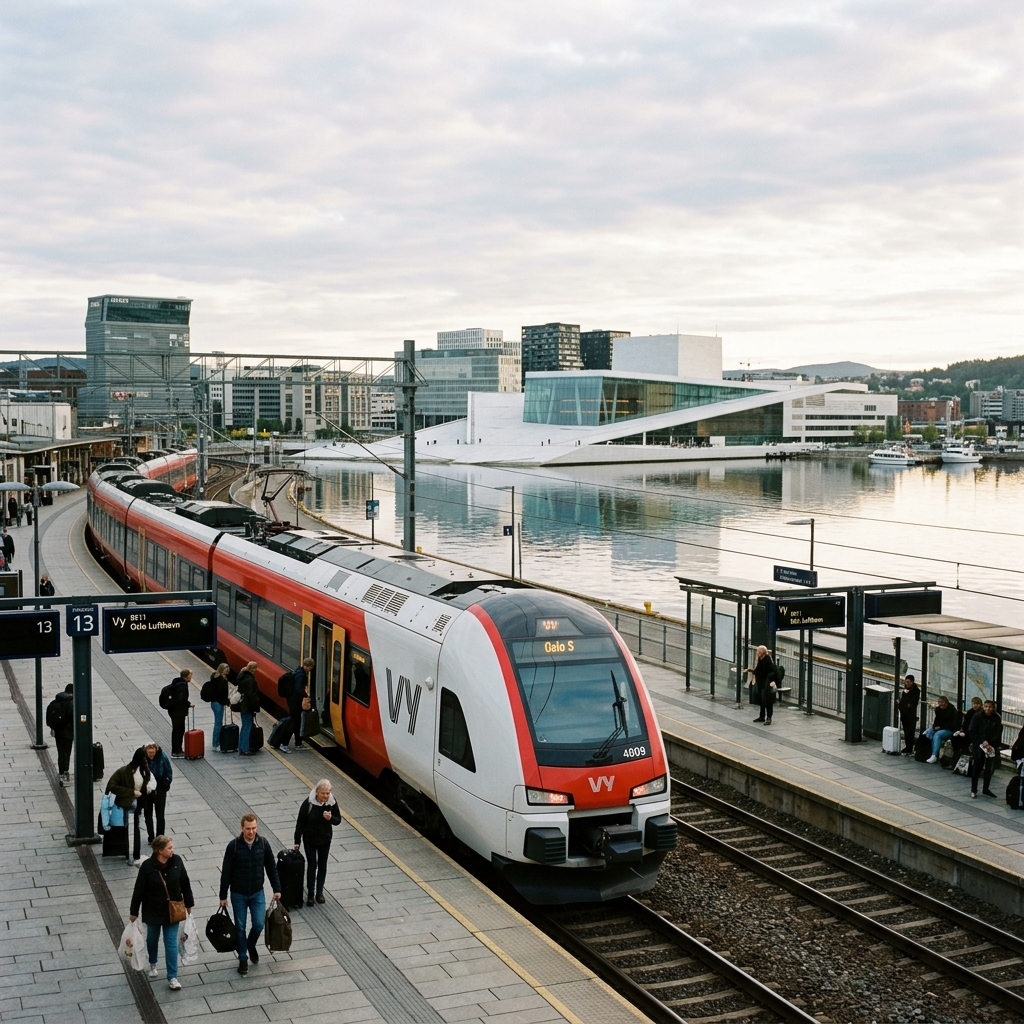
Norway does something that very few places in the world manage: it makes the journey as interesting as the destination. This is not accidental. It is the consequence of a geography so dramatic — fjords, mountain plateaus, Arctic light — that the space between cities refuses to be incidental. On the Bergensbanen, crossing the Hardangervidda at 1,300 metres above sea level with snowfields visible in June, the train is not the vehicle delivering you to Bergen. It is the point.
Oslo is where all of this begins. A capital of 700,000 people that manages to be genuinely cosmopolitan without the pressure of London or Paris — a city with excellent food, a remarkable concentration of world-class museums for its size, and a fjord directly accessible from the city centre by public transport. It is also, without apology, expensive. That requires planning.
Start here. The trains fan out in every direction.
how to plan a slow travel journey across Europe by rail
TL;DR: Oslo S (Oslo Sentralstasjon) sits in the city centre, connected to everything. Stockholm is 5 hours away by direct train (from €30 advance). Copenhagen is 7h 30min via Göteborg (from €40); Snälltåget runs a direct summer overnight. The Bergen Railway (6h 30min) is one of Europe’s great train journeys. Norway in a Nutshell connects Oslo to the fjords via Myrdal and the Flåm Railway. Budget NOK 800–1,200/day (€70–€110). The Oslo Pass (NOK 545/€48 for 24h) covers transit and most museums. Download the Ruter app on arrival.
How Do You Get to Oslo by Train?
Stockholm to Oslo: The Main Connection
The Stockholm–Oslo route is the primary rail link between Norway and continental Europe. Direct services are operated jointly by SJ (Swedish Railways) and Vy (Norwegian Railways), with the journey taking approximately 5 hours from Stockholm Central to Oslo Sentralstasjon.
Trains run roughly every two hours throughout the day. Advance fares start around €30 in second class; standard fares run €50–€80. Book via sj.se or vy.no — both sites have English versions and accept international cards. Trainline and Rail Europe also carry this route. First class (SJ Business or Vy Comfort) offers larger seats and table service; the premium is modest and worthwhile for a 5-hour journey.
The route runs through Mälardalen west of Stockholm, then the lake-and-forest landscape of Värmland, before crossing into Norway at Magnor and descending the Glomma River valley to Oslo. It is not the most dramatically scenic route in Scandinavia — save the dramatic scenery for the Bergen Railway — but the Swedish section is genuinely beautiful: long views across birch forest and open water, the kind of northern landscape that establishes a mood for Norway before you arrive.
Copenhagen to Oslo: Via Göteborg
There is no direct daytime train from Copenhagen to Oslo. The standard route requires one change:
- Copenhagen Central → Göteborg Central: approximately 3 hours via the Öresund Bridge and Sweden’s west coast. Operated by SJ and DSB.
- Göteborg Central → Oslo S: approximately 3 hours, operated by SJ and Vy.
Total journey: approximately 7 hours 30 minutes with a connection in Göteborg of typically 20–45 minutes. Through-booking is possible on SJ and Vy websites. Advance fares for the full route run €40–€75; standard fares €70–€120.
Snälltåget runs a direct overnight sleeper between Malmö/Copenhagen and Oslo during summer months (mid-June through late August), departing in the evening and arriving Oslo the following morning in approximately 8 hours. Couchette berths start around €45–€60. The service sells out well in advance in peak summer; book at snalltaget.se. This is a worthwhile option: a night train that eliminates a hotel night while delivering you to Oslo at a reasonable morning hour.
the full guide to Copenhagen by train — arriving, navigating, and the Öresund crossing
The Göteborg layover is an opportunity. Göteborg is one of Sweden’s most underrated cities — a serious fish market (Feskekôrka, the “Fish Church”), a compact canal network, and a food scene that has outgrown its reputation. A planned 3–4 hour layover on a Copenhagen–Oslo journey becomes a half-day in Göteborg. It’s worth arranging rather than avoiding.
What Is Oslo S Like?
Oslo Sentralstasjon — universally shortened to Oslo S — is the operational hub of Norway’s rail network: a 1980 building that is functional rather than beautiful, but positioned exactly right in the city’s geography. Karl Johans gate, the main civic boulevard, begins directly outside the western exit. The harbour at Aker Brygge is a 15-minute walk south.
The station integrates train services, the Flytoget airport express (20 minutes to Oslo Gardermoen), the T-bane metro at Jernbanetorget, tram connections, and a shopping and food hall on the lower level. Left luggage is available. There’s a Narvesen newsagent, a 7-Eleven, and several cafés. The station is open 24 hours.
Download the Ruter app immediately on arrival. Ruter manages all public transport in Oslo: T-bane (metro), tram, bus, and the Oslofjord ferry routes. A 24-hour unlimited transit ticket costs NOK 113 (€10); the Oslo Pass (from NOK 545/€48 for 24 hours) adds museum entry. The app handles planning, tickets, and real-time departures.
How Do You Get Around Oslo?
The T-bane and Ruter System
Oslo’s T-bane runs five lines converging at a central underground loop, with key stations at Jernbanetorget (Oslo S interchange), Nationaltheatret (Aker Brygge waterfront), Majorstuen (Vigeland Park), and Holmenkollen (the ski jump and forested hills). A single ticket costs NOK 39 (€3.50), valid for one hour across all modes — metro, tram, bus, and ferry within Oslo.
The Oslofjord Ferries as Public Transport
This is the detail most Oslo visitors miss. The ferry routes across the Oslofjord are part of the Ruter public transit network — meaning your standard transit ticket (or Oslo Pass) also covers the boats. The most useful for visitors is route 91B from Rådhusbrygge (City Hall pier) to Bygdøy — approximately 10 minutes, running every 20–30 minutes in season. Bygdøy is the museum peninsula: the Viking Ship Museum, the Kon-Tiki Museum, and the Norwegian Folk Museum are all a short walk from the landing.
Arriving at Bygdøy by boat across the fjord, with Akershus Fortress visible behind you and the wooded shoreline approaching, is significantly more pleasant than arriving by bus. Use the ferry.
On a summer evening, routes to Nakholmen and Langøyene — car-free islands with rocky swimming spots — are a thoroughly Norwegian way to spend a few hours. These run on standard Ruter tickets. The swimming in the Oslofjord is clean; this surprises people from more southerly latitudes and shouldn’t.
What Are the Best Day Trips from Oslo by Train?
Bergen via the Bergensbanen: One of Europe’s Great Rail Journeys
The Bergen Railway — Bergensbanen — runs 496 kilometres from Oslo S to Bergen in approximately 6 hours 30 minutes, crossing the Hardangervidda mountain plateau at a maximum altitude of 1,237 metres. It is, without qualification, one of the great train journeys in Europe.
The journey narrative:
- Oslo to Geilo (3h): steady climb through birch forest and the lake landscape of Hallingdal. Geilo is a ski resort at the plateau edge.
- Geilo to Finse (1h): the plateau opens. Above the treeline, the landscape becomes something that resists easy description — arctic tundra in summer, frozen lakes visible into June, the Hardangerjøkulen glacier to the south. Finse station at 1,222 metres is the highest point on the Norwegian mainline network.
- Finse to Myrdal (1h 30min): the descent begins. Myrdal is the junction for the Flåm Railway.
- Myrdal to Voss (30min): steeper descent through forest to the valley floor.
- Voss to Bergen (1h 15min): fjord country, then Bergen’s harbour approach.
Vy advance fares (“minipris”) from NOK 199 (€18) in second class; standard fares NOK 499–799 (€44–€70). Book at vy.no. Window seat allocation: sit on the left (seats A/B) for the best views of the Hardangerjøkulen glacier going westbound; on the right for the Myrdal descent.
[IMAGE: Finse station in summer with snowfields on the Hardangervidda plateau stretching to the horizon — search terms: Finse station Norway Hardangervidda summer snow Bergensbanen]
Myrdal and the Flåm Railway
Myrdal is a mountain junction at 866 metres altitude, reachable from Oslo in approximately 4 hours by Bergensbanen — and the gateway to the Flåmsbana (Flåm Railway): a 20-kilometre branch line descending 865 metres from Myrdal to the village of Flåm at fjord level. Gradients reach 55 per thousand (1 in 18), making it one of the steepest standard-gauge railways in the world. The journey takes 55 minutes.
The train stops at Kjosfossen waterfall for five minutes — photographers alight, and in warmer months a figure in red appears on the rocks above the falls (a theatrical nod to the huldra of Norwegian folklore). This is less strange than it sounds and doesn’t detract from the waterfall, which is substantial on its own terms.
From Flåm, Nærøyfjord ferry cruises run to Gudvangen through one of the narrowest fjord arms in the world — UNESCO World Heritage listed, walls rising 1,400 metres on both sides. This is the water section of the Norway in a Nutshell route.
Lillehammer: Two Hours North
Lillehammer — host of the 1994 Winter Olympics — is 1h 45min–2h from Oslo by Vy regional train, fares from NOK 149 (€13). The ski jump at Lysgårdsbakkene, the Norwegian Olympic Museum at Håkons Hall, and the Maihaugen open-air folk museum (185 historic buildings relocated to a single hillside) fill a comfortable day. The town itself is compact and genuinely Norwegian in atmosphere — wooden houses, the Aker river, a manageable scale that Oslo lacks.
Norway in a Nutshell from Oslo
Norway in a Nutshell is a self-guided combination of public transport segments that connects Oslo to Bergen via the fjords. It is not a package tour — it is a sequence of individually bookable segments that happen to combine into one of the finest single-day or two-day trips in Northern Europe.
The long day trip (works in summer with long daylight):
| Segment | Duration | Operator |
|---|---|---|
| Oslo S → Myrdal (Bergensbanen) | ~4h | Vy |
| Myrdal → Flåm (Flåmsbana) | 55min | Flåm Railway |
| Flåm → Gudvangen (Nærøyfjord ferry) | ~2h | Norled |
| Gudvangen → Voss (bus) | ~1h | Skyss |
| Voss → Bergen (Bergensbanen) | 1h 15min | Vy |
Total: approximately 10–11 hours. Leave Oslo by 07:50; arrive Bergen by early evening.
The two-day version — one night in Flåm or Bergen — is the better experience. A night in Flåm after the fjord cruise, when the tour boats have left and the valley is quiet, is one of those evenings that justifies the entire journey.
Book segments individually rather than buying a package. Fjord Tours’ “Norway in a Nutshell” package costs more than booking each segment separately and provides no logistical advantage — the connections are already public transport with reliable timing. Book Oslo→Myrdal and Voss→Bergen on vy.no, the Flåmsbana on visitflam.com, and the Nærøyfjord ferry on norled.no. You save NOK 200–400 (€17–€35) for the same trip.
Slow Travel Oslo: The City at Walking Pace
Grünerløkka and the Akerselva Walk
Grünerløkka sits northeast of the centre, occupying the former working-class area around the Akerselva river — the watercourse that powered Oslo’s industrial revolution and now anchors one of the city’s most pleasant green corridors. The Akerselva river walk runs 7 kilometres from the Oslofjord to the forested hills, past waterfalls, converted textile mills, and public art. It is free, unhurried, and at its best on a clear October morning.
The neighbourhood itself has the density and character that Oslo’s western residential quarters lack: independent cafés, vintage shops, weekend markets at Birkelunden park, and a concentration of food producers at Mathallen in the Vulkan complex at the southern end of the walk.
Tim Wendelboe’s roastery and espresso bar on Grüners gate opened in 2007 and is among the foundational figures of the global specialty coffee movement (Tim Wendelboe, 2025). A cortado costs NOK 55 (€5). It is worth it.
Frogner and the Vigeland Sculpture Park
Vigeland Sculpture Park — Vigelandsparken — is Norway’s most-visited attraction, which is usually the kind of fact that lowers expectations. It should not. Gustav Vigeland (1869–1943) spent 40 years producing 212 sculptures in bronze, granite, and cast iron, all installed in a single 80-hectare public park. The central Monolith — a 14-metre granite column carved from a single block, containing 121 intertwined human figures — took the sculptor 14 years to complete. The park is free, open year-round, and best visited in early morning or late afternoon when the light is horizontal and the tour groups have thinned.
Metro Line 2 or tram 12 to Majorstuen, then a 5-minute walk.
how to slow travel Europe by train — planning the journey, not just the destination
Aker Brygge and the Harbour
Aker Brygge was Oslo’s main shipyard until 1982 and is now the city’s principal waterfront — restaurants, the Astrup Fearnley Museum of Modern Art (Renzo Piano building, genuinely excellent collection), and the departure pier for Oslofjord ferries. The waterfront itself is free. In summer, Osloites swim in the fjord from rocks at Sørenga and Tjuvholmen — open water in the middle of a capital city, clear enough to see the bottom. This surprises visitors from warmer latitudes. It shouldn’t.
Where to Eat in Oslo
Mathallen: Oslo’s Food Hall
Mathallen Oslo in Vulkan, adjacent to Grünerløkka, is a covered food market in a converted industrial building with around 30 vendors — Norwegian charcuterie, artisan cheese, fresh pasta, sushi, and a fish counter at Fiskeriet that is among the best in the city (Mathallen Oslo, 2025). It’s not a tourist market. A market lunch costs NOK 150–220 (€13–€19). This is where food-conscious Osloites eat on a weekday.
Vippa Street Food
Vippa is a street food market in a former warehouse on the Akershus waterfront, 15 minutes’ walk from Oslo S (Vippa, 2025). Around 15 vendors serve food from across the world — Ethiopian injera, Vietnamese pho, Peruvian ceviche, Norwegian shrimp rolls. Mains run NOK 100–170 (€9–€15). Open Thursday through Sunday, year-round. Eat outside facing the fjord when weather allows.
Maaemo: The Reference Point
Maaemo has held three Michelin stars since 2016 and is one of the most celebrated restaurants in northern Europe (Maaemo, 2025). The menu is built on Norwegian ingredients — wild herbs, preserved fish, game, coastal shellfish — with a technique that reflects the best of the Nordic cuisine movement: restraint, precision, and honesty about what Norwegian land and sea actually produce. A tasting menu runs NOK 3,500–4,500 (€310–€400) per person without wine. Book months in advance. This is not an everyday proposition. It is the reference point for understanding what serious Norwegian cooking looks like at its best.
On cost reality in Oslo: A round of drinks at a bar costs NOK 300–400 (€26–€35) and nobody apologises for it. The practical response: eat well once a day and manage the rest. A proper lunch at Mathallen, a supermarket dinner from Kiwi or Rema 1000, and a bakery breakfast — that’s a NOK 400 (€35) food day that still involves genuinely good Norwegian ingredients. Oslo’s expensive restaurants are genuinely excellent. The expensive mediocre ones are the ones to avoid.
Practical Oslo
The Oslo Pass
The Oslo Pass covers unlimited Ruter transit (including Oslofjord ferries) plus free entry to over 30 museums: the Viking Ship Museum, the Munch Museum, the Fram Museum, the Norwegian Folk Museum, and others (Oslo Pass, 2025). Prices: NOK 545 (€48) for 24 hours; NOK 745 (€66) for 48 hours; NOK 945 (€84) for 72 hours.
The arithmetic: Viking Ship Museum (NOK 200) + Munch Museum (NOK 180) + Fram Museum (NOK 165) + 24h transit (NOK 113) = NOK 658 without the pass. With the pass: NOK 545. For any first-time visitor planning to see two or more museums, the pass pays for itself within half a day.
The Munch Museum
The Munchmuseet opened in its current building — a 13-storey tower cantilevering over the Oslofjord at Bjørvika — in 2021 (Munchmuseet, 2025). The collection includes over 26,000 works by Edvard Munch, including multiple versions of The Scream, The Madonna, and The Kiss. Entry NOK 160 (€14), covered by the Oslo Pass. Stand in front of the 1893 tempera version of The Scream for 10 minutes. It is smaller than the posters suggest and more unsettling than you expect.
The Viking Ship Museum
The Vikingskipshuset on Bygdøy houses three of the best-preserved Viking ships ever found — the Oseberg, Gokstad, and Tune ships, dating from approximately 820–890 CE — along with funerary objects buried with them: carved sledges, a wagon, textiles, and personal effects that reconstruct a world 1,100 years old with unusual completeness (Viking Ship Museum, 2025). Entry NOK 200 (€18), covered by the Oslo Pass. Arrive by fjord ferry on route 91B from Rådhusbrygge — a more rewarding approach than the bus.
[IMAGE: The Oseberg Viking ship viewed from the gallery above inside the Vikingskipshuset on Bygdøy — search terms: Oseberg Viking ship Oslo museum interior Bygdøy]
Cost Reality
Budget NOK 800–1,200/day (€70–€110) at a moderate level. A mid-range hotel in Oslo costs NOK 1,200–2,000 (€105–€175) per night. A beer at a bar: NOK 80–110 (€7–€10). Managing costs: buy breakfast and lunch at Kiwi or Rema 1000 supermarkets, use the Oslo Pass for transport and museums, and concentrate dinner budget on one genuinely good meal.
how to book European trains — passes, point-to-point, and what to know before you go
How Long Should You Stay in Oslo?
Four nights is the honest minimum — enough for the Munch Museum, the Viking ships by ferry, the Akerselva walk, Vigeland Park, a Mathallen lunch, and one day trip: either Lillehammer or Myrdal and the Flåm Railway. Five nights allows the Bergen Railway as a day trip or overnight, which transforms the visit into something more than a city break.
Oslo doesn’t overwhelm you with unmissable things. It reveals itself through the quality of its everyday life: the waterfront at 8am with the fjord flat and the light low, the T-bane running punctually through the forest suburbs, the smell of cardamom from a bakery in Grünerløkka that doesn’t have a sign outside. That version of Oslo takes time to find. Four nights is enough.
solo train travel in Europe — how to plan a journey that suits the way you travel
Related Reading
- Norwegian Fjord Ferries: Sailing the World’s Most Dramatic Coastline — Norwegian fjord ferries guide: Bergen to Flåm, Hurtigruten coastal voyage, Norway in a Nutshell, Geiranger, and how…
- Athens by Train: Arriving, Exploring, and Day Trips by Rail — Athens by train is easier than you think: suburban rail from the airport in 40min, direct services from…
- The Best Scenic Train Routes in the USA: A Guide to America’s Great Rail Journeys — Amtrak’s long-distance trains are slow by European standards, frequently delayed, and entirely worth taking.
Frequently Asked Questions
How do I get from Stockholm to Oslo by train?
SJ and Vy operate direct services from Stockholm Central to Oslo S in approximately 5 hours, running roughly every two hours throughout the day. Advance fares start around €30 in second class. Book via sj.se or vy.no.
the full guide to Scandinavia and Northern Europe by train
Is the Bergen Railway worth doing as a day trip from Oslo?
Yes — without qualification. The Bergensbanen crosses the Hardangervidda plateau at over 1,200 metres, with snowfields visible in summer and the Hardangerjøkulen glacier to the south. It runs daily year-round. Advance fares from NOK 199 (€18) via vy.no. A same-day return is feasible in summer, but at least one night in Bergen is a more rewarding experience.
What is the Norway in a Nutshell route from Oslo?
Norway in a Nutshell combines the Bergensbanen to Myrdal, the Flåm Railway to the fjord, a Nærøyfjord ferry, a bus to Voss, and the train on to Bergen. Book each segment separately — via vy.no, visitflam.com, and norled.no — for better prices than the packaged version. The full route takes 10–11 hours as a day trip or can be split across two days with a night in Flåm.
How expensive is Oslo, and how do I manage costs?
Budget NOK 800–1,200/day (€70–€110) at a moderate level. Buy breakfast and lunch at Kiwi or Rema 1000 supermarkets; use the Oslo Pass (NOK 545/€48 for 24 hours) for transit and museums; eat one proper meal at Mathallen or a Grünerløkka neighbourhood restaurant rather than spreading food budget across expensive mediocre options. A beer at a bar costs NOK 80–110 (€7–€10) — plan for this.
Can I use an Interrail or Eurail pass on Norwegian trains?
Yes. Interrail (European residents) and Eurail (non-European residents) are both valid on Vy trains within Norway, including the Bergen Railway. The Flåm Railway accepts pass holders at a reduced supplement of around NOK 150 (€13). Reserve Bergen Railway seats in advance even with a pass — they sell out weeks ahead in summer (Interrail, 2025).
Eurail and Interrail passes — when they make sense and when they don’t
Getting There
Oslo rewards the deliberateness of arriving by train. From Stockholm, 5 hours gives you the Swedish countryside transitioning slowly into Norwegian valley landscape — a geographic introduction to a country that earns its scenery. From Copenhagen, the 7h 30min route via Göteborg traces the full breadth of southern Scandinavia in a single day’s light. Either approach deposits you at Oslo S, in the city centre, with everything accessible from the platform.
The Bergen Railway, once you’re there, is one of the strongest arguments in Europe for train travel as a mode worth choosing on its own terms. Not faster or cheaper than flying. But qualitatively different, in the way that matters: a train crossing the Hardangervidda at 1,200 metres gives you the landscape, the scale, the silence at Finse when the doors open — things you cannot get at 35,000 feet. Oslo earns its place at one end of that journey.
night trains in Europe — the routes, the booking, and why they’re worth it
slow travel — what it means and how to plan for it
Citation Capsule — Stockholm to Oslo: SJ (Swedish Railways) and Vy (Norwegian Railways) operate direct services between Stockholm Central and Oslo Sentralstasjon in approximately 5 hours. Services run roughly every two hours. Advance second-class fares start around €30–€50. Timetables and booking: vy.no, sj.se (2025).
Citation Capsule — Bergen Railway (Bergensbanen): The Bergensbanen connects Oslo S and Bergen Station in approximately 6 hours 30 minutes over 496 kilometres, crossing the Hardangervidda plateau at a maximum altitude of 1,237 metres. Finse station, at 1,222 metres, is the highest station on the Norwegian mainline network. Multiple daily services run year-round. Advance (minipris) fares from NOK 199 (€18) via Vy (vy.no, 2025).
Citation Capsule — Flåm Railway (Flåmsbana): The Flåmsbana runs 20 kilometres between Myrdal (866m altitude) and Flåm (at sea level) in approximately 55 minutes, with gradients reaching 55 per thousand. It is one of the steepest standard-gauge railways in the world. Interrail and Eurail pass holders pay a supplement of approximately NOK 150 (€13). Tickets and schedules at visitflam.com (2025).
All transport times, fares, and entry prices reflect December 2025 conditions. Prices in NOK are approximate euro equivalents at prevailing exchange rates. Verify current fares before booking — train prices and museum entry fees change seasonally.