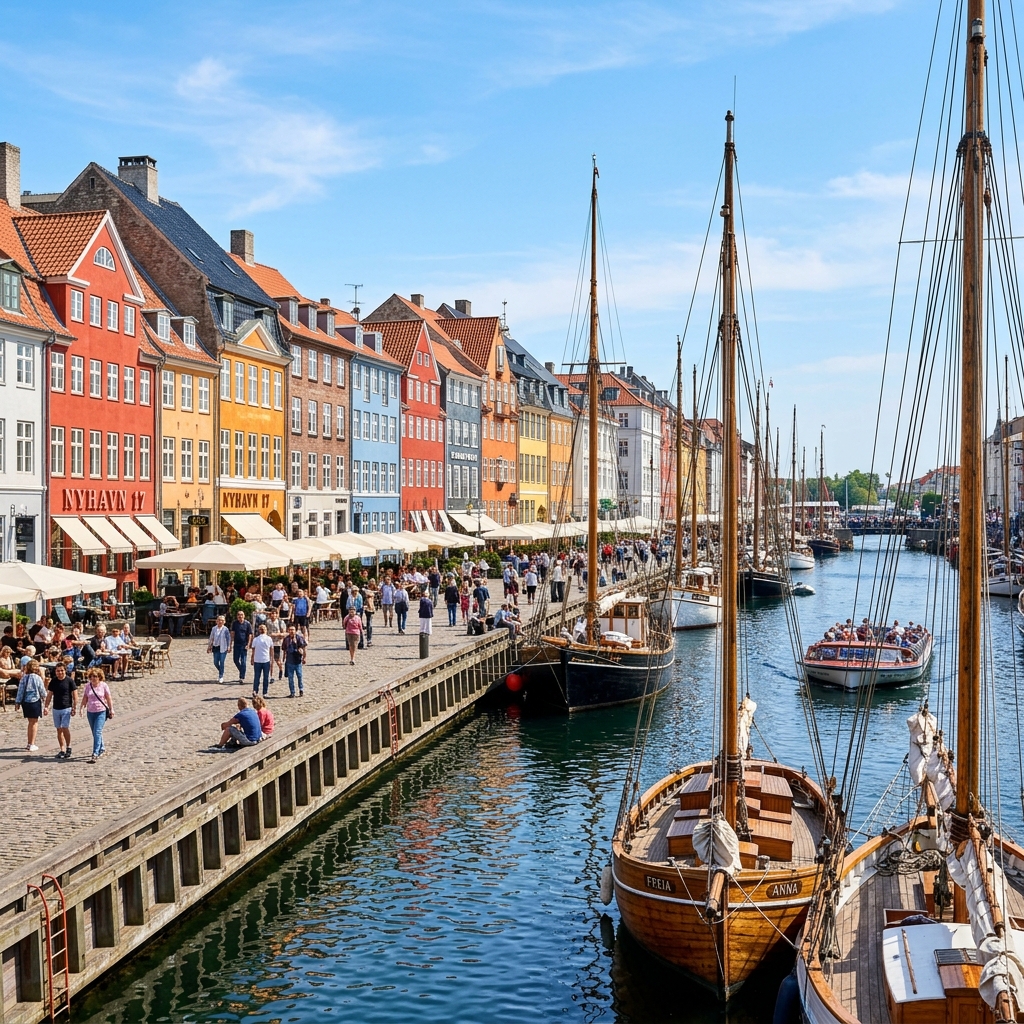
Copenhagen does something to people. They arrive expecting a Nordic city, orderly, cool, slightly expensive, and find instead something warmer and stranger: a city that has quietly assembled a remarkable quality of life, a food culture that changed how the world cooks, an architectural tradition that marries the historic and the contemporary without apology, and a cycling infrastructure so embedded in daily life that the bicycle has stopped being a mode of transport and become something closer to a default state of being.
It is one of the genuinely great European cities. And the best way to arrive is by train.
The Hamburg–Copenhagen service covers the distance in around 4 hours 30 minutes, running through northern Germany, across the historic border region of Schleswig-Holstein, and ultimately onto a ferry crossing or through the Fehmarn Belt that deposits you at Kobenhavns Hovedbanegård, Copenhagen Central Station, one of the finest railway stations in northern Europe. From Stockholm, the approach is even more spectacular: 5 hours across the Öresund Bridge, one of the great pieces of rail infrastructure on the continent.
the philosophy behind slow travel and why arriving by train changes everything
TL;DR: Copenhagen is 4h 30min from Hamburg and 5 hours from Stockholm by direct train. The Stockholm route crosses the Öresund Bridge, a genuine engineering marvel and one of the great train crossings in Europe. Copenhagen Central Station opened in 1911 and sits minutes from the city centre. Copenhagen consistently ranks as one of the world’s most liveable cities (Mercer Quality of Living, 2025). It’s expensive, but manageable. Plan for 4-5 nights minimum. Rent a bike on day one, this is not optional.
How Do You Get to Copenhagen by Train?
Copenhagen is well-connected by rail to the rest of Europe, with direct or near-direct services from Hamburg, Stockholm, Oslo, and Amsterdam. The city’s position at the geographic tip of the Scandinavian peninsula, connected to continental Europe only by the Jutland peninsula, means that almost every rail route into the city is interesting. You’re always crossing something. A border, a body of water, a field that changes register as you move north. That geography shapes the journey.
Hamburg to Copenhagen: The Continental Gateway
The Hamburg–Copenhagen service is the primary rail connection between continental Europe and Scandinavia. The journey takes approximately 4 hours 30 minutes on IC (InterCity) and EC (EuroCity) trains operated by DSB (Danish State Railways) and Deutsche Bahn, running roughly every two hours throughout the day (DSB timetables, 2026). Advance fares from Hamburg start around €29–€39 in second class; standard fares run €50–€80.
The route runs north through Schleswig-Holstein, the flat, wind-battered borderlands between Germany and Denmark that changed hands between the two countries as recently as 1920. You cross into Denmark at Padborg, where the landscape shifts almost imperceptibly but the architecture of the stations changes. The service currently includes a ferry crossing via the Vogelfluglinie (Bird Flight Line) at Puttgarden–Rødby. This will eventually be replaced by the Fehmarn Belt Fixed Link, a tunnel under the Baltic Sea that will cut the journey to around 2 hours 30 minutes, one of the largest infrastructure projects in Europe, currently under construction with an opening expected in the early 2030s (Femern A/S, 2026).
The Fehmarn Belt tunnel will do for Hamburg–Copenhagen what the Channel Tunnel did for London–Paris. When it opens, northern Europe’s rail map will be fundamentally redrawn. Hamburg to Copenhagen in 2h 30min is fast enough to make the route competitive with flying on almost every metric. Book the current ferry-inclusive service now, the slower, more atmospheric version has its own character worth experiencing before the tunnel replaces it.
Stockholm to Copenhagen: Across the Öresund
The Stockholm–Copenhagen route takes approximately 5 hours by SJ (Swedish Railways) or DSB high-speed X2000 train via Malmö (SJ timetables, 2026). Advance fares start around €29 in second class. The train is fast and comfortable, but the reason to choose it has nothing to do with the train itself.
Forty-five minutes before Copenhagen, you cross the Öresund Bridge. It’s one of those moments in European rail travel that genuinely stops a conversation.
[IMAGE: The Öresund Bridge at sunset viewed from the train, showing the transition from bridge to tunnel mid-crossing, search terms: Öresund Bridge train crossing aerial view sunset]
What Is the Öresund Bridge?
The Öresund Bridge is 16 kilometres of combined bridge and tunnel connecting Malmö in Sweden to the island of Amager in Denmark. It opened in 2000 and carries both rail and road traffic (Öresundsbron, 2026). The western approach is underwater, a submerged tunnel emerging onto an artificial island, before rising onto the cable-stayed bridge section that crosses the strait at height. From the train window on a clear day, you watch the Swedish coastline recede, the open water approach, and the Danish coast emerge on the far shore. It takes perhaps 20 minutes and it is, without exaggeration, one of the great train crossings in Europe.
The Öresund Bridge also created one of the most unusual metropolitan areas in the world. Copenhagen and Malmö are now, effectively, a single conurbation of 4 million people split across two countries. Swedes commute daily to Copenhagen for work. Danes cross to Malmö for cheaper restaurants. The crossing produced a TV series (the Nordic noir classic Broen/Brücke) and a degree of cross-border integration that is, by European standards, remarkable.
On the crossing in practice: The transition from bridge to artificial island to tunnel happens quickly enough that first-time passengers frequently miss the tunnel entry. Watch for the moment the sea closes over you, the light shifts, the windows go dark, and then, about four minutes later, you surface in Denmark. It happens fast. Pay attention.
From Amsterdam: Via Hamburg
There’s no direct train from Amsterdam to Copenhagen, but the connection is straightforward: Amsterdam Centraal to Hamburg Hauptbahnhof by ICE (about 5h 30min), then onwards to Copenhagen. The full journey runs to about 10 hours with a comfortable connection in Hamburg. It’s a long day but a very good one, Northern European landscapes at their flattest and most horizontal, all the way to the Danish coast.
the full guide to Amsterdam by train and where to stay
What Is Copenhagen Central Station Like?
Københavns Hovedbanegård, universally shortened to Hovedbanegård or simply “Hoved”, opened in 1911 and was designed by the architect Heinrich Wenck in a national romantic style that makes it unlike almost any other railway station in Europe. The facade uses red brick and turrets in a way that references medieval Danish architecture while remaining unmistakably late-Victorian in its engineering ambition. It is handsome and slightly eccentric. Worth 10 minutes of your time before you leave the building.
The station is centrally located, the Tivoli Gardens are immediately opposite, and the main city grid begins at the back of the station. Trains, the Metro (M3 Cityringen), S-Tog, and buses all converge here. You can reach most Copenhagen neighbourhoods within 20 minutes. There’s luggage storage on the lower level, ATMs, several cafés, and a 7-Eleven that, like all 7-Elevens in Denmark, is significantly better stocked than it has any right to be.
[IMAGE: The red-brick national romantic facade of Copenhagen Central Station in morning light with commuters outside, search terms: Kobenhavns Hovedbanegård facade exterior station]
how to book European trains across multiple countries
Why Is the Bicycle Not Optional in Copenhagen?
Copenhagen has approximately 390 kilometres of dedicated cycling lanes, and around 62% of residents cycle to work or education every day (City of Copenhagen, 2025). This is not a statistic about leisure or recreation. It’s an infrastructure fact: the city was redesigned over 40 years to make cycling the fastest, most convenient, and most socially normal way to move. The consequence for a visitor is simple. Rent a bike on day one.
[CHART: Bar chart, modal share of daily transport in Copenhagen (cycling 62%, car 9%, public transit 19%, walking 6%), City of Copenhagen, 2025]
Rental runs €15–€25 per day or €60–€90 per week from reputable shops. Donkey Republic operates a solid app-based system across the city; Baisikeli in Nørrebro rents Dutch-style bikes and hybrids. Avoid the heaviest tourist bikes near the central station, they’re slow and uncomfortable. A decent 7-speed with good brakes and a basket will do everything you need.
What the bicycle does is change your relationship to Copenhagen’s geography. The city is flat, compact, and laid out on a scale that rewards cycling pace. Walking between districts takes too long. A taxi costs too much and misses the point. But on a bike, the distance from the Central Station to Nørrebro to the Meatpacking District to Christiania is 15 minutes in any direction. The city becomes coherent, connective, and, on a clear morning, genuinely joyful to move through.
What Should You Do in Copenhagen Slowly?
Nørrebro: The City’s Most Interesting Neighbourhood
Nørrebro is the neighbourhood Copenhagen residents actually live in when they’re not performing Copenhagen for visitors. It’s the most ethnically diverse district in the city, a working-class area that absorbed successive waves of immigration from Turkey, Pakistan, Somalia, and the Middle East over the past 50 years, and it has the energy that genuine mixture produces. Street food stalls, independent bakeries, second-hand furniture shops, natural wine bars, and grocery stores selling spices you won’t find anywhere else in the country. It sits about 2 kilometres north of the city centre, 10 minutes by bike from the main station.
The neighbourhood’s main artery is Nørrebrogade, a wide cycling boulevard thick with shops and cafés, but the better exploration happens on the side streets. Jægersborggade is a short street that has become one of the most concentrated stretches of independent retail in Copenhagen, coffee, ceramics, bread, wine, without becoming self-consciously precious about it. It’s worth an unhurried morning.
Superkilen, the public park running through the middle of the neighbourhood, was designed by Bjarke Ingels Group in 2012 as a curated collection of objects from the 60+ nationalities living nearby: a fountain from Morocco, a neon sign from Russia, a jungle gym from Iraq. It sounds like a concept. It works as a park, full of children, cyclists, and picnicking families on any dry afternoon.
[IMAGE: The colourful geometric tiles and street furniture of Superkilen park in Nørrebro on a sunny afternoon, search terms: Superkilen Copenhagen park Nørrebro Bjarke Ingels]
Tivoli Gardens: Not Just for Children
Tivoli Gardens opened in 1843, making it one of the oldest amusement parks in the world, and it inspired Walt Disney in his design of Disneyland, a fact Disney apparently confirmed himself (Tivoli, 2026). It is, yes, touristy. It has rides. But Tivoli at dusk, lit by thousands of lanterns, with gardens in full bloom, a glass of wine at an outdoor table, and the city visible beyond the walls, this is a genuinely beautiful experience. Go in the evening. Don’t feel guilty about enjoying it.
The National Museum of Denmark
The Nationalmuseet is free and one of the finest history museums in Scandinavia. The collection spans 14,000 years of Danish history, from the Stone Age through the Viking Age to the 20th century (National Museum of Denmark, 2026). The Viking Age exhibits are extraordinary, not the tourist-facing cartoon version of Viking culture but the real artefacts: runestones, ship fittings, silver hoards, the Trundholm sun chariot (a 3,400-year-old bronze sculpture of a horse pulling the sun across the sky, found in a Danish bog in 1902). Budget 2–3 hours. The entrance is free; a donation box sits inside.
On the sun chariot: It’s in a glass case in the Bronze Age section, set at eye level, and it stops most people cold. A horse cast in bronze pulling a gilded disc across a wheeled platform, made in 1400 BCE, found in a peat bog 3,300 years later, still intact. No photograph does it justice. No photograph will make you understand that it’s smaller than you expect and more affecting for it. Stand in front of it for five minutes.
Freetown Christiania
Christiania is approximately 850 residents living on 34 hectares of former military barracks on the island of Christiansholm in central Copenhagen, an autonomous community established in 1971 when squatters occupied an abandoned army base and declared it a free town (Christiania, 2026). It has been in a complicated legal relationship with the Danish state ever since.
Be honest about what Christiania is. The main path through the settlement, known as Pusher Street, has for decades hosted an openly tolerated cannabis market. This is not a secret and it is not the interesting part of Christiania, though it is the part most visitors come for and the part that generates most of the political controversy. Photography is not permitted on Pusher Street; respect this.
The interesting part is the rest. Christiania has a functioning community of artists, craftspeople, families, and long-term residents. It has a music venue (Loppen, which has hosted major concerts for 50 years), a café, a bakery, several galleries, workshops, and an internal economy built around communal self-governance. The architecture is a 50-year accumulation of improvised building: hand-built houses, painted murals, garden allotments, chickens. It is genuinely unlike anywhere else in Europe, not because of the cannabis market but because it’s one of the few places on the continent where a different set of rules has operated long enough to produce a different kind of daily life.
Walk through it slowly. Don’t take photographs of residents without asking. Spend money at the bakery. This is how you visit Christiania without being a spectator.
Louisiana Museum of Modern Art
Louisiana is 35 kilometres north of Copenhagen by train, 35 minutes on the S-Tog from Nørreport station to Humlebæk, then a 10-minute walk through a small town to the water’s edge (Louisiana Museum of Modern Art, 2026). It is one of the finest modern art museums in Europe. Not one of the best given the circumstances or impressive considering where it is. One of the finest, without qualification.
The collection includes permanent works by Giacometti, Calder, Warhol, and Francis Bacon, among others. The architecture is the other argument: a series of interconnected white pavilions built into a hillside sloping down to the Øresund strait, with the Danish coast in the foreground and the Swedish coast visible on the far side. The sculpture park sits between the museum and the water. On a clear day in late spring, with a Calder mobile turning in the breeze above the sound, this is one of the great places to spend an afternoon in northern Europe.
Entry runs around DKK 145 (approximately €19) for adults (Louisiana, 2026). The café is excellent. Budget a full day rather than an afternoon.
[IMAGE: The Louisiana Museum of Modern Art pavilions on the hillside above the Øresund strait with sculpture garden visible, search terms: Louisiana Museum Modern Art Humlebæk Denmark exterior water]
Refshaleøen: The Former Shipyard
Refshaleøen is a former industrial island northeast of the city centre, home to the Burmeister & Wain shipyard until the 1990s, and since then progressively occupied by creative and food businesses. It’s an evolving place; what’s there when you visit may differ from what’s described anywhere. But the core offer is stable: Copenhagen Street Food operates a large outdoor market in the old warehouse spaces, with stalls running the range from Thai to smørrebrød to artisan ice cream. There’s a kayak hire, a climbing wall, and several bars operating in repurposed industrial buildings.
It’s a 20-minute bike ride from the city centre or reachable by harbour bus. Go on a weekend afternoon. It’s not a polished tourist attraction, it’s a place where Copenhageners go to eat outside and be in a large, interesting space. That’s the right frame for it.
What Should You Eat in Copenhagen?
Smørrebrød: Denmark’s Definitive Lunch
Smørrebrød, open-faced sandwiches on dark rye bread, is the architecture of Danish lunch. The bread is rugbrød: dense, slightly sour, nearly black, nothing like the soft rye loaves sold internationally. The toppings are precise and traditional: pickled herring with onion and capers, roast beef with remoulade and crispy onions, liver pâté with pickled beetroot, smoked salmon with cucumber and dill. Each combination has a correct construction order, a correct garnish, and a category (fish, meat, or cheese) that determines its position in the meal sequence.
eating on trains and what food tells you about European rail culture
A proper smørrebrød lunch at a traditional restaurant, Schønnemann on Hauser Plads has been operating since 1877, costs DKK 150–250 (€20–€33) per person for two or three pieces and an Aquavit. That’s not cheap. The alternative is a takeaway smørrebrød from a bakery or supermarket, still on dark rye bread, still correctly constructed, for DKK 30–50. The supermarket version is genuinely good. This is Denmark.
New Nordic Cuisine: What Copenhagen Actually Changed
Copenhagen changed the world’s approach to fine dining, a statement that would have seemed absurd in 1995 and is now, in 2026, simply historical fact. Noma, which opened in 2003, was named the world’s best restaurant four times and catalysed a global reassessment of what a kitchen’s relationship to local ingredients, fermentation, and seasonality could look like (World’s 50 Best Restaurants, 2024). Noma closed to the public in 2024, but its influence is embedded in the city’s entire restaurant culture.
You don’t need a reservation at a two-Michelin-star restaurant to experience what Copenhagen did to food. The ideas that Noma generated, hyperlocal sourcing, fermented condiments, vegetables as the lead ingredient rather than an accompaniment, foraged herbs that ten years ago had no name in a restaurant context, have filtered down through the city’s bistros and neighbourhood restaurants. A DKK 250 (€33) set lunch at a competent mid-range Copenhagen restaurant will show you more about the New Nordic movement than any amount of reading.
Pastries: The Real Wienerbrød
Danish pastries are called wienerbrød, “Vienna bread”, in Denmark, because the technique was brought from Austria by journeyman bakers in the 19th century. The Danes kept the laminated pastry method and made it their own: more butter, more cardamom, more architectural variety in the shapes. The international export version, the swirl of sweet dough covered in icing that goes by “Danish” everywhere else, has a family resemblance to the original in the same way a postcard has a family resemblance to the place.
A proper wienerbrød from a good bakery (Juno the Bakery in Frederiksberg and Mirabelle near Nørreport are the reference points) costs DKK 30–45 (€4–€6). Eat it warm, with coffee. This is a non-negotiable morning in Copenhagen.
Coffee: Genuinely Serious
Copenhagen has a coffee culture that predates the international third-wave movement and has contributed to shaping it. The Coffee Collective, which opened in 2008, is one of the founding roasters of the Nordic coffee wave and still operates several locations across the city (The Coffee Collective, 2026). A flat white or filter coffee costs DKK 45–60 (€6–€8), more than you’re used to, less than you’ll mind once you’ve tasted it.
Should You Take a Day Trip to Malmö?
Yes. Malmö is 35 minutes by train across the Öresund Bridge from Copenhagen Central Station, a DKK 110–130 (€15–€18) return ticket that takes you into another country, another currency, and a city with its own distinct character. It counts, thoroughly, as a day trip.
Malmö’s old town (Gamla Staden) is compact and well-preserved. The Turning Torso, Santiago Calatrava’s twisted residential tower, completed in 2005, is visible from most of the city and is worth seeing from the water’s edge at Västra Hamnen, the former industrial harbour now redeveloped into one of Sweden’s most architecturally ambitious residential districts. The food market at Saluhallen is excellent. Lunch in Malmö is cheaper than lunch in Copenhagen by roughly 20–25%.
The day trip to Malmö is also the best way to experience the Öresund Bridge if you’re arriving from Hamburg rather than Stockholm. Cross it by train, have lunch in Sweden, cross back in the late afternoon. Two countries in a day, two crossings of one of Europe’s great infrastructure achievements. That’s a well-spent 8 hours.
the complete guide to travelling Europe by train, network, booking, passes
How Expensive Is Copenhagen, and How Do You Manage It?
Copenhagen is expensive. This needs to be said plainly rather than hedged. Denmark has the second-highest cost of living in the EU (Eurostat, 2025), and prices across accommodation, food, and drink reflect that consistently. A pint of beer in a bar costs DKK 70–100 (€9–€13). A sit-down lunch costs DKK 150–200 (€20–€27). A mid-range hotel runs DKK 900–1,400 (€120–€190) per night. These are not tourist-zone prices, they’re the normal prices of a city with high wages, high tax, and an exceptional quality of public services.
The practical response is to spend intelligently rather than avoid Copenhagen altogether:
Supermarket lunch. Netto, Føtex, and Irma operate throughout the city. A supermarket lunch, rye bread, a piece of smoked fish, a yoghurt, a coffee, costs DKK 60–80 (€8–€11) and is, by any objective measure, good food. This is the approach Copenhageners themselves use on weekdays.
Street food dinner. Refshaleøen’s food market and the stalls around the Meatpacking District (Kødbyen) in Vesterbro serve main-course portions for DKK 80–130 (€11–€17). Standing outside eating something from a paper tray is not a compromise in Copenhagen, it’s what the food scene here does particularly well.
Free museums. The National Museum of Denmark, the Museum of Copenhagen, and the Danish Architecture Centre are all free (Copenhagen Visitors Bureau, 2026). Louisiana requires an entry fee but is worth every krone.
Cycling. Once you’ve paid for a week’s bike rental, you’ve eliminated taxis and most public transport costs. The city is small enough that almost every destination is reachable by bicycle.
How Long Should You Stay?
Four nights is the honest minimum, enough for a proper Nørrebro morning, a day at Louisiana, a Christiania walk, a smørrebrød lunch, a Malmö day trip, and a Tivoli evening. Five nights gives you breathing room. With five nights you can have one unplanned afternoon and not feel you’ve wasted it.
Copenhagen doesn’t sprawl. It doesn’t exhaust you with unmissable things. It rewards the traveller who goes slightly slowly, who returns to the same bakery twice, who watches the cycling commuters from a canal-side bench at 8am, who takes the train to Humlebæk on a Tuesday and has Louisiana almost to themselves. That’s the version worth experiencing. Four or five nights is enough time for it to emerge.
how to plan a slow travel trip from scratch, the complete practical guide
Related Reading
- Oslo by Train: Arriving, Exploring, and Norway’s Rail Network, Oslo by train from Stockholm takes 5 hours; from Copenhagen, 7h 30min via Göteborg.
- The Adriatic Coast by Train and Ferry: Italy to Croatia Slow, Travel the Adriatic slow: Italy’s coastal rail line from Bologna to Bari, then overnight ferry to Split and…
- Amsterdam to Paris by Train: Thalys Guide, Times & Tickets, Amsterdam to Paris by train takes just 3h 17m on Eurostar.
Frequently Asked Questions
How do I get from Hamburg to Copenhagen by train?
Book DSB or Deutsche Bahn IC/EC services directly through DSB or via Trainline. The journey takes around 4h 30min, including a short ferry crossing at Puttgarden–Rødby. Advance fares start around €29–€39 in second class. The service runs roughly every two hours throughout the day. A fixed rail link (the Fehmarn Belt Tunnel) is under construction and will reduce this to around 2h 30min when complete in the early 2030s (Femern A/S, 2026).
how European train booking works across borders
Do I need a visa to visit Denmark?
Denmark is in the Schengen Area but not in the European Union’s currency zone (Denmark uses the Danish Krone, DKK). EU and EEA citizens enter without visa requirements. Citizens of the US, UK, Canada, and Australia can visit for up to 90 days without a visa under the Schengen Agreement. Check your country’s specific requirements before travel, the rules for non-EU nationals are reviewed periodically (Schengen Visa Information, 2026).
Is Copenhagen good for solo travellers?
Copenhagen is one of the safest cities in the world for solo travel, Denmark consistently ranks in the top five globally for personal safety and social trust (Numbeo Safety Index, 2026). The cycling culture means you’re rarely relying on public transport to get around after dark. Solo dining is culturally normal in Copenhagen to a degree that’s unusual in southern European cities. The city is easy to handle, well-signed in English, and genuinely welcoming.
When is the best time to visit Copenhagen?
Late May through August offers the longest daylight hours, Copenhagen is at 55° north latitude, and June days are very long. This is peak tourist season, but Copenhagen handles visitor numbers better than many European capitals. September and early October are the sweet spot: the weather holds, the crowds thin slightly, the food scene is at its autumn peak (game, mushrooms, root vegetables, the Nordic pantry in its richest configuration). Winter is cold, dark, and, in the right frame of mind, beautiful. The Christmas markets around Tivoli are genuine rather than commercial.
How do I get around Copenhagen without a bicycle?
The Metro M3 Cityringen opened in 2019 and forms a full circular line linking Frederiksberg, Nørrebro, the central station, and the harbour area. A single Metro ticket costs DKK 26 (€3.50); a 24-hour ticket DKK 80 (€11) (Rejseplanen, 2026). The S-Tog suburban rail network reaches Louisiana (Humlebæk station) and the airport. Buses cover everything else. But the city is compact enough that walking between adjacent neighbourhoods is always a reasonable option.
Getting There
Copenhagen is a city that rewards the trouble of arriving. Not that arriving is particularly difficult, from Hamburg it’s 4h 30min; from Stockholm it’s 5 hours and one of the great crossings in European rail travel. But the act of arriving by train, at a proper railway station, in a city centre rather than at an airport perimeter, gives you the right relationship to Copenhagen from the first moment. You step off the platform, the Tivoli Gardens are visible across the street, and the city is immediately available.
The Öresund Bridge matters here beyond engineering. It is the physical argument for a kind of travel that prizes connection over speed, the experience of crossing a body of water in daylight, watching two countries change places on the horizon, feeling the scale of Northern Europe through a train window. That’s not something you experience at 35,000 feet. It’s something the train gives you and nothing else does.
Come for 4-5 nights. Rent a bike the same afternoon you arrive. Go to Louisiana. Find a bakery in Nørrebro that you go back to twice. That’s the version of Copenhagen worth having.
planning a multi-city European rail itinerary
night trains in Europe, where to go and how to book
Citation Capsule, Hamburg to Copenhagen: DSB and Deutsche Bahn operate IC/EC services from Hamburg Hauptbahnhof to Copenhagen Central Station in approximately 4 hours 30 minutes, including a ferry crossing at Puttgarden–Rødby. Around 6–8 services run daily. The Fehmarn Belt Fixed Link, currently under construction, will replace the ferry crossing with a 18-kilometre tunnel and reduce the journey to approximately 2h 30min when complete in the early 2030s (Femern A/S, 2026).
Citation Capsule, The Öresund Bridge: The Öresund Bridge spans 16 kilometres between Malmö, Sweden and Amager, Denmark. It opened in 2000 and carries both road and rail traffic. The rail crossing takes approximately 20 minutes and is operated by both DSB and SJ. Around 34,000 vehicles and trains cross daily (Öresundsbron, 2026). The rail journey from Stockholm to Copenhagen crosses the bridge in the final 45 minutes of a 5-hour journey.
All transport times, fares, and entry prices reflect March 2026 conditions. Prices listed in DKK are approximate euro equivalents at prevailing exchange rates. Verify current fares before booking, train prices and museum entry fees vary by season and booking window.