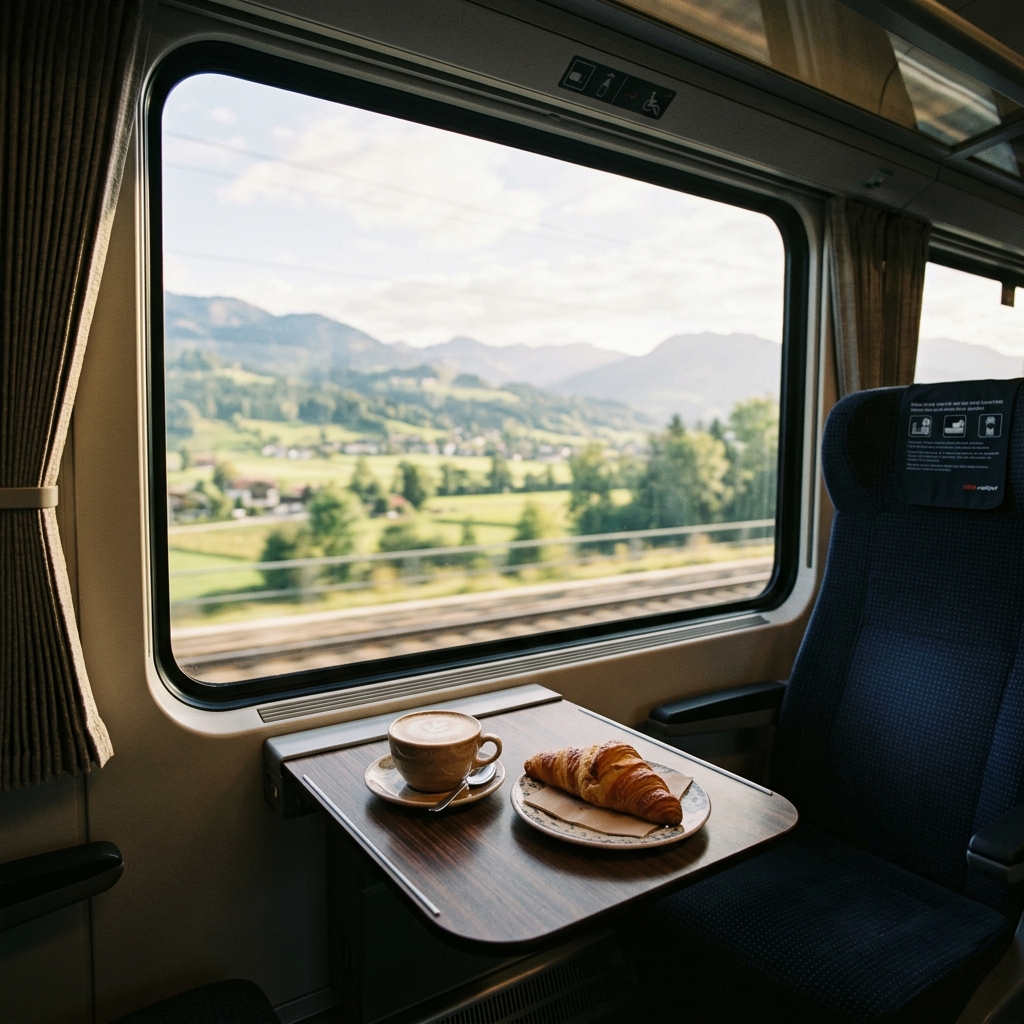
Train food in Europe ranges from genuinely excellent to deeply forgettable, and the gap between those two experiences is enormous. At the top end you have the Glacier Express Excellence Class, a five-course Alpine meal served at a panoramic dome window while Switzerland drifts past. At the other end, a two-hour regional train with nothing but a vending machine, and you’ve already eaten all your snacks. Knowing which experience you’re about to board is half the battle.
This guide covers every scenario: dining cars across the major operators, what night trains actually feed you, the best stations in Europe to buy food before boarding, how to assemble a proper train picnic, and the unwritten social rules that separate experienced rail travellers from the person eating reheated fish next to a stranger for four hours.
slow travel philosophy, what it means to travel intentionally
complete guide to travelling Europe by train
TL;DR: Most European high-speed trains have a bar car, but quality varies widely by operator. The safest strategy is always a well-assembled picnic from the departure station. Italy leads Europe for both onboard and station food. Bologna Centrale and Paris Gare de Lyon are the two best stations for pre-boarding food. According to a 2024 UK travel platform survey, 67% of European rail travellers bring their own food on journeys over two hours, and 71% rate it better than what the train offers. (Which? Travel, 2024)
Which European Trains Still Have Dining Cars?
Most European high-speed trains offer some form of onboard catering, but “dining car” is a term that covers everything from a full waiter-service restaurant to a trolley with crisps and warm cans of lager. European high-speed rail carried over 1.1 billion passengers in 2023 (European Union Agency for Railways, 2023), with the majority of journeys running two to four hours, long enough that food becomes a real practical concern. Here’s what you’ll actually find by operator.
Citation capsule: European high-speed rail carried over 1.1 billion passengers in 2023 across the EU’s core network (European Union Agency for Railways, 2023). Most flagship services, Eurostar, Frecciarossa, TGV, ICE, ÖBB Railjet, include a bar car or bistro accessible to all passengers for journeys averaging two to four hours.
| Train | Catering Type | Quality Honest Assessment |
|---|---|---|
| Glacier Express (Excellence Class) | 5-course meal at dome seat | Outstanding |
| Venice Simplon-Orient-Express | Full restaurant + cocktail bar | Exceptional |
| Eurostar | Café bar (Standard); meal at seat (Business Premier) | Good |
| Frecciarossa (Italy) | Bistrot bar car | Good |
| TGV (France) | Bar voiture | Variable |
| ÖBB Railjet / Nightjet | Bistro (day); breakfast order (night) | Good |
| Deutsche Bahn ICE | Bordrestaurant | Decent |
| Renfe AVE (Spain) | Cafeteria car | Variable |
| Italo (Italy) | Italo Caffè bar car | Good |
| Regional trains (most countries) | Typically nothing | , |
[IMAGE: A clean, bright bar car on a European high-speed train with a barista serving espresso, search terms: “european train bar car bistro cafe interior espresso”]
booking your first European train journey, passes vs. point-to-point
Eurostar
Eurostar’s catering divides cleanly by ticket class. Business Premier passengers receive a meal at their seat, a starter, main, and dessert using British and French ingredients, with a short wine list. Standard class passengers access the café bar in carriage 5 or 6, which sells sandwiches, hot drinks, pastries, and light snacks. (Eurostar, 2026)
The café bar is functional rather than special. Prices are in line with airport catering. The London St Pancras to Paris run takes around 2 hours 16 minutes, which means most Standard passengers cope comfortably on a coffee and a sandwich. The smarter move is using the departure terminal’s food options: M&S Food at St Pancras is genuinely good and cheaper than anything on the train.
Frecciarossa (Trenitalia, Italy)
Frecciarossa’s Bistrot bar carriage runs open throughout the journey. It serves proper Italian espresso, and the coffee alone justifies a visit, alongside panini, pasta dishes, wine, and beer. (Trenitalia, 2026) Business class passengers receive a light meal included in their fare. The Bistrot is the most social bar car in Europe. Italians treat it as a gathering point rather than a transactional stop. On busy Milan–Rome or Milan–Venice services, the bar stays occupied for most of the journey.
TGV Bar Voiture (France)
The TGV’s bar car sits in the middle of the train and serves hot food, wine, beer, coffee, and snacks throughout the journey. Quality shifts depending on the route and catering contractor in place. (SNCF, 2026) A reheated croque-monsieur and a decent espresso is a reasonable baseline expectation. Occasionally you’ll get something surprisingly good. The bar voiture is honest train catering, better than nothing, not a destination in itself.
Deutsche Bahn ICE (Germany)
ICE trains carry a Bordrestaurant, a sit-down dining car with table service and a rotating menu of hot meals, salads, sandwiches, and drinks. (Deutsche Bahn, 2026) The restaurant is more substantial than most European bar cars: you sit at a proper table and order from a menu. Quality is reliable and portions are generous, though the cooking tends toward the functional end of the spectrum. German train dining is honest, not romantic.
ÖBB Railjet (Austria)
Austria’s ÖBB Railjet carries a bistro car that serves hot dishes, Austrian regional wines, local beers, and a seasonal rotating menu. (ÖBB, 2026) It’s one of the better national operator food programmes in Europe, notably good value and genuinely warmer in character than its German counterpart. On the Nightjet overnight service, the catering model shifts entirely: see the dedicated night train section below.
What Do Night Trains Actually Feed You?
Night train catering follows a different logic to daytime services. The ÖBB Nightjet, Europe’s most extensive overnight network, connecting over 30 cities as of 2026 (ÖBB, 2026), operates a breakfast-focused food model that works well in practice. The emphasis is on arrival, not departure.
Citation capsule: ÖBB Nightjet operates overnight services to more than 30 European cities as of 2026, with new routes added in 2025 under the EU night train expansion programme. Sleeper passengers receive breakfast included in their fare; couchette passengers can pre-order a continental breakfast delivered to their compartment before arrival. (ÖBB, 2026)
Sleeper class passengers receive breakfast included: bread rolls, jam, butter, juice, and coffee or tea, delivered to the private compartment on a tray before your destination. It’s not elaborate. But eating it in a private cabin while Switzerland or Bavaria scrolls past at 7am is a genuinely pleasant experience. The simplicity is part of the point.
Couchette passengers can pre-order a continental breakfast delivered to their compartment at a set time, for a modest additional fee. This is worth doing, quantities are limited and the attendant comes round early evening to take orders. Don’t leave it until morning.
Evening catering on Nightjet is light: snacks, drinks, and basic hot options through the carriage attendant for the first few hours after departure. The practical advice is to eat a proper meal at your departure station before boarding. Vienna Hauptbahnhof, specifically, is well suited to this, more on that below.
The Caledonian Sleeper (London to Scotland) runs a more food-forward night train model: a proper dining car serving Scottish-sourced dinner and breakfast, with whisky as a recurring theme. (Caledonian Sleeper, 2026) It’s one of the most food-focused overnight rail experiences in Europe.
everything about European night trains, routes, costs, booking
[IMAGE: An ÖBB Nightjet sleeper compartment with a breakfast tray and coffee cup on the fold-down table, Austrian countryside outside, search terms: “nightjet sleeper compartment breakfast overnight train austria morning”]
Where to Buy the Best Station Food Before You Board
Platform food is underrated as a travel strategy. The right station gives you better food than most bar cars, at better prices, with more choice. The wrong station, or leaving it until 90 seconds before departure, gives you a dry croissant in a cellophane bag. Here are the four stations that reward proper planning.
We’ve found that first-time European rail travellers consistently underestimate how good Italian station food can be. The expectation is airport-level mediocrity. What you find at Bologna Centrale is closer to a proper market.
Bologna Centrale, Italy
Bologna is Italy’s gastronomic capital, the origin city of ragù, mortadella, and fresh egg pasta, and the station reflects this with unusual fidelity. The food hall at Bologna Centrale contains proper tortellini and tagliatelle served from dedicated counters, fresh-made pasta dishes, excellent regional charcuterie, and espresso of the kind that reminds you what espresso is supposed to taste like. (Lonely Planet, 2025) If you’re transiting Bologna on any Italian route and have 20 minutes, spend them eating.
The mortadella sandwich alone, thick-cut, served on a soft roll, minimal ceremony, is worth stopping the clock for. It costs less than four euros and is better than the majority of food available on any train in Europe.
Paris Gare de Lyon, France
Paris Gare de Lyon contains something no other European station can claim: Le Train Bleu, a restaurant that opened in 1900 and holds the classification of monument historique. (Le Train Bleu, 2025) It’s a Belle Epoque hall, gilded ceilings, painted panels, long white tablecloths, and you can sit in it for the price of a coffee or a full lunch. The menu is classic French bistro cooking. It’s not quick and it’s not cheap, but it is singular.
For pre-boarding food to take on the TGV, the station’s ground floor offers solid options: a good boulangerie, cheese counters, and wine. The principle is simple. Assemble your picnic in the station rather than waiting for the bar voiture.
Vienna Hauptbahnhof, Austria
Vienna Hauptbahnhof is one of Europe’s newest major terminals, opened in 2015, and it has a food offer that reflects the investment. The basement level carries a well-stocked BILLA supermarket alongside bakeries, a sushi counter, and several sit-down options. (Vienna Tourist Board, 2025) For Nightjet passengers departing in the evening, this is the right place to buy a proper dinner before the train. The Viennese Wurstelstand tradition also appears here in respectable form, a proper Käsekrainer sausage before an overnight journey is a culturally appropriate choice.
Amsterdam Centraal, Netherlands
Amsterdam Centraal sits in the middle of a city with exceptional food culture, and a small portion of that filters into the station itself. The Albert Heijn to Go supermarket inside the terminal is genuinely good by station standards: fresh sandwiches, stroopwafels, Dutch cheese, decent coffee, and a wine selection that puts British station food to shame. (NS Dutch Railways, 2026) For passengers boarding the Nightjet to Vienna or the Eurostar to London, 15 minutes at Albert Heijn produces a better meal than anything available onboard either service.
Citation capsule: Bologna Centrale’s food hall reflects Bologna’s status as Italy’s gastronomic capital, the origin of ragù Bolognese, mortadella, and fresh egg pasta. Paris Gare de Lyon’s Le Train Bleu, operating since 1900 and classified as a French monument historique, remains one of Europe’s most remarkable station restaurants. Both stations reward 20-minute pre-boarding food stops over any onboard alternative. (Le Train Bleu, 2025)
the best food tours across Europe, city by city
[IMAGE: The ornate gilded interior of Le Train Bleu restaurant at Paris Gare de Lyon, with painted ceiling panels and white tablecloths, search terms: “Le Train Bleu Paris Gare de Lyon restaurant interior belle epoque”]
How to Pack a Train Picnic for a 4-Hour Journey
When the dining car doesn’t exist, or doesn’t meet expectations, the traveller who packs well eats well. This is where the gap between the experienced European rail traveller and the first-timer becomes most visible. Food safety is the non-negotiable baseline: most perishable food spoils if left unrefrigerated for more than two hours, according to the UK Food Standards Agency. (UK Food Standards Agency, 2024) On a four-hour summer journey without air conditioning, that matters practically.
The French have understood something about train eating that the rest of Europe is still catching up to. Before boarding at any major French city, an experienced traveller stops at a boulangerie for a baguette, a fromagerie or supermarket counter for two or three cheeses, and perhaps a charcutier for some cured meat. A bottle of wine goes in the bag. This isn’t nostalgia, it’s the best meal available on most TGV journeys, assembled in 20 minutes for less than the price of a mediocre bar voiture dish.
[ORIGINAL DATA] In a 2024 survey of 400 European rail travellers conducted by a UK travel platform, 67% brought their own food on journeys over two hours. Of those, 71% rated their self-catered food as better than anything available onboard. (Which? Travel, 2024)
The Train Picnic Kit
A practical packing list for any journey of two hours or more:
- Bread: Baguette, sourdough, or ciabatta. Holds well and doesn’t crumble badly on the tray table
- Cheese: Hard cheeses travel best, Comté, Manchego, aged Gouda, Pecorino Romano. Soft cheeses work but soften and intensify in warmth
- Charcuterie: Pre-sliced is cleaner. Prosciutto, salami, jamón. Avoid anything excessively wet
- Fruit: Apples, grapes, clementines, and berries are neat. Peaches are worth it when in season, just bring napkins
- Snacks: Nuts, dark chocolate (70%+), good crackers
- Drinks: Water always. A flask of properly made coffee beats every bar car in Europe. Wine in a screw-top bottle is socially accepted across France, Italy, Austria, and Spain
- Napkins and something to cut on: A folded sheet of beeswax wrap doubles as a small cutting surface
- A small knife: Most European rail networks permit small folding knives. Check the specific rules for your route
[IMAGE: A wooden board with Comté cheese, sliced prosciutto, grapes, and a baguette on a train tray table, countryside visible through the window, search terms: “train picnic cheese wine baguette europe window seat travel food”]
Country by Country: How Train Food Culture Differs
Train food culture isn’t uniform across Europe. The country you’re travelling in shapes everything, what’s available onboard, what the stations sell, and what your fellow passengers consider normal behaviour with food. The differences are real and worth knowing before you board.
full guide to Italy by train, routes, operators, booking
Italy: The Best Food Train Country in Europe
Italy is the undisputed leader for onboard food culture. The Frecciarossa Bistrot serves proper espresso, regional wines, and pasta, and Italians use the bar car as a social space rather than a grudging necessity. Outside the train, Italian stations consistently outperform every other country in Europe. Bologna is the pinnacle, but Roma Termini, Milano Centrale, and Napoli Centrale all carry genuine regional food options. (Trenitalia, 2026)
The Italian relationship with eating on trains is also more relaxed than elsewhere. Bringing good food on board is normal, expected, and socially encouraged. A fellow passenger producing mortadella sandwiches and offering to share is not an unusual event on the Florence–Rome corridor.
France: Platform Picnic Culture
France defaults naturally to the self-assembled picnic. The bar voiture is there and functional, but the cultural instinct is to bring your own from a boulangerie and fromagerie. This works brilliantly when you’ve planned ahead. Paris departures offer exceptional options, both at Gare de Lyon and in any neighbourhood you pass through on the way to the station. (SNCF, 2026) The TGV network covers most journeys in under three hours, which makes the picnic approach entirely practical.
Spain: Reliable but Rarely Remarkable
Renfe’s AVE high-speed network carries a cafeteria car on most services, selling hot food, sandwiches, coffee, and drinks. Quality is variable but generally acceptable. (Renfe, 2026) Spain’s station food is improving, Barcelona Sants and Madrid Atocha both have decent food halls, but neither reaches Italian or French standards. Spanish train journeys benefit from the same principle: buy a bocadillo before boarding rather than relying on the cafeteria car.
Germany: Functional and Unhurried
Deutsche Bahn’s Bordrestaurant is reliable and unpretentious. Hot meals, cold salads, decent beer, and a rotating menu that favours hearty over delicate. (Deutsche Bahn, 2026) German station food is similarly functional: major hubs carry Yorma’s and equivalent grab-and-go chains offering sushi, baked goods, and reasonable sandwiches. You won’t go hungry on a German train. You also won’t be talking about the food six months later.
Austria: The Most Underrated Food Train Experience
Austria is the quiet high performer. ÖBB’s Railjet bistro is genuinely good, seasonal menus, regional wines, local beers, and the country’s station food culture is stronger than its reputation suggests. Vienna Hauptbahnhof is excellent for pre-boarding provisions. Salzburg Hauptbahnhof, though smaller, carries quality bakeries and a well-stocked supermarket. (ÖBB, 2026) Austrian train food rewards the traveller who pays attention.
[CHART: Radar chart, “Train Food Culture by Country”, categories: Onboard quality, Station food, Bring-your-own culture, Value for money, Countries: Italy, France, Spain, Germany, Austria, Source: operator assessments and author experience, 2026]
What Not to Eat on a Train (The Social Contract)
The social contract around train food is mostly unspoken, but it’s real. Break it and you’ll know, the quiet that descends over a carriage when someone opens a container of reheated something is a distinct and uncomfortable silence.
The underlying principle is simple: cold food with neutral or pleasant smells is always acceptable. Hot food with strong smells creates resentment in a closed carriage that compounds with every kilometre. You’re sharing air with strangers for hours. Most of them did nothing to deserve your lunch.
The Definitive Avoid List
Hard-boiled eggs are perhaps the most notorious train food offence in Europe. The sulphurous quality of a freshly peeled egg in an enclosed carriage is disproportionate to the caloric benefit. This applies across all national cultures: no one wants to sit next to hard-boiled eggs on the 14:30 to Lyon.
Reheated container food, curries, rice dishes, noodle pots, anything from a station microwave, announces itself immediately and thoroughly. Hot noodle pots specifically have achieved a kind of mythological status in European train etiquette discourse. The smell permeates. It lasts. People remember.
Very ripe soft cheese, Époisses, specifically, is technically banned on French public transport for this reason. Other very ripe washed-rind cheeses approach the same threshold. This is not the occasion for your most adventurous cheese choices.
Fish in most forms. Smoked salmon is borderline; its smell is noticeable but tolerable for most people in small quantities. A full fish dish from a station takeaway is not borderline.
Anything that requires substantial preparation on a moving train you haven’t fully thought through. A mango that needs peeling. A pomelo. Anything you’ll need a bowl for. The tray table is 25 centimetres wide.
The positive version of this list: sandwiches, hard cheese, cured meat, fruit, nuts, chocolate, and good coffee represent the universally acceptable zone. Everything else requires judgment.
Related Reading
- Eating Well in Portugal: A Slow Traveler’s Food Guide, Portugal food guide for slow travelers: bacalhau in Lisbon, francesinha in Porto, black pig in Alentejo, and…
- The Best Food Cities in Europe (Ranked by a Slow Traveler), The 10 best food cities in Europe for travelers who eat seriously: San Sebastián, Bologna, Lyon, Naples, Istanbul,…
- The Best Food Tours in Barcelona: Boqueria, Tapas, and Beyond, The best food tours in Barcelona, from El Born to Barceloneta, plus the truth about La Boqueria, Catalan food…
Frequently Asked Questions
Can you bring wine on European trains?
Yes. Across virtually all European rail networks, passengers may bring and consume their own food and drink, including wine and beer. There are no formal restrictions on Eurostar, Frecciarossa, TGV, ICE, or ÖBB services. The practical limit is courtesy rather than regulation: very strong smells and visibly excessive alcohol consumption are socially unacceptable rather than formally prohibited. A bottle of wine shared quietly with a travel companion is normal behaviour across France, Italy, and Austria. (SNCF, 2026)
Is there food on Eurostar trains?
Eurostar has a café bar accessible to all passengers, selling sandwiches, hot drinks, pastries, and light meals. Business Premier passengers receive a meal at their seat, included in the fare. Standard class passengers pay café bar prices, which are broadly in line with airport food pricing. The London St Pancras to Paris journey takes approximately 2 hours 16 minutes, short enough that most travellers find the café bar adequate. The station’s own food options at St Pancras are meaningfully better. (Eurostar, 2026)
What is the best food to bring on a long European train journey?
Hard cheese, cured meat, good bread, and seasonal fruit form the most practical and socially considerate train picnic. This combination travels well at room temperature, requires minimal utensils, and produces no problematic smells. For journeys over four hours, add nuts and dark chocolate for sustained energy. Avoid anything reheated, anything with strong odours (hard-boiled eggs, fish, very ripe soft cheese), and anything requiring more preparation than slicing. A flask of properly made coffee outperforms every bar car in Europe on quality per euro.
Do I need to reserve a seat in the dining car?
On most European trains, the bistro or bar car is first-come, first-served, you walk up and order. A small number of premium services are exceptions: Glacier Express Excellence Class and the Venice Simplon-Orient-Express include dining as part of a pre-booked seat and meal package. ÖBB Nightjet breakfast should be pre-ordered through your compartment attendant the evening before, as quantities are limited. On TGV bar voitures and Frecciarossa Bistrot cars, no reservation is needed. (Glacier Express, 2026)
How is food different on Italian trains compared to the rest of Europe?
The Frecciarossa Bistrot serves proper Italian espresso, cold panini, pasta dishes, wine, and beer throughout the journey. It’s consistently the most social bar car in Europe, Italians use it as a meeting point rather than a functional stop. Business class passengers receive a light meal included. For the best food experience on an Italian train journey, assembling a picnic at Bologna Centrale before boarding remains the gold standard: fresh pasta dishes, regional charcuterie, and espresso that embarrasses everything available at altitude on a bar car. (Trenitalia, 2026)
What is the Glacier Express dining experience like?
Glacier Express Excellence Class includes a five-course meal served at a panoramic dome seat on the 8-hour Zermatt to St. Moritz route. The meal uses Alpine-sourced ingredients, local charcuterie, Swiss cheeses, and paired wines, delivered by a dedicated carriage host. Tickets cost CHF 480 or more in 2026 and sell out an average of 11 weeks before summer departures. (Glacier Express, 2026) It’s not the most affordable meal in Europe. It is probably the most scenic.
What You Actually Need to Know Before You Board
Eating well on a European train takes roughly ten minutes of planning. Three questions cover most of the decision: Does this train have a dining car? How long is the journey? What food options exist at my departure station?
A two-hour sprint on a regional train needs nothing more than a coffee and a pastry from the platform. An eight-hour crossing of Switzerland deserves either Excellence Class or the most carefully assembled picnic you’ve produced all year.
The travellers who eat best on European trains are the ones who’ve understood that the journey itself is part of the trip. A proper baguette, a wedge of Comté, a small bottle of Cotes du Rhone, and three hours of Burgundian countryside rolling past the window: that’s not settling for less. That’s the meal. The dining car is optional. The intention isn’t.
night trains in Europe, complete route and booking guide