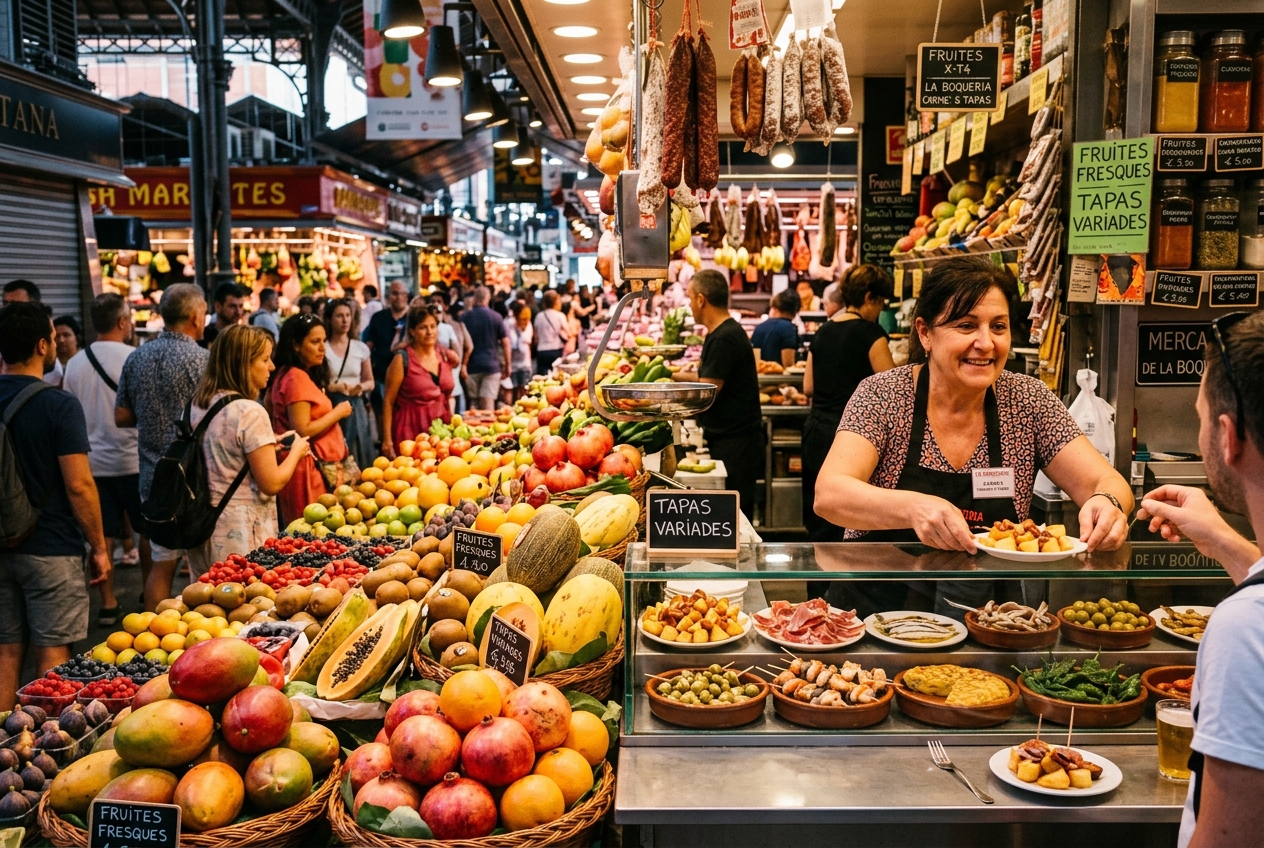
Barcelona is one of the most culinarily complex cities in Europe, and it requires a small decoding effort. The food that tourists typically encounter — overpriced fruit cups at La Boqueria, generic tapas bars near the Ramblas, paella sold aggressively from restaurant doorways — has almost nothing to do with how the city actually eats. Understanding the distinction between Catalan and Castilian Spanish food, knowing which markets are for locals and which are for visitors, and finding the neighbourhoods where genuine food culture survives: this is what a good food tour in Barcelona does for you.
The Truth About La Boqueria
Let’s start with the elephant in the room.
La Boqueria — officially the Mercat de Sant Josep de la Boqueria — is one of the most beautiful market buildings in Europe. The iron structure dates from 1840, the stained glass is extraordinary, and the sheer density of colour from the produce on display is worth experiencing. It is absolutely worth walking through once.
It is not, however, where you should buy food or eat a meal.
The front half of La Boqueria, facing the Ramblas entrance, is almost entirely tourist infrastructure: €5 cups of mixed fruit that cost a fraction of that price at a greengrocer, charcuterie boards at tourist prices, smoothie bars, and juice counters where the prices are displayed in four languages and the stalls operate on turnover rather than quality. The market became so popular with tourists that it began actively discouraging locals — the Ajuntament (city hall) has at various points considered limiting tourist access to protect what remains of its actual function.
What to do instead: Walk to the back of the market, past the point where most tourists turn around. The back sections — the fishmongers, the mushroom vendors, the herb stalls — operate more normally. You’ll find extraordinary wild mushrooms (ceps, chanterelles, morels depending on the season) at prices that are high by market standards but fair by restaurant standards. The fish counter near the rear is one of the better places in the city to understand what’s in season.
Then, for your actual shopping and eating, go to Mercat de Santa Caterina in El Born. Designed by Enric Miralles with an undulating mosaic roof, it’s less famous, far less crowded, and genuinely functions as a neighbourhood market. Locals shop here.
Catalan Food vs. Spanish Food: Why the Distinction Matters
Barcelona is in Catalonia, which has its own language, cultural identity, and culinary tradition that is distinct from Castilian Spanish cooking. Understanding this makes the city’s food make considerably more sense.
Pa amb tomàquet — bread rubbed with a cut tomato and good olive oil, then salted — is the single most important Catalan food concept. It accompanies everything. It is not bruschetta. It is not toast with tomato sauce. It is a specific technique (you rub the tomato into the bread until the pulp soaks in, then discard the skin) that produces something that seems too simple to be remarkable and consistently is.
Escalivada — roasted aubergine (eggplant) and red peppers, peeled and dressed with olive oil and salt — is a standard Catalan tapa that you’ll find on nearly every traditional menu. It’s a demonstration of how Catalan cooking extracts extraordinary flavour from minimal ingredients through patient cooking.
Fideuà — short noodles cooked in a wide flat pan with seafood and saffron, served with alioli — originated in Valencia but has been absorbed fully into Barcelona’s culinary repertoire. If you sit down at a seafood restaurant in Barceloneta, you’ll see it on the menu. Order it. It’s not paella but it’s often better.
Crema catalana — the Catalan predecessor to French crème brûlée, though Catalans will correct you if you call it that. The sugar crust is caramelised with a hot iron rather than a torch; the custard is flavoured with lemon zest and cinnamon rather than vanilla. It predates the French version by at least a century.
Romesco sauce — almonds, hazelnuts, dried red pepper, tomato, garlic, and olive oil. Served with calcots (spring onions grilled over fire) in winter, with grilled fish, with almost anything. One of the great sauces of European cuisine.
The Best Food Tours in Barcelona
El Born Market District Food Walk
El Born is the best neighbourhood in Barcelona for food tourism that doesn’t feel like tourism. The narrow streets behind the Basílica de Santa Maria del Mar contain dozens of independent restaurants, wine bars (Bodegues de Santa Maria, El Xampanyet), and the covered Mercat de Santa Caterina.
A food walk through El Born will typically include:
- Pa amb tomàquet — the starter for almost every tour in Barcelona, and correctly so
- Ibéric charcuterie — though Catalan, the cured meats from the surrounding regions are outstanding; expect jamón ibérico, fuet (thin, dried sausage, very Catalan), and lomo
- Cheese course — Catalan cheeses including Garrotxa (a semi-soft goat cheese with a grey rind, nutty and mild) and Serrat Gros
- Seafood pintxos — El Born’s bars often serve Basque-influenced pintxos alongside their own Catalan dishes
- A glass of cava — Catalonia produces the vast majority of Spain’s cava (sparkling wine made by the traditional method), and drinking it locally, fresh, is a different experience from drinking it exported
Tours in El Born: 3 hours, €80–€95 per person, small groups. Morning starts are best for Mercat de Santa Caterina; evening walks hit the wine bar circuit.
Barceloneta Seafood Tour
Barceloneta, the 18th-century fishing neighbourhood between the old port and the sea, is a natural focus for a seafood-oriented tour. The neighbourhood has been gentrified significantly but retains a handful of genuinely old-school seafood restaurants and a fish market (La Barceloneta market, smaller than you’d expect) that supplies them.
A Barceloneta seafood tour includes:
- Fresh seafood tastings, typically including gambas al ajillo (prawns with garlic) and razor clams
- A demonstration of fideuà preparation if the tour includes a cooking element
- A stop at one of the old xiringuitos (beach bars) for vermut and anchovies
These tours are better in winter than summer — in July and August, Barceloneta is overwhelmingly touristic. March or October for the best combination of seafood quality and manageable crowds.
Gràcia Neighbourhood Pintxos Crawl
Gràcia was an independent town before Barcelona absorbed it in the late 19th century, and it retains a strong neighbourhood identity. Its plaças (squares) — Plaça de la Vila de Gràcia, Plaça del Sol — are where the neighbourhood’s residents actually socialise, and the bars surrounding them are where the good pintxos crawls happen.
Pintxos (the Catalan/Spanish adaptation of Basque pintxos) are small bites on bread, held together by a toothpick. They differ from tapas in that they’re typically cold or assembled rather than cooked to order. A crawl through Gràcia will take in 4–6 bars over 3–4 hours, including:
- Classic pintxos: gildas (olive, anchovy, pickled pepper skewers), tortilla Española, jamón on pa amb tomàquet
- Wine pairing — often Priorat (Catalan, powerful) or Penedès whites
- The vermouth hour if you’re doing an early evening tour that starts at 6pm
Raval Multicultural Food Tour
El Raval, the neighbourhood west of the Ramblas that was historically working-class and is now rapidly gentrifying, has Barcelona’s most multicultural food scene: Pakistani restaurants, Moroccan bakeries, Filipino grocery stores, South American taquerías. A food tour of Raval tells a different story from the Catalan-focused tours and is particularly interesting for visitors who want to understand Barcelona as a contemporary city rather than as a historic one.
These tours are less common and harder to find in standard tour listings — Withlocals and Airbnb Experiences occasionally offer them. Worth seeking out.
The Vermouth Tradition
Vermut in Barcelona deserves its own section because it is one of the most pleasant rituals in European urban life and almost no tourist participates in it.
On Saturday and Sunday mornings, from roughly 11am until 2pm, Catalans go out for la hora del vermut — the vermouth hour. They sit at bar counters or terrace tables, order a small glass of vermut (usually Cinzano Rosso or local Catalan vermut from producers like Yzaguirre or Miró), eat a few small things (olives, boquerones, potato chips), and talk. It is not brunch. It is not drinking. It is a social ritual with its own timing, its own snacks, and its own atmosphere.
The best neighbourhoods for this are Gràcia and Sant Antoni. In Sant Antoni, the covered market is surrounded by vermouth bars that have become fashionable with the neighbourhood’s creative class — Bar Calders, Federal Café, and the classic vermouth spots that predate the gentrification. In Gràcia, the bars on Plaça del Sol and the surrounding streets maintain the tradition with less self-consciousness.
What to order: “Un vermut, si us plau” (in Catalan) or “Un vermut, por favor” (in Spanish). You’ll get a glass, probably some olives, and a slice of orange. Pay about €3–€5. Drink slowly.
Self-Guided: Mercat de Santa Caterina and Palo Market
Mercat de Santa Caterina (Weekdays, open until 3:30pm)
Santa Caterina is the genuine alternative to Boqueria for anyone who wants to shop or eat at a functioning market. The mosaic roof — 325,000 hexagonal tiles in 67 different colours — is architecturally extraordinary, and the market inside is a working neighbourhood institution.
What to look for: The fishmongers in the central section (some of the best fish quality in the city), the produce vendors selling local vegetables and fruit (seasonal strawberries in spring, calçots in winter, wild mushrooms in autumn), and the small bar at the entrance serving breakfast bocadillos to market workers and locals.
Palo Market (Monthly, Poblenou)
Palo Market takes place on the last weekend of most months in the Palo Alto complex in Poblenou, Barcelona’s former industrial district now being transformed into a tech and creative hub. It’s a design and food market — part Portobello, part street food festival — with excellent food stalls, local wine vendors, and a younger creative crowd than you’ll find anywhere near the Ramblas.
Check the Palo Market website for specific dates before planning around it. Entry is around €4.
Getting to Barcelona by Train
Barcelona’s position on the Mediterranean makes it one of the best-connected cities in Europe by rail, with high-speed links to Madrid, Paris, and Valencia.
From Madrid Atocha: The AVE high-speed train covers the 621km between Madrid and Barcelona Sants in 2h30m to 3h, with services roughly every 30 minutes at peak times. Fares range from €35 to €120+ depending on how far in advance you book and the service type (Avlo is the budget option; AVE standard is more comfortable). This is one of the great rail corridors in Europe — mountain scenery north of Zaragoza, the Catalan plains approaching Barcelona.
From Paris Gare de Lyon: The TGV Lyria service covers Paris to Barcelona in 6h30m, with 2–3 services daily. Fares from €59 booked weeks ahead. This is the correct way to travel between Paris and Barcelona — the overnight options that used to exist are mostly discontinued, and the day TGV is fast and comfortable.
From Valencia: The Euromed and AVE services cover Valencia to Barcelona in 2h50m to 3h15m depending on the service. Fares from €25.
For the Paris to Barcelona journey in detail, see our Paris to Barcelona train guide. For the Madrid to Barcelona corridor, see our Barcelona to Madrid train guide.
Practical Details
Best months for food tours in Barcelona: October through May. June is acceptable; July and August are exhaustingly hot and the city is at peak tourist density. September is a transitional month — heat reducing, tourists departing, the local food season picking up.
Booking lead time: 3–5 days in shoulder season for most tours; 1–2 weeks ahead in summer.
What to wear: Walking shoes that can handle both cobblestones and market floors. Most tours involve 3–5km of walking. Dress for the season — Barcelona is Mediterranean but January evenings can be cool.
Language: Catalan and Spanish are both official languages. In food contexts, Catalan is appreciated — even attempting “bon profit” (bon appetit in Catalan) before eating will be warmly received.
Tipping: Not obligatory in Spain but rounding up is appreciated. For tour guides, €5–€10 at the end of a good tour is appropriate.
Barcelona rewards visitors who engage with it as a Catalan city rather than as a generic Spanish destination. The food is the easiest entry point into that distinction — and a good food tour makes it effortless.
For more on getting around Spain, our Spain by train guide covers the national rail network in full.
Related Reading
- The Best Food Tours in Lisbon: Pastéis, Petiscos, and Ginjinha — The best food tours in Lisbon — from Mouraria to LX Factory — what to eat, which bakeries to trust, and how to…
- The Best Food Tours in Rome (And What They Actually Cover) — The best food tours in Rome, from Testaccio Market to the Jewish Ghetto — what you’ll eat, what to skip, and how to…
- The Best Food Cities in Europe (Ranked by a Slow Traveler) — The 10 best food cities in Europe for travelers who eat seriously: San Sebastián, Bologna, Lyon, Naples, Istanbul,…