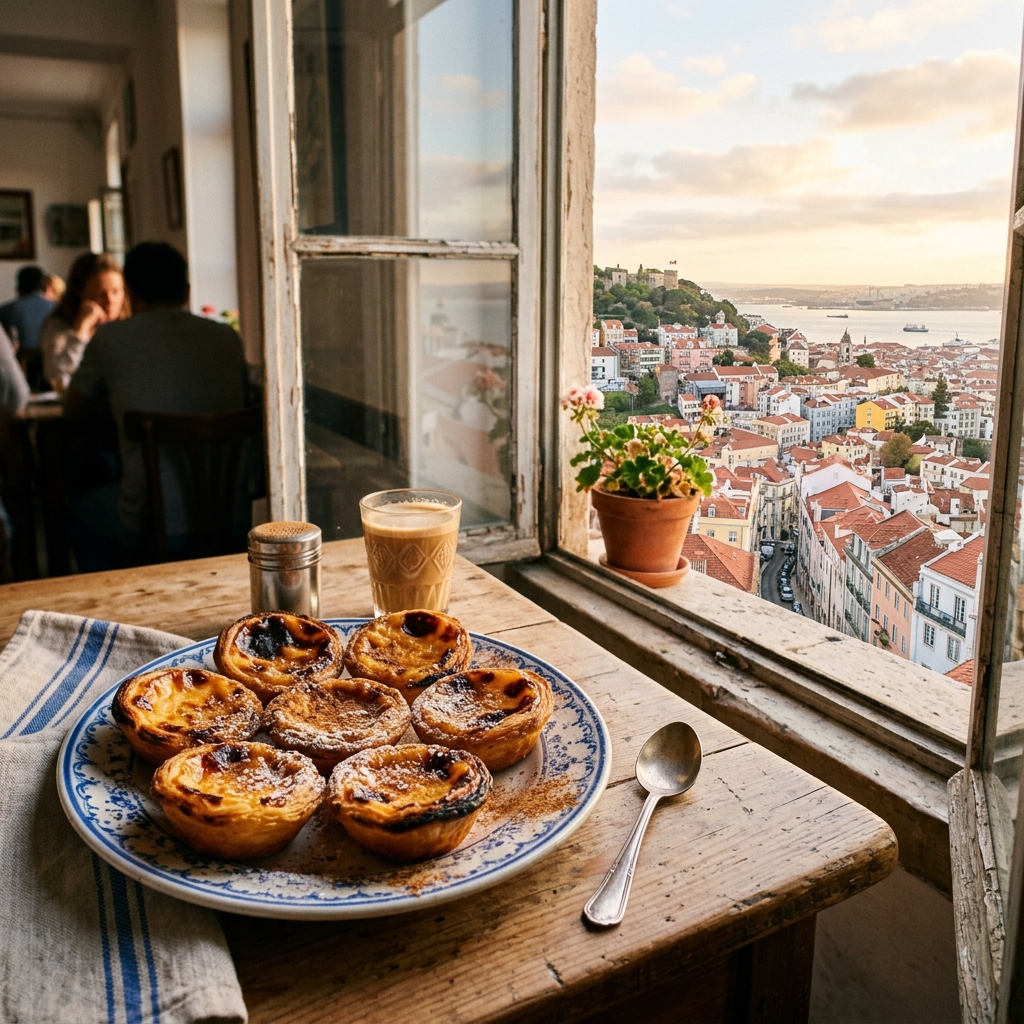
Lisbon is the most underestimated food city in Western Europe. It is also, in some ways, the most historically layered — a city whose colonial past brought ingredients and techniques from Brazil, Angola, Mozambique, and the Indian subcontinent into a culinary tradition that is today genuinely distinct from anything else on the continent. Salt cod (bacalhau), custard tarts (pastéis de nata), sour cherry liqueur (ginjinha), African-influenced piri piri — these are not the foods of any one tradition, but of a city that has been cooking at the intersection of the Atlantic world for five centuries.
A food tour in Lisbon makes sense not just for restaurant recommendations but for context: the Mouraria quarter’s Moorish and immigrant heritage, the Jewish contribution to Portuguese baking, the fado houses where food and music are inseparable, the Sunday markets where the city’s creative class gathers. This guide covers the best tours, the best things to eat, and how to arrive by train.
What Makes Lisbon’s Food Distinctive
Before the specific tours, it helps to understand what you’re eating.
Bacalhau (salt cod) is Portugal’s defining ingredient — not fresh cod, but cod that has been salted and dried, then rehydrated and cooked in a hundred different ways. The claim that there are 365 recipes for bacalhau (one for every day of the year) is an exaggeration, but there are dozens of genuinely distinct preparations: bacalhau à Brás (shredded cod with eggs and straw potatoes), bacalhau com natas (salt cod in cream gratin), pataniscas (fritters), and the simple but perfect bacalhau à lagareiro (roasted with olive oil and garlic). A good food tour in Lisbon will involve at least two bacalhau preparations.
Pastel de nata — the custard tart — is Lisbon’s most exported food product, now made in every country with a Portuguese community. In Lisbon, it’s different: the pastry is flakier, the custard is slightly runnier and more intensely eggy, and it’s eaten warm, fresh from the oven, with cinnamon and powdered sugar at the counter of the place that made it.
Ginjinha (sour cherry liqueur) is the city’s signature drink, served in tiny shots from even tinier bars that have operated for generations. At €1.50–€2 a shot, it’s one of the most affordable pleasures in Lisbon.
Petiscos — the Portuguese version of small shared plates — include alheira (a smoked sausage with Jewish origins; Jewish families in Portugal created a pork-free version that appeared to be the same as chorizo, to survive the Inquisition), chouriço (smoked pork sausage, often flambéed at the table), pica-pau (pickled beef strips), and the ever-present tray of olives, bread, and queijo da serra (mountain cheese).
The African influence — present particularly in Mouraria and Intendente — includes piri piri preparations, caldeirada (fish stew with influences from Mozambican coastal cooking), and funge (a maize porridge found in Angolan and Mozambican restaurants in the neighbourhood).
The Best Food Tours in Lisbon
LX Factory Sunday Market Food Tour
LX Factory is a 19th-century industrial complex in Alcântara, west of the city centre, that has been converted into a creative hub of restaurants, studios, bookshops, and event spaces. On Sundays, a market fills its central street with food stalls, vintage clothing vendors, artisan producers, and live music.
A guided food tour of the LX Factory Sunday Market runs approximately 2.5 hours and costs €65–€75 per person, including tastings. You’ll typically eat:
- Tosta mista from the bread vendors (a Portuguese grilled cheese that seems humble and is genuinely excellent)
- Portuguese olive oils with tastings from producers
- Regional cheeses — particularly Queijo da Serra da Estrela (a runny sheep’s milk cheese from the mountains north of Lisbon) and Queijo de Azeitão (a soft, slightly pungent sheep’s milk cheese from the Setúbal peninsula)
- Craft beer from Portuguese microbreweries that have set up stalls
- Pastéis de nata from at least one quality stall
The LX Factory also contains Ler Devagar — a bookshop built inside a former printing factory, with books stacked to the ceiling and a bicycle suspended from a wall. Not a food experience, but one of the most beautiful bookshops in Europe, and worth 20 minutes of any Sunday.
Mouraria Food Walk
Mouraria is the neighbourhood at the base of the Castelo de São Jorge, on the eastern side — the area where the Moorish population was relocated after the Reconquista in 1147, and which has since become Lisbon’s most culturally diverse neighbourhood: a mix of old Portuguese families, recent immigrants from Bangladesh, India, West Africa, and Brazil, and a slowly gentrifying creative class.
A food walk through Mouraria is the most intellectually layered food tour available in Lisbon. A good guide will connect the neighbourhood’s food to its Moorish origins (spice use, preserved foods), its Jewish history, and its current immigrant food scene.
Expect to eat:
- Caldo verde from a traditional tasca — the kale and chouriço soup that is Portugal’s most famous comfort food
- Bifanas — pork sandwiches in soft rolls with mustard and piri piri, eaten standing up, one of Lisbon’s best quick foods
- Pastéis de bacalhau (salt cod cakes, different from pataniscas — denser, potato-based) from a neighbourhood pastelaria
- A stop at a South Asian or West African restaurant in the neighbourhood’s international section, contrasting the immigrant food with the traditional Portuguese
Tours: 3–3.5 hours, €70–€85 per person.
Alfama Evening Petiscos Tour with Fado
Alfama is Lisbon’s oldest and most photogenic neighbourhood — a Moorish-era maze of narrow streets cascading down the eastern hill from the castle to the Tagus. It is also the traditional home of fado — the mournful, complex Portuguese song tradition associated with saudade, the untranslatable concept of nostalgic longing.
An Alfama evening food tour combines petiscos at local tascas with exposure to fado. This requires careful selection, because Alfama also contains many commercial fado restaurants that are, frankly, theatrical performances for tourists rather than genuine musical evenings.
How to tell the difference: A genuine fado house has performers who are also neighbourhood residents or regulars; the audience is partly local; the music is not synchronized to a fixed performance schedule but happens when it happens; the food is secondary to the music rather than the reverse. Commercial fado dinners have printed menus in four languages and a showtimes schedule.
Tour guides who live in Alfama will take you to the real places. The petiscos at a good fado tasca include:
- Pataniscas de bacalhau — salt cod fritters, lighter than the cakes, dressed with lemon
- Alheira grilled and sliced — the smoked sausage with the complicated history; your guide should explain it
- Chouriço grelhado — smoked sausage grilled over charcoal, often at your table in a clay dish with a small flame beneath
- A carafe of house red wine — Alentejo or Douro reds, unfussy, good with everything
Tours: 4–5 hours, €90–€120 per person. Evening start (7pm) is standard; the music typically begins around 9pm.
The Real Fado vs. The Commercial Version
Because this distinction is important enough to expand:
Genuine fado is performed in small spaces — rooms with perhaps 30 seats, often in a neighbourhood tasca that has hosted fado for decades. The performers may be known locally or nationally but they are not celebrities in the commercial sense. The music begins spontaneously; conversations at other tables quieten; the food and wine continue. The emotional register is not entertainment — it is something between prayer and lament.
Commercial fado dinners are fixed-price restaurants where fado performances are scheduled, marketed, and synchronized with the dining experience. They exist in significant numbers in Alfama and Mouraria. They are not fraudulent exactly, but they are productions rather than performances.
For genuine fado in a food context: Tasca do Chico on Rua do Diário de Notícias in Bairro Alto has operated since 2013 and maintains genuine performer relationships; Povo on Rua Nova do Carvalho (Cais do Sodré) combines a good wine list with genuine fado performers. Book in advance — genuine fado houses have limited space.
What to Eat: A Lisbon Food Primer
Pastel de nata at the right bakeries: Pastéis de Belém (1837, the original, worth the Belém trip) and Manteigaria (Chiado, central, very good) are your reference points. Everywhere else should be compared to these two. Eat them warm. Use the cinnamon and sugar on the counter.
Bifanas: Pork cooked with white wine and piri piri, served in a soft roll. Available from any traditional café or snack bar. One of the best €3 things you can eat in Europe. The correct place to try your first one is O Trevo on Praça da Figueira, a counter bar that has been serving them since 1942.
Ginjinha at A Ginjinha: Rossio square, tiny bar (Largo de São Domingos 8), operating since 1840. Order one with the cherry (com ginja), stand at the counter, drink it in two sips. Cost: €1.50–€2. This is non-negotiable.
Bacalhau à Brás: Shredded salt cod scrambled with eggs, straw potatoes, black olives, and parsley. A quick lunch staple available at almost every traditional restaurant. Judge a Lisbon restaurant by this dish; the variations in quality are instructive.
Queijo da Serra da Estrela: The great Portuguese cheese. Made from raw sheep’s milk from the Serra da Estrela mountains. When young and runny (outubro a março — October to March season), you cut the top off and scoop with a spoon. When aged, it firms to the consistency of a young manchego. Available at any quality cheese shop or market.
Pastel de tentúgal: Less famous than the pastel de nata, this is a flaky pastry filled with a runny egg yolk and sugar custard, from the town of Tentúgal near Coimbra. Occasionally available in Lisbon’s better pastry shops; worth seeking out as a contrast to the ubiquitous nata.
LX Factory in Detail: Beyond the Market
Even outside Sunday market days, LX Factory is worth visiting. The complex contains:
- Cervejaria Liberdade (craft beer and petiscos, generally good)
- Cantina LX (Portuguese food, reliable quality for the neighbourhood)
- Clube de Jornalistas (a slightly hidden restaurant with a garden; excellent)
- Ler Devagar bookshop (see above)
- Several independent clothing and design studios
On Sundays, the food stalls typically set up from 10am; the best produce vendors sell out by noon. Arrive by 10:30am for the full selection.
Getting to Lisbon by Train
From Porto: Alfa Pendular
The Alfa Pendular is Portugal’s semi-high-speed train connecting Porto and Lisbon, covering the 313km in 2h45m to 3h15m depending on the service. Fares from €25 booked ahead, though the most popular Sunday evening southbound trains can fill up. The train departs from Porto Campanhã (note: not São Bento, which only serves regional trains) and arrives at Lisbon Oriente or Santa Apolónia.
This is a comfortable, reliable service. The Douro valley scenery in the first 30 minutes south of Porto is pleasant, and the train is modern enough that the journey feels half its actual length. Book at least 3–4 days ahead for weekend travel.
For the journey in detail, see our Lisbon to Porto train guide.
From Madrid: The Complicated Reality
There is currently no direct train between Lisbon and Madrid. The historic Sud Express service that connected the two capitals has been discontinued, and negotiations over a high-speed rail connection (which would require new track on both sides of the border) have progressed slowly.
The practical options for Madrid–Lisbon travel in 2026:
- Bus: The Renfe-Iryo/Rede Expressos bus takes approximately 9 hours and costs €20–€40. Uncomfortable but functional.
- Flight: 1h20m, frequently cheap, frequently delayed. The obvious option for most travellers.
- Train via Badajoz: A technically possible but very long multi-change rail journey (10+ hours) that nobody seriously recommends.
The planned Lisbon-Madrid high-speed rail project, which would cut the journey to approximately 2h45m, remains in the planning phase as of early 2026. When it opens — and Portuguese and Spanish rail authorities continue to work toward it — it will transform travel between the Iberian capitals.
For more on Portugal’s rail network, see our Portugal by train guide.
Practical Details
Best months for food tours in Lisbon: October through May is ideal — mild weather, full cultural calendar, no summer heat. June and September are transitional months that work well. July and August are hot (35°C+ not uncommon) and busy; the city remains functional but less comfortable.
Booking lead time: 3–5 days for most tours in shoulder season; 1–2 weeks in July and August, particularly for fado-included evening tours.
Neighbourhood orientation: Lisbon’s hills (and there are seven significant ones) mean that food walking involves genuine vertical movement. The Alfama steep-street walks can be tiring if you’re not used to uneven cobblestones. Comfortable shoes are not optional.
Water: Lisbon has excellent drinking water from its fountains (chafarizes) — you can fill a bottle at any public fountain for free. This matters in summer heat.
Language: Portuguese is not Spanish. Many Lisboetas in tourist-facing roles speak English well, but attempting a few words in Portuguese — obrigado/obrigada (thank you), por favor (please), uma imperial (a small draft beer) — is genuinely appreciated.
For a broader guide to experiencing Lisbon slowly, our Lisbon slow travel guide covers the city’s rhythms, neighbourhoods, and how to stay long enough to understand it.
Related Reading
- Eating Well in Portugal: A Slow Traveler’s Food Guide — Portugal food guide for slow travelers: bacalhau in Lisbon, francesinha in Porto, black pig in Alentejo, and…
- The Best Food Tours in Rome (And What They Actually Cover) — The best food tours in Rome, from Testaccio Market to the Jewish Ghetto — what you’ll eat, what to skip, and how to…
- The Best Food Tours in Barcelona: Boqueria, Tapas, and Beyond — The best food tours in Barcelona, from El Born to Barceloneta — plus the truth about La Boqueria, Catalan food…