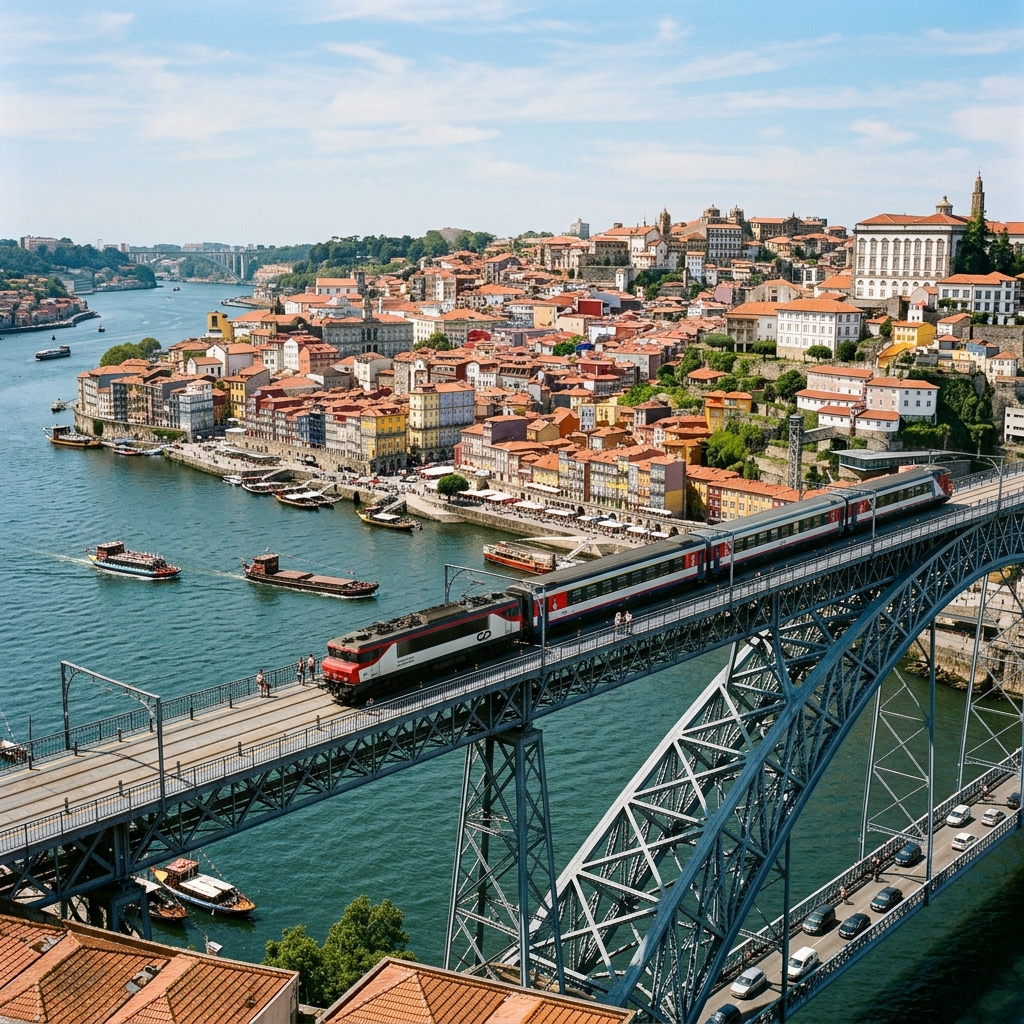
The train between Lisbon and Porto is not a commuter service dressed up as something else. It is one of those journeys that works — in the way that the TGV Paris–Lyon works, or the Shinkansen between Tokyo and Kyoto — where the speed is comfortable, the seats are wide, the landscape does its job, and the city waiting at the far end justifies every minute of the ride.
Portugal is a small country in geographic terms: 561km from north to south, 218km at its widest. That smallness is its rail advantage. Lisbon to Porto is 314km. On the Alfa Pendular, it takes 2 hours 45 minutes. By the time you’ve bought a coffee from the café car and finished your first chapter, you’re in the Douro River valley watching the light shift over the terraced vineyards.
TL;DR: Alfa Pendular is the right train — 2h 45min, €15–€35 advance. Depart from Lisboa Oriente (Metro Red Line). Arrive at Porto Campanhã, then take a 5-minute suburban rail connection to São Bento in the city centre. Book at cp.pt at least a week ahead for best fares. Consider a half-day stop in Coimbra if your schedule allows. Plan 3–4 nights in Porto minimum — it rewards time.
Choosing the Right Service
CP (Comboios de Portugal) operates three types of service on the Lisbon–Porto corridor, and the difference between them matters.
Alfa Pendular: The Right Choice
The Alfa Pendular (AP) is CP’s premium tilting train, running between Lisbon and Porto in 2 hours 45 minutes — or, on some faster services, as little as 2h 37min. The tilting mechanism allows higher speeds on Portugal’s curved main line, and the ride is smooth. Seats are wide, with tables in many configurations, decent legroom, and a café/bistro car serving coffee, sandwiches, and light meals.
Fare classes:
- Conforto (standard): the vast majority of seats, very comfortable. Advance fares from €15–€20; last-minute or busy period fares €25–€35.
- Executivo (first class): larger seats, more space, often slightly quieter. Advance fares from €30–€45. Worth it for a four-hour working session; probably unnecessary for a leisure trip.
The Alfa Pendular runs roughly every 90 minutes throughout the day between Lisbon Oriente and Porto Campanhã, with a few services extended to or from Porto São Bento. The 07:00, 09:00, and 13:00 departures from Oriente are typically the most popular; book those services at least a week ahead in summer.
Intercidades: The Budget Option
The Intercidades (IC) is a slower, less glamorous service that takes approximately 3 hours 30 minutes via a slightly different route. Fares run €12–€25 depending on timing and advance booking. The trains are older, the seats slightly less comfortable, and there’s less consistency in the café service.
For a single journey where you’re happy to take slightly longer, the IC is perfectly adequate. For a route you’re doing regularly, or one you want to enjoy, the Alfa Pendular premium is worth paying.
Regional Services
Regional (R) trains on this corridor take 4 hours or more and stop at dozens of small towns. They are inexpensive — fares as low as €8–€12 — but the journey time makes them impractical for anyone heading directly between the two cities. They make sense only if you have a specific town on the route you want to visit.
The Stations
Lisboa Oriente: Where Most Trains Depart
Lisboa Oriente is Lisbon’s main rail terminal for long-distance services — a striking 1990s structure designed by Santiago Calatrava for the 1998 World Exhibition, with a vaulted steel-and-glass concourse that would look at home in a science fiction film. It sits in the Parque das Nações district in eastern Lisbon, connected to the Metro network via the Red Line (Oriente station) and to the suburban rail network (Fertagus and CP Urbanos de Lisboa lines).
Getting to Oriente from central Lisbon: Metro Red Line, approximately 20 minutes from Marquês de Pombal or 15 minutes from Alameda, costing €1.65 on a Viva Viagem card (Lisbon’s reloadable transit card). Oriente has left-luggage facilities, a good range of cafés and restaurants in the adjacent shopping centre, and a bus terminal serving national and international routes.
Lisboa Santa Apolónia: The Historic Alternative
Santa Apolónia is the older of Lisbon’s two main stations, sitting on the Tagus riverbank in the Alfama district. Some Alfa Pendular and Intercidades services originate here before stopping at Oriente; some depart from Oriente only. Check your specific booking — if you’re staying near the Alfama, Mouraria, or Baixa, Santa Apolónia may be closer to your accommodation.
The station is on the Blue Line Metro (Santa Apolónia stop) and is served by suburban rail services. It lacks the scale of Oriente but has more character — it’s a genuinely old building, with some of the Lisbon azulejo tile decoration that becomes a recurring motif once you start noticing it.
Booking tip: On cp.pt, when you search Lisbon–Porto, the default departure station is Lisboa-Oriente. If you prefer Santa Apolónia, look for services marked with “SP” or filter by origin station. Not all Alfa Pendular services stop at both stations.
Booking on CP: A Practical Guide
The CP website (cp.pt) is fully available in English and processes international cards without difficulty. It is not the most intuitive booking interface in European rail, but it is functional. A few tips:
- Use the price calendar. On the booking page, click the date field and scroll forward/back to see fare availability across the week. Mid-week departures (Tuesday–Thursday) are usually cheaper; Friday afternoon and Sunday evening are most expensive.
- Tickets are issued as PDF e-tickets — download to your phone. CP conductors accept phone screens; there is no need to print.
- Seat selection is available at no extra charge at time of booking. On the Alfa Pendular, choose seats on the right side of the train (seats ending in B/D depending on configuration) for northbound services — this gives you the best views of the Atlantic coast stretching north past Aveiro.
- The booking system times out after around 8 minutes of inactivity. Have your card details ready.
- No dynamic pricing tricks: CP’s fares are regulated to a degree unusual in European rail. The price difference between booking three months ahead and three days ahead is real but not punitive in the way it is on, say, Eurostar or Renfe’s AVE.
The Journey Itself
Leaving Lisbon from Oriente, the train runs east along the Tagus estuary before curving north. The first 30 minutes are suburban — industrial edges of Lisbon, warehouses, the occasional stretch of flat agricultural land. Then the landscape opens.
The section through Santarém is the first real scenery: the Ribatejo plain, wide and flat, the Tagus running silver through it. Coimbra arrives at approximately 1h 45min — the university on the hill above the city is visible from the train, the old city descending to the Mondego River in layers.
North of Coimbra, the terrain shifts. The Aveiro lagoon — the Ria de Aveiro, Portugal’s “Venice,” a shallow coastal lagoon fringed with salt marshes and traditional moliceiro boats — appears to the west for a brief stretch. Then the coastal moor (moita) scrubland and pine forest typical of northern Portugal. The final approach into Porto follows the Douro River valley from the east — the river suddenly appearing as the train descends towards Campanhã, the terraced wine estates of the Douro visible on the far bank.
This last stretch, from roughly 30 minutes outside Porto, is worth the window seat.
The Alfa Pendular tilts into corners. The tilt mechanism is subtle — passengers rarely notice it consciously — but it is what allows the train to maintain higher speeds on Portugal’s old mainline curves. Watch your coffee cup at sharp bends. It is a small reminder that you are on a piece of engineering, not just a conveyance.
Arriving in Porto
Porto Campanhã: The Main Terminus
Long-distance trains arrive at Porto Campanhã, a functional railway station 3km east of Porto’s historic centre. Campanhã is not beautiful, but it is efficient, and the connection to the centre is quick.
From Campanhã, two options:
-
Suburban rail to São Bento: A short CP Urbano service connects Campanhã to São Bento in the city centre in 5 minutes. Fares are €1.65 on a Andante card (Porto’s transit card) or approximately €1.65–€2 for a single paper ticket. Trains run every 10–15 minutes.
-
Metro (lines A/B/E/F): Porto’s Metro has several lines passing through Campanhã. The Blue Line (A) and others connect through the central network. Metro to the centre takes around 10–12 minutes.
São Bento Station: The Real Arrival
São Bento is where you actually arrive in Porto, even if your train technically stopped at Campanhã. The station is one of the most extraordinary interiors in European rail travel: the entrance hall is decorated with 20,000 blue-and-white azulejo tiles, painted by Jorge Colaço between 1905 and 1916, depicting scenes from Portuguese history — the conquest of Ceuta in 1415, the arrival of João I in Porto in 1387, rural scenes from the Minho and Douro regions.
Stand in the centre of that hall with your bag and look at all four walls for five minutes. This is architecture that functions as national memory, as aesthetic provocation, as civic statement. There is nothing quite like it in railway architecture anywhere in Europe — and São Bento is an active, working station, not a museum.
São Bento Station is a 5-minute walk from the Ribeira waterfront district and 10 minutes from the Livraria Lello bookshop, which may be the most beautiful bookshop in the world and is significantly more than a tourist attraction if you give it the time.
Porto for Slow Travellers
Porto does not reveal itself in a single day. The city is built on steep hills descending to the Douro, with medieval, Baroque, Beaux-Arts, and contemporary architecture in a constant negotiation. Neighbourhoods that look uniform from above turn out, on foot, to be deeply differentiated — the gentrified design district of Bonfim, the faded grandeur of Cedofeita, the industrial-turned-creative Fontainhas cliff-face district, the village-quiet streets of Foz where the Douro meets the sea.
Ribeira
The riverside district directly below São Bento is the most visited part of Porto, and rightly so. The medieval casas rising in layers from the river, the boats moored at the quay, the view across to Vila Nova de Gaia (where the port wine lodges sit) — it is genuinely beautiful, not in spite of the crowds but somehow alongside them.
Come early morning (before 9am) or early evening (after 7pm) when the tour groups have thinned. The light on the Douro at dusk is extraordinary.
Vila Nova de Gaia: Port Wine Country
Directly across the Douro via the Luís I Bridge (the double-deck iron bridge designed by Théophile Seyrig, a collaborator of Eiffel), Vila Nova de Gaia is technically a separate municipality but functions as Porto’s southern extension. The port wine lodges — Graham’s, Sandeman, Taylor’s, Ramos Pinto — line the riverbank here, offering tastings and cellar tours.
A Porto Tónico (port and tonic, with a slice of orange) on a terrace in Gaia at 5pm, watching the river traffic, is one of those uncomplicated pleasures that slow travel is built around.
Livraria Lello
Livraria Lello (Rua das Carmelitas, 144) was founded in 1906 and is architecturally extraordinary: a narrow Neo-Gothic façade, a sinuous red staircase rising through the interior, stained glass overhead. There is a €5 entrance fee (redeemable on book purchases) that manages the crowds. Pay it. Spend 20 minutes inside on a weekday morning and you will understand why it consistently appears on lists of the world’s great bookshops.
Porto is cheaper than Lisbon. Accommodation, restaurants, and bars in Porto consistently run 20–30% below equivalent quality in central Lisbon. This matters for slow travellers staying a week or more. A dinner that would cost €45 per person in Bairro Alto runs €30 in Porto’s Bonfim district. The quality is comparable. The crowds are fewer.
Foz do Douro
At the western end of Porto’s riverside, where the Douro meets the Atlantic, Foz do Douro is the city’s beach neighbourhood — wide Atlantic beaches (often windy, frequently cold even in summer), excellent seafood restaurants, and an atmosphere more village than city. Tram Line 1 (the historic tram, not the modern Metro) runs from Infante along the river to Foz, a slow and rather beautiful journey along the waterfront.
A Stop in Coimbra: Worth the Detour
If your schedule allows a single night or a long afternoon between Lisbon and Porto, Coimbra repays the stop more than almost anywhere on the route.
The city is 300km north of Lisbon, sitting above the Mondego River on a steep hill. The Universidade de Coimbra, founded in 1290 and returned to Coimbra permanently in 1537, crowns the upper city — and the Biblioteca Joanina, its 18th-century Baroque library, is among the most beautiful interiors in Europe. The books are protected by a resident colony of bats who eat the paper-eating insects at night; the leather on the desks shows the marks. This is a library that is genuinely used.
Below the university, the medieval upper city (Alta) descends through narrow lanes to the river and the modern lower city. The fado de Coimbra tradition — different from Lisbon fado, more formal, sung exclusively by male students in black capes — is heard at the few remaining authentic venues in the upper city.
Getting there from Lisbon: Alfa Pendular or Intercidades, approximately 1h 45min, fares from €11–€18. From Porto: approximately 1h, fares from €8–€15.
Coimbra-B is the main station (where long-distance trains stop); a short connection by urban train takes you to Coimbra-A, closer to the city centre. Factor in 10 minutes for the connection.
Practical Information
Lisbon–Porto Route Summary
| Service | Time | Fare (advance) | Frequency |
|---|---|---|---|
| Alfa Pendular | 2h 37min–2h 45min | €15–€35 | Every 90 min |
| Intercidades | 3h 15min–3h 30min | €12–€25 | Several daily |
| Regional | 4h+ | €8–€12 | Several daily |
Porto Andante Card
Porto’s transit system uses the Andante rechargeable card, available from Metro station machines (€0.50 for the card itself, then loaded with credit). Metro single fare within the central zone is €1.65. A 24-hour unlimited card costs €6.35 and covers Metro, bus, and funicular within Porto’s urban area.
guide to train travel throughout Portugal slow travel in Lisbon
When to Go
Portugal’s climate is mild year-round by northern European standards, but the seasons matter:
- Spring (March–May): Ideal. Warm days, wildflowers, smaller crowds than summer. Book Alfa Pendular tickets 1–2 weeks ahead.
- Summer (June–August): Popular, occasionally hot (35°C+ in interior Portugal). Porto itself is tempered by Atlantic breezes. Book at least 2–3 weeks ahead.
- Autumn (September–October): Often the best window — warm enough, harvest festivals in the Douro, significantly fewer tourists.
- Winter (November–February): Mild and wet. Coimbra and Porto are quieter and atmospheric in the rain. Cheap accommodation everywhere.
The Case for Slowing Down
The train from Lisbon to Porto takes 2 hours 45 minutes. Ryanair covers the same distance in about 50 minutes. The flight costs roughly the same money once you’ve added airport transfers, security theatre, and the 90 minutes you’ll spend getting to and standing in Lisbon Humberto Delgado Airport.
The train leaves from the middle of Lisbon and arrives at the middle of Porto. You don’t take off your shoes. You watch Portugal go past the window — the Tagus, the Mondego, the Aveiro lagoon, the Douro terraces. Someone brings you coffee.
It is not a competition. The train is simply better.
First-time Portugal tip: If you’re arriving in Lisbon by train from Spain (the Sud Express from Madrid, or the Lusitânia night train from Madrid — see the Portugal by Train guide), you arrive at Lisboa Santa Apolónia. Take the Metro Blue Line one stop east to Oriente for your Porto connection, or give yourself a day in Lisbon first. The city earns a day.
Related Reading
- Eating Well in Portugal: A Slow Traveler’s Food Guide — Portugal food guide for slow travelers: bacalhau in Lisbon, francesinha in Porto, black pig in Alentejo, and…
- The Best Food Tours in Lisbon: Pastéis, Petiscos, and Ginjinha — The best food tours in Lisbon — from Mouraria to LX Factory — what to eat, which bakeries to trust, and how to…
- The Adriatic Coast by Train and Ferry: Italy to Croatia Slow — Travel the Adriatic slow: Italy’s coastal rail line from Bologna to Bari, then overnight ferry to Split and…